Mixed media show at holiday bazaar

Tahoe Flow Arts Studio’s fifth annual Holiday Bazaar: eARTh is Dec. 9 at Tahoe Art Haus & Cinema in Tahoe City.

This mixed media show includes aerial arts, acrobatics, dance and more. Through entertainment the goal is to ignite activism to start a revolution. Entertainment, Activism, Revolution, Together, Home spells Earth.

This year’s Holiday Bazaar is a no-plastic event and a fundraiser for No Plastic Tahoe – a community initiative to reduce and eventually eliminate single-use plastic in the Lake Tahoe Basin. Bring a stainless steel cup or purchase one at the event.

Donation based workshops:
11-11:45am: Hula Hoop at the Yoga Room with Nicole
11:30am-12:30pm: Dance Workshop inside Art Haus with Renee
noon-1 pm: eARTh yoga at the Yoga Room with Jenna
1:30-2:30pm: Showtime

11am-3pm: Holiday shopping in Cobblestone with local vendors.

Tickets are $25 in advance, $30 at the door, with ages 8 and younger $15, free for 3 and younger.


Joan Jack — 1933-2017

Joan Jack

Joan Marie Jack passed away peacefully on Nov. 27, 2017, in South Lake Tahoe, surrounded by her loving family. She was 84.

She was born Joan Marie Pluth on Oct. 2, 1933, in Petaluma.

She met Don when she was just 17 years old. They were married a few days after her 18th birthday in 1951. Don and Joan moved to South Lake Tahoe with their young family in 1957 when she was 24.

While raising her growing family, she became an active parishioner at St. Theresa Catholic Church. She worked many jobs, including cocktail waitress at Harrah’s and secretary at the Catholic school. Joan obtained her real estate license in the early 1970s. She was instrumental in running the family construction business, building many houses in and around Lake Tahoe, including the Impossible Cabins.

Growing up in the Depression era, she knew the value of hard work and instilled that value in her children and grandchildren. She taught them to cook, sew, knit, crochet, hunt, fish, split wood, rake pine needles and shovel snow.

Joan was the organist at St. Theresa Church for nearly 60 years, and until recently she played and sang at the 8am Mass every Sunday.

She was an avid sports fan and enjoyed watching her San Francisco Giants, the Green Bay Packers, and the San Francisco 49ers. She loved spending time outdoors with her husband hunting in Montana and fishing in Lake Tahoe, Fallen Leaf Lake and the Sea of Cortez in Baja.

Joan fought through and survived many health challenges throughout her life and was the strength and backbone of her family. She called herself a survivor. Her family called her a warrior. She will be greatly missed by all who knew and loved her.

She was preceded in death by her husband, Donald Jack in 2009; brother James Pluth in 1987, and brother Gerald Thompson in June of this year.

Joan is survived by her six children and their spouses, Sue (Bruce Detweiler), Paul (Lynda), Dave (Diane), Sandy (John Walsh), Marie (Damon Stokes), Lorri (Andy Williams). She was also loved by her 16 grandchildren, seven great-grandchildren, cousins, nieces and nephews.

A rosary will be Jan. 12 at 6pm at St. Theresa Catholic Church. Funeral Mass to be said Jan. 13 at 10am, followed by a celebration of her life in Grace Hall.

In lieu of flowers, donations may be made in her name to St. Theresa Catholic Church or Barton Hospice.


Letter: SLT nonprofit helping treat dogs with cancer

To the community,

Max was just a tiny puppy when he was found wandering the streets of Houston. Lucky for Max some kind hearted South Lake Tahoe residents who were visiting on vacation found him and took him from the mean streets of Houston back home with them to Lake Tahoe, where he found his forever home with DeAnn Forman.

She saw Max on a rescue website for animals and it was love at first sight.

Max

The goofy puppy from Houston fit right in. Not only did DeAnn adopt him, but the entire neighborhood fell in love, taking turns visiting him when they had spare time to walk and exercise the energetic puppy, and checking in on Max when DeAnn was working long shifts.

DeAnn first noticed a mass when she took 18-month-old Max to get him neutered. After the surgery Max continued to spot pale red tinted urine. DeAnn knew her perfect, fun loving puppy needed to head back to the vet. At Sierra Veterinary Hospital, Dr. David Monroe diagnosed Max as having transmissible venereal tumors, a canine STD that produces cancerous tumors. Left untreated this cancer would spread and end Max’s short life.

Enter Wild Blue Dogs, a canine cancer nonprofit that provides funding for treatment and research. We are funding Max’s chemotherapy treatment and his prognosis is excellent.

Wild Blue Dogs is delighted to announce that after six weeks of chemotherapy, Max has finished his course of treatment with great results. All of his tumors have been killed by the chemo and there is no evidence of any metastasis (spread). His veterinarian will follow up in a few months with blood work to make sure all the cancer has been eradicated, but Max’s prognosis for a full recovery is excellent.

Without Wild Blue Dogs, the Sierra Veterinary Hospital, and the generous support of Wild Blue Dogs donors, Max would have died from his tumors. Instead he is looking forward to a long and happy life.

Special thanks to South Lake Tahoe residents and visitors who donated the money that saved Max’s life and kept a family together.

Nicole DiAngelo, Wild Blue Dogs


U.N. investigating extreme poverty in the U.S.

By Ed Pilkington, Guardian

The United Nations monitor on extreme poverty and human rights has embarked on a coast-to-coast tour of the U.S. to hold the world’s richest nation – and its president – to account for the hardships endured by America’s most vulnerable citizens.

The tour, which kicked off on Friday morning, will make stops in four states as well as Washington, D.C., and the U.S. territory of Puerto Rico. It will focus on several of the social and economic barriers that render the American dream merely a pipe dream to millions – from homelessness in California to racial discrimination in the Deep South, cumulative neglect in Puerto Rico and the decline of industrial jobs in West Virginia.

With 41 million Americans officially in poverty according to the U.S. Census Bureau (other estimates put that figure much higher), one aim of the U.N. mission will be to demonstrate that no country, however wealthy, is immune from human suffering induced by growing inequality. Nor is any nation, however powerful, beyond the reach of human rights law – a message that the U.S. government and Donald Trump might find hard to stomach given their tendency to regard internal affairs as sacrosanct.

Read the whole story


Caltrans work on I-80 to cause delays

Caltrans is alerting motorists that the left lane of westbound Interstate 80 will be closed Dec. 6 from 8am-4pm from Magra to 1.5 miles east of Colfax.

Maintenance crews will be performing drainage work.

Drains for rain and snowmelt runoff are located along the median in this area of Interstate 80.

Because there are only two lanes on this three-mile length of Interstate 80, motorists are likely to experience traffic delays.


Helicopter crashes during flight training in Truckee

By Marcella Corona, Reno Gazette-Journal

Two pilots were hospitalized and were in stable condition after crashing a helicopter at the Truckee Tahoe Airport on Thursday afternoon.

The commercially rated pilots were flying in a two-seat Robinson R22 helicopter when they crashed at the east end of the airport. The crash was reported at about 3:40pm, according to a statement on the Truckee Tahoe Airport Facebook page.

The pilots were flown to a hospital in Reno. They were being treated in the hospital’s intensive care unit.

Read the whole story


Snippets about Lake Tahoe

·      Mickey Avalon, plus the Guestlist and DJ (R) Styles will be at Whiskey Dicks Saloon in South Lake Tahoe on Dec. 29. Must be 21. Doors open at 9pm. Tickets are $25 at the door.

·      Tahoe Women’s Community Fund is looking for members. For more info, go online.

·      On Dec. 9 South Lake Tahoe will light the tree at The Crossing. There will also be a Holiday Mall Crawl featuring all shops in the center at the Y joining together for exclusive specials.

·      Tioga Pass (Highway 120) is closed for the season.

·      The Truckee Community Christmas senior program and toy, food and coat drives are under way. Coats may be donated at Church of the Mountains in downtown Truckee and Tahoe Forest Church on Hirschdale Road. Food items are being collected at several shops and grocery stores around Truckee. Recipients have been identified by area agencies, schools and churches, and are screened and approved. 


3D image revolutionizes mammograms at Barton

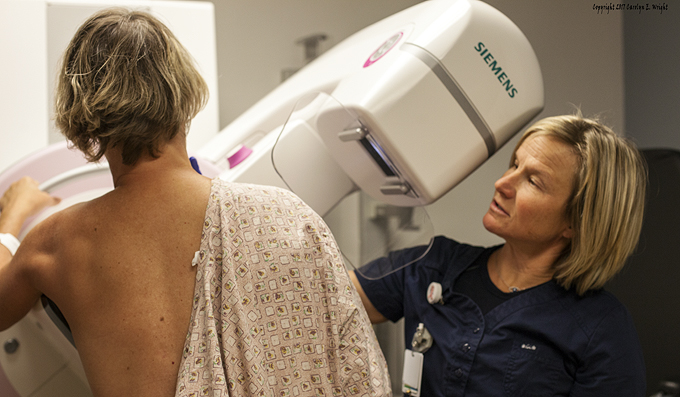
Sara Rourvinen of Barton Health, right, positions the new 3D mammogram machine. Photo Copyright 2017 Carolyn E. Wright

By Kathryn Reed

I call it getting my boobs squeezed. It’s an annual ritual most women of a certain age subject themselves to – the mammogram.

While I won’t say the new machine Barton Memorial Hospital has is something I would want to experience any more often, it is better than the old piece of equipment. It doesn’t squeeze the breast as hard, but it does take longer to get the full image because it is going through a 50-degree arc.

There is also a bar to hold onto, which makes things more comfortable.

The exam room is larger, a little warmer, a little more secluded. It’s part of Barton creating a women’s suite.

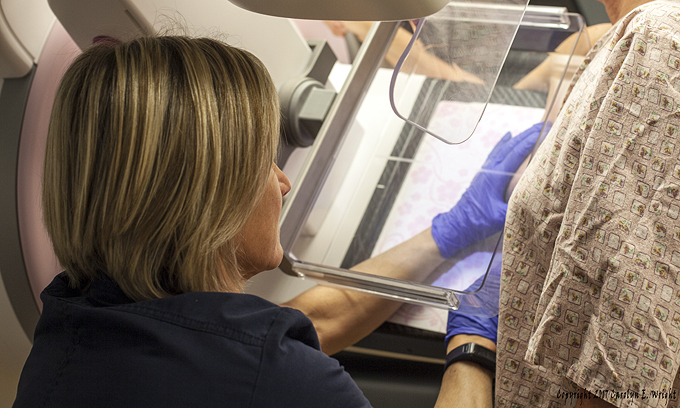
Sara Rourvinen of Barton works to position a breast for the best pictures. Photo Copyright 2017 Carolyn E. Wright

The whole experience is better. While that’s great, the best part is the efficiency of the new machine. Cancer detection is increased by 30 to 40 percent. The earlier the diagnosis, the better the outcome is likely to be.

The new technology is called tomosynthesis, which is essentially taking a 3D image of the breast.

As technician Sara Rourvinen explained it, 2D images are like taking a picture of a book cover, while the 3D version allows all of the pages to be seen. Those pages, so to speak, are layers of breast tissue.

“Cancer doesn’t have places to hide anymore,” Rourvinen said.

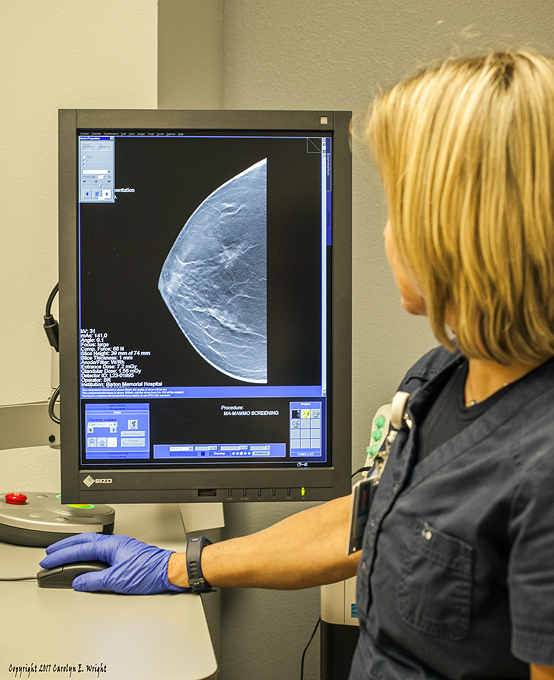
In many ways it’s an awkward procedure – what with having someone placing your breast on the flat surface of the machine, then a vice like contraption pressing down to keep it in place, having the tech tell you to standstill, but still breath. Rourvinen then walks behind the lead glass to be protected from the radiation. Next to her she has a monitor to see the images come up. She prides herself in getting it right the first time. Then the pictures are sent electronically to radiology.

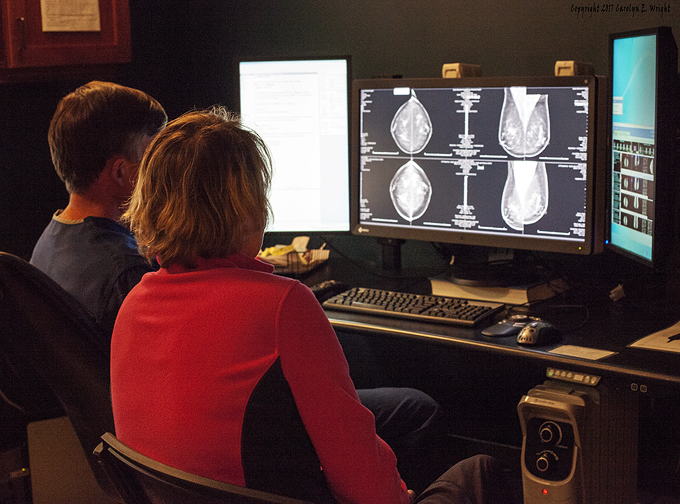
Sara Rourvinen reviews the 3D image of a mammogram. Photo Copyright 2017 Carolyn E. Wright

This machine is going to be most beneficial to women with dense breast tissue.

“High density breasts are a cancer risk. Because there is more breast tissue, there are more places for cancer to arise,” physician Leonard Holmgren told Lake Tahoe News.

Holmgren, one of the radiologists at Barton tasked with reading mammograms, looked at my images in his office on a 5-megapixel monitor. He compared them to last year’s. No change – still cancer free.

2D images are still taken. It is static. Sorting through the 3D images the layers of tissue are distinguishable. It’s easy for the doctor to scroll back and forth for another, closer look.

This new machine, which has been in use since June, requires doctors to spend about 40 percent longer reading the results. The added time is looking at all those layers of images. My exam resulted in 68 images on one setting, 75 on the other.

Dr. Leonard Holmgren goes over the mammogram results with patient Kathryn Reed. Photo Copyright 2017 Carolyn E. Wright

Two different images of each breast are taken. The number of images the 3D machine takes is dependent on how thick the breast tissue is.

This machine is better for everyone, not just those with dense tissue. It also gives a better reading for women with implants.

The stack of images also means fewer women will have to be called back for a second diagnostic mammogram. What might have been a suspicious spot with the 2D exam can now be seen in full, so to speak. Dense breasts in particular produce spots that need more analysis. This 3D machine is in essence providing that deeper analysis without subjecting the woman to another dose of radiation.

Barton mimics the national average of 10 percent of women being called back for a second screening. The machine is expected to decrease that rate to 8 percent.

This technology was approved by the FDA a handful of years ago, but only in the last couple has it been perfected. Plus, there are multiple manufacturers now. That is what led Barton to want to pursue purchasing the device. The Siemens machine cost $402,000, with the Barton Auxiliary contributing $220,000 toward it.

At first insurance companies would not pay for mammograms using the 3D device, but now they do. This was a concern of Barton’s because many of the healthcare system’s patients are on Medicare or Medi-Cal.

An added benefit is Barton can use the instrument to perform stereotactic biopsies. Before patients were sent to Carson City or Placerville.

The docs and technicians had to go through specialized training on the machine, with the 3D now being what all mammogram patients will use.

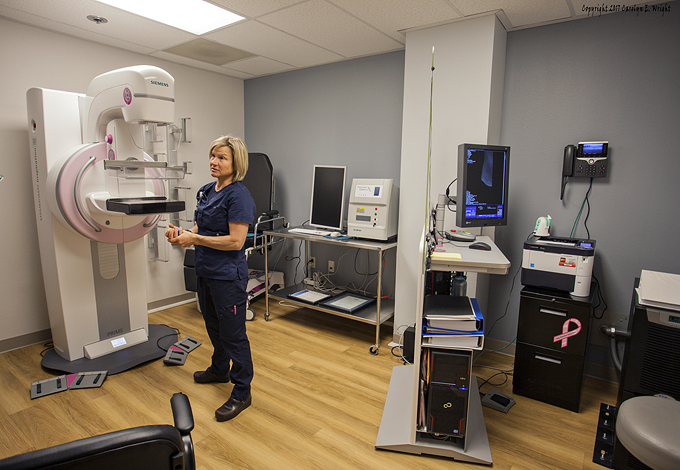
Technician Sara Rourvinen in the new space for mammograms at Barton Hospital. Photo Copyright 2017 Carolyn E. Wright

Notes:

When to get a mammogram: Ob-gyns at Barton Women’s Health go by the recommendations specified in the American Congress of Obstetricians and Gynecologists. The ACOG recommends starting clinical breast exams at age 25. Average-risk women should start getting annual mammograms at age 40. Barton Health urges people to speak with their doctor about frequency, as well as other possible testing if they have a family history of breast cancer.


Opinion: Civics should make students squirm

By Sarah Cooper

In many conversations, the topic of civics education comes with its own halo. The conventional wisdom is that it’s good, clean medicine, and if our children just get enough of its inoculation, the American body politic will be healthy enough to survive another generation.

But after nearly two decades as a middle school and high school history teacher, I’ve come to understand through teaching civics—and studying how it’s taught—that learning how to be a citizen doesn’t work like that. Indeed, civics education is best when it’s messy and uncomfortable.

That’s especially true in times of conflict and transition, like the ones we are living in now.

Approaches to teaching civics have been as volatile as the country’s history.

Horace Mann, common school advocate in the mid-19th century, believed that schools should teach only those values that everyone agreed with, such as charity and justice, recounted the educational historian David Tyack in “Seeking Common Ground: Public Schools in a Diverse Society.” At the time, “everyone” meant people like Horace Mann—white, wealthy, Protestant, and native-born, not the immigrants who poured across the Atlantic.

Later in the 19th century and into the 20th, the government waded into programs of Americanization, trying to replace the influence of the family with the power of the state in teaching how to be an American citizen. Such inculcation through schools included Native Americans early on and Japanese Americans later, after World War II. In contrast, with the cultural upheavals of the 1960s and ’70s, many school districts began treating each culture as something to be celebrated rather than repressed.

Regardless of the era, civics education over the past two centuries has been driven by social upheaval. As Tyack observed, “During periods of sharp demographic change, or war, or ethno-religious conflict, or economic challenge, for example, foundational principles of civic education came into sharper relief because they were less taken for granted.”

Today we live in a period of such conflicts, and I take absolutely nothing for granted in teaching civics. So I try to mix traditional and contemporary approaches.

On the traditional side, I ask my students to memorize lines from the Declaration of Independence and Lincoln’s speeches, especially those that focus on difficult compromise and principled revolt. I hope that phrases such as “We shall nobly save, or meanly lose, the last best hope of earth,” and “it is their right, it is their duty, to throw off such government,” will ring in students’ heads well into adulthood, inciting them to action.

When I first taught eighth-grade history, I required students to memorize a lot more. On tests they had to regurgitate names that educated Americans barely remember, such as John O’Sullivan with his Manifest Destiny theory or Frederick Jackson Turner with his frontier thesis. For women’s suffrage, students had to spit out a litany of names rather than just a few who could serve as touchstones, such as Elizabeth Cady Stanton, Ida B. Wells, or Alice Paul.

With civics and the Constitution, I also used to include details that no longer matter as much to me, because they mire students in minutiae at the expense of deeper understanding. My middle schoolers no longer have to know the exact number of the amendment that limits presidential terms, but rather why it happened and in response to what.

Broad educational shifts, such as evolving state standards, have definitely influenced me to focus more on depth and less on breadth when teaching both civics and history. Even Advanced Placement history exams have been overhauled in the past several years to emphasize thematic understanding over disconnected details.

Yet even this kind of conceptual focus on the broader picture has not always felt like enough.

In the past several years, to get students to engage and think like citizens, I’ve found that I have to do a heck of a lot more than ask them to understand the past and dissect the present: I need them to create the future in my classroom, right now, through discussion and debate. I need them to be leaders in the classroom, not just participants, so that they can imagine presiding over boardrooms, civic groups, and family conversations in the future.

And so, on the best days, these eighth-grade U.S. history students conduct discussions on their own, pose questions that provoke and unsettle, and challenge authority—including and especially mine—with respect.

After all, the laws of a country mean little without the ability of leaders and citizens to listen to other views and believe that our laws mean something. The Constitution remains powerful only in that citizens have gifted it that power over two centuries and counting.

As Horace Mann foresaw, open dialogue breeds discomfort. When we examine Black Lives Matter or gun control, some of my students lean in, while others squirm and slouch. I tell them that these discussions are supposed to be uncomfortable.

And each Friday in my classroom, several students bring up such uncomfortable issues in their weekly current events presentations. The presenter summarizes a news article and gives the reasons he or she chose it. Everyone writes down a question or comment—and then the floor opens for discussion.

The presenter fields questions on everything from how to prevent nuclear war, to why there are so many homeless people in Los Angeles, to what abortion looked like before Roe v. Wade. Week by week, we work on solving problems together. 

When I first started teaching, students did these weekly presentations, but we talked about their articles only for a few minutes, and the questions came largely from me. In an attempt to make my classroom feel more democratic, I realized a few years ago that more of the power needed to be in students’ hands, at least one day a week.

And so I sit back and listen, to questions they ask of each other: “So is the government doing anything yet to help with the recent flooding?” or “Why has the homicide rate gone up in that country?”

In describing such “maximally open classroom climates,” education Professor Meira Levinson in “No Citizen Left Behind” offers questions that students can ask themselves and each other while engaging in discussion, such as “Why do people care about this topic?” and “Is this person making an argument, or just talking for the sake of talking?”

In our national discourse, Levinson’s kind of metacognition might inspire those who talk too much to listen more, and those who don’t talk enough to speak up already.

By fostering such reflective questions about how we talk, civics education can also create new lenses through which students can view the world.

I see kids change their perspectives in my classroom every week. For instance, once they understand how a concept such as federalism relates to marijuana or immigration laws in California, they begin to ask about how people in other states are affected by these issues. The thought that someone in Texas might possess entirely different rights than someone in Los Angeles shocks them. They sputter at what seems to them the unfairness of it all.

If we’ve just discussed the road to Civil War, I’ll link civics to history—ask them to imagine what it might have felt like to be bound under even more serious state-to-state conflicts, such as the Fugitive Slave Law.

Not all of these discussions come easy. Sometimes the political opinions that the presenters express, in our majority but certainly not entirely liberal school, land the wrong way for a student who believes in pushing tax cuts or loosening gun restrictions. Sometimes I worry that those in the ideological minority don’t even want to talk because they don’t feel it’s worth it. And so I occasionally step in to play devil’s advocate for whichever side is not getting enough airtime on an issue, to remind students that our classroom bubble is not the world’s bubble.

The ultimate perspective that I hope for my students is that they assume a little more humility than adolescents (or adults) typically do. When I ask them what they don’t know about an issue, I want these eighth-graders to remember that they need to rely not only on themselves for answers to civic problems, but also on the people around them. Often I’ll bring in a historical primary source to make a point like this, such as a speech that the not-always-humble Ben Franklin gave to the Constitutional Convention in September 1787.

Franklin, after four months of difficult deliberations, asked each delegate in Independence Hall to accept that the draft of the Constitution was good enough. Then he asked each man to do even more, to leap beyond mere acceptance and “doubt a little of his own infallibility.”

Franklin’s ability to step back from the debate is the real inoculation I’m looking for as a civics teacher and a citizen. Not a syringe filled with terms such as ratify and suffrage, but one packed with a heavy dose of self-doubt. And it should be a big enough dose for our children to understand that raising citizens, and being citizens, can be as messy and pungent a process as four months of sitting in a hot Philadelphia summer, until you’re ready to call something good enough, for now.

Sarah Cooper teaches eighth grade U.S. history and is dean of studies at Flintridge Preparatory School in La Canada, just north of Los Angeles. She is the author of “Creating Citizens” and “Making History Mine.”

N. Nev. schools willing to end true state playoffs

By Ray Brewer, Las Vegas Sun

We learned at a young age the importance of beating a high school from Reno in the state tournament. If you played football, the goal was to win the zone championship game at the Silver Bowl, then to carry the flag for Southern Nevada when taking on a team from the north for a state title.

Times have surely changed over the past 20 years. The Silver Bowl is Sam Boyd Stadium, after all.

Reno-area high school athletic officials, so frustrated with a decade of taking second place to Bishop Gorman in football and basketball, are well on their way to making it to where the days of a north-south state championship are over in the large-school classification for all sports.

The Nevada Interscholastic Activities Association’s Board of Control in January will be asked to approve a new 5A classification for high-enrollment, perennially competitive schools such as Gorman, Coronado and Palo Verde.

Read the whole story