Tips for a safe holiday season

The South Lake Tahoe Police Department has the following safety tips for the holiday season:

Vehicle safety:                                                                                                                                      

  • Park your vehicle in a well-lighted area.                                                                                           
  • Ensure all of your car doors are locked.                                                                                              
  • Hide shopping bags and other valuables in the trunk or out of site.                                       
  • Be aware of your surroundings.                                                                                               
  • Avoid displaying large amounts of cash.                                                                                              
  • Give yourself plenty of time to reach your destination as the roadway may be icy.            
  • Do not drink and drive. Designate a sober driver.                                                                   
  • Never text and drive.                                                                                                                
  • Do not leave your vehicle running and unattended.                                                     

Safety at home:                                                                                                                                   

  • Keep candles out of reach of children.                                                                                                 
  • Never burn candles near flammable items.                                                                            
  • Never leave burning candles unattended.                                                                               
  • Do not burn wrapping paper or wreaths in your fireplace.                                                    
  • Have your chimney inspected and cleaned once a year.                                                     
  • Inspect stringed lighting for fraying. A small fray in the wiring could ignite a fire.                             

Online purchases/deliveries:                                                                                                               

  • Only purchase from trusted websites.                                                                                                  
  • Use a credit card or pre-paid card for online purchases.                                                        
  • If you are making a Craigslist purchase, find a safe location to make the transaction.       
  • If you are expecting a package, tell a trusted neighbor to keep an eye out for the delivery.


Letter: Bring back clean mountain air

To the community,

The United States Forest Service admits it has mismanaged our forests for the past 30 years. Now they are experimenting with massive daily burn projects, while concealing and refusing to discuss their serious impact on our health. The general public does not realize that the USFS no longer tries to extinguish wildfires, but are actually turning wildfires into massive prescribed burns.

The surgeon general has determined that smoke is so hazardous to your health that it has banned indoor smoking, yet we must endure breathing the smoke by the USFS. Prescribed burns do not burn hot enough for the smoke to rise. Instead the smoke spreads along the ground infiltrating our lungs, lives and homes. If you are experiencing chest pain, arthritis, inflammation, headaches, burning eyes, sinus problems and breathing difficulties, it may well be that prescribed burns are the cause.

The USFS will not even discuss how seriously they are effecting our health, but run slick ads which try to brain wash the public that prescribed burns are the only solution. To learn how prescribed burning is effecting your health and methods of safer forest management go to Prescribed Burning Versus Human Health – YouTube.

To sign and email a moratorium request to halt prescribed burning for one year until the USFS can develop a plan that will not jeopardize human health go online and look for the Urgent-Stop the burning link in red.

Marsha Honn, Snowflake, Ariz.


International visitors’ habits explored at Nev. summit

By Thomas Moore, Las Vegas Sun

French tourists to Nevada seek the outdoors and cultural opportunities, while Chinese tourists are switching from group arrangements to independent travel.

Travel tendencies of international tourists were among the discussion topics on the second day of the Governor’s Summit on Tourism at the Flamingo Las Vegas.

Gov. Brian Sandoval underlined tourism’s importance to the state during his luncheon speech at the summit, hosted by the Nevada Department of Tourism. He noted that one-third of the state’s tax revenue comes directly from the tourism industry.

Read the whole story


Snippets about Lake Tahoe

·      Lake Tahoe Community College’s women’s soccer team finished No. 10 in the nation in the final poll of the season.

·      Registration opens Jan. 16 for Tahoe Rim Trail Association’s youth backcountry camps. Three trips are available for youth ages 12-17 to discover Tahoe’s backcountry and learn valuable navigation skills, wilderness survival, leadership, and more. Go online for more info.

·      The Zephyr Cove library will be showing “The Polar Express” (rated G) on Dec. 20 at 3:30pm. The movie will be shown on a big screen in the meeting room. Hot chocolate and popcorn will be provided. 

·      El Dorado County is conducting an economic survey. This survey is scheduled to end Dec. 7 at 1:30pm.


Burn permits available in Incline Village

With the recent change in weather conditions, the North Lake Tahoe Fire Protection District will lift the seasonal fire restrictions on outdoor burning on Dec. 9.

Permits for open burning of pine needles, slash pile, construction warming fires, and recreational fire pits are available for free at the district’s administration, 866 Oriole Way, Incline Village.

The fire district reminds everyone to follow the safety guidelines on their burn permit. Guidelines for open burning are:

  • Permit holder must call fire dispatch before burning
  • Open burning starts at 6am and all piles must be extinguished by 3pm
  • Provide a 30-minute fire watch after extinguishing any fire
  • Have a charged garden hose and hand tools nearby
  • Keep pine needle and slash piles small and manageable
  • Fire must be constantly attended by an adult
  • Clear a 25-foot radius noncombustible area around all fires
  • Keep fires away from any overhanging branches
  • Burning of household refuse, trash, cardboard, rubber products, tires, plastic, petroleum, construction debris and other non-vegetative materials is prohibited.

For any questions or to obtain a burn permit application, call the North Lake Tahoe Fire Protection District at 775.831.0351, ext. 0.


Backcountry demo day at Alpine Meadows

The Lake Tahoe Backcountry Demo Event, North America’s largest venue for all things alpine touring, telemark, and splitboard, is back. Alpenglow Sports has again partnered with Alpine Meadows for this annual opportunity to try the best backcountry gear of the season.

It will be Jan. 6, 9am to 3pm.

Participating vendors will include DPS, Black Crows, Tecnica, Blizzard, G3, Scarpa, NTN, Salomon, Scott, Marker, Volkl, Twenty-Two Designs, La Sportiva, Voile, Moment, Julbo, Fly Low, Jones Snowboards, and more. Meidjo telemark bindings will also be on hand for demo.

The event is free, but participants must have a valid lift ticket or season pass purchased from Alpine Meadows or Squaw Valley USA, along with a driver’s license and credit card for deposit. Registration for the event will occur onsite at the Alpenglow Sports tent that day.


Viability of Squaw Creek, aquifer being studied

By Kathryn Reed

Those tasked with managing water in Olympic Valley, in particular Squaw Creek and the surrounding aquifer, are taking a more methodical approach to studying trends and potential impacts.

The Lahontan Regional Water Quality Control Board is one of the regulators of this body of water between Tahoe City and Truckee and had requested a workshop on the item; which occurred at the last meeting.

“The state board years ago when they approved our water quality restoration plan for Squaw Creek, which focused on reducing sediment coming from primarily the ski resort, and also the county roads and development in the valley, asked us to also look at the effects of groundwater pumping in the valley,” Lauri Kemper with Lahontan told Lake Tahoe News. “Residents had complained that the creek goes dry every fall and fish kills occur due to overpumping for drinking water supply in the valley. Because of the concern and the proposed increased development in the valley, the local water district conducted a study looking at ground and surface water interactions. Pumping does affect creek flows in late summer and wells could be relocated away from the creek closer to the mountain (canyon walls) and reduce chances of lowering creek flows.”

Mike Geary with Squaw Valley Public Services District went over the aquifer/stream flow interaction study at the November meeting.

In addition to SVPSD, the main groundwater pumpers in that basin are Squaw Valley Mutual Water Company, Resort at Squaw Creek and Squaw Valley Ski Resort. The ski resort has four wells on the valley floor for snowmaking, while Resort at Squaw Creek has an irrigation well for the golf course. SVPSD has four active wells.
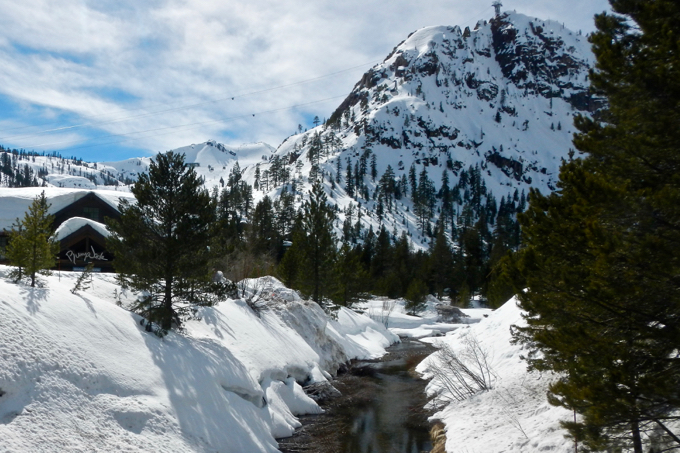
Squaw Creek and the surrounding aquifer are how the Olympic Valley gets its drinking and irrigation water. Photo/LTN file

There is plenty of snowmelt to recharge the aquifer each year. It takes eight hours to fill the SVPSD tanks, which uses about 4 percent of the water in the creek, according to Geary. Storage capacity, or the lack of it, is one of the main issues.

“We can’t store enough in the water tanks to be useful,” Geary said. “We struggle to capture some of the water that leaves the valley in the dry months. That is challenging.”

He doesn’t foresee a dam/reservoir being a viable storage alternative.

One thing being talked about is reconfiguring the creek to more of its natural route with the hope less groundwater is lost to the creek. Right now there is a trapezoidal channel that was built by the Army Corps of Engineers before the 1960 Olympics. It drains water from the shallow aquifer into Squaw Creek.

By modifying the trapezoidal channel it would reduce drainage from the shallow aquifer into the channel in spring and early summer.

Also being proposed is moving pumping as far west as possible and reducing or eliminating pumping on the east side of the valley. Developing a formal pumping management strategy has been proposed to map municipal water needs and minimize impacts on the creek.

SVPSD looks at what water usage may be 25 years from now. The big change would be the proposed development in the Squaw Valley Village that would create lodging, retail and recreational entities in what is now the parking lot. Two new wells will be paid for by the ski resort for that project.

Officials have an eye on climate change as well, especially with all the predictions that there will be less snow falling in the Sierra in the coming years. This would mean Squaw Creek would dry out sooner. On the flip side, more rain would mean the aquifer would recharge with those storms.

One thing SVPSD doesn’t have that is a norm in the water business is interties with neighboring districts. It makes these water users a bit isolated and potentially cut off in an emergency.

This is why tying into the Martis Valley has been broached. That proposed $25 million project would inevitably invite a political/environmental firestorm. Still, it’s a battle the district is contemplating.

The Olympic Valley aquifer has a maximum depth of 150 feet and is one-half square mile. The Martis Valley aquifer has a depth of about 800 feet and is 15 square miles.

It is not possible to tap into Lake Tahoe because federal agreements prohibit entities downstream of the lake to use the water.


Opinion: The cost of devaluing women

By Sallie Krawcheck, New York Times

My first job out of college in the late 1980s was at Salomon Brothers, a trading house of cigar-smoking, expletive-spewing strivers. One day, I leaned over a colleague’s desk to work on a spreadsheet, and heard loud laughter from behind me; one of the guys was pretending to perform a sex act on me. Almost every day, I found a Xerox copy of male genitalia on my desk.

I was not alone in being treated this way: During that era another brokerage house, Smith Barney, paid out $150 million in a bias and harassment case — known as the “boom-boom room” suit, named after a basement party room in one of its branches. Wall Street was a hypermasculine culture, where the all-nighter was a badge of honor and the ever-bigger deal was proof of one’s status, and women were not safe, either emotionally or physically.

In the 1990s, I changed firms and was now a midlevel professional. The harassment shifted: Instead I had to rebuff a client, a chief executive, who asked me to join him — “Just you, no need to bring the rest of the team” — in his hotel room at 11pm to go over some numbers. One company rescinded a job offer upon learning I had a baby at home.

Read the whole story


Multibillion-dollar water measures heading to Calif. ballot

By Kurtis Alexander, San Francisco Chronicle

With a five-year drought and then a winter of floods having exposed the limits of California’s vast network of reservoirs, dams and canals, voters are likely to have the chance next year to decide whether to pay for major upgrades to the state’s waterworks.

Two multibillion-dollar bonds are expected to go before voters that promise to boost water supplies, offer flood protection and restore rivers and streams. One measure, sponsored by the Legislature, also would fund new parks and hiking trails. The second, a privately backed initiative, would go further to improve the infrastructure that moves water to cities and farms.

Regardless of whether state voters approve either measure, a handful of reservoirs will be built or expanded with billions of dollars from a previously approved water bond.

Read the whole story


Experts weigh in on holiday decorating safety

By Jessie Bekker Las Vegas Review-Journal

Deanna Goble leaves the holiday decorating to the professionals every year.

“None of us want to climb up this ladder and go around, for one. Two, we don’t really know how,” said Goble, a long-time Las Vegas resident.

But when she forgot to ask them to wrap baby palm trees in her front yard with lights, she figured she could do it herself.

Big mistake. When she came out with cuts that stung with the palm trees’ juices, she decided: “Forget it.”

Her injuries were surface level, but about 14,900 Americans landed in emergency rooms last year after decorating for the holidays, the U.S. Consumer Product Safety Commission reported.

Read the whole story