SLT, EDC approve garbage rate hikes

South Lake Tahoe electeds on Tuesday voted for the full garbage rate increase, while El Dorado County officials decided to stagger the fee.

The Waste Management Joint Powers Authority board in November approved South Tahoe Refuse bills to go up Jan. 1 in South Lake Tahoe by 8.81 percent, El Dorado County 9.34 percent and Douglas County 6.81 percent. On a monthly residential bill this would equate to an increase of $2.34 to $28.89, $2.85 to $33.32 and $1.21 to $18.93, respectively.

The JPA gave the individual jurisdictions the option to increase the bill starting in 2018 or to spread it over two years.

How the city noticed the rate increase it was such that what the elected were faced with was the full fee increase. They weren’t happy with not having the choice. So much so that Councilwoman Brooke Laine on Dec. 12 voted no, though she was the only one to do so.

The county on the other hand had the option to space the increase out – and that’s what it did. So, the immediate hike will be 6.26 percent in 2018 and 3.08 the following year.

Douglas County commissioners still need to vote on the increase.

— Lake Tahoe News staff report


Clock ticking to find shelter for Tahoe’s homeless

By Kathryn Reed

The overnight low in South Lake Tahoe last night was supposed to be 15 degrees. There were residents who were outside, in a vehicle or in other substandard housing.

That is going to keep happening until the warm room is able to open. Now in its third year, the facility could open New Year’s Day with about 25 cots.

The delay is the lack of a facility.

The South Lake Tahoe City Council took steps Dec. 12 to do something about this situation. The city owns a vacant building on Rufus Allen Boulevard that used to be rented by Unity at the Lake. A few improvements would need to be made to the structure first.

To help with warm room costs, checks may be made payable to Tahoe Coalition for the Homeless and mailed to PO Box 13514, South Lake Tahoe, CA 96151 or go online. To get a list of what the warm needs in terms of donations, contact tahoewarmroom@gmail.com or 775.573.0822.

But the main obstacle is appeasing neighbors who think these men and women are a threat to them and their children. A task force was put together to quickly mitigate concerns. Lake Tahoe Unified School District and Lake Tahoe Boys and Girls Club will be part of the team to find solutions because they have facilities within walking distance.

People are concerned about the proximity to a school bus stop, the recreation center, senior center, library, school and Boys and Girls Club. They don’t want these people loitering or committing crimes.

The naysayers tried to paint a picture of these people being scary criminals. Statistics from the past two years show no evidence of that being a true characterization.

It was repeatedly pointed out that homeless people as a group are not law breakers, they are financially challenged. Some have mental health issues, some substance problems.

The warm room has an in-take form that asks if they are sex offenders. They self-report – just like they are supposed to do with law enforcement. If they say, yes, they are turned away. Guests must abide by rules at the warm room – like not drinking or using other drugs. If they do, they are shown the door.

Leigh Wayne Miller, a doctor in town, was one of the overnight workers at the warm room last year. This meant staying with the 25 guests overnight – alone. She’d do it again.

This week she saw three women who were admitted to the hospital, all talking about suicide. Miller said they all felt hopeless, were cold and didn’t think they could handle another night in the elements.

“There is an empty building. We need to get people inside sooner rather than later,” Miller said.

Assuming a compromise is found, the council gave direction to staff to devise a contract. It would have the Tahoe Homeless Coalition pay about $5,000 in rent for the four-month period, of which the city would then use those funds for its hard costs related to the operation. This would include utilities, possibly security and maybe a porta-potty.

The Catholic and Presbyterian churches in town have offered their facilities on an interim, short-term basis. But that requires some special permitting by the city, so it’s not an immediate answer.

“We are going to host the homeless on Christmas Eve. It’s an issue of humanity,” the Rev. Bob Kelly with Lake Tahoe Community Presbyterian Church said.

The homeless coalition is out of options. Barton Health has said it can’t help.

“Prior to the warm room initially opening, Barton Health was approached about providing space. Unfortunately, we did not have space to meet their requirements,” CEO Clint Purvance told Lake Tahoe News.

Lake Tahoe Community College will be asked about space. The college did not respond to an inquiry by LTN.

Of the 22 people who spoke at Tuesday’s meeting, the majority were in favor of the warm room at this location.

Bruce Cox, a 1976 graduate of South Tahoe High School, volunteered at the warm room last year. He spoke about how shocked he was to discover a classmate was among the more than 100 people who stayed at the shelter last winter.

Life has a way of turning bleak in the blink of an eye – an illness, job loss, addiction, mental condition – they all can lead a person to not being able to pay his or her bills.

In a town where housing is in short supply – even the shabby hotels fill up on busy weekends. People can be hard pressed to find four walls and a roof. More than a quarter of the people who slept at the warm room last winter had jobs. They just couldn’t afford a place to live.

Cheyanne Lane with Tahoe Youth & Family Services said six of her clients are in need of the warm room.

“These are young people working two and three jobs. They are sleeping in their car. One client is pregnant,” Lane told the council.


Editorial: 2018 could be worse for California

Publisher’s note: This editorial is from the Dec. 2, 2017, Sacramento Bee.

Living atop ever-shifting tectonic plates, we know the Earth can shift with deadly force at any time, though we don’t dwell on it. But as 2017 nears its end, let’s reflect on the disasters we endured, and what they portend for next year and years ahead.

In the last rainy season, more rain and snow fell on our valleys and mountains than in any year recorded, this after five years of drought. Eroded by the force of millions of gallons water cascading out of Lake Oroville, the concrete spillway at the massive Oroville Dam crumbled in February, and the Butte County sheriff wisely erred on the side of safety by ordering 188,000 people to evacuate.

You can be forgiven if the Oroville Dam scare seems to have happened in the distant past, although in this time of climate change, such anomalous events could well be part of our future. That became evident on the terrible night of Oct. 8 and early morning of Oct. 9.

Read the whole story


Kings Beach event center lease terminated

The controversial lease agreement between North Tahoe Public Utility District and Laulima Kings Beach Event Center LLC has been terminated – and not because of public outcry.

“LKBEC did not submit sufficient documentation to the district’s third-party financial consultant to satisfy the contingencies in the lease agreement and otherwise verify LKBEC’s operational and financial ability to fulfill the terms of the lease agreement,” NTPUD said in a press release.

The lease with Laulima was approved Sept. 18 and effective Oct. 5. That approval also began various performance timelines, including a 60-day financial contingency period which ended Dec. 4.

The board voted Dec. 12 to sever ties with Laulima.

This means the operation of the North Tahoe Event Center in Kings Beach will remain in the hands of TCPUD. North Tahoe PUD said it will be “investigating alternatives that reduce or eliminate its on-going operational deficit.”

The district has operated the center since 1979.

According to Duane Whitelaw, general manager of TCPUD, this all came about from a “property transfer from the county of Placer who had received the property and building improvements from the state of California following the passage of a voter-approved Parks Bond Act. A condition of the state’s acquisition and grant which carried forward in a deed restriction to the county and ultimately to the NTPUD was the property acquired could only be used for ‘park purposes’.”

The board will be discussing what to do next at its January meeting.

— Lake Tahoe News staff report


SLT, EDC taking time to allow pot shops

By Kathryn Reed and Susan Wood

There will be no sales of recreational marijuana anywhere in El Dorado County for the foreseeable future.

This is because on Dec. 12 the South Lake Tahoe City Council and El Dorado County Board of Supervisors at their respective meetings agreed to implement urgency ordinances related to cannabis. Each is a ban for 45 days. (The ban does not affect the current medicinal marijuana operation in the city.)

This is in response to the 2016 California voter approved initiative making recreational pot legal starting Jan. 1. Each jurisdiction has the right to regulate sales and other aspects of the law. What is allowed is growing up to six plants for personal use and smoking at your residence assuming the landlord says it is OK.

It is not legal to drive high – nor will it ever be, private businesses may restrict the use on their premises, it can be illegal in public places, and employers still have a right to say being under the influence is a big no-no.

The city already has a working group of two council members – Tom Davis and Brooke Laine – who are leading a community committee to write a recreational marijuana ordinance with the help of the city attorney.

Three of the six planned meetings have taken place. The time line is for all recommendations to go to the city attorney by the end of January, have it be aired before the Planning Commission in March, with a workshop of the City Council that month, too, and possibly have the ordinance in place by June.

At Tuesday’s meeting the Board of Supervisors unanimously voted on the 45-day urgency ordinance to ban commercial licenses for medical and recreational cannabis.

A four-fifths vote for all urgency ordinances – in the city or county – is necessary.

However, it was a 4-1 vote to establish an ad hoc committee of Supervisors Mike Ranalli and Sue Novasel. Supervisor Shiva Frentzen, without saying why, voted no. The committee will study and create ballot measures for various commercial uses tied to taxation.

Novasel reminded the other supervisors that the state’s direction seems to be “ever changing.” The temporary ban serves as a “wait and see” concession in order to stall decisions until all aspects of the options surrounding the new law are reviewed.

“Nothing’s off the table,” Novasel told Lake Tahoe News.

The county agenda item brought out seven speakers all in favor of supporting the cultivation of the crop, whether for medicinal use or economic benefits.


Bobcat cubs spotted on Tahoe Mountain

One of three bobcat cubs on Tahoe Mountain on Dec. 12. Photo/Nancy Hedqvist

While bobcats are known to live in the Lake Tahoe Basin, it’s unusual to see them.

It’s even more rare to see three at once. But that happened today.

Nancy Hedqvist spotted three cubs on Dec. 12 at about 1pm on Tahoe Mountain.

Even more rare is to seem them in the daylight because they are nocturnal animals.

Their food of choice is rabbits.

“They will also take small cats and small dogs, if given the opportunity,” Tom Millham with Lake Tahoe Wildlife Care, told Lake Tahoe News. “They will definitely shy away from humans. Do not corner them. They will not attack humans, but, they will go ‘through’ someone if that is the only way out.”

— Lake Tahoe News staff report


Snippets about Lake Tahoe

·      South Tahoe High School Holiday Music Concert is Dec. 18 from 7-8:30pm at the school. Cost is $5.

·      The first tree run in the Shirley zone at Squaw Valley was renamed “Mac & Ernie’s” for the 2017-18 season to honor and thank Ryan McInerney, president at Visa, and his family for their donation to Waterkeeper Alliance. Waterkeeper Alliance is the largest nonprofit solely focused on clean water, fighting for every community’s right to drinkable, fishable, swimmable water. The trail name was awarded to McInerney during the fundraising gala and auction celebrating the World Cup at Squaw Valley last March. 

·      Carolyn Grubb, who was the glue holding the Valhalla Festival together through some turbulent times, is retiring now that the art-music festival is on solid footing.

·      H2uP Tahoe, South Shore’s IV hydration wellness service, has a new brick and mortar location at MontBleu.


With climate change, tree die-offs may spread

By Jim Robbins, New York Times

Ponderosa pine and pinyon forests in the American West will die at an increasing rate as the world grows warmer, becoming less and less resilient when they are weakened by higher temperatures, according to new projections.

Although these forests now withstand short droughts, warming temperatures increasingly stress the forests, which means they will no longer survive the shorter droughts they once endured.

And future droughts will be hotter as the planet warms.

Read the whole story


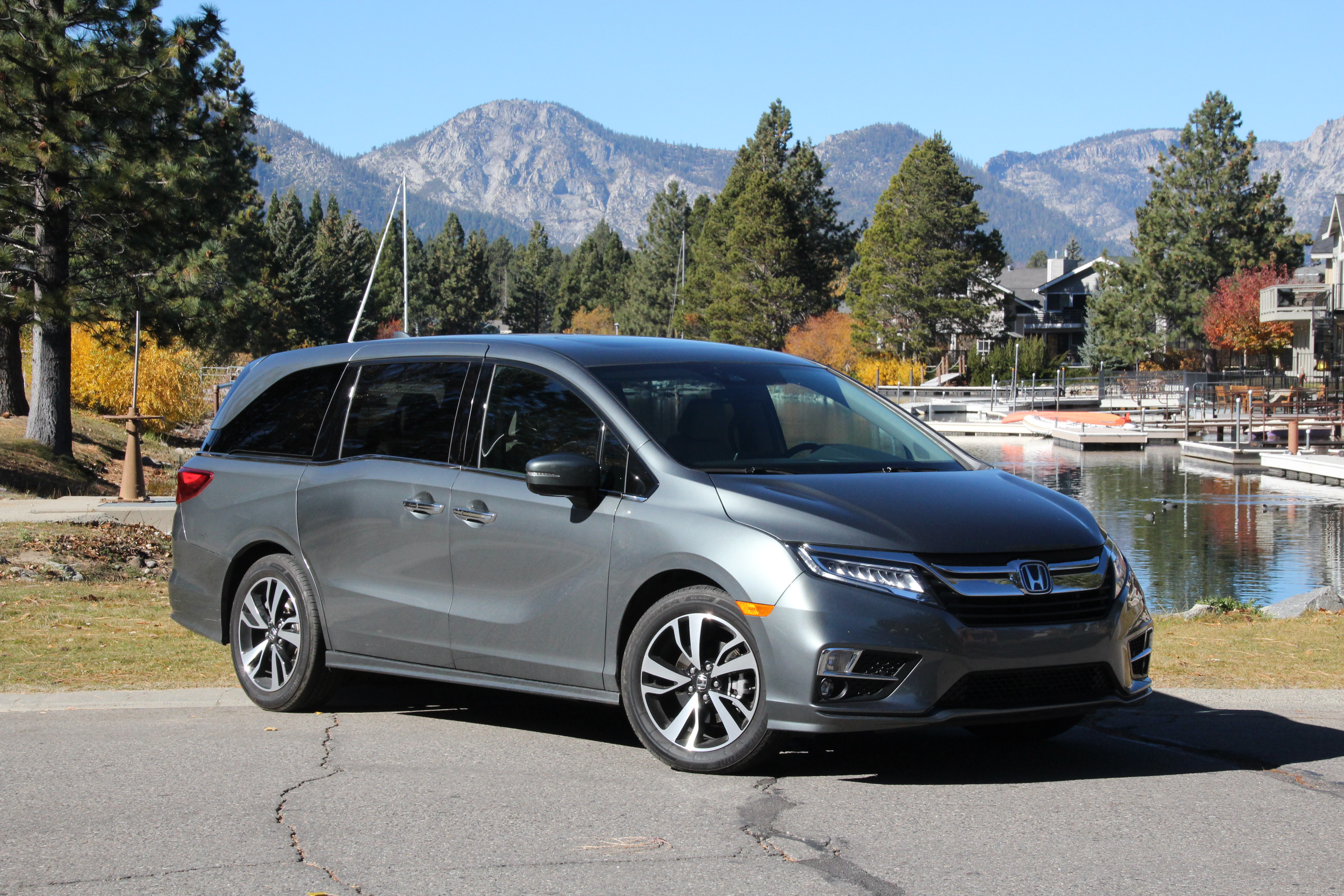
Road Beat: ’18 Honda Odyssey moving right to the top

The Honda Odyssey has been redesigned for 2018. Photos/Larry Weitzman

By Larry Weitzman

Honda for 2018 brings an almost entirely new Odyssey. Always ranked by most journalists at or near the top of this competitive class, this new Odyssey has to be second to none. About the only thing that didn’t change is the wheelbase which remains 118.1 inches. Everything else has changed, although curb weight is also listed at 4,593 pounds, which is down by 20 pounds from the prior generation.

One of the detractions of the prior generation was that the window line made it look perfect for a funeral home. Unless you are ghostbusting ala Bill Murray and Dan Ackroyd (they used an old Cadillac Hearst), the styling always bugged me. But Honda has fixed that window line by giving it a smoother, edgier look. It does have an attractive look now and the new excellent front headlights give it a sporty, aggressive look

Overall footprint for the Odyssey remains virtually the same with a length of 203 inches and a width near 79 inches. Odyssey stands almost 70 inches tall. Although the size remains the same, interior volumes are slightly down, which may be the result of new measuring requirements. But the fuel tank is down from about 21 gallons to 19.5 gallons, but not to fret, fuel economy is up.

While the engine is dimensionally the same, Honda has gone from port fuel injection to a more expensive direct injection, meaning higher compression, more power and improved fuel efficiency. Horsepower jumps from 248 at 5,700 rpm to now a full 280 hp at 6,000 rpm and torque jumped by 12 pounds of twist to 262 at a lower 4,700 rpm. Also new is either a super slick nine speed or in their two top of the line Odysseys a 10-speeder. My top of the line Elite got the 10 speed. The Touring gets the same cog-swapper.

Performance is greatly enhanced as with that many tranny ratios, the engine is almost always at peak efficiency and it shows with a 0-60 mph time of just 7.07 seconds. My advice is not to choose off a new Odyssey at the traffic light Grand Prix. You will be in for a comeuppance. Hit it hard and you can smoke the tires a bit. This almost quickest of minivan times is backed up by excellent passing performance with a 50-70 mph run on a level highway taking just 3.48 seconds and the same run up a steep grade only slowing that time by just over a second to 4.76 seconds. While the nine speed Pacifica is a couple of tenths quicker to 60 mph, the Odyssey smokes the Pacifica is passing times by a half to a full second.

Specifications
Price $30,930 to $47,610
Engine
3.5L SOHC, 24 Valve V-6 280 hp @ 6,000 rpm
262 lb.-ft. of torque @ 4,700 rpm
Transmission
Nine-speed torque converter automatic
10-speed torque converter automatic Touring and Elite
Configuration
Transverse mounted front engine/front wheel drive
Dimensions
Wheelbase 118.1 inches
Length 203.2 inches
Width 78.5 inches
Height 69.6 inches
Track (f/r) 67.3/67.2 inches
Weight 4,593 pounds
Weight distribution (f/r) 55/45 percent
Wheels 19 inch alloys
Tires 235/55X19 inches
Steering lock to lock 2.97 turns
Turning circle 39.64 feet
Fuel capacity 19.5 gallons
Passenger volume 160.1 cu ft
Cargo volume behind third row 38.6 cu ft
Tow capacity 3,500 pounds
Performance
0-60 mph 7.07 seconds
50-70 mph 3.48 seconds
50-70 mph uphill 4.76 seconds
Top speed Tires are rated for 130 mph continuous and I am sure it could do it.
Fuel Economy EPA rated 19/28/22 mpg city/highway/combined. Expect 23-25 mpg in rural country driving and 31-32 mpg on the highway at legal speeds.

Fuel economy as rated by the EPA comes in at 19/28/22 mpg city/highway/combined. On a level highway at 70 mph the Odyssey averaged 32 mpg and over the Sierra to Carson City it averaged 28 mpg. In overall driving of about 500 miles it averaged about 25 mpg. Pretty amazing fuel economy considering its size and performance.

Handling is another area of Odyssey improvement. Steering is much quicker at just 2.97 turns lock to lock, wheels are now 19 inches on the Elite and they are shod with lower profile 235/55 series rubber. While MacPherson struts still reside up front, a new improved compact trailing are set up now resides in the rear. Odysseys have also had decent handling, sharper than other minis, but this new version will downright surprise you right up to its limit. Turn in is crisp and its attitude remains reasonable flat for a mini and its cushy ride. It gets it done when the road bends and its 67-inch-wide track certainly helps.

Ride quality is super absorbent, and quiet, very quiet and Hondas aren’t known for their quiet until lately where they have done a great job on quelling road noise.  It rivals some near luxo models in quiet. There is no bobbing, weaving and certainly little if any float. Well done, Honda.

Brakes appear to be the same big ventilated discs in front and bigger solid discs in the rear. All the acronyms are present with ABS and a plethora of others. Lane departure warning, collision mitigation (which should help prevent future litigation), lane keep assist, adaptive cruise and the kitchen sink are all here, standard in this Elite edition. LED headlights are terrific.

Inside is a luxo leather interior with doors and dash done with top quality materials. Storage and cubbies abound. The Elite comes with the cabin watch system which puts on a screen what’s happening in the second and third row. Seats are comfortable if not a bit firm, so long haul comfort should be good and with that nearly 20-gallon fuel tank, maybe a private lav might be a good option with a near 600-mile range. Second and third row seating is comfortable and copious. Rear seats fold flat and the middle row is a snap to remove.

With a bit over 140 cubes behind the front row, going to Home Depot or Lowe’s could get costly.

My Elite tester stickers for $46,670 plus $940 for the train ride from the Odyssey’s Lincoln, Ala., assembly plant. Everything is standard and it doesn’t get any better than this model. A still well-equipped LX model sticker for $29,990 plus the obligatory $940 train ride and there are four models and prices in between each with increasing levels of features, but the base model will surprise you with its standard equipment list and the powertrain is identical, but even the base gets a great nine-speed cog-swapper.

Larry Weitzman has been into cars since he was 5 years old. At 8 he could recite from memory the hp of every car made in the U.S. He has put in thousands of laps on racetracks all over the Western United States.


Second La Niña winter could mean drought

By Matt Weiser, Water Deeply

Winter is off to a dry start across the West, raising the specter of ongoing drought in many locations. The culprit could be La Niña – a periodic cooling of Pacific Ocean waters near the equator that often brings drought. And not just any La Niña, but a “double whammy” effect, which latest research concludes may cause even worse water shortages.

La Niña is popularly known as the opposite of El Niño, a warming of equatorial Pacific waters that can result in wet winters. But that is a misconception, according to Yuko Okumura, a research associate at the University of Texas Institute for Geophysics.

In reality, La Niña is unpredictable. As we found out last winter in California, for example, it can also produce wetter than average conditions.

Read the whole story