What is Lake Tahoe News worth to you?

Is an independent local news source important to you?

If your answer is yes, keep reading.

While Lake Tahoe News is free to read, it is not free to produce. We depend on advertising dollars and subscribers – who are really donors who have the benefit of commenting.

Businesses have multiple options how to spend their money. While there are plenty of shop local campaigns, the same can be said for shopping for marketing opportunities. Lake Tahoe News is an incredible resource for reaching in market and out of market customers.

If you want to keep reading daily news about Lake Tahoe, the region and beyond, then it’s imperative to support Lake Tahoe News. If you want investigative/enterprise reporting, it takes time and money to produce those stories. We have the time. Do you have the money to help fund these stories?

For advertising information, email us at info@LakeTahoeNews.net and put Advertising in the subject line. To subscribe, click here.


K’s Kitchen: Hummus that isn’t ordinary

By Kathryn Reed

Hummus always seems like a safe bet as an appetizer. The problem I have, though, is that so many store bought ones taste bland.

This one is not bland. In fact, it has a bit of a kick. That can be adjusted by altering the seasoning, the cayenne in particular. The amounts listed are what I found to work well. But if you are not sure, start with less and then adjust to your liking.

The other good thing with hummus is that it can be made ahead of time. It’s also something that can be served any time of year.

Spicy Hummus

2 C garbanzo beans/chick peas, drained

2 T olive oil

2 T lemon juice

2 tsp parsley

Roasted red peppers to taste (4 or so out of a jar)

½ medium onion, rough chop

4 cloves garlic

½ tsp cayenne pepper

1 tsp salt

2 T tahini

1 tsp cumin

1 tsp oregano

Combine all the ingredients in a food processor or blender.


DUI enforcement increasing during holidays

From Dec. 18 to Jan. 2, the Washoe County Sheriff’s Office will dedicate extra deputies specifically to look for drivers under the influence.

Funding for these extra patrols is made possible by a Joining Forces grant received from the Nevada Department of Public Safety/Office of Traffic Safety.

Joining Forces is a multi-jurisdictional law enforcement program aimed at reducing injuries and crashes through statewide enforcement in the areas of: DUI, speed, distracted driving, seat belt and pedestrian safety. The goal of these enforcement campaigns is to save lives by increasing public awareness about the dangers of making poor choices while driving.


Plenty of dead trees, too few biomass facilities

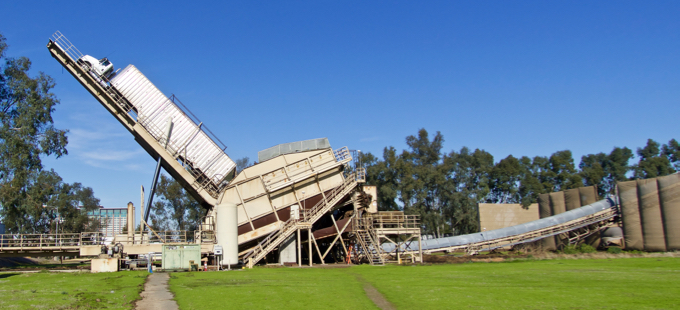
A truck delivers biomass to the Rio Bravo plant in Rocklin. It then goes up the conveyor belt. Photo/Kathryn Reed

Publisher’s note: This is the second of two stories about California’s tree mortality and how biomass is one solution to the problem.

By Susan Wood

If a record 129 million dead and dying trees collected over the last seven years doesn’t electrify California to get serious about renewable energy like biomass, then perhaps nothing will.

State and local officials along with stakeholders have started to see the light more than ever in terms of processing biomass, which is organic matter used as fuel.  

A study released this fall by a working group assigned by the California Resources Agency took a collective swipe at proposing the modern method as an alternative to burning slash piles, or worse yet, allowing them to decompose and present a fire hazard. The multi-agency effort was spawned from Senate Bill 859, which was signed by Gov. Jerry Brown last year as a comprehensive $900 million climate control package intended to reduce carbon emissions.
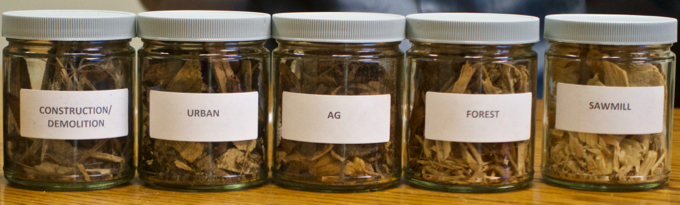
It’s not just forest material that can be turned into electricity. Photo/Kathryn Reed

Three times as many defunct plants versus operational biomass facilities exist in the state. Regulations are cumbersome. Space is necessary. And establishing a market can be tricky.

Placer County is wrestling with all three challenges in its creative quest with green waste management at its Eastern Regional Material Recovery Facility “MRF,” once called the landfill outside Truckee.

The plant is already surging with efficiency in what it does with area residents’ trash. Now it wants to transfer some of that waste it collects from contractors clearing the mass timber out of the forest into a biomass fuel.

A rendering of what the Cabin Creek facility between Tahoe City and Truckee could look like. Rendering/Phoenix Energy

Placer seeks to establish a place close to the basin

County officials are negotiating with Liberty Utilities to come up with a price and terms that would lead to Placer having its own 1 to 2 megawatt biomass plant on the waste facility grounds.

Four years in the making, the Cabin Creek proposal involves building an 8,000-square-foot structure where a caretaker’s residence now sits, but would be relocated. The operation would span on a strip of property along power lines and the service road, while wrapping around a cell tower. A storage area would be designated, and operators would need another grinder to work alongside the MRF’s existing one.

The concept coined a Power Purchase Agreement “PPA” went through the California Environmental Quality Act process years ago, but there were other hurdles in the tedious banter of the deal. The difficult part is that unlike other renewables biomass as a fuel source is not subsidized. Plus, natural gas is inexpensive by comparison.  

Nonetheless, the light at the end of the tunnel could be Liberty’s goal to go 100 percent renewable; so, many options are on the table. The percentage of the renewable energy mandate has been climbing, as California grapples with leading the world in combating climate change.
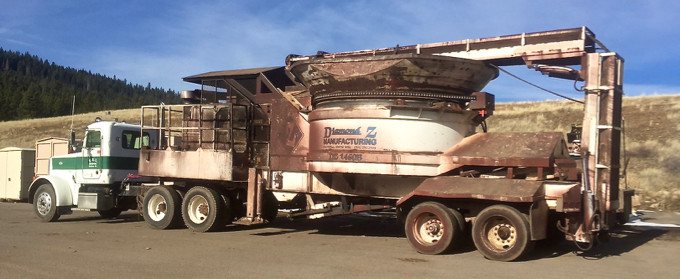
A grinder at the MRF in Placer County could be used by a future biomass company. Photo/Susan Wood

Placer County Supervisor Jennifer Montgomery had hoped a deal would be reached Dec. 15. The county and Liberty are still talking.

“We’re committed to getting the biomass facility built,” county Deputy Chief Executive Officer Dave Defanti said Friday. He added the results are “positive,” and the county is “exploring all options.”

The aim is to find a middle ground between what Liberty Utilities currently pays and what biomass would cost to generate. For now, the difference hovers at about a nickel per kilowatt.

Liberty Utilities contends there’s no “deal breaker” price that would guarantee its business interest.

“Energy markets fluctuate, and what may seem like a reasonable cost now may not be in the relatively near future,” Liberty spokeswoman Kathy Carter told LTN.

The energy purveyor brought on a 50-megawatt solar project earlier this year that is already meeting a quarter of its customers’ electricity use. Another project added 10 MW more. 

“Biomass energy is a renewable resource, but it’s more expensive than solar and wind. Still, we understand that it also has many forest health and other benefits, so we’re open to continuing to work with Placer County to take a fresh look at this,” Liberty Vice President Travis Johnson said.

Currently, the MRF represents a pit stop for agencies and their contractors to funnel their treetop debris to Rio Bravo in Rocklin. Already, 5,200 tons of biomass woody debris are channeled through the Truckee area recovery plant to Rocklin.
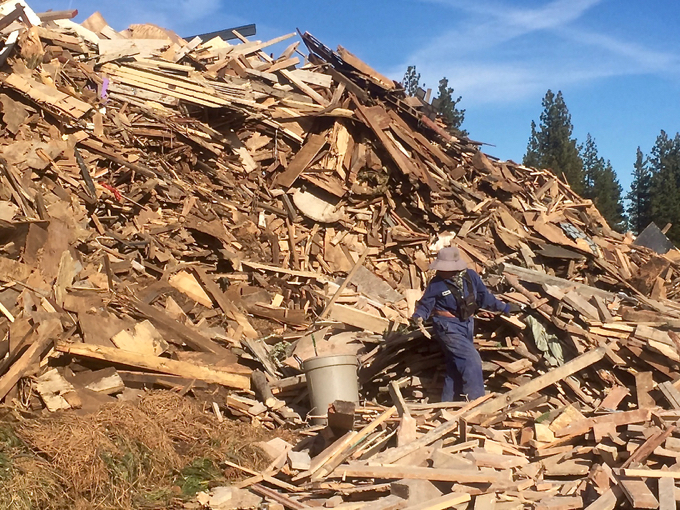
Wood debris at the MRF at Cabin Creek could become energy one day. Photo/Provided

But that’s a long, expensive haul for trees coming out of the Sierra Nevada as agencies such as Caltrans have learned. The transportation agency worked alongside the U.S. Forest Service in massive fuel reduction programs.

“To me, it makes a lot of sense,” Placer County senior civil engineer Walt Schwall said of the proposed Cabin Creek on a tour this week.   

He’s not alone.

“We see a facility like the one in the Cabin Creek area as a tremendous option. It would not only accelerate the removal of the dead and dying trees as a result of drought, biomass facilities like that would reduce the wildfire threat by helping us catch up on the burn piles,” said Tom Lotshaw, spokesman for the Tahoe Regional Planning Agency.

“We definitely see biomass as a viable option,” Lotshaw told LTN.

One could even argue that processing the woody debris through an energy facility is better environmentally than burning carbon into the air. The concept of having one nearby is also an eco-improvement because fewer vehicle miles equal less carbon emissions from trucks.

Once again, the state is asked to strike that delicate balance between business and the environment. And history has shown that change in the name of progress doesn’t come easy.

Still, if Cabin Creek fails to proceed with Liberty Utilities, there are other parties who may be interested, insists Brett Storey, a Placer County analyst.

The playing field is vast with possibilities.
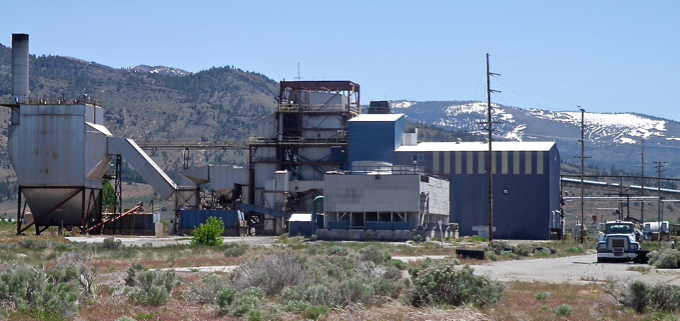
The Loyalton biomass plant is about to resume activity. Photo/Provided

The planned return of the Loyalton plant

Thirty-seven miles from Truckee, a 212-acre, 20-megawatt biomass facility is due to go on line again within a month in Loyalton where one once operated.

The Loyalton Biomass Plant was the site of a Sierra Pacific sawmill and biomass facility before the mill closed in 2001 and within the decade the biomass portion shut down.

American Renewable Power, the new operators based in Irvine, are in the process of adding to the 17 employees hired, and securing contracts with utilities and energy purveyors, according to Sierra Business Council President Steve Frisch. Plant manager Jim Turner expects the facility to go on line shortly after the holidays. Plant owner Steve Mueller was unavailable for comment.

The company estimated an economic windfall of $1.7 million to the rural region over the next few decades as it sources biomass fiber from 5 million acres in nine counties within an hour’s drive from the plant. 

More than 40,000 tons of the woody debris are awaiting the plant’s return to operation. It’s expected Loyalton could process 180,000 tons a year.

Bigger plans exist beyond producing energy, given the cost inequity of processing biomass.

“There has to be another motivator,” Frisch said, referring to the community-service need of ridding the California forest of its tree die-off crisis.  

It takes vision to complete the mission. For example, biochar –a charcoal used as a soil amendment — is yet another “value-added” product company officials and the business council anticipate seeing out of the Loyalton plant.

“We need to do some other product in order to offset the cost,” Frisch said in speaking for the Sierra County region. “That’s why Loyalton is so important.”
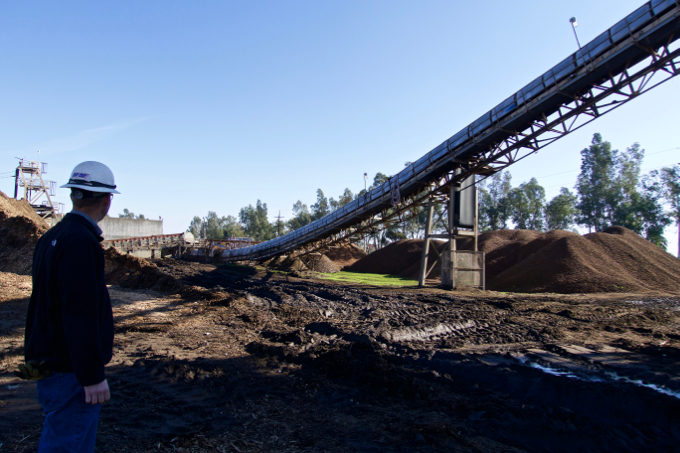
Rio Bravo plant manager Chris Quijano watches the material go on a conveyor belt into the plant. Photo/Kathryn Reed

No time to waste

The burning desire to rid the Sierra Nevada of its ever-escalating tree die-off has put the big boys of biomass into action. Rio Bravo of Rocklin has processed 6,000 tons of green waste from the Lake Tahoe Basin this year.

The 50-acre plant located adjacent to Thunder Valley Casino began its quest to “re-compose” the mass timber about 30 years ago – with a five-year shutdown in the 1990s. Biomass became the answer, despite solar being a lot cheaper to produce, plant managers contend.

Today, the facility processes 35 tons of the green energy source, cranking out 24.4 megawatts of energy an hour now under contract with Southern California Edison. The plant had earlier managed a 26-year contract with Pacific Gas & Electric.

In its daily routine, the Rocklin plant sees 50 trucks hauling 24 tons of debris. They’re channeled through an elaborate system of chutes and machines that grind up and break down the treetop debris and other timber material. One megawatt can power 800 homes. Overall, 20,000 homes get their electricity in a given hour through the 25-megawatt facility.

Jeff Johnson handles the control room at the Rocklin biomass plant. Photo/Kathryn Reed

The facility represents an efficient system that operates at 87 percent capacity when the operation is not undergoing checks or audits.

It takes in wood chips and mass pine timber, along with other materials from orchard trees in what’s considered its agriculture segment. Other sources from the urban sector also make their way through the processing plant.

With a state energy diversion mandate of 50 percent by 2030, much material is considered capable of being broken down and reused.

“We can make power every day,” plant manager Chris Quijano told Lake Tahoe News on a recent tour of the grounds. Rio Bravo is one of six biomass plants IHI Power Services Corporation runs in the United States.

The mechanics of this one in Northern California is impressive – taking 30,000 tons of high-hazard dead trees out of the woods and turning them into electricity in 2016. The power the plant generates is essentially thrown into an energy bucket to dispense.

The alternative to burning slash piles in the forest produces water vapor opposed to carbon emissions. That huge white plume from the plant is not smoke – even though there’s severe burning involved from a boiler connected to the turbine. The combination and process creates steam at 950 degrees Fahrenheit.

“And 3 million tons of high hazard trees are available,” Quijano said.

The process has other air quality benefits advocates tout.

When the mass timber goes either unburned or unprocessed as biomass, it is left in the forest to rot. The decomposition releases greenhouse gases, including methane.

Either way, following the tree from a dead state to energy commands cooperation from Mother Nature. That’s why the plant even carries a weather station on site.

The wet deluge from last year represented a trying time for plant operators. At one point, they had to deal with a lake on the property that didn’t exist before, providing a few disruptions in truck traffic for starters.

Of course, the pond brought out more birds, as a sanctuary of organic matter, dirt and water gave wildlife a place to land.

That’s the circle of life meeting the cycle of material.


Opinion: A new approach to protecting rivers

By Brian Gray, Leon Szeptycki and Buzz Thompson, Sacramento Bee

California’s native freshwater fish – salmon, steelhead, sturgeon and others – continue to decline, and regulations to reverse this trend have fanned controversy. A new approach to environmental stewardship is needed.

We should start by granting the environment a water right, as detailed in a new report we helped write for the Public Policy Institute of California.

The way California manages water for environmental purposes isn’t working for anyone.

Read the whole story


Ganong off to slow start in World Cup

By U.S. Ski & Snowboard

VAL GARDENA, Italy – Weather continues to wreak havoc on the men and women’s FIS Ski World Cup European circuit. On Friday, the men’s super-G in Val Gardena, Italy, was cut off due to snow and fog after 38 racers took to the start, leaving 42 racers no opportunity to tackle the Saslong course.

Germany’s Josef Ferstl officially took the victory after FIS officials cut off the remaining portion of the race due to fog and light snow. Austria’s Max Franz was second, followed by countryman Matthias Meyer in third. Ferstl started second before light snow began to fall, and with a clear track, was able to grab his first World Cup victory.

As the race progressed, snow continued to fall and course conditions changed dramatically, with grippy snow accumulating on the track hardened by a couple days of rain earlier in the week.

“With this snowfall, the snow is really slow and sticky compared to yesterday,” said Travis Ganong of Squaw Valley, the top American finisher in 17th. Ganong ran 18th as snow fell and fog rolled in on the middle section of the course. “Hopefully it will be better tomorrow,” he added.

Tommy Biesemeyer finished 18th and Andrew Weibrecht (Lake Placid, N.Y.) was 28th. Wiley Maple (Aspen, Colo.), who finished second in Wednesday’s downhill training run; Bryce Bennett (Squaw Valley), Ryan Cochran-Siegle (Starksboro, Vt.) and Jared Goldberg (Holladay, Utah) were among the 42 athletes that did not start after the race was cancelled due to weather conditions.

Up next, the men are scheduled to race downhill on the Saslong track Saturday. Steven Nyman (Sundance, Utah) is expected to make his return to the World Cup circuit on the track where he has claimed all three of his World Cup downhill victories.

Ganong, who admits he’s off to a slow start this season, finishing 35th in Wednesday’s downhill training, and not finishing Thursday training run, hopes to continue to build confidence with two months remaining before the 2018 Olympic Winter Olympics in Saturday’s downhill.

“It was kind of a rough start to the season, so I’m just trying to build some confidence from race to race and find the speed and find the race gear,” Ganong said. “When it’s going well, it’s super easy. When it’s not going well it’s really hard and you’re questioning everything.

“Ski racing is such a simple sport, but the margins are so small, a half a second separates you from a really good day to a really bad day,” he continued. “I’m taking it day-by-day and hopefully I’ll be building into the Olympics – that’s the goal.”


Skier raising cash for climate change Super Bowl ad

By Sierra Davis, Powder
 
About half of all Americans don’t believe global warming is caused by human activities, despite the overwhelming consensus by climate scientists who say this is true. Salt Lake City-based pro skier Julian Carr is taking action to change this by attempting to raise $5.5 million by Dec. 22 to fund what will be the first ever Kickstarter-supported Super Bowl ad.

An ambassador of Protect Our Winters, Carr hopes to bring important climate change data to the largest audience in the United States.

According to Nielsen, 70 percent of U.S. households watched the 2017 Super Bowl, which saw a total audience of 172 million viewers. So far, Carr’s campaign has raised $13,400.

Read the whole story


SnowGlobe using cover to protect ball field

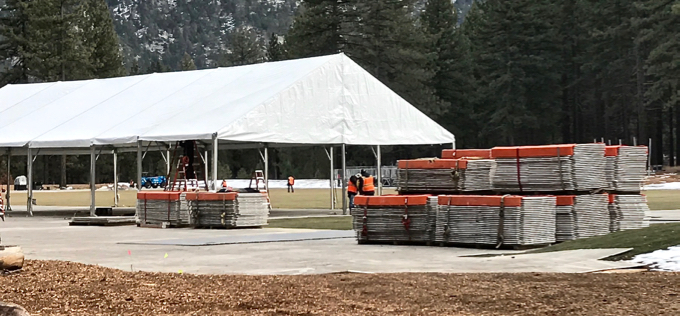
A protective layer is being placed on the South Lake Tahoe ball field. Photo/LTN

While it’s in the contract for the SnowGlobe to return the field to the condition it was in prior to setup for the concert, promoter Chad Donnelly is going a step further this year.

He has purchased a cover for the new field near Lake Tahoe Community College. It will be over the majority of the area.

It cost about $1 million. There is the possibility of Donnelly renting the cover to an entity putting on an event at that location, which would help him recoup some of his costs.

Donnelly wants a long-term contract with the city. Electeds are in a wait-and-see mode with this new ball field. The cover is seen as a step in securing SnowGlobe’s future in South Lake Tahoe.

While SnowGlobe was on this field last year, at the time it was just dirt. Sod was laid this fall. Prior to 2016 the event was on the artificial turf at LTCC.

Crews began setting up for the Dec. 29-31 music festival this week, with the bulk of the infrastructure coming Christmas week.

— Lake Tahoe News staff report


Calif. wildfires a looming threat to climate goals

By Julie Cart, CalMatters

Beyond the devastation and personal tragedy of the fires that have ravaged California in recent months,  another disaster looms: an alarming uptick in unhealthy air and the sudden release of the carbon dioxide that drives climate change.

As millions of acres burn in a cycle of longer and more intense fire seasons, the extensive efforts of industry and regulators to protect the environment can be partly undone in one firestorm. In particular, as raging blazes pump more carbon into the atmosphere, state officials are grappling with the potential effect on California’s ability to adequately reduce greenhouse gas emissions.

The state’s environmental regulations are known to be stringent, but they have limits: They apply only to human-caused emissions. Carbon and other pollution generated by wildfires is outside the grasp of state law.

“The kinds of fires we’re seeing now generate millions of tons of GHG emissions. This is significant,” said Dave Clegern, a spokesman for the state Air Resources Board, a regulatory body.

In less than one week, for example, October’s Wine Country fires discharged harmful emissions equal to that of every car, truck and big rig on the state’s roads in a year. The calculations from the subsequent fires in Southern California are not yet available, but given the duration and scope of the multiple blazes, the more recent complex of fires could well exceed that level.

The greenhouse gases released when forests burn not only do immediate harm, discharging carbon dioxide and other planet-warming gases, but also continue to inflict damage long after the fires are put out. In a state where emissions from nearly every industry are tightly regulated, if wildfires were treated like other carbon emitters, Mother Nature would be castigated, fined and shut down.

The air board estimates that between 2001 and 2010, wildfires generated approximately 120 million tons of carbon. But Clegern said a direct comparison with regulated emissions is difficult, in part because of limited monitoring data.

“Nature doesn’t follow the rules very well,” said Jim Branham, executive officer at the Sierra Nevada Conservancy, a state agency that has created a plan to better harness California’s forests in reducing carbon in the atmosphere.

As is so often the case in environmental catastrophes, one thing leads to another, creating what Branham calls the double whammy: Burning trees not only release powerful pollutants known as black carbon, but once a forest is gone, its prodigious ability to absorb carbon from the atmosphere and store it is lost, too.

Scientists estimate that in severely burned areas, only a fraction of a scorched tree’s emissions are released during the fire, perhaps as little as 15 percent. The bulk of greenhouse gases are released over months and years as the plant dies and decomposes.

And if a burned-out forest is replaced by chaparral or brush, that landscape loses more than 90 percent of its capacity to take in and retain carbon, according to the Conservancy.

Severe fires have the capacity to inflict profound damage in a short span. The U.S. Forest Service estimates that the 2013 Rim Fire in Central California spewed out the equivalent of the carbon dioxide emissions from 3 million cars. That is a setback to the state’s effort to get cars off the road, another critical tool for reducing greenhouse gases.

The role of wildfire as a major source of pollution was identified a decade ago, when a study conducted by the National Center for Atmospheric Research concluded that “a severe fire season lasting only one or two months can release as much carbon as the annual emissions from the entire transportation or energy sector of an individual state.”

It’s a measure of the dramatic ramping up of fires in the West that today a single fire can meet that threshold.

The entire equation has been made worse by the state’s epidemic of tree death, caused by drought, disease and insect infestation. The U.S. Forest Service this week updated its estimate of dead trees across California to 129 million. That loss alone could be a blow to the state’s vision of a low-carbon future.

“Dead trees don’t sequester carbon,” Branham said.

Forests as carbon-chewers are part of the state’s strategy for cutting greenhouse-gas emissions significantly by 2020 and beyond—a goal that could be undermined by nature’s caprice. The air board is expected to direct state agencies to determine more precisely how much carbon can be absorbed by California’s variety of landscapes.

Air quality, too, is subject to state, as well as local and federal, regulations. But those standards go out the window in large fires, when soot and ash blanketing entire regions can be seen from space.

The federal Environmental Protection Agency, which sets air pollution standards nationally, has an “exceptional events” rule that exempts states from fines under certain extraordinary conditions.

California has invoked the rule during wildfires at least once before, in 2008, for fires in the Sacramento area. The request was accepted, according to the air board.

More recently, Sean Raffuse, an analyst at the Air Quality Research Center at the University of California, Davis, came up with the “back of the envelope” calculations for October’s Sonoma County fires.

Raffuse said he used federal emissions inventories from fires and calculated that five days of ashy spew from the northern California blazes equated to the annual air pollution from every vehicle in California.

Those kinds of computations are seldom replicated, largely for lack of the necessary instruments present at fire sites. But things are changing. Researchers have been attempting to better understand the full range of environmental damage wrought by wildfires. One tool is drones that can be flown through smoke plumes to collect samples for analysis.

“We don’t have the means to measure emissions from a wildfire like we do from a tailpipe,” Branham said. “We are lagging well behind in understanding and having hard data of the effects of these fires. And most of the data are chasing reality.”


Snowboarding competition determines Olympic team

By U.S. Ski & Snowboard

BRECKENRIDGE, Colo.  – The U.S. riders continued to demonstrate their dominance in the second Olympic qualifying event of the season at Dew Tour. Chloe Kim (Mammoth) led another U.S. sweep of the podium with teammates Kelly Clark (Mammoth) and Arielle Gold (Steamboat Springs, Colo.) in second and third.

Jake Pates (Eagle, Colo.) put his name on the board with a big victory, and Ben Ferguson (Bend, Ore.) landed his second podium in the same number of Olympic qualifying events, finishing third.

After a win at the Toyota U.S. Grand Prix in Copper last weekend, Kim confirmed her nomination to the U.S. Olympic snowboard team, posting a 93.0 on her first run of the day that would carry her through to victory. After a gnarly crash on her second run, veteran Clark pulled out a solid, clean final run to finish second. Gold landed her first podium finish of the Olympic qualifying season, finishing third.

“I am speechless right now, it hasn’t really set in,” said Kim. “I just looked at my parents and was like, ‘I just made the Olympic team!’ I’m still processing it, but I am so excited.”

The U.S. women stacked riders into the top spots in the final with Maddie Mastro (Wrightwood) finishing fourth, Hannah Teter (Meyers) fifth and Elena Hight (South Lake Tahoe) eighth.

Pates pulled out the biggest surprise of the day, landing a killer last run that included a back double 12 tail grab to score a 97.33, besting Australia’s Scotty James and fellow U.S. Snowboard Team rider Ferguson who both also posted scores above 90. It was Pates’ first major event win, propelling the 19-year-old into the mix for the coveted Olympic team spots.

Danny Davis (Truckee), Chase Josey (Sun Valley, Idaho), Gabe Ferguson (Bend, Ore.) and Greg Bretz (Mammoth Lakes) rounded out top finishes for the U.S., finishing sixth through ninth respectively.

Olympic qualification competitions continue after the New Year with the Toyota U.S. Grand Prix at Snowmass, Colo., Jan. 7-14.