STPUD impersonator tries to enter house

South Tahoe Public Utility District was notified of an individual posing as a district staff member last weekend. The incident occurred off North Upper Truckee.

A customer received a knock at the door and the man asked to be let into the house to shut-off the water because the customer did not pay their bill on time. The customer said no.

South Tahoe Public Utility District will never contact people after hours regarding payment and will never shut-off water for non-payment on the weekend. District staff will only come to your house after hours if called out for an emergency. District staff will never ask to come into your home as the main water shut-off valve is at the street. 

District staff will always be in uniform and driving a district vehicle.

District staff is available at all times to answer calls at 530.544.6474.


Road Beat: 2018 Hyundai Santa Fe Sport impresses

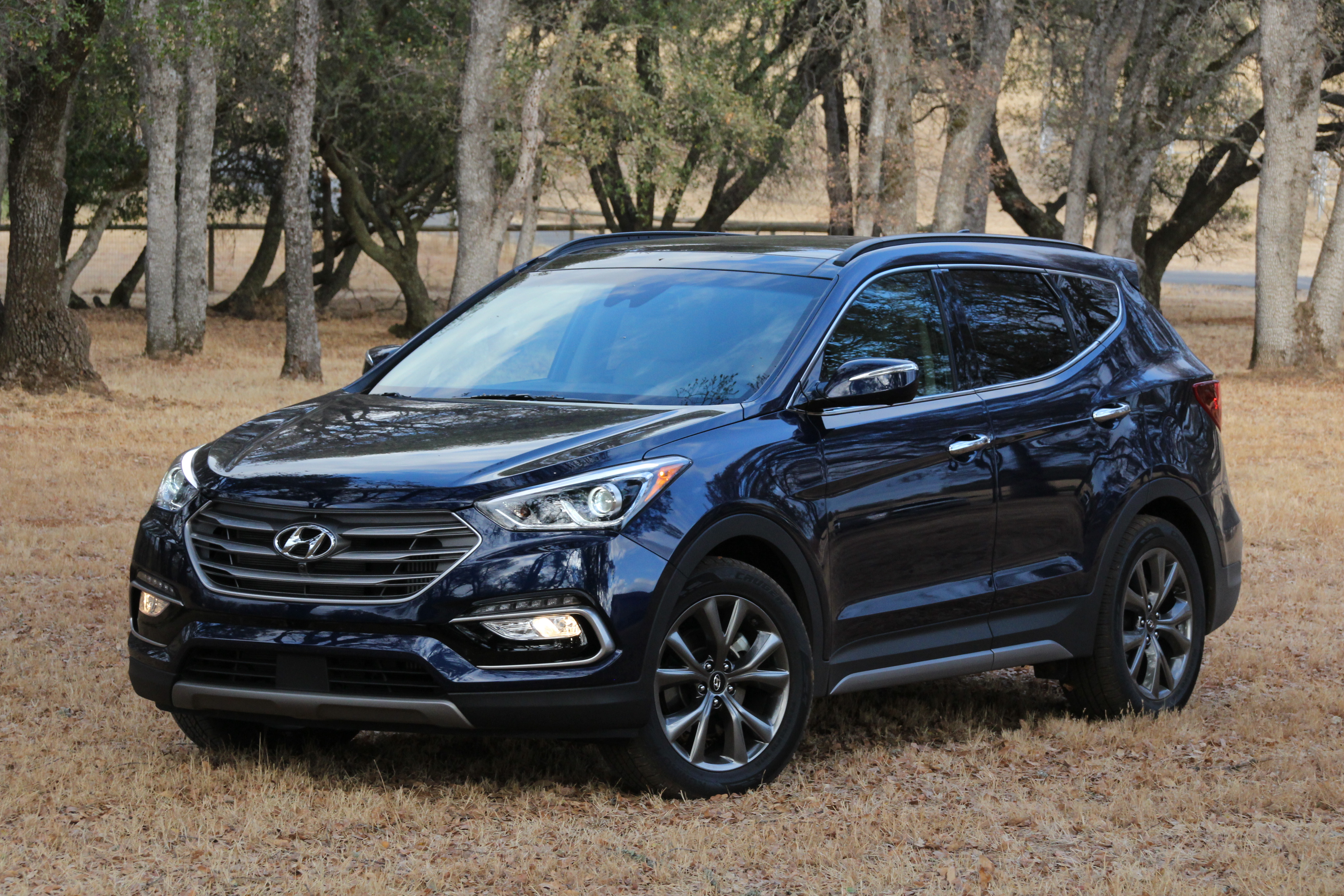
The 2018 Hyundai Santa Fe Sport continues to be at the top of its class. Photos/Larry Weitzman

By Larry Weitzman

Last year I called the Santa Fe Sport at least tied for the spot of No. 1 in the class of compact CUVs (crossover utility vehicles). Crossover means an SUV based on a sedan chassis, sort of like a modern day tall station wagon. Wagons of the ’50s, ’60s and ’70s averaged about 57-58 inches in height, most crossovers are 66 inches or slightly taller. Lots of headroom inside, plus much more cargo capacity and flexibility.

With just finishing a week with the new 2017 Mazda CX-5, I thought it prudent to re-experience the Santa Fe Sport to see how the new 2018 version stacks up. In many respects the new Hyundai still retains its title, and an important title it is.

Compact CUVs are a huge seller with the sales leaders, the Honda CR-V and Toyota RAV4 both selling over 400,000 units annually and a bunch of other manufacturers not far behind. One item worth mentioning with the CX-5, in its new iteration, albeit with somewhat improved looks and enhancements. It is a great looking ride and interior, and while horsepower was up by 3 to 187, performance and fuel economy remained relatively constant.

With the 2018 Santa Fe Sport, its looks were just ever so slightly tweaked which is good because you don’t fix what isn’t broken and the Santa Fe Sport certainly isn’t even close to broken. It still has a sporty, fresh, muscular appearance. At 185 by 74 x 66 inches it is sized just right on a long 106-inch wheelbase.

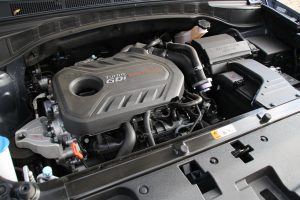
Under the bonnet is a powerful 2.0T DOHC, 16 valve turbocharged power plant that knocks down 240 at 6,000 rpm and a stump pulling 260 pounds of twist from a mind boggling 1,450 -3,500 rpm. This makes for an unbelievable throttle response and the SF Sport will wow you with its part throttle response, absolutely no turbo lag. Power gets to the front wheels via a six-speed torque converter auto cog-swapper. It shifts beautifully.
Specifications
Price $25,350 to about $40,000
Engine
2.0T DOHC, 16 valve, directed injected turbocharged inline four 240 hp @ 6,000; 260 lb.-ft. of torque @ 1,450-3,500 rpm
Tranny
Six-speed torque converter automatic
Configuration
Front mounted, transverse mounted engine/FWD/AWD
Dimensions
Wheelbase 106.3 inches
Length 185.0 inches
Width 74.0 inches
Height (w/o/with roof rack) 66.1/66.5 inches
Track (f/r) 64.1/64.5 inches
Weight 3,949 pounds
GVWR 5,004 pounds
Fuel capacity 17.4 gallons
Cargo capacity (behind front seats/second row) 71.5/35.4 cubic feet
Wheels 19 x 7.5 inch alloys
Tires 235/55 x 19
Tow capacity 3,500 pounds with trailer brakes
Steering lock to lock 2.96 turns
Turning circle 35.8 feet
Co-efficient of drag 0.34
Performance
0-60 mph 6.92 seconds
50-70 mph 3.47 seconds
50-70 up a steep grade 6-7 percent) 5.49 seconds
Top Speed Well into triple digits
Fuel economy EPA rated 20/27/23 mpg city/highway/combined. I recorded 26-27 mpg overall with 50 percent in rural country driving and 10 percent freeway. Highway mileage should average 31 mpg at legal speeds.

Straight line performance is slightly improved over my last visit with 0-60 mph arriving in under seven seconds at 6.92 seconds. Simulated passing times are also marginally improved with a 50-70 mph jaunt taking just 3.47 seconds and the same run up a steep grade sowing that time to 5.49 seconds. Prior numbers were 7.17, 3.51 and 5.65 seconds, respectively. It actually feels much quicker. And when up in the Sierras, there is the turbo bonus that altitude will not strangle this SF Sport and it will still deliver sea level power throughout the Sierra.

Fuel economy is EPA rated at 20/27/23 mpg city/highway/combined. Overall mileage was down by about an mpg with a two-way 70 mph run capturing 31.3 mpg, but still a big improvement over the EPA test cycle. A two-way run to Carson City average a reasonable 28.1 mpg and in rural driving 26 mpg should be the norm. Fuel capacity is a large 17.4 gallons, so range should extend out an easy 500 miles. My tester was a FWD model so expect about a one mpg loss in a AWD model from weight and drive gear losses.

Handling is sport sedan secure. SF Sport has all the credentials, 19 x 7.5-inch alloys, 235/55 series rubber, independent suspenders and coils in all four corners along with gas filled shocks. Stab bars reside at both ends and the steering is reasonably quick at 2.96 turns lock to lock. The totals equal oodles of cornering power, crisp turn in, great on and off-center steering and it does the tango in the twisties like that well sorted out sporting sedan. SF Sport gets it done with a flat attitude. Turning circle is a tight 36 feet.

Ride quality is quiet. The engine spins at just 2,050 rpm at 70 mph and is inaudible. And it is a smooth mover, very smooth. And here’s why the SF Sport is such a good ride. It performs like gazelle, it is reasonably fuel miserly, achieving over 30 mpg on the highway (real numbers), handles like a sporting sedan with accurate, easy steering and serious grip and feedback, rides like a much larger car and gives passengers the feeling of real spaciousness because of its extra inch or two in shoulder and hip room, never mind swallowing most of Home Depot during a big garden sale.

Safety is also second to none with most, if not all the acronyms including lane departure warning. But the piece d’resistance is the Multiview camera which shows everything in a 360-degree top view when in reverse and going forward at less than 10 mph. This is besides the backup camera. There will be no excuses for every touching any part of its gorgeous body on anything during parking maneuvers. Headlights are very good.

Inside is a well-designed instrument panel, with tach and speedo and trip computer front and center. The center stack is also very well done and no three-unit college course required to figure out its operation. It’s intuitive.

Seating is leather and comfortable with full power in the Ultimate with about every adjustment you can imagine or want, but there is no ejection seat. Who wants to get blown out of the roof of a car by a 37mm cannon shell? Without a sunroof it might shorten your neck. Rear seating is also copious with legroom galore and some adjustability. It’s an almost luxo ride for under $40K even with go anywhere AWD.

Larry Weitzman has been into cars since he was 5 years old. At 8 he could recite from memory the hp of every car made in the U.S. He has put in thousands of laps on racetracks all over the Western United States.
Calif. regulators back fire safety rules following lethal infernos

By George Avalos, Bay Area News Group

State regulators last week approved new rules aimed at improving fire safety in multiple areas of California, a move taken after an array of deadly infernos in the North Bay and Southern California.

PG&E and other utilities in the fire-prone Golden State would be required to increase the minimum clearances between trees and other vegetation and electrical equipment such as power and transmission lines, under wide-ranging rules adopted by the Public Utilities Commission.

“This decision adopts new regulations to enhance the fire safety of overhead electric power lines and communication lines located in high fire-threat areas,” PUC staffers wrote in a proposal that was approved by the PUC.

Read the whole story


12-year-old, retired SLTPD K9 Duke dies

By Tony Broadfoot

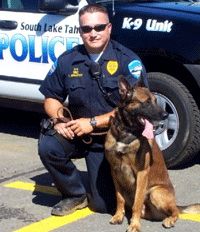
Duke was a Belgium Malinois who was born on March 5, 2005. He was trained by the Dutch police in Belgium prior to us being introduced in December of 2005.

Tony Broadfoot and Duke

I was at K9 decoy school when I was first introduced to him. The owner of the contract company showed up one day during instruction with Duke in a crate. He said he had just picked him up from the airport and wanted to see how his bite was. He asked for volunteers and I eagerly accepted. I was the first person on American soil to take a bite from him and needless to say it was the start of a lifetime friendship and partnership.

I remember I went back to my hotel room that night and called my lieutenant, who had approved my request to attend decoy school. I remember saying to him “LT, a police K9 followed me home. Can I keep it?” Of course the answer was “no.”

I was there at decoy school and hadn’t earned the position of a handler yet. Fast forward to February 2006. I was driving on Highway 395 when I got a call from the same lieutenant. He told me I had been selected as a K9 handler and told me to call and see if my beloved Duke was still available.

I immediately called and was told another agency had asked for the best four dogs available, sight unseen, and Duke was one of the four. I was heart broken and the owner knew it. He remembered the bond Duke and I had formed in such a very short interaction. He explained the agency had never seen the dogs they had purchased and he could give them another dog in Duke’s place.

The same lieutenant and I were at the training facility a couple days later, where I came home with Duke. Duke was certified for patrol deployment and we were off running. Duke served the South Lake Tahoe Police Department from February 2006 until September 2012. During that time he was a phenomenal narcotics detection K9 that maintained continuous certification with the California Narcotics Canine Association and the Western States Police Canine association.

He was responsible for the seizure of almost half a million dollars cash collectively throughout his career and countless narcotics detection arrests. He had numerous street suspect apprehensions, none of which was ever challenged in criminal or civil court.

It will never be known how many times he saved myself or my partners’ from physical confrontation, merely by his presence. He was also certified as a SWAT K9 Integrated Deployment (SKIDs) K9 and worked regularly with the SWAT team. Throughout his career Duke was recognized and received accolades and commendations and was awarded by the department as well as several other community entities.

Upon Duke’s retirement he spent his time at home, mostly laying in the sun or on the couch. While he was in service we literally spent 24/7 together. He would get anxiety if he wasn’t near me. He got a little better after retirement, but still wanted to be with me all the time. We were truly attached at the hip, best friends.

I had the honor of being with Duke when he went home. Duke passed away peacefully with his head in my arms at home on his bed. I miss him so much, but know he touched so many people he will never be forgotten.

I love you Durka.

Tony Broadfoot is a former officer with the South Lake Tahoe Police Department.


3 accused of committing burglaries in Stateline

Three Bay Area residents were arrested early Saturday morning in Stateline on burglary charges.

The three were allegedly breaking into a vehicle in the parking lot at MontBleu at 1am Dec. 16.

Arrested were Sandra Vilchis-Toledo, 25, Emmanuel Fonseca, 32, and Sonia Chavez, 28 – all from the San Francisco area.

South Lake Tahoe detectives were contacted to serve a search warrant on a room at Motel 6. There officials said they located a significant amount of property that had been stolen in Douglas County.

The two law enforcement agencies are seeking the public’s help with identifying the stolen property.

— Lake Tahoe News staff report


Sandoval talks up three new Nev. tourism attractions

By Richard N. Velotta, Las Vegas Review-Journal

When Gov. Brian Sandoval goes looking for solitude once he’s term-limited out of office next year, there’s a chance you’ll see him at Walker River State Recreation Area, one of three new facilities being preserved that in the future will attract millions of tourists from all over the world.

Sandoval addressed nearly 350 tourism professionals from across the state this month in one of the closing sessions of the two-day Governor’s Global Tourism Summit at the Flamingo.

For Sandoval, addressing the annual conference was a 180-degree turn from the first one he hosted in 2010, when the state was in the depths of the Great Recession, money was tight and the state’s primary mission was diversifying the economy and adding jobs.

This time he was able to talk about investing in new attractions that will complement the state’s rural attractions.

Read the whole story


Tahoe Tails — Adoptable Pets in South Lake Tahoe

Coco

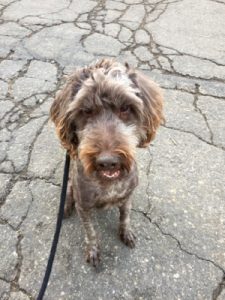
Maisy and Coco are mother and daughter Labradoodles, and they have been at the shelter for over a month, much longer than we expected. Even though they are “designer dogs,” they are not puppies.

They are 9- and 7-years-old, with plenty of happy and healthy years left for a family to enjoy. Severely matted when they arrived at the shelter, they have been groomed and are beautiful and friendly chocolate Labrador/standard Poodles. Maisy and Coco can be adopted together or separately.

Maisy and Coco are spayed, microchipped, tested for heart worm, and vaccinated. They are at the El Dorado County Animal Services shelter in Meyers, along with many other dogs and cats who are waiting for their new homes. Go to the Tahoe animal shelter’s Facebook page to see photos and descriptions of all pets at the shelter.

Call 530.573.7925 for directions, hours, and other information on adopting a pet.

For spay-neuter assistance for South Tahoe residents, go online.

— Karen Kuentz


Birders flock to Tahoe’s waterways for annual count

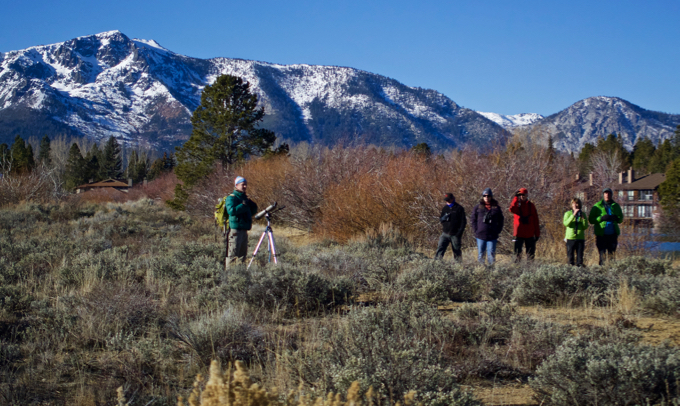
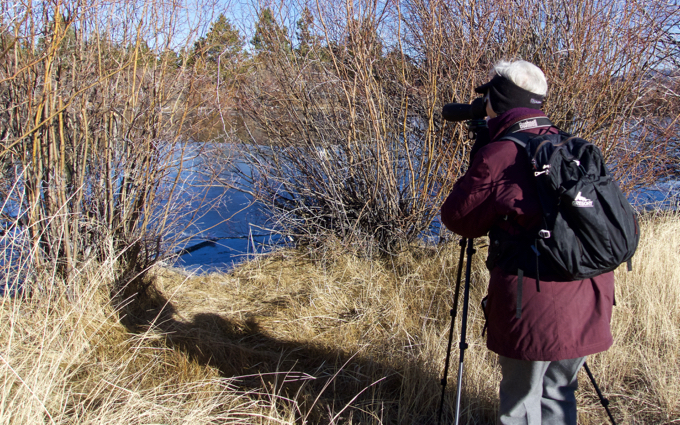
TINS Executive Director Will Richardson, left, leads a group Dec. 17 at Cove East to count birds. Photo/Kathryn Reed

By Kathryn Reed

It was a hunting expedition of a different kind, which netted more than a hundred waterfowl, a ruby-crowned kinglet, magpie, stellar jay, meadowlark and more.

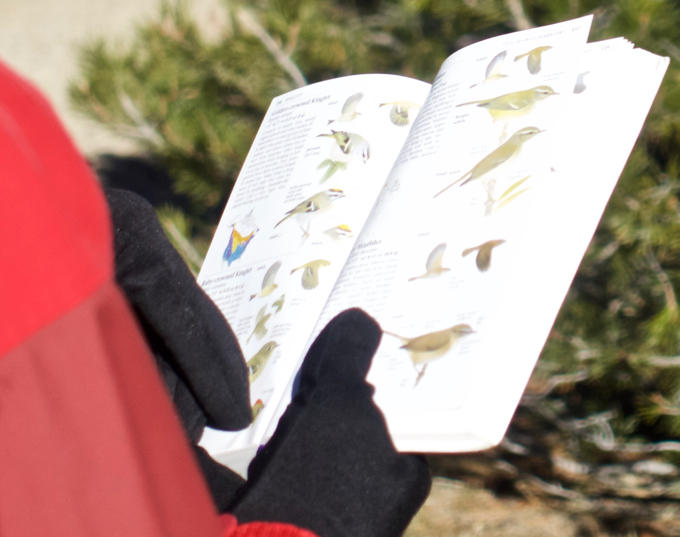
These birds were captured in photos, through binoculars, high-powered telescopes, and with pen and paper.

The birders were out in force on Sunday for the annual Christmas bird count. This one organized by Tahoe Institute for Natural Science is the only one in the basin.

“Our focus is on the lake level wetlands and meadows. They tend to be where most of the birds are,” Will Richardson with TINS told Lake Tahoe News.

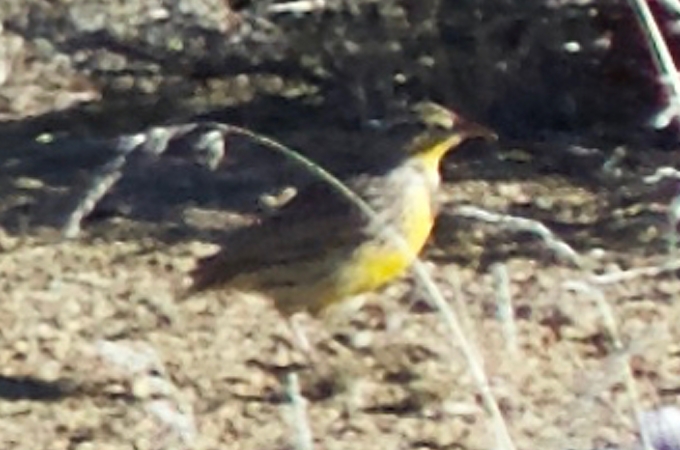
Meadowlarks are identifiable by their yellow chests. Photo/Kathryn Reed

The weather cooperated for the count. While it was near freezing temperature-wise, the wind was non-existent unlike the day before. This was a good thing because birds tend to hole up in the wind, and don’t make their presence known.

A large throng on Dec. 17 had their eyes focused on the water and in the trees at Cove East. Other groups were scattered about the South Shore. The local count goes through Dec. 20, after which the tally will be available.

Sue Stevenson gets an up close view of waterfowl. Photo/Kathryn Reed

“These people are so knowledgeable. I learn so much,” Grace Anderson of Meyers told Lake Tahoe News as she walked near the Tahoe Keys Marina. “Tahoe is an amazing bird place.”

Richardson and other TINS staff dispensed tidbits of information along the way. The ruby-crowned kinglet used to breed in the lodgepole pines throughout the basin in the early 1900s. Today it would be hard to find them nesting. They come here in the winter because they are tough, Richardson said.

Resources are at the ready to help birders with identification. Photo/Kathryn Reed

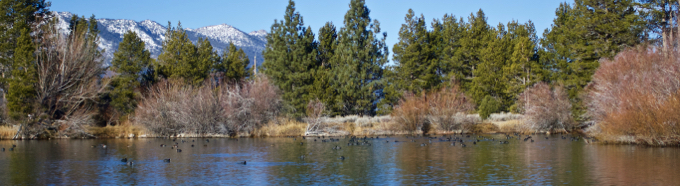
At the lagoon that juts north from the Tahoe Keys Marina area toward Cove East are more than 100 ducks. But then the group is told they aren’t all ducks. A coot is not a duck; it’s a rail. It doesn’t have webbed toes like a duck, but instead has lobbed toes.

Those in the know are surprised to see coots, redheads, ruddys and gadwalls all swimming together.

Sue Stevenson of South Lake Tahoe has her scope out watching a redneck dive for food. It’s like a dance of sorts that is mesmerizing.

She’s been birding since the 1980s, having started in New Jersey. She’s been doing so in Tahoe since 2000. Stevenson is a regular in the birding group led by Lynn and Don Harriman. They have been counting birds every Wednesday for the last nine years – either at Cove East or in the Upper Truckee Marsh.

At the Cove East count are people from South Lake Tahoe, Truckee, Carson City, Sacramento, Penryn and the Bay Area.

The group pauses to watch a meadowlark scamper about. It’s distinct with its yellow breast and black collar. While it’s not unusual to see them in the basin, it’s not an everyday bird like a stellar jay or mountain chickadee or magpie.

Waterfowl are a predominant fixture in the Lake Tahoe Basin. Photo/Kathryn Reed

This is the Audubon Society’s 118th annual bird count. Tahoe has been doing it since the early 1980s.

“The data collected by observers over the past century allow Audubon researchers, conservation biologists, wildlife agencies and other interested individuals to study the long-term health and status of bird populations across North America,” according to the Audubon Society’s website.

The concept of the Christmas bird count came about as an alternative to the annual hunt where two sides tried to kill as many animals as possible. Ornithologist Frank M. Chapman came up with the idea, which in that first year in 1900 involved 27 birders in 25 locations.

Now the count goes beyond Christmas Day, spanning the period from Dec. 14-Jan. 5. While most counts are in the United States, the event is global.


Opinion: Scientists working to protect Lake Tahoe

By Geoff Schladow

Another year has come and gone at Lake Tahoe, and it was no ordinary year. We had one of the most extreme winters of snow on record. Lake levels came up 7 feet in a few months and thin ribbons of sand replaced the wide beaches of the last few years. Long forgotten seasonal springs re-emerged on hillsides and wildflowers seemed to last all summer.

Other things about the lake were different too. While the annual record is still being collected and analyzed, early indications are that we are experiencing conditions not seen before, be it high lake temperature or different floating algae. What is science doing to understand and control the changes in the lake and in the forests?

Geoff Schladow

Two new projects in 2018 are aimed precisely at addressing these changes. A pilot project in Emerald Bay is looking at restoring Lake Tahoe’s native food web by locating and removing the invasive Mysis shrimp using new, sophisticated echo sounding equipment. Earlier research has shown that Mysis removal can lead to a return of native zooplankton, a restoration of clarity, and improved fish health in one year. But the changes at Tahoe are not just restricted to the lake. A new project to restore sugar pine trees in areas of the North Shore that have suffered high tree mortality due to prolonged drought and associated pine beetle activity is also commencing in 2018.

These projects that go to the heart of restoring Lake Tahoe have been made possible through a combination of funding. This includes funds from the California Tahoe Conservancy, Nevada Division of Environmental Protection, Tahoe Fund, UC Davis, and individual community members. This broad base of support is essential, and makes it possible to attract the best scientists and students and to apply the newest technological approaches. Even though Tahoe has been studied for half a century, the challenges we are experiencing are evolving and the science needs to evolve even faster.

While we hope these two projects will achieve their goals, hope is not a strategy. To that end, we continue to work on the essential task of understanding, at a fundamental level, how the Lake Tahoe Basin is changing. From underwater robotic vehicles that silently track the motions of the water, to measurements on the exchanges of carbon that occur in the forests, to high school programs that train and spark the imagination of future scientists, we are embarking on the science that will be needed to save the lake.

To all who have contributed to our achievements this year, my heartfelt thanks. This includes our dedicated staff, our amazing volunteer docents, the students and interns that work at TERC, our partners in other research institutes and our colleagues in the various Tahoe agencies, those who visit our education centers, and those of you who have supported our research and education programs and partnered with us in unique ways.

My very best wishes for a safe and peaceful holiday season. I look forward to working together again in 2018.

Geoff Schladow is director of UC Davis Tahoe Environmental Research Center. This column was first published in the TERC newsletter.


Bowman still in contention for Olympic team

By Karen Price, Team USA
 
Olympic medalists Maddie Bowman and Devin Logan both had the opportunity to qualify for the 2018 U.S. Olympic halfpipe skiing team with a win at Friday’s Dew Tour stop in Breckenridge, Colo.

Instead, Canada’s Cassie Sharpe took first place, and the Americans will have to wait.

Bowman, the defending Olympic gold medalist in women’s halfpipe skiing, led briefly after rebounding from a fall early in her first run with a big second run, but Marie Martinod of France and Sharpe pushed the Meyers resident to third place going into the third and final run.

Read the whole story