Incline beach access fight leads to questionable land sales

By Anjeanette Damon, Reno Gazette-Journal

Five years ago, Washoe County handed 87 parcels of land over to the Incline Village General Improvement District, forgiving more than $800,000 in unpaid property taxes on the land in exchange for a promise from Incline Village to use the land as publicly owned open space.

The lots, most of them unbuildable scraps of land, had wound up on Washoe County’s delinquent tax rolls because the owners hadn’t paid property taxes for at least three years. Under state law, those parcels can be given to another government agency if that agency will use the land for a specific public purpose.

But after telling the county the land would be used for open space, an IVGID official, without approval from the agency’s elected board or public notice, sold three parcels to private buyers, a Reno Gazette Journal investigation found.

Read the whole story


Road Beat: MDX Sport Hybrid SH-AWD is stellar

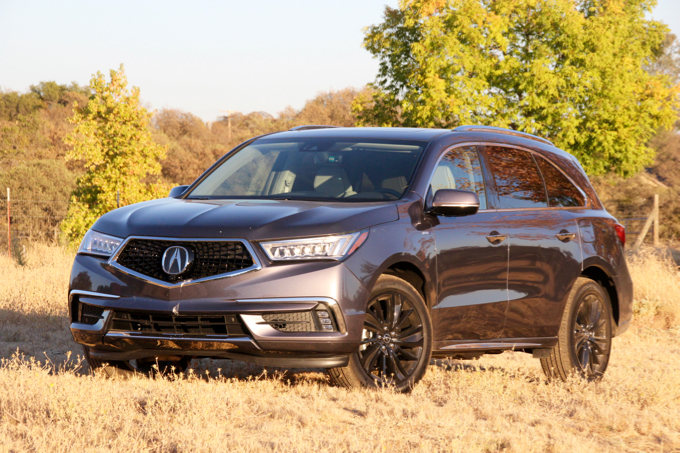
The 2017 MDX Sport Hybrid SH-AWD, Better in every way but one. Photos/Larry Weitzman

By Larry Weitzman

The only way in which the MDX SH-AWD Hybrid is not better than the conventional MDX is the price, but that differential is only $1,500; a small price to pay when you consider the advantages of more performance and about 15 percent better fuel economy overall and perhaps a 20 percent improvement on the highway.

Size-wise and in appearance the vehicles are virtually identical except for the hybrid badging. MDX is a large midsize with a 111-inch wheelbase, a length of 196 inches and a beamy width of almost 78 inches.  It has the same new body which received a face lift and rhinoplasty is much improved getting rave reviews from those who see it.

But what separates the MDX Hybrid from its siblings is its powertrain. While the 1.3 kWh battery and three electric motors have added about 200 pounds to its mass, the 4,471-pound MDX Hybrid is little affected.

A slightly smaller 3.0L DOHC 24 valve V-6 with 257 hp at 6,300 rpm and 218 pounds of twist at 5,000 rpm is the main motive force. It’s so smooth it’s difficult to tell when its running. Only the tach provides positive proof. It is supplemented by three electric motors as described below giving the MDX Hybri8d a combined motive force of 321 hp.

MDX Hybrid’s three electric motors consist of a 47 hp unit integrated in the super slick seven-speed dual clutch tranny up front and a twin motor pack of 36 hp each (72 total) driving the rear wheels when necessary. There is no drive shaft between the front and rear axles. Under the floor is a large for a hybrid 1.3 kWh L-I battery pack which during my test was able to go pure electric for up to 60 mph. The only indication of driving a hybrid was the starting of the engine when releasing the brake after being stopped and that transition would be imperceptible to most people. It had an extremely rapid recharge rate so you always seem to be able to go pure electric when appropriate.
Specifications
Price S44,050 (MDX FWD) to $58,000 plus $975 for the boat
Engine
3.0L SOHC, 24 valve, direct injected V-6 257 hp @ 6,300 rpm
218 lb.-ft. of torque @ 5,000 rpm
Hybrid system
Battery 1.3 kWh L-I battery
One front electric motor integrated into the tranny 47 hp.
Two rear electric motors each driving as rear axle of 36 hp each.
A magical computer that imperceptibly integrates everything.
Transmission
Seven-Speed Dual Clutch automated manual fully automatic
Configuration
Transverse mounted front engine/AWD
Dimensions
Wheelbase 111.0 inches
Length 196.2 inches
Width 77.7 inches
Height 67.4 inches
Ground clearance 7.3 inches
Track 66.3 inches
Weight 4,471 pounds
Weight Distribution (f/r) 57/43 percent
Fuel capacity 19.4 gallons
Passenger volume 132.7 cubic feet
Cargo volume behind third row seat 15.0 cubic feet
Wheels 20X8 inch alloys
Tires 245/50X20
Turning circle 38.4 feet
Performance
0-60 mph 5.60 seconds
50-70 mph 2.74 seconds
50-70 mph uphill (6-7 percent) 3.58 seconds
Top Speed Probably way too fast for me.
Fuel economy EPA rated at 26/27/27 mpg city/highway/combined. Expect 27-28 mpg in rural country, suburban driving. 31-32 mpg on the highway at legal speeds.

Performance over the 290 hp conventional MDX is improved, and in some parameters more than marginally. Zero-60 mph arrive in just5.60 seconds a small improvement over the conventional MDX of .05 seconds, but the passing times improved significantly with a 50-70 mph pass taking just 2.74 seconds and the same run up hill required a scant 3.58 seconds. The conventional times were 2.87 and 4.11 seconds respectively. MDX Hybrid rocks and its 31 hp gain becomes obvious.

EPA mpg numbers are conservative at 26/27/27 city/highway/combined mpg. Real world fuel economy also improved significantly over the conventional model with an overall mileage in 480 miles of driving of 27.2 mpg about a 4 mpg improvement over the conventional model. My highway mpg test averaged 31.6 mpg a 5 mpg improvement over the conventional model and my round trip run to Carson City from Placerville averaged 29.7pg a 3-mpg improvement. With its 19.4-gallon fuel tank range should stretch out to almost bladder busting 600 miles.

I said the conventional MDX was deafeningly quiet. The hybrid is even more quiet requiring one to think in a quiet whisper. Since the trannies between the two are different the Hybrid runs at a slightly higher engine speed at 70 mph at a still low 1,900 rpm. As with the conventional, the body structure feels like an Abrams tank, it’s that solid. The ride couldn’t be better, extremely smooth and capable of smoothing out the biggest of bumps and the smallest of ripples.

Suspension is state of the art MacPherson struts up front and a multilink system holding up the re3ar. MDX flat out handles with tenacious cornering power helped by 20 x 8 inch wheels shod with wide 245/50 series rubber, a good selection for quiet, ride and handling. Turn in is crisp and steering accurate with great off and on center feel. The more the road bends, the more you will enjoy the MDX Hybrid.

All the safety features are standard down to the surround view camera and lane keep assist system and everything in between. Its big brakes were amazing as well, strong and powerful. Acura’s trick LED headlights are fabulous. With the surround camera, parking should be a snap in the tightest spots.

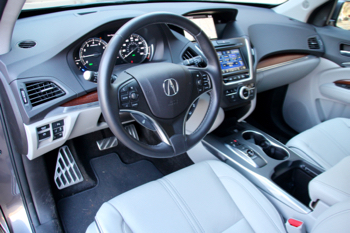
Acura MDX Hybrid also sports a luxurious and sublime interior with perforated leather seats adjustable in a million directions. Rear seating is copious and the third row which folds perfectly flat will hold a couple adults for a couple of hours.

Instrumentation is terrific in the Acura which has a standard tach and speedo left and right with a flanking battery level gauge left and a fuel gauge right. Also, Acura has taken pains to improve the center stack which is now easy to use and user intuitive. It has stacked LED screens one for the map and other info and one for the sound system which is excellent.

It’s also a danger at a Home Depot or Lowe’s as it has a cabin volume of about 148 cubes. It’s big and when ensconced in the interior it feels massive with amazing shoulder room.

MDX Hybrid comes with everything for one price at $58,000 plus $975 for the luxury suite on the Santa Fe or whatever railroad from Lincoln, Ala. Pricing includes the Tech Package and the Advanced Package. Seventy percent of the MDX originates in the U.S. and Canada and only the major part from Japan is the tranny and it’s a great tranny. I used to poo-poo hybrids, but technology and its integration are amazing. This is not a great ride, but a superb, great, fantastic ride. Here’s a vehicle that coddles seven in comfort, it can pretty much clear out a Home Depot, never worry if the road is paved or covered with snow, accelerate with World Class vigor and return over 30 mpg on a highway trip while achieving 27 mpg in most other driving. Acura has done an amazing job. What a vehicle. What a pleasure to drive (right pass gas stations).

Larry Weitzman has been into cars since he was 5 years old. At 8 he could recite from memory the hp of every car made in the U.S. He has put in thousands of laps on racetracks all over the Western United States.



Mystery power outage in Douglas County

Updated 3:31pm:

NV Energy had no idea why the power is out this afternoon. At one point 4,386 customers at the lake and in the Carson Valley were without power.

The outage affected the Douglas County Commissioners meeting at Stateline on Dec. 21. It had to be halted at 2:30pm because the meeting is supposed to be recorded. There was talk of using a phone to record it, but they weren’t sure all the voices would be picked up. Then staff scrambled to find a tape recorder.

By that time the power was restored.

But technology as it is, the rest of the meeting was only audio and not video.

An NV Energy rep said she had no idea why the power was out and at one point tried to convince Lake Tahoe News that it had been restored when in fact the room was still dark.

However, the power as of 3:30pm still was out for 2,434 customers. The estimated time line for power to be restored is 5:3opm, even though the company still has no idea what the problem is.

— Lake Tahoe News staff report


2 victims of phone scam in Douglas County

The Douglas County Sheriff’s Office is repeating the warning to the public that calls are being made to residents from people claiming they are a member of the department.

The caller stating the resident has missed a court date, or missed jury duty and claim there is now a fine due and a warrant issued. The caller states to avoid incarceration they need to satisfy the bail on the warrant by asking for a credit card or it can be paid by buying gift cards at a store. After the purchase of the gift cards, the victim gives the numbers on the gift card to the scammer and the scammer immediately redeems them.

There have been two Douglas County residents who have been scammed for more than $5,000 each. 

The calls may appear local on the resident’s caller ID, but they may be computer “spoofed” to show a local number.

Senior citizens are being targeted.

The Douglas County Sheriff’s Office or any other law enforcement agency will never call the public to notify them that they owe money on a warrant or fine. The public is encouraged to hang up on those calls and never give out personal information on the phone.


Nev. marijuana tax brings in $5.8 million in Oct.

By Chris Kudialis, Las Vegas Sun

Tax proceeds on Nevada’s marijuana sales is continuing an upward trajectory, establishing a new monthly high in October during the fourth month of the state’s recreational marijuana program, officials announced Wednesday.

The industry brought in more than $5.8 million in October, which includes a 15-percent wholesale tax for both medical and recreational pot, and a 10-percent excise tax on recreational weed sales, the Nevada Department of Taxation said. That’s up from about $4.7 million in September, $4.8 million in August and $3.6 million in July for a total of $19.1 million.

Read the whole story


SnowGlobe to cut off Al Tahoe Blvd. to locals

By Kathryn Reed

SnowGlobe is already irritating people and the loud bass that permeates the otherwise tranquil night air of South Lake Tahoe hasn’t even started.

A section of Al Tahoe Boulevard, one of the major thoroughfares in town, is going to be closed the better part of the three days of the music festival.

“Just another issue that points out that the play fields are not a suitable location for SnowGlobe,” a local resident told Lake Tahoe News.

For some residents wanting to get to the post office, their bank and the shops in the center at Al Tahoe and Highway 50, it will mean driving seven miles or so out of their way.

Johnson Boulevard will be open.

Al Tahoe will be closed from the college entrance at Johnson to Murietta Drive, the road leading to South Tahoe Public Utility District.

This will be the first time in the seven-year history of the controversial festival that the road has had restrictions.

Safety is being the reason given for the closure.

With people driving into crowds becoming almost a norm (the latest incident happening today in Australia), the closure will help prevent that from occurring. It’s only a chain link fence that keeps people out. There are usually 10,000-plus people at the ball fields each of the nights of the Dec. 29-31 event.

An added benefit to the closure is pedestrian safety.

“In years past we have had some concerns with motorists up and down Al Tahoe when SnowGlobe is letting out,” Police Chief Brian Uhler told Lake Tahoe News. “There are big crowds of people up and down Al Tahoe. The intersection with the college is problematic.”

People versus vehicle issues are more of an issue at the end of the night because most of the people leave at once, whereas they trickle in.

The closure will be in place from 12:30pm to 12:30am on Dec. 29 and Dec. 30, with the closure being extended on the morning of New Year’s Day to accommodate the concert lasting longer.

Those associated with the concert are also warning residents to expect the sound to be an issue this year without snow on the ground. The snow absorbs the bass. One thing neighbors can be thankful about is the concert promoter didn’t get his way with everything; he wanted one of the stages to be in Bijou Community Park. That would have put the noise even closer to residents.

However, SnowGlobe is forcing the closure of Bijou Park starting Dec. 27. It will reopen Jan. 3, assuming things are cleaned up faster than they were a year ago. Because Lake Tahoe Community College doesn’t want much to do with this event any more, the city has allowed this locals’ park to be used by the promoter.


Uber offering discounted rides in EDC, Placer

El Dorado County District Attorney’s Office is partnering with Uber to encourage local residents to use safe rides to reduce impaired driving.

This comes on the heels of a similar partnership with Lyft.

The program with Uber offers a $10 discount to any new Uber rider whose origin or destination is in El Dorado, Sacramento, Yolo, or Placer counties. The offer is valid through Jan. 7 using the code SAFERIDE2018. There will also be $2 off up to 2 discounted rides for existing Uber users available through Jan. 2 using the code SAFEUBER2018.


Decrease wildfire risks by choosing the right plants

By Ciji Taylor

Traveling at speeds up to 14 mph, wildfires can quickly ravish landscapes and homesteads. Experts with USDA’s Natural Resources Conservation Service, (NRCS) are studying what plants can slow fire rather than fuel it.

NRCS’ Plant Materials Centers evaluate and study plants, including those that can reduce fire damage or losses, helping keep people, property and natural resources safe. These centers, located across the United States, can provide information on the type plant best suited for an area given factors such as geography and climate.

“All plants burn, but using the right management and plant materials gives you a better chance of lessening damage,” said Jim Jacobs, NRCS plant materials specialist for Montana and Wyoming.

“Weather, topography and fuels dictate fire behavior,” Jacobs said. “A landowner can only control the type and amount of plant fuels, so the focus should be on managing what you can manage.”

A perimeter or firebreak of about 30 feet should be created around homes and other buildings. This area can be created by planting low-stature grasses or perennial herbaceous plants and shrubs. Plants in the 30-foot area should be kept green, since green plants don’t burn as hot and can buffer buildings from the heat’s intensity. Plant maintenance is an important preventive step.  Pruning trees and shrubs, mowing, and keeping dead material out of the perimeter will decrease fuel load around structures.

If planting trees, they should be planted far enough away that their canopy doesn’t grow within 10 feet of a building. Trees that hold more moisture are better than trees containing resin, such as pines, because they won’t burn as fast or as hot. Trees can also help block heat, slow wind and intercept embers, which are the main causes of structural fires and costliest part of wildfires.

In shelterbelts and wind breaks, farmers and ranchers should work to reduce what’s known as ladder fuels or plants that enable fire to climb from the ground into canopies. Keeping fires out of tree canopies helps reduce the number of embers in the air.

“Wildfires race across fields, so farmers and ranchers don’t have time to react,” Jacobs said. “At that point, it’s left to the preparation and management of your plant materials to help protect you and your structures.”

On wild lands, low- and moderate-intensity ground fires actually help forests by rejuvenating understory growth. But high-intensity fires can kill the entire plant leaving the soil bare, which increases the chances of erosion and flash flooding. In order to stabilize the soil and provide food and shelter for wildlife, landowners should reseed with grasses that establish quickly.

The Plant Materials Center in Aberdeen, Idaho, is supporting post-fire reseeding management by providing foundation seeds to the commercial seed industry. These foundation seeds come from plants that are evaluated to ensure establishment and performance under specific conditions, such as post fire.

“Firefighters aren’t our only defense to fires. Simply by using the right plants and management, we’re dispatching another type of preventive firefighter,” Jacobs said.

Ciji Taylor is with the Natural Resources Conservation Service.


LTVA expanding focus beyond traditional tourist

By Kathryn Reed

Diversifying the types of people coming to the South Shore and the reasons they do so is a goal of local business owners and tourism officials.

Lake Tahoe Visitors Authority is making a concerted effort to attract more conventions/meetings to the area. This in turn will ideally put more heads in beds and get the people to spend money on other things during their stay.

To begin with the goal is to work on groups with attendees of up to 400 people.

This isn’t just about getting more people into the Stateline casinos. Plenty of smaller properties have meeting rooms as well which could be good for a few dozen people. The goal is to fill these spaces on both sides of the state line.

“One of our strategic goals is to do what our partners cannot do themselves. In last year’s budget, we allocated a small amount toward a consultant to evaluate our destination as it relates specifically to meetings and make recommendations on how to launch a campaign,” Carol Chaplin, LTVA executive director, told Lake Tahoe News. “Based upon those recommendations, there are things we can do that are very cost effective: build out a better meetings webpage; allocate some staff time to some regional trade shows; create a collateral piece; create a sales committee representative of our destination properties. That’s where we are right now.”

The Nevada Division of Tourism this month gave LTVA a $15,000 grant to develop a marketing plan to attract meetings and conventions to this area. The money could be used on digital display advertising, e-blasts and e-newsletters and website page redesign.

LTVA will convene a group of interested properties to devise a strategy for luring groups to the South Shore. The marketing committee will have a say, and then the proposal will be presented to the board.

This effort is separate from and in advance of anything involving the event center that is being developed in Stateline.

“As we get closer to event center reality, we’ll have the opportunity to tackle the trade show/exhibition segments as well as events. The event center will need its own strategy,” Chaplin said.


Opinion: Could Calif. be seeing the onset of a recession?

By Dan Walters, CalMatters

Twice each year, once in January and again in May, Gov. Jerry Brown warns Californians that the economic prosperity their state has enjoyed in recent years won’t last forever.

Brown attaches his admonishments to the budgets he proposes to the Legislature – the initial one in January and a revised version four months later. 

Dan Walters

Brown’s latest, issued last May, cited uncertainty about turmoil in the national government, urged legislators to “plan for and save for tougher budget times ahead,” and added:

“By the time the budget is enacted in June, the economy will have finished its eighth year of expansion – only two years shorter than the longest recovery since World War II. A recession at some point is inevitable.”

It’s certain that Brown will renew his warning next month. Implicitly, he may hope that the inevitable recession he envisions will occur once his final term as governor ends in January 2019, because it would, his own financial advisers believe, have a devastating effect on the state budget.

A new report from the federal Bureau of Economic Analysis, however, hints that the downturn may have already started.

The BEA releases state-by-state economic data each quarter and its reports for the first and second quarters of 2017 are not good news for California.

Last year was a very good one for the state’s economy. The 3.3 percent gain in economic output in 2016 was more than double that of the nation as a whole and one of the highest of any state.

However, California stumbled during the first half of 2017. California’s increase was an anemic six tenths of one percent in the first quarter compared to the same period of 2016, and 2.1 percent in the second quarter, well below the national rate and ranking 35th in the nation.

The report revealed that almost every one of California’s major sectors fell behind national trends in the second quarter, with the most conspicuous laggard being manufacturing.

The only big California sector showing robust health was “information,” reflecting the unfortunate truism that the Silicon Valley-centered technology industry continues to prop up an otherwise lackluster overall economy.

It may be only a hiccup in California’s $2.6 trillion economy, the fifth or sixth largest in the world were it a nation. But maybe not.

Were the oft-predicted recession to finally hit, the most obvious effect would be on the state budget. It is highly dependent on income taxes paid by a handful of high-income Californians, particularly on their investment gains and particularly in the tech-heavy San Francisco Bay Area.

The last recession a decade ago revealed just how that dependency backfires in recession.

The state is even more dependent now, thanks to voter-approved increases in marginal tax rates, so a new recession would have even harsher fiscal effects.

However, the impact would not be confined to the budget. We could see unemployment, which has been at record-low levels recently, skyrocket as it did a decade ago with collateral impacts on housing, retail sales and virtually every other economic activity.

We would also see a new debate over whether California’s high taxes, high labor and housing costs and high levels of regulation have, as critics allege, made the state less attractive to job-creating investment and more vulnerable to recession.

Will it happen? Yes. A recession is inevitable as Brown warns. What we don’t know is when and whether it would seriously impact the high-tech industry. It is so vital to California’s overall economic health that were it to falter, an otherwise mild recession could be devastating.