Snippets about Lake Tahoe

·      Philanthropist Lisa Maloff recently gave Tahoe Youth & Family Services $75,000 to help families in South Lake Tahoe, Douglas County and Alpine County. 

·      David Smith is now the chef at Alder Creek Café at Tahoe Donner.

·      The Science of Cocktails is coming to the UC Davis Tahoe Science Center in Incline Village on Feb. 2 from 5:30-7:30pm. There will be more than 10 cocktail stations that double as learning hubs with unique activities and demonstrations for adults. Tickets are $30 for appetizers and two drinks — additional drinks $5 each. For more info, email tercinfo@ucdavis.edu.

·      Denyelle Nishimori is now Truckee’s Community Development director and Jenna Gatto is planning manager.

·      Tahoe Regional Planning Agency offices will be closed Dec. 25-Jan. 1.


Beer release to benefit fire academy scholarship fund

South Lake Brewing Company is hosting a release party for Fog-Nozzle IPA on Jan. 5.

This is an opportunity to honor the firefighters who protect the area. The goal is to bring attention to wildfire protection basinwide and raise money for the Lake Tahoe Basin Fire Academy scholarship fund.

The night starts out with music from former firefighter Kevin Marcy.

Feel like you can firefight better than the pros? Compete against the pros in a water bucket brigade.

Doors open at 5pm, show starts at 6pm for this free for all ages event.

South Tahoe Brewing Company is located at 1920 Lake Tahoe Blvd., South Lake Tahoe.


Chamber workshop focuses on laws at work

Lake Tahoe South Shore Chamber of Commerce’s annual HR Employment Law Workshop is designed to provide attendees with the latest business laws such as the new minimum wage requirements in California, cannabis in the workplace, and other employment laws in store for 2018.

This workshop will be facilitated by MOBO Law.

It will be Jan. 17 from noon-1:30pm at the chamber’s Stateline office.

Cost is $10 for members, $20 for others.


Douglas County struggles with Master Plan update

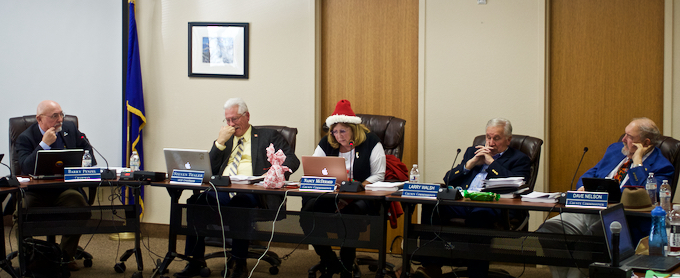
Douglas County commissioners disagree about the Master Plan process and its contents. Photo/LTN

By Kathryn Reed

STATELINE – For those hoping Douglas County’s Master Plan update was going to be certified by the Board of Commissioners this week, just the opposite and then some occurred.

Not only did the electeds not vote on the update Dec. 21, they chose to methodically go through each of the remaining elements in late January and then will schedule a joint meeting with the planning commissioners to tell them what to do. By that time, though, there are likely to be three new planning commissioners who have had nothing to do with this update.

The current plan was adopted in April 1996 and was last updated in 2011.

It is state law that dictates some of the process. Counties with more than 45,000 residents are mandated to have a planning commission. That entity is tasked with preparing a master plan that must be updated every five years.

The seven-member Planning Commission, which is appointed by the Board of Commissioners, has conducted multiple meetings in this two-year update process, gathered public input at the meetings and via a survey.

The two bodies met together at the beginning of the year with the purpose of making sure they were on the same page. That didn’t last long.

All changes the electeds make must go back to the Planning Commission for approval, with the Board of Commissioners having the ultimate say.

A change to this year’s document is there was more supporting material to explain how they came to their conclusions

Not all of the electeds believe that much detail should be part of the Master Plan. Some want to revamp the entire process, while others said that should be done prior to the next update.

Others don’t like that the plan is presented as a wish list instead of being more concrete. Others see this as an umbrella document, with the master plan as a guiding document from which precise code can be written. Others questioned if the electeds are going to have this much input, then what is the purpose of the Planning Commission? Others don’t want to be a rubber stamp.

Of the 11 elements in the Master Plan, housing and agriculture have been vetted, with proposed changes to go back to the Planning Commission. The remaining elements are conservation, economic development, growth management, historic preservation, land use, parks and recreation, public facilities and services, public safety, and implementation.

At this rate, adoption of the Master Plan is not expected until spring at the earliest.


Opinion: Supporting the Wildfire Safety and Recovery Act

By Jennifer Montgomery

Wildfires aren’t supposed to happen in December. And yet, just days before the holidays, thousands in Southern California are still evacuated from their homes as the Thomas Fire rages on, almost sure to become the largest wildfire in California history.

Wildfires aren’t supposed to burn cities, either. But the Thomas Fire has consumed neighborhoods in Ventura and Santa Barbara, while in nearby Los Angeles, the Skirball Fire destroyed Bel-Air mansions. All this comes only two months after the Tubbs Fire burned nearly 7,000 homes in the city of Santa Rosa and Napa County.

Jennifer Montgomery

Catastrophic wildfire is California’s new normal, and it’s not just a rural problem anymore.

Clearly, saving lives is our main concern. But as California wildfires worsen, a looming crisis of property insurance access further threatens the foundation of our communities, at a time when we are already facing an unprecedented housing crisis.

This week I joined California Sen. Ricardo Lara at the state Capitol to announce the introduction of the Wildfire Safety and Recovery Act, co-sponsored by Placer County. This act, when passed, will help protect responsible homeowners from significant insurance rate rises or cancellations due to wildfire risk.

This partnership — of a rural Northern California county and an urban Southern California senate district — marks a new consensus that when it comes to wildfire, we are all in this together. What was historically perceived as a rural problem is now all of our problem.

Placer County has been on the front line of this battle for affordable insurance for over four years. As wildfire risk has increased after years of severe drought and tree death due to bark beetle, many of our residents have had been dropped by their insurance carriers or faced the doubling or tripling of their premiums. This despite the actions of so many to reduce their risk by building with non-combustible materials, maintaining defensible space and hardening their homes in other ways against wildfire.

We have been fierce advocates on their behalf, but after years of limited success at bringing property owners relief administratively, it has become clear that the broader solution must be legislative. With this law, California will join states including Arkansas, South Carolina, Texas, New York, Alabama and Florida that prohibit or limit insurance companies from canceling or non-renewing policies following natural disasters, or require them to offer discounts to property owners who harden their homes.

Make no mistake: We want insurance companies to continue to operate successfully and profitably in California. Risk is increasing, but insurance providers must be required to set and adjust premiums based on an understanding of the real risk to the properties they insure. That means balancing the risk equation with the many mitigations property owners can take to reduce their risk.

The Wildfire Safety and Recovery Act will allow insurers to continue to profitably invest in California and to support responsible property owners and local communities who are stepping up to be fire safe.

Ensuring a stable insurance market for insurers and access to insurance for property owners is in all of our interests as we work together to build community resiliency across California in this new age of wildfire.

Jennifer Montgomery is a supervisor for Placer County, representing Lake Tahoe.


Traditional lightbulbs set to vanish from Calif. stores

By Dale Kasler, Sacramento Bee

Traditional incandescent lightbulbs are about to start going dark in California.

The old-fashioned bulbs are expected to start disappearing from hardware and home-improvement store shelves beginning Jan. 1, when ambitious energy-efficiency regulations are scheduled to take effect across the state.

Although bulb manufacturers are trying to get a court order preventing the regulations from kicking in, it looks like consumers will soon be left to choose between light-emitting diode bulbs (LEDs) or those oddly shaped, compact fluorescent lights.

Read the whole story


SLT man dies crossing street in Nevada City

A South Lake Tahoe man was killed Wednesday after being struck by a vehicle in Nevada City.

Ronson Sakioka, 64, was walking back to his vehicle after attending the Victorian Christmas when the incident occurred. He was with his wife, who escaped injury. They were crossing Highway 49 where it is dark and there was no sidewalk.

Sakioka was airlifted to a hospital in Roseville, where he later died.

The driver was not cited. Alcohol and drugs are not believed to be a factor in the Dec. 20, 9:25pm accident, according to the California Highway Patrol.

— Lake Tahoe News staff report


Squaw becomes training site of U.S. ski-snowboard teams

U.S. Ski & Snowboard and Squaw Valley entered a five-year agreement designating the resort as an official training site of the U.S. ski and snowboard team.

Squaw Valley joins Mammoth Mountain, Deer Valley in Utah, Copper Mountain in Colorado and Timberline Lodge in Oregon as one of only five official training sites across the country. In addition to being an official training site, Squaw Valley is a high performance center and development site for the team.

Squaw Valley will host U.S. team athletes for elite training sessions at the resort at key times during the season. Additionally, the high performance center and development center designations connect Squaw Valley staff with the Park City-based Center of Excellence and other high performance centers across the country to share best practices in strength and conditioning, sport science and sports medicine while also acting as a central training and education site for U.S. Ski & Snowboard clubs in the region.


Enough snow in Tahoe for Christmas skiing

By Benjamin Spillman, Reno Gazette-Journal

Winter is off to a slow start, especially in the Lake Tahoe Basin, with snow totals well below normal for late December.

But a recent shot of snow and mild holiday forecast spell good news for conditions at Sierra Nevada resorts.

In the Tahoe Basin the snowpack is just 35 percent of normal while the Truckee, Carson and Walker river basins are at 68, 54 and 62 percent of normal, respectively.

Read the whole story


Mental health focus of Vail CEO’s donations

Agencies that deal with mental health are benefiting from the generosity of Vail Resorts CEO Rob Katz and his wife, Elana Amsterdam.

The couple created the a charitable organization in October with funding of approximately $58 million.

Katz and Amsterdam worked with local community leaders and Vail Resorts employees to identify that mental health and drug and alcohol abuse were some of the most important issues that need to be addressed in these local towns, cities and counties.

Nationwide, suicide is the second leading cause of death in youth ages 14-25, and mountain resort communities are not immune to this disturbing trend. In surveys conducted in the resort communities by various organizations, many residents indicated they don’t know where to turn for help if they have a mental health issue and if they did know where to turn for help, frequent barriers such as cost, perceived stigma and language prevented them from seeking treatment. Vail Resorts offers mental health and substance abuse counseling to all of its seasonal and year-round employees.

Beginning in the new year, the couple will be bringing on philanthropic advisors to help design a grant-making process, facilitate community engagement, and ensure the greatest impact for the resources available from the new charitable fund. A grant process for the charitable fund will be announced in the spring.

Until the, the charitable fund will be making contributions to the following nonprofits that focus on mental health issues in the communities where the company operates.

  • $55,000 – Tahoe Truckee Community Foundation in Truckee.
    This grant will fund the Community House Consolidation, community-based organizations that work to consolidate, maximize and streamline their mental health services; mental health vouchers for counseling services distributed through Family Resource Centers; What’s Up Wellness, which provides depression screening and follow-up services to high school students; and Whole Hearts Through Gateway, a nature-based therapeutic program designed to support the most at-risk youth.
  • $100,000 – Boulder Community Health in Boulder, Colo.
  • $100,000 – Eagle County School District with MindSprings, Early Childhood Partners and Our Community Foundation in Eagle County, Colo.
  • $100,000 – The Summit Foundation in Summit County, Colo.
  • $100,000 – Jewish Family Service, Christian Center of Park City and the Summit County Health Department in Summit County, Utah.
  • $100,000 – Whistler Community Services Society in Whistler, B.C., Canada.
  • $100,000 – U.S. Ski & Snowboard, Park City, Utah.