U.S. launches plan to battle rangeland wildfires

By Keith Ridler, AP

BOISE, Idaho — Federal officials have launched a two-pronged plan to stop a vicious cycle of rangeland wildfires in a wide swath of sagebrush country in the West that supports cattle ranching, recreation and is home to an imperiled bird.

The U.S. Bureau of Land Management on Friday said it will create an environmental impact statement concerning fuel breaks and another on fuels reduction and restoration for Idaho, Oregon, Nevada, California, Utah, and Washington.

The agency said the documents when finished will help speed the process for future landscape-scale projects in the Great Basin by providing a blanket approval for similar areas that will likely just need minor additional environmental reviews to proceed.

Read the whole story


Too drunk to drive? Calif. law may provide a free ride

By Daniel Wilson, Sacramento Bee

It’s an all-too-familiar scene in Sacramento. A group of friends heads to midtown for a night of partying and drinking, but one friend has to miss out on the fun and stay sober to be the designated driver.

A new law that takes effect Jan. 1 may not only let everyone join in on the fun, but it’ll also mean more money for the bubbly.

Under Assembly Bill 711, alcohol manufacturers and licensed sellers can offer free or discounted rides to transport drinkers home safely through ride-sharing services, taxicabs or other ride providers.

Read the whole story


Making headway battling aquatic invasive plants

By Tahoe Resource Conservation District

After four years of treatment, Emerald Bay remains free of aquatic invasive plants.

In 2010, the Tahoe Resource Conservation District, in collaboration with California State Parks and the Lake Tahoe Aquatic Invasive Species Program, began treating 6 acres of Emerald Bay to remove Eurasian watermilfoil, an invasive plant that alters the aquatic ecosystem by raising the pH of the water, decreasing oxygen, and increasing water temperature. Dense mats of vegetation can also interfere with boat navigation and recreational activities such as paddling and swimming.

The Emerald Bay project was a model for success that is being replicated at other locations.

This year, Tahoe RCD realized a similar achievement at Crystal Shores East Marina in Incline Village. From 2014 to 2016, crews used diver-assisted suction removal and lake-bottom barriers to eliminate invasive plant growth. In 2017, no plants were detected in any of the three Crystal Shores marinas. Surveillance surveys will continue in 2018.

With support from public and private partners, teams are controlling invasive plants at other locations around the Lake Tahoe Basin. The University of Nevada, Reno’s 2015 Implementation Plan for the Control of Aquatic Invasive Species within Lake Tahoe is guiding the way. The plan uses an ecological and science-based framework to prioritize locations for controlling satellite populations of invasive plants.

In 2017, Tahoe RCD surveyed over 9 acres of aquatic plant habitat at Lakeside Beach and Marina, Fleur du Lac, Crystal Shores, Tahoe Vista Boat Launch, the Truckee River, and three miles along Nevada’s shoreline. All Eurasian watermilfoil and curlyleaf pondweed plants were removed this season, and the sites will be monitored next year.

In a pilot project, Inventive Resources Inc. and Tahoe RCD used ultraviolet light to treat invasive plants at Lakeside Marina. Lab studies and small field tests have shown that ultraviolet light damages the DNA and cellular structure of aquatic plants, causing them to die back. Tahoe RCD will work with partners this winter to finalize initial results and schedule post-treatment monitoring for 2018.

“From our work in Emerald Bay and Crystal Shores, we know that invasive plant populations can be reduced, and with continued treatments, we will be able to better manage populations around the lake in the future,” said Nicole Cartwright, executive director at Tahoe RCD. “While bottom barriers and diver-assisted suction removal have proven to be successful, we need to identify other techniques that could help us get ahead of the battle, particularly with persistent plant species such as curlyleaf pondweed, and much larger infestations that are looming.”

Funding for these projects has been provided by California Tahoe Conservancy, Crystal Shores East Homeowners Association, California Department of Water Resources, Incline Village General Improvement District, Tahoe Water Suppliers Association, Nevada Division of State Lands, Tahoe Fund, Tahoe Regional Planning Agency, Truckee River Fund, and the U.S. Fish and Wildlife Service.

This article is republished from the winter 2017 edition of Tahoe In Depth.


Lawsuit could force Nev. to alter education funding

By Meghin Delaney, Las Vegas Review-Journal

A nationwide education trend might be coming to Nevada, but it’s not necessarily one that overseers of the public school system will welcome.

Nevada could soon join the ranks of states that have been sued over the way they fund public education. Education activist groups and other parties already have filed such court challenges in 45 states, and several public school advocates active in Nevada have indicated they are considering such a step.

The lawsuits essentially allege that state lawmakers aren’t meeting their responsibility to provide an equal education for all students as required by each state’s constitution. A majority of the challenges have been successful in getting courts to force legislative changes that pump more money into education and often change how the funding is distributed.

Read the whole story


Fun in Tahoe without skiing/snowboarding

By Ryan Buell, Moonshine Ink

A lot of ink (and the digital equivalent) has been used to write about skiing in Tahoe. Obviously — more resorts than you can count on both hands, more than 100 lifts, world class backcountry offerings, The Palisades. It needs no repeating. And that’s why we want to devote some space to sharing the love with Tahoe’s less-renowned and equally-epic sports and activities.

While most locals certainly know it, if you were going only off media coverage, it might come as a surprise that there is, in fact, more to do here in the winter than ski — and I don’t mean snowboarding. For that matter, there’s more to do in the summer than hike and mountain bike. It’s time to celebrate the full breadth of recreation we have in our community.

Starting with the Truckee-Donner Recreation and Park District. TDRPD is as sure a place as any to find the diversity of recreation in our community. From common sports like hockey and indoor volleyball, to the more eclectic pickleball and broomball, the TDRPD offers a variety of sports for all interests and levels of skill and competition.

Read the whole story


Travel industry has sparked a backlash against tourists

By Carter A. Hunt, The Conversation

Travel is a major global industry, but in 2017 it attracted unprecedented resentment and retaliation towards tourists. A growing global backlash against tourism extended from tropical rain forests to urban destinations like Rio de Janeiro and Venice.

I have studied tourism’s social and environmental consequences along the coastlines of Colombia, Costa Rica and Nicaragua, in the rain forests of Peru and Ecuador, on the islands of Fiji and the Galapagos and across the savannahs of South Africa and Tanzania. My research and that of numerous other scholars spotlights a key fact: More tourism is not always better. Increasing the number of visitors has generated profits for travel companies – particularly the cruise ship industry – but it has not always benefited local communities and environments where tourism occurs.

Fortunately, once people are aware of the often surprising ways in which their trips impact local people and places, it becomes easy to ensure that their travel has more positive consequences for the destinations they visit.

Billions on the move

Born from the accessibility of mass air travel, modern international tourism has been popularized as “holiday-making” in regions that offer comparative advantages of sand, sun and sea. Travel is often portrayed as a tool for personal growth and tourism as an economic motor for destination countries and cities. There is a tendency to assume that tourism is good for everyone involved.

Today the big bang of tourism drives more than 1.2 billion tourists across international borders each year, generates 9 percent of global GDP and provides one out of every 11 jobs on earth. But many popular places are literally being loved to death. Recent protests in ports of call like Venice and Barcelona against disturbances created by larger and more numerous cruise ships show the unfortunate consequences of emphasizing quantity over quality in tourism.

Unabated tourism development has become a primary driver of social and environmental disruption. Tourism studies, which came of age as a scholarly field in the 1970s, provides much documentation of the many negative social impacts of tourism and resulting resentment that local populations direct towards visitors.

Early tourism scholars even developed an “irridex” to measure this irritation with tourists among local residents. Later, scholars identified stages through which tourist destinations evolve. Antagonism toward tourists typically develops in mature, heavily visited destinations. Protests in heavily visited destinations suggest that traditional tourism has overstayed its welcome.

Resentment toward tourists, attacks on foreign-owned hotels and increases in crime against both tourists and local residents were regularly documented in the 1970s and ‘80s, at a time when only 2 to 3 million tourists were crossing international borders annually. So it is not surprising that such protests have escalated in scale and frequency as tourism has grown.

In Barcelona, for example, growing resentment of neighborhood gentrification, elevated real estate and rental prices, and erosion of local social networks has led some residents to call tourism the city’s biggest problem and label tourists as “terrorists.”

Friends without benefits

Residents often become frustrated when the benefits of tourism are not felt locally. Although it can generate foreign exchange, income and employment, there is no guarantee that multinational hotel chains will allocate these benefits equitably among local communities.

On the contrary, when people stay at large resorts or on cruise ships, they make most of their purchases there, leaving local communities little opportunity to benefit from tourist spending. These forms of tourism widen economic and political gaps between haves and have-nots at local destinations.

In recent decades, local residents in destination communities also have found themselves negotiating new cultural boundaries, class dynamics, service industry roles and lifestyle transformations. For example, data show that tourism activity corresponds to increased alcohol, drug and sex abuse as local residents adopt the behaviors of tourists, often leading to parallel upticks in crime, addiction and prostitution.

All-inclusive resorts can also privatize access to important coastal, marine, forest and agricultural resources. And when foreign investment drives up local land values and living costs to international standards, it may put ownership out of reach for local residents. In such situations, even people who depend on tourism will often question its ethics, whether they are rural Nicaraguan residents working in a newly booming resort industry or urban dwellers being priced out of their apartments by the sharing economy.

Cruise lines miss the boat

Jim Damalas, owner of Si Como No ecolodge in Costa Rica, observes that publicly traded corporations do “not fall in love with the country, they fall in love with the numbers.” No form of tourism is more in love with the numbers than cruises. While all forms of tourism have grown in recent decades, the rise in cruise travel is dramatic. For instance, cruise visitors to Belize grew from 34,000 in 1999 to 800,000 in 2005.

Contemporary cruise ships can entertain as many as 5,700 passengers. These boats themselves are the destinations. As they bounce from port to port, they are not beholden to any particular community and provide only the most superficial levels of engagement with local people and places. Their business model emphasizes packing the greatest number of travelers into the greatest number of places in the shortest amount of time.

Research into the industry’s impact has shown that few forms of tourism do less to improve the social, environmental or economic well-being of the places where they occur than cruises. These trips may give passengers a pleasurable experience, but they miss the boat – pun intended – with regard to supporting local communities and environments.

A better model

The United Nations declared 2017 the International Year of Sustainable Tourism for Development. What does this mean for the everyday traveler? Here are a few of the U.N.’s suggestions, which research on tourism supports.

First, as Stephen Colbert has quipped, “There’s nothing American tourists like more than the things they can get at home.” All tourists should make every effort to honor their hosts and respect local conditions. This means being prepared to adapt to local customs and norms, rather than expecting local conditions to adapt to travelers.

Second, tourism is a market-based activity and works best when consumers reward better performers. Livelihoods, human rights and the fate of endangered species all can be affected by travelers’ decisions. In the information age, there is little excuse for travelers being uninformed about where their vacation money goes and who it enriches.

Informed travelers also are better able to distinguish between multinational companies and local entrepreneurs whose businesses provide direct social, environmental, and economic benefits for local residents. Such businesses are in love with the destination, not just the numbers, and are therefore deserving of market reward.

In the long run, the goal should not be just to minimize the impact of travel. Being a responsible traveler means ensuring net positive impacts for local people and environments. With the amount of information available at our fingertips, there has never been more opportunity to do so.


K’s Kitchen: Mushrooms too good to share

By Kathryn Reed

Sometimes I don’t want to share the food I make. I really do have a mushroom problem; I could have eaten all of them on my own.

The problem, so to speak, is I cooked them for a wine tasting I was hosting, so I had to share. They were paired with a JCB 2015 Pinot Noir. I’m not a big Pinot fan, but this one was great – or maybe it was the mushrooms that made the difference.

I used a Cabernet in the recipe, and the mushrooms tasted fantastic with it as well the following day.

Thank goodness there were leftovers. The mushrooms were good cold, reheated and on pizza.

This would be a good side dish for a steak, or even on top of the steak.

Some of the grocery stores on the South Shore have a container of mixed mushrooms. To that I added sliced cremini and baby portabella. Wild mushrooms are pricy, but the flavor compared to regular button mushrooms is night and day apart.

Roasted Mushrooms with Red Wine

3 lbs mixed mushrooms, such as cremini, oyster and chanterelle

¾ C, plus 1 T canola oil

1 T thyme leaves

1 tsp rosemary, minced

1 large shallot, minced

3 cloves garlic, minced

1 C dry red wine

3 T cold unsalted butter

Kosher salt

Pepper

¼ C tarragon, chopped

Preheat oven to 400 degrees. Heat two rimmed baking sheets for at least 10 minutes.

In a large bowl, toss the mushrooms with ¾ cup of the oil, thyme and rosemary. Spread mixture on warmed baking sheets and then roast for 30 minutes. Mushrooms should be tender and browned.

Heat remaining oil in skillet. Add the shallot and garlic, cook over moderately high heat until softened. Add the wine and simmer until reduced to a glaze. Mix in the butter, salt and pepper.

Put mushrooms in bowl. Add wine sauce and mix. Toss in tarragon.


Winter sketching workshop in Hope Valley

Nature artist John “Jack” Muir Laws will join Sorensen’s Resort on Jan. 7 to lead a winter sketching workshop.

He will teach techniques for fast sketches, drawings and paintings. 

Bring a sketchbook, binoculars, and favorite lightweight drawing materials. No experience necessary.

Laws is the author of easy-to-use “Laws Field Guide to the Sierra Nevada”, “Laws Guide to Drawing Birds,” and “The Laws Guide to Nature Drawing and Journaling.”

The workshop will be from 9am-1pm. Cost is $60 for Sorensen’s guests, $95 for others. For more info or to sign up, email info@sorensensresort.com.


‘Tonight thank God it’s them instead of you’

By Kathryn Reed

“At Christmastime it’s hard, but when you’re having fun

There’s a world outside your window
And it’s a world of dread and fear

Where the only water flowing
Is the bitter sting of tears
And the Christmas bells that ring there are the clanging chimes of doom
Well tonight thank God it’s them instead of you ….”

The lyrics from “Do they know it’s Christmas” is about Africa, but it might as well be Lake Tahoe.

For some on the South Shore, the material riches of Christmas are only something to dream about.

For Rich Barkley, he woke up this morning outside. That’s where he lives. For Laurie, she was in a chilly trailer, unable to afford any decorations, and without her teen-age daughter who is in foster care.

Thousands of people are in the Lake Tahoe Basin now – vacationing, spending a holiday in one of the most beautiful places in the world. And, yet, for so many who call this place home, it is less than idyllic.

According to the U.S. Department of Housing and Urban Development, nearly 554,000 people across the country are homeless. The South Shore is part of that equation.

Barkley and Laurie share having income insecurity. He has a job, but no home. She has a home, but no job. It’s a precarious situation for both.

Poverty with a view – Lake Tahoe’s longtime moniker – is getting more real for more people almost on a daily basis.
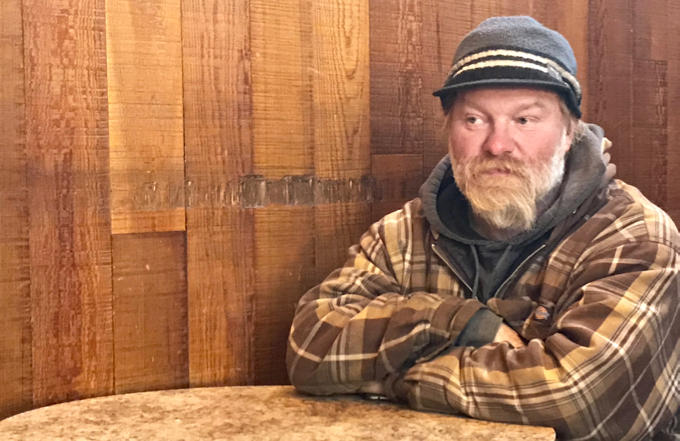
Even though it has been below freezing every night for weeks, Rich Barkley lives in the woods in Stateline. Photo/Kathryn Reed

Finding his way in Lake Tahoe

Barkley was in Lakeside Inn at Stateline on Thursday, trying desperately not to fall asleep. They don’t take kindly to vagrants using their establishment as a warm room, so to speak.

“Lakeside doesn’t give me crap if I’m not sleeping,” he says. It’s a place to hang when he has nowhere else to be and the daytime high is hovering at freezing.

While the hotel-casino doesn’t have a homeless policy per se, it doesn’t tolerate loitering.

“Anyone who makes our guests uncomfortable is asked to leave,” Stacy Noyes with Lakeside told Lake Tahoe News.

Barkley lives in the woods not far from the casino. His two sleeping bags keep him warm, though there are nights he has sought out public places to give him a little shelter, a little break from the bone-chilling wind.

Snow he can handle. It’s the rain, when everything is soaked that makes life difficult. It is impossible to get warm. He insists he doesn’t start fires.

Barkley packs his stuff up every day, putting it in a garbage bag and then placing it in a ditch. He doesn’t want the little that he has to be stolen or thrown away.

He carries a small backpack with him. Some of what he has is how he is able to eat. He’s a harmonica player with a fairly regular gig at Base Camp Pizza in Heavenly Village. Owner Ted Kennedy gives him food credit for his playing.

“We helped him because he’s a friend. The Bible calls on us to do that. In fact, Christ said, you guys didn’t feed or shelter me when I needed it. The folks said – wait, we never saw you hungry. Christ said when you didn’t do those things for the most needy among you, then you didn’t do it for me,” Kennedy told Lake Tahoe News. “Rich is also a hell of a harmonica player and we love his music.”

Barkley has seven harmonicas; using them to join other musicians who are at the restaurant.

Barkley has been in the area for more than seven years, having come from San Diego. Like so many who call Lake Tahoe home, he saw that lake in pictures and wanted to be here. It’s what keeps him here.

He secured a seasonal job right away at Kirkwood Mountain Resort. At Heavenly Mountain Resort he’s taught skiing, at various hotels he has done maintenance. Today he is working at the snowplay area across from MontBleu.

He doesn’t explain what happened to his vehicle. He doesn’t explain why it’s been so hard to keep a traditional roof over his head. He’s had roommates, even places to himself. He admits he doesn’t like living with other people. Friends let him stay on occasion, or just come in to shower. He does work for them in exchange. The recreation center in South Lake Tahoe is a place to get clean as well.

Barkley won’t use the warm room, saying he can fend for himself.

Hanging out at the South Lake Tahoe Library is common, as it is for others who are homeless. It’s easier to get to compared to the library in Zephyr Cove.

“I actually enjoy not being in a fixed location,” he said.

What Barkley would really like is to save money for an old truck to fill it with tools so he could drive around fixing things for people. An RV would do, too, so then he has that roof.

“My goal is to save money to get my electrician’s license,” he tells Lake Tahoe News in between bites of a hot meal at Lakeside.
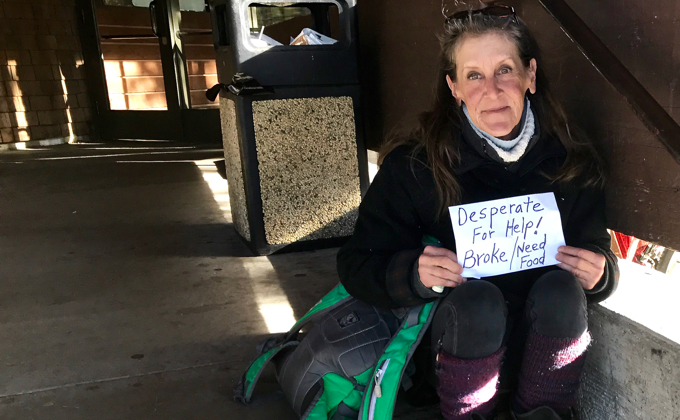
Health issues keep Laurie from having steady work; begging puts food on the table and heats her trailer. Photo/Kathryn Reed

A life of uncertainty

Laurie is a bit of a fixture at the main post in South Lake Tahoe where she sits on the steps with a sign saying she needs work. On this particular day her quest is to collect $25 from strangers so she can fill her propane tank. This will last five to seven days.

She’ been begging there on and off since 2014.

She doesn’t want her last name used because of legal reasons. When her daughter was with her, she was getting welfare checks. While her daughter is still in her life, she isn’t living with her. It was illegal to keep the money even though some of the money was spent on the 17-year-old. Laurie is willing to pay the money back, but the payments have to work for her.

Her court date is set for late January.

“I can’t be locked up. I wouldn’t have this trailer,” Laurie tells Lake Tahoe News through tears.

While this felony lingers, it’s makes getting a job difficult.

Health issues are what led her to unemployment. She said she’s been diagnosed with Crohn’s disease, which she said is not on the list of maladies to trigger disability.

Calling in sick one too many times forced her to lose her jobs at Jamba Juice and Doc’s Cottages.

She doesn’t like to beg, but doesn’t know what else to do. A regular job is hard to commit to. And right now a bike is her main means of transportation.

“There are some angels out there and some haters,” she says of the people she encounters. Laurie says she is the example where drugs, alcohol and mental health issues are not the cause of her problems.

She’s had an array of jobs – clerical, retail, cleaning, even topless dancing. Laurie says she wants to work.

A friend may be giving the 59-year-old a car after the first of the year so then she could work for a cleaning agency that said it would hire her.

Her daughter’s father has never been part of her life. The South Tahoe High School senior is living with a friend and her mom. She has plans to go to college, with the hopes of going into the medical profession.

“Her happiness is the reason I breath every day,” Laurie says of her daughter. They see each other nearly every day.

On Friday they celebrated Christmas with a few gifts exchanged.

Laurie has been in Tahoe for 25 years. Her illness has been part of her life since her daughter was 5. It’s been a struggle ever since, with living conditions for the two of them that have included hotel rooms and a shed.

Sitting in Laurie’s trailer near the Y it’s cold even with a jacket on. It’s never more than 65 degrees inside. Blankets cover the windows. A picture of her daughter is on the table, one of the few items that makes it look like a home rather than an ordinary travel trailer.

Laurie has been at this location since the summer. She does work for the landlord in exchange for the trailer.

She is able to get food at Bread & Broth once a week, and when she’s able to transport the goods Christmas Cheer is also a resource.

“Cash goes to things I run out of – propane, soap, laundry detergent,” Laurie said. “Asking for help is really hard.”


Opinion: Tackling Tahoe’s transportation troubles

By Joanne Marchetta

The rural mountain lifestyle we all enjoy at Lake Tahoe is not isolated from the major urban areas nearby. On a typical holiday weekend, the Tahoe basin turns into a recreation thoroughfare as tens of thousands of day and overnight visitors who sustain our local economy drive up from the San Francisco Bay Area, Sacramento and Reno.

During peak times of visitation, this influx of cars and people causes traffic congestion on our limited roadways as residents, commuters, and visitors all struggle to get into, out of, and around communities, and as vehicles gather and park at major recreation attractions.

Joanne Marchetta

Tahoe is taking a systemswide approach to better manage these transportation challenges.

Public and private partners are working together to enhance the basin’s transit services, making them more frequent and more reliable, to improve the region’s network of bike and pedestrian trails, and to upgrade roadways. Private and nonprofit partners are also stepping up by helping fund projects, running shuttles, bringing new bike share programs into communities, and partnering with smartphone applications that can help people plan trips to, from, and around Tahoe.

But Lake Tahoe’s transportation challenges will be difficult to address. Even today, a shortage of bus drivers is preventing more frequent bus service this winter. There is no one silver bullet, no one entity that can solve all the difficulties. Success will not come overnight. We need to form new public-private partnerships, coordinate better, and work together on these issues as a region.

This December, with help from the Federal Highway Administration, the Tahoe Regional Planning Agency and nearly 60 public and private partners met for an all-day workshop on travel management. The focus was on emerging technologies and best practices we can consider using at Tahoe to better manage traffic congestion and parking problems not only to improve residents’ quality of life and visitors’ quality of experience, but also to reduce the impact that transportation has on the environment.

Partners at the workshop included local governments, state highway departments, inter-regional transportation agencies, nonprofit groups, ski resorts, lodging associations, chambers of commerce, visitor’s authorities, and elected officials. With this broad array of partners and stakeholders in one room, we learned about the technologies and techniques that other tourism communities are using to address transportation issues. We also talked about what we are already doing, what is working and what is not working, and areas where we can work together to grow our initiatives for broader reach and impact.

Our transportation challenges will not solve themselves. Lake Tahoe is in the middle of the rapidly-growing Northern California megaregion, a transportation planning area that includes the Bay Area, Sacramento, Stockton, Truckee, and Reno. As these nearby metropolitan areas continue to grow, we can expect more and more people will be traveling to Tahoe to recreate.

Fortunately, many new tools are available to us today. Today, nearly everyone has a smartphone. That means they have access to online applications that can provide real-time travel and parking information, help them plan trips to avoid congestion, and book new ride-sharing services that make it easier than ever to carpool.

With the right partnerships and a consistent approach throughout the Tahoe region, people could use these new technologies to learn more about our local transit services, bike share programs, and bike and pedestrian trails to avoid driving altogether, not only to and from Tahoe, but during their stay here.

Through partnership and collaboration, progress is being made all around Lake Tahoe. The 2012 Regional Plan, with its unprecedented public-private partnership for community revitalization and environmental restoration, is delivering a renaissance of projects both big and small that are revitalizing communities, reducing blight, and improving the environment.

More than 50 public, private, and nonprofit partners have made the Lake Tahoe Environmental Improvement Program one of the nation’s most ambitious and successful conservation and restoration initiatives. Partners are continuing to implement projects each year that restore the lake’s famous water clarity, clean up storm water pollution, fight aquatic invasive species, restore meadows and wetlands, improve forest health and reduce wildfire risk, and enhance the public recreation opportunities that drive Lake Tahoe’s $5 billion annual economy.

Lake Tahoe has clearly shown the power of collaboration and public-private partnerships. It’s time to focus that power on coming together to solve the region’s transportation challenges.

I know we can take our partnership and collaboration to the next level and work together on transportation issues to reduce the traffic congestion in our communities during times of peak visitation, better manage our roadways and parking areas, and make people more aware of alternatives to get to, from, and around Lake Tahoe. Please join us in this work to make Lake Tahoe a healthier, more enjoyable place for all of us, and for future generations to come.

Joanne Marchetta is executive director of the Tahoe Regional Planning Agency.