Heavenly looking for adult racing teams

Heavenly Mountain Resort’s Adult Racing League starts Jan. 10.

This is for skiers and snowboarders who are at least 21. There will be slalom and giant slalom courses.

Team of five will compete against each other. Cost is $135 per person. Deadline to register is Jan. 9 at the Cal Lodge pass office. The cost is $135 per person. 

Races are from 5-8pm on Jan. 10, Jan. 17, Jan. 24, Feb. 7 and Feb. 14. The championship is Feb. 28.


Learn about the dark side of the universe

What is dark matter? This elusive “stuff” makes up a quarter of the universe.

Marusa Bradac on Feb. 8 will talk about research on the composition of the universe, properties of dark matter, and the latest discoveries about the universe’s past. Bradac, originally from Slovenia, is a physics professor at UC Davis.

The tools of her trade are telescopes in space, including the Hubble Space Telescope and Spitzer Space Telescope, the future James Webb Space Telescope, and also on the ground, the Keck Telescope in Hawaii.

Registration for this event is required. The program will begin at 6pm, with refreshments and no-host bar from 5:30-6pm at TERC on the campus of Sierra Nevada College in Incline Village.

A $5 suggested donation will be collected at the door.


Recreational marijuana business thriving in Incline

Adrian Angulo helps a customer at NuLeaf in Incline Village. Photo Copyright 2018 Carolyn E. Wright

By Kathryn Reed

INCLINE VILLAGE – Even though recreational pot could be sold in California as of this year, only one place in the Lake Tahoe Basin is doing so – and that’s in Nevada.

NuLeaf has been selling medicinal marijuana since July 1, 2016, and recreationally since Aug. 5, 2017.

“We’ve gotten a lot of business from California customers coming over on the weekends,” Andrew Zaninovich, a manager at NuLeaf, told Lake Tahoe News on a tour of the facility. The Incline Village shop is building a regular local clientele as well.

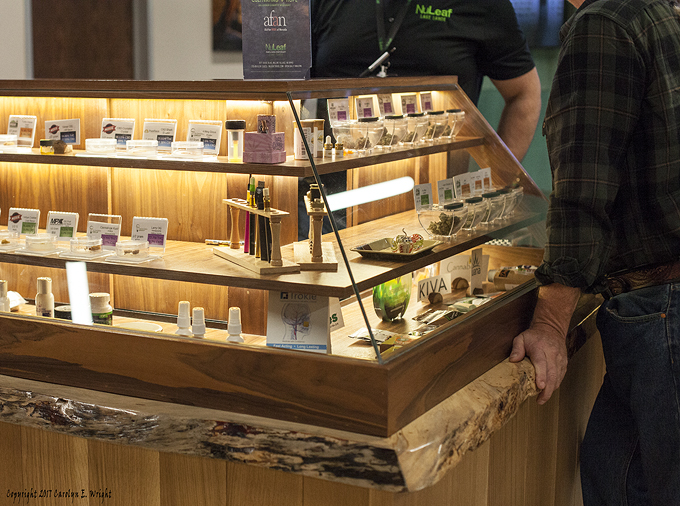
Two cases are full of various marijuana products. Photo Copyright 2018 Carolyn E. Wright

It is up to the individual jurisdictions to decide if they will allow pot to be sold. South Lake Tahoe is on a path to regulate it starting in the summer. Other locales are taking a hands-off approach for now.

Walking into NuLeaf it’s almost like a medical office in that it’s a bit sterile. The receptionist takes people’s IDs to make sure they are valid and the customer is of age. The information is also logged into their system. Signing in and out, and stating the purpose of the visit are also required. No one younger than 21 (except for medicinal patients) are allowed into the retail area.

Andrew Zaninovich of NuLeaf talks about the various products that are for sale. Photo Copyright 2018 Carolyn E. Wright

Behind the locked door it looks like a boutique candy shop – and for some, that is exactly what this is. The edibles in that glass case, though, will produce more than a sugar high.

Two glass cases containing the exact same product allow for efficiency. The natural wood and low light give the place a sense of refinement.

Customers are smelling the flowers. To the uninitiated, that’s the pot you’d smoke. Besides THC (tetrahydrocannabinol) and CBD (cannabidiol) levels, the flavor profile is important to some people.

It’s possible to buy it raw or already rolled. The least expensive joint before taxes is $13.

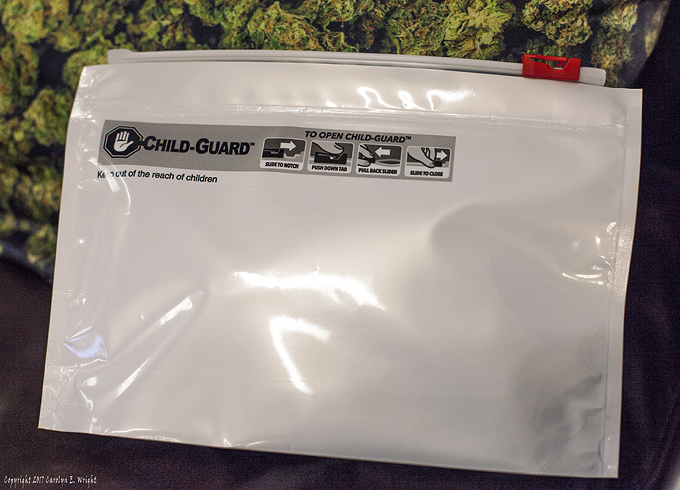
Purchases come in a discrete, child-proof bag. Photo Copyright 2018 Carolyn E. Wright

Indica, sativa and hybrid varietals are available, with the latter two being more popular. Sativa tends to be more energizing.

Edibles come in flavors, too. NuLeaf purchases its edibles from a third party that the state of Nevada has approved. They can be eaten or products mixed into drinks.

Blueberry, lemon meringue, mint chocolate chip and key lime are just some of the flavors – which could be for flowers, edibles or concentrates.

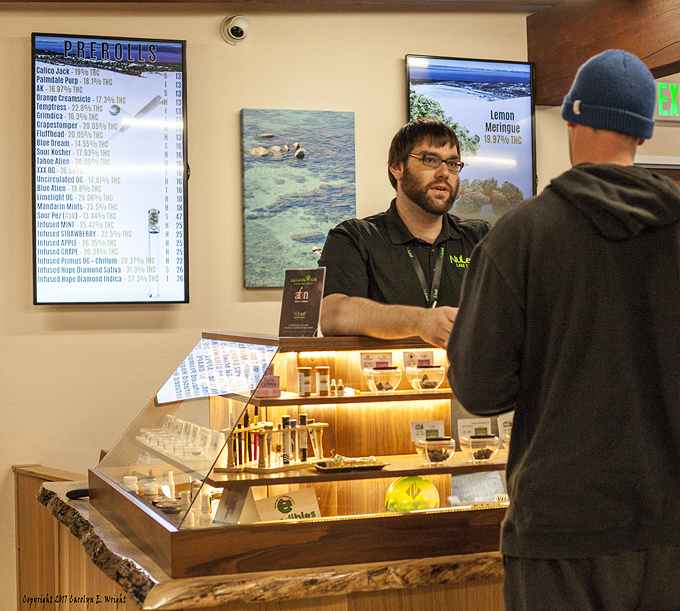
Sam Fuller talks to a customer about what his shop has to offer. Photo Copyright 2018 Carolyn E. Wright

Cartridges are another way to partake in pot. It’s similar to a vaping pen. Zaninovich explains this is a more discrete, easier way to use the drug.

For cancer patients, the most popular item is Rick Simpson oil.

“It’s shown a lot of promise for people dealing with cancer,” Zaninovich said.

The budtenders – that’s what the salespeople are called – are well versed in the products. They can speak to what someone might feel by eating or smoking or vaping a product, they know where it came from, and are patient with those who aren’t accustomed to buying pot legally.

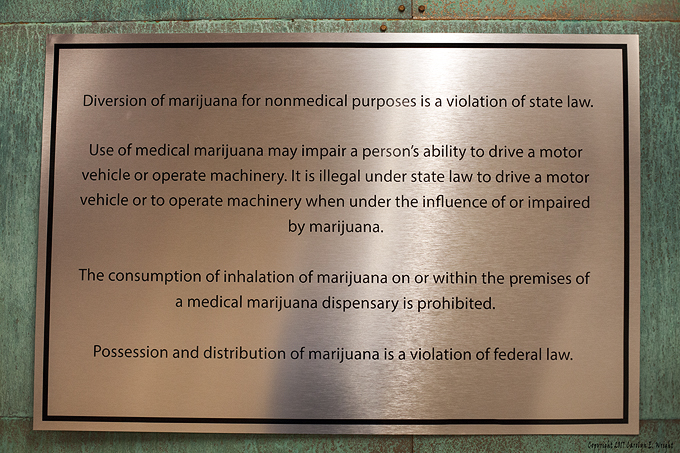
There is a limit to how much one can buy – 1 ounce, or 3½ grams of concentrate. This is to abide by state law as to how much one person is allowed to have on them at a time. No one can use the goods on the premise. It’s also not legal in Nevada to smoke in public.

Rules about the use of marijuana are clearly posted. Photo Copyright 2018 Carolyn E. Wright

Each purchase comes in a sealed, child proof package.

An ATM is in the lobby. Cash is the way business is transacted because marijuana is still illegal on the federal level. An ATM machine exists inside the shop, which is essentially taking cash from the lobby ATM. It gets around some banking rules.

Against the left wall are accessories as well as ointments, lotions, salts, patches and other products such as coffee with CBD. Items with CBD for pets are also available. Apparel is for sale, too.

NuLeaf is on the main street through Incline. On this particular day people of all ages – most appeared older than 30 – men and women, were making purchases. The store is open seven days a week.


Opinion: Putting a price tag on life

By Eli Cook

Everything, as they say in America, has its price: It has been found that a lack of sleep costs the American economy $411 billion a year and stress another $300 billion. Countless other studies have calculated the annual cost of pain ($560 million), heart disease ($309 billion), cancer ($243 billion), and diabetes ($188 billion). Surf the web at work sometimes? That costs the American people $63 billion a year. Did you show up hungover as well? Tack on another $77 billion.

And while you may not know it, the American government has long put a price tag on Americans themselves. The Obama administration pegged the value of the average American life at $9.1 million. That was up from $6.8 million under the Bush administration.

Americans have developed the penchant for measuring nearly every aspect of their lives in dollars and cents, a process of seeing humans as assets that is so deeply ingrained in American life and decision-making that it constitutes a national philosophy.

Consider the price tags that Americans place on nature. According to “willingness to pay” surveys, dog owners will shell out $7,000 more than cat owners to save their pets, while Americans would pay $257 to save the bald eagle from extinction and $208 to save the humpback whale. (That may sound noble but should be compared to the survey finding that Americans would pay $225 to drop 10 pounds.) Think the purple mountain majesties of a Yosemite or a Yellowstone are priceless? Think again. The total economic value of the National Park Service was recently estimated at $92 billion.

Finally, there is the planet itself: Americans are willing to pay $177 a year to avoid climate change and save the world. That’s about 75 percent  more than what they pay a month for cable TV.

What is the impetus behind such calculations? The short answer: cost-benefit analysis. In 1981, President Ronald Reagan passed executive order 12,291, which mandated cost-benefit analysis for all major environmental and health-and-safety regulations. Many of the above examples were the product of such analyses. But if you look back farther—before the Reagan era—to the mid-19th century, you’ll find that the pricing of everyday life has long been an American pastime. Go back even farther, to the 18th century, and you will uncover some of the deep—and disturbing—origins of this American penchant to price everything and everyone.

In 1830, for example, the New York State Temperance Society measured the social damage produced by excessive drinking by pricing the overall cost to the city. “There cannot be a doubt,” the society concluded after a series of in-depth calculations, “that the city suffers a dead yearly loss of three hundred thousand dollars” due to “time spent drinking,” “drunkenness and strength diminished by it,” “expenses of criminal persecutions,” and “loss to the public by carelessness.” An 1856 article titled “The Money or Commercial Value of Man” in Hunt’s Merchants magazine—the first national business magazine in America—valued the education of New York children at a profit of $500 million to the country.

In 1910, an article in the New York Times headlined “What the Baby is Worth as a National Asset” utilized Yale economist Irving Fisher’s money valuation of human beings to deduce that “an 8 pound baby is worth, at birth, $362 a pound.” By 1913, as eugenics became the rage,  the National Committee for Mental Hygiene asserted that the insane were “responsible for loss of $135,000,000 a year to the nation.”

Such acts of social pricing, while rare in the early 19th century, were ubiquitous by the early 20th. The common thread running through these examples is that the men (and they were nearly all men) who made these calculations were imagining American society as a capitalized investment and its inhabitants as income-generating units of human capital.

Aspects of everyday life such as education, mental health or alcohol consumption could only be given price tags if one treated American society and its residents as a series of moneymaking assets, thus measuring their value in accordance to their ability (or, in the case of hungover employees surfing the net, their  inability) to generate monetary income. This uniquely capitalist way of conceiving of the world, which I have called “investmentality,” was already poignantly on display in that 1856 Hunt’s Merchants magazine article which priced the value of a child’s education.

“The brain is … an agricultural product of great commercial investment,” noted the author, and the “greatest problem of political economy” was how to “produce the best brain and render it most profitable.”

Today, as the term “human capital” crops up everywhere and countless self-help experts encourage Americans to become more productive by “investing in yourself,” an investmentality has achieved the status of common sense.

The investmentality that sparked the pricing of everyday American life emerged out of the rise of American capitalism. The key element that separates capitalism from previous forms of economic organization is not market exchange or monetary spending (those have been around for thousands of years) but rather widespread capital investment. Such investments are acts through which various aspects of everyday life—be they natural resources, industrial factories, cultural productions, or technological inventions—are reconceived as income-generating assets and valued as such. As capital flowed into various investment channels across the United States in the 19th century, distinctly capitalist quantification techniques escaped the confines of the business world and seeped into every nook and cranny of society.

Like capitalism itself, the pricing of everyday life is not an exclusively American phenomenon. Similar examples of investmentality and social monetization first appeared in 17th-century England and can now be found across the globe. What distinguishes America is the enthusiasm with which our elites embraced money measures. As early as the 1830s, Alexis de Tocqueville recognized that “as one digs deeper into the national character of the Americans, one sees that they have sought the value of everything in this world only in the answer to this single question: how much money will it bring in?”

There are various reasons why the United States embraced the pricing of everyday life more than other nations—including the long-standing American tendency to leave much of the responsibility for the allocation of resources, cultural production and economic development in the hands of private capitalists rather than public states.

Yet one reason demands a few final words: American slavery.  The “chattel principle” and the rise of an economic institution in which human beings were actually bought and sold helped to jumpstart, legitimize, and normalize the pricing of everyday life. On the rare occasions when early Americans did seek to evaluate social developments in monetary values, slaves served as their main source of both inspiration and data.

The earliest instances of the pricing of everyday American life I discovered in my research were from South Carolina in the 1710s—the colony with the highest proportion of slaves and the most capital invested (especially in large rice plantations). By the 1740s, James Glen, South Carolina governor and slaveholding planter, anticipated the invention of gross domestic product two centuries later by calculating the income generating “value” of all inhabitants of the colony at £40,000 a year.

Up North, similar developments were afoot. In 1731, Benjamin Franklin priced the social cost of a smallpox epidemic in Philadelphia by calculating each loss of life at £30 because that was the going price of slaves in the city. He was not alone. “Calculating the value of each person, in a pecuniary view, only at the price of a negro,” the newspaper called the Weekly magazine estimated the monetized worth of  all Americans as “equal to nearly one hundred million sterling” in the 1790s.

It was, in short, often the institution of slavery that set important historical precedents by first enabling early Americans to price the residents of their young nation, be they free or enslaved. By the mid-19th century—following a half-century in which Southern investment in human bodies (alongside Northern investment in real estate, railroads and factories) had fanned the flames of American investmentality—slavery finally came to an end. The pricing of everyday life, however, was just taking off.

Eli Cook is an assistant professor of history at the University of Haifa. An historian of American capitalism, he is the author of “The Pricing of Progress: Economic Indicators and the Capitalization of American Life” (Harvard University Press).


Hipsters go glamping, and RV makers soar

By Spencer Jakab, Wall Street Journal

For anyone who has gotten stuck on a mountain road behind a massive recreational vehicle, get used to it, there are a lot more on the highway.

Recreational vehicles, ranging from bus-sized motor homes to retro trailers, have been a boom-and-bust industry since they first became popular in the early 1970s. Now a wave of retiring baby boomers and a surprisingly young new fan base have sent U.S. unit sales above their housing boom peak. S

The fundamentals—fuel prices, interest rates, disposable income and demographics—all look solid. That has the Recreation Vehicle Industry Association projecting a further jump this year and next. Despite that, delighted investors might want to unhitch themselves from these stocks. When things go badly for the economy, they go very badly for RV makers.

Read the whole story


Top fitness trends for 2018: Back to basics

By Patti Neighmond, NPR

Enough already with the activity trackers and fitness apps. They’re so 2017. If you’re tired of tech and of exercising solo and are ready to simplify your routine — maybe even join a group exercise class — you’ll be in good company this new year.

The latest annual survey of fitness professionals suggests 2018 will find more of us ditching the gadgets and getting back to basics in the way we work out: more resistance training, yoga and jump-ropes; fewer earbuds and iWatches.

In the recent survey, the American College of Sports Medicine checked in with more than 4,000 fitness professionals around the world and asked them to look beyond marketing and discern exercise trends from fads.

Read the whole story


Nevada law aims to tackle opioid epidemic

By Jessie Bekker, Las Vegas Review-Journal

Doctors have additional protocols to consider when writing and maintaining opioid prescriptions under a new law that took effect on New Year’s Day.

The Prescription Drug Abuse Prevention Act, passed by the 2017 Legislature, outlines safeguards for doctors before they prescribe controlled substances to treat pain and increases requirements necessary to continue a prescription after one month, three months and a year.

The additional paperwork is meant to curb the state’s opioid overdose problem and track down doctors who overprescribe.

Read the whole story


Participate in LTN’s monthly book club

Lake Tahoe News has launched an online book club in the hopes of getting more people to read. It will also give people the opportunity to “talk” about the book via the comments. Questions will be asked and ideally a “dialogue” will follow much in the same way an in-person book club would work.

Anyone may comment, even pose your own questions.

On the first of each month a new book will be reviewed. The title of the next book will be included at the end of each review.

If you would like to review a book, please send us an email at info@LakeTahoeNews.net with “Book Review” in the subject in, the title and author of the book, and why you chose that book. We’ll get back to you soon.

Here is the review for Jan. 1. It’s about the founders of Airbnb.

The book to be reviewed for Feb. 1 is “What Unites Us” by Dan Rather and Elliot Kirschner. 


New Nev. laws tackle day care, women’s health issues

By Kimber Laux, Las Vegas Review-Journal

Several laws adopted by the Nevada Legislature in 2017 sprang into effect just after midnight Monday.

Amid the new crop of legislation are laws that require state insurance plans to cover contraceptives, strengthen penalties for guardians who abuse or neglect vulnerable persons in their care, and increase regulations on day care facilities.

The enactment of Senate Bill 233 and Assembly Bill 249 guarantees Nevada women access to contraception and other preventive care services, such as mammograms and HPV screening and vaccinations. The new laws require private and state insurance plans, including Medicaid, to provide coverage for reproductive health and allow women to obtain a 12-month supply of contraceptives.

Read the whole story


Snippets about Lake Tahoe

·      Filing for judge positions opens Jan. 2. The terms are up for Douglas County’s two judges.

·      The team behind the grocery store on Capitol Avenue in Truckee is having a neighborhood meeting Jan. 11 at 6pm at the Hampton Inn & Suites in Truckee. The proposed tenant is Grocery Outlet.

·      Here are the El Dorado-Tahoe and Sierra roadwork schedules for the week.

·      The Hangar, a craft brewery, is expected to open in January where the amusement park used to be in South Lake Tahoe off of Highway 50 near the Upper Truckee River.