K’s Kitchen: Redefining spaghetti dinner

By Kathryn Reed

This is an incredibly unique way to serve pasta.

With the whole milk and all the cheese, it is definitely not light on the calories. And, well, so what? Sometimes it’s good have some fat in your diet. This just isn’t something to have every night or every week.

The flavor is outstanding. It’s a bit rich, but not over the top.

I’m pretty sure this was the first time I’ve use my springform pan for something other than a cheese cake.

Spaghetti Pie

Unsalted butter, softened, for brushing

1 pound spaghetti

3 T olive oil

1  medium yellow onion, minced

5 garlic cloves, minced

1 pound mixed wild mushrooms cut into 1-inch pieces

Kosher salt

Pepper

5 ounces spinach

3 large eggs

1½ C whole milk

3 C Fontina cheese, shredded

1 C fresh ricotta cheese

1 C Parmigiano-Reggiano cheese, grated

1 T sage, chopped

1 T thyme leaves

Preheat oven to 425 degrees. Tightly wrap the outside of a 9-inch springform pan with foil and brush the inside with butter.

Cook the spaghetti until barely al dente; drain.

In a large skillet, heat 2 tablespoons of the olive oil. Add the onion and garlic, cook over moderately high heat, stirring until sizzling. Add the mushrooms, season with salt and pepper; cook until browned. Set aside in a bowl.

In the same skillet, heat the remaining tablespoon of olive oil. Add the spinach, season with salt and pepper and cook over moderate heat until just wilted.

In a large bowl, whisk the eggs with the milk.

Add the spaghetti, mushroom mixture, three cheeses, sage, thyme; mix well.

Pour the mixture into the pan. Place the pan on a baking sheet and bake for about 35 minutes, until bubbling and the top is golden. Let stand for 15 minutes. Remove the ring, cut the pie into slices.


Opinion: How to win at winter

By Lori Moore, New York Times

My first winter in the Northeast, I thought I was set.

When I was growing up in the South, the heaviest coat I ever owned was a corduroy pea coat — more of a jacket, really. But after a year of working in the powdery mountain snow out West, I moved to New York City with a heavy Patagonia fleece, a knit hat or two, and a pair of gloves. Nothing could faze me after 20-foot snowdrifts, so I thought.

I found myself raging at winter, which seemed to never end. Long after the date I was used to greeting the spring, snow was still falling.

In short, I hated winter when I first moved north. But now, I find myself looking forward to it. It took over a decade, but I have learned ways to not just deal with the coldest season but to seek out the joys of it.

Read the whole story


$125,000 snow machine latest toy of the superrich

By Kyle Stock, Bloomberg

Way back in the snow-choked mountains, miles from any road, curb appeal is still a thing.

Consider the Tucker Sno-Cat. It sits on four treads, seemingly designed for a tank, that nevertheless appear to float atop fluffy snow that’s swimming pools-deep. The cab is painted an industrial orange that contrasts cartoonishly against the cottony landscape. A Tucker, like all great vehicles, is a cross between a serious machine—purpose-built for a job—and a child’s toy.

Demand for Tucker Sno-Cats—both new and used—is peaking, thanks to affluent landowners, classic collectors, and gearheads with a love of snow.

This year, Tucker drew almost $600,000 in government contracts, including an order to service seven of its machines at the U.S. Marine Corps Mountain Warfare Training Center in California’s Sierra Nevada.

A few months ago, a customer with a spread near Lake Tahoe ordered a Tucker in Ferrari red. 

Read the whole story


Adaptive ski festival on North Shore

Achieve Tahoe, a leading provider of winter and summer adaptive sports instruction for adults and children with disabilities, will host the Ability Celebration & Winter Ski Festival, its annual military sports camp for injured veterans and their family members, Jan. 16-19 in North Lake Tahoe.

The program will provide 34 participants with complimentary ski and snowboard lessons, overnight accommodations in the Village at Squaw Valley, meals and transportation.

Participants will travel to North Lake Tahoe from all over the country to participate in specialized private ski and snowboard instruction that will be provided to them free of charge. Each person will receive lessons specifically designed to support their physical therapy, boost their emotional well-being, build their confidence and ultimately help their re-integration into their communities. The veterans in attendance are also invited to bring a guest to share in their experience, and to provide them with support and encouragement.

The Warfighter Sports program was designed to offer sports rehabilitation for severely wounded warriors in military hospitals and communities across the U.S. through a nationwide network of over 120 community-based chapters of Disabled Sports USA. The program helps to rebuild lives through sports by improving self-confidence, promoting independence and uniting families through shared healthy activities.

Contributions cover all expenses for participation of the warrior and a family member, including individualized adaptive instruction, adaptive sports equipment, transportation, lodging and meals. Since 2003, more than 12,000 of the most severely wounded and their families have been served, including those with amputations, traumatic brain injury, spinal cord injury, visual impairments, and significant nerve and muscle damage.


Fires prompt bill to improve emergency alert system

By Joaquin Palomino, San Francisco Chronicle

North Bay lawmakers have introduced a bill to bolster the ability of emergency officials to contact residents who may be in harm’s way — a topic that has been scrutinized since last year’s devastating wildfires.

The legislation, introduced by multiple lawmakers, including state Sen. Mike McGuire, D-Healdsburg, would create uniform statewide emergency notification protocols. It also would require all counties to develop and adopt guidelines for using Wireless Emergency Alerts, a federally administered system that can send Amber Alert-style messages to cell phones in a disaster area.

As the Chronicle and others have reported, many North Bay residents said they received no official warning and were blindsided by the rapidly spreading flames that sparked in multiple counties in October.

Some experts said that statewide systems can be useful for regional or large-scale disasters, but in smaller incidents notification decisions are often better left to local leaders.

Read the whole story


South Lake Tahoe pot shop willingly closes doors after being denied for-profit status by state

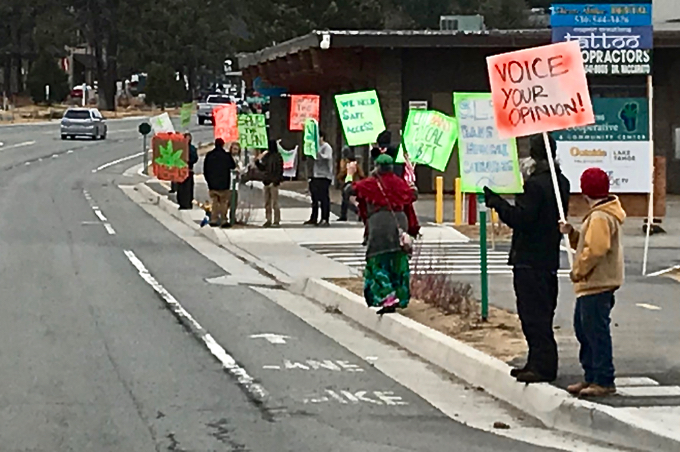
People wanting Tahoe Wellness Cooperative to remain open picket outside the center on Jan. 7. Photo/LTN

By Kathryn Reed

Tahoe Wellness Cooperative shut its doors on Jan. 7, but the medicinal marijuana shop hopes to reopen tonight or Tuesday morning.

There is a discrepancy as to why exactly the doors were closed because neither the state nor the city of South Lake Tahoe directed the business to do so.

“He decided to close on his own free will,” City Manager Nancy Kerry told Lake Tahoe News of TWC owner Cody Bass.

As California started its foray into recreational marijuana on Jan. 1, it also meant changes for existing medicinal marijuana establishments. New businesses and those changing their status must have a permit from the state Bureau of Cannabis Control. Those permits are temporary until June at which time the state will be assessing what is working and what isn’t.

The South Lake Tahoe shop said it had its license in hand before 2018 arrived.

However, a letter dated Jan. 5 from the state agency to Bass says, “After review of your application and supporting documentation your application is denied because you do not qualify for a temporary license at this time. You have not been authorized by the local jurisdiction to conduct the commercial cannabis activity for which you have applied.”

The “commercial” aspect is what is the stumbling block. This puts TWC under a different classification from how it has operated for the last seven years as a nonprofit. It would still only be a medicinal dispensary because the city has a temporary moratorium on recreational sales.

“Commercial designation means for-profit and that they could only do business with other licensed entities,” Alex Traverso with the state Bureau of Cannabis Control told Lake Tahoe News.

Bass would not speak directly to LTN.

Had Bass not sought the commercial designation, he could have been operating as he always has. He did not need a temporary state license to continue what he had been doing.

The city had to tell the state if TWC had a permit to do business. It doesn’t, but the city explained by court order the dispensary is allowed to operate.

(The city and Bass are in a legal dispute about the permit. While a court hearing is slated for next month, that could be a moot point because Bass is in escrow to buy the building near the Bijou Center – which means he’d be his own landlord and would permit the business to continue operating.)

“In order for a state license to be issued, the local government must also agree to permit the business, and the local government was not willing to permit the activity. So we couldn’t license Tahoe Wellness,” Traverso said.

On Sunday less than a dozen people were outside TWC protesting. They were placing blame for TWC’s closure on everyone but TWC when in fact TWC chose to lock its doors.

The TWC employee who said the dispensary may soon reopen didn’t explain why this could happen nor did the person elaborate if TWC would stick with being a nonprofit.

This means for now NuLeaf in Incline Village is the only place to get marijuana legally in the Lake Tahoe Basin.


Educating people about human trafficking in Tahoe

By Alysone Hussmann

The question I get asked the most when sharing that I’m a member of PATH (Partners Against the Trafficking of Humans) is: Is human trafficking happening here in South Lake Tahoe?  The answer is yes, although solid numbers are hard to come by. 

Recently, it was reported in local media that 14 people were arrested and one 17 year old girl rescued from a trafficking ring in El Dorado County that included South Lake Tahoe, Placerville, and El Dorado Hills.  This sting operation began by looking at escort and dating sites on the internet, one of the main ways that traffickers target young girls and boys. 

In an article by Awaken (an anti-trafficking organization based in Reno), “Mapping Commercial Sexual Exploitation around Reno,” Lake Tahoe is a hot spot for sex trafficking. It is part of the Highway 50 corridor from San Francisco, Sacramento, to South Lake Tahoe, and an easy cross-over state lines into Nevada.  According to the Human Trafficking Initiative Data Science Lab, in 2016 there was one case of trafficking at Emerald Bay, 200-225 cases in Lake Tahoe, with 50-55 cases specifically in South Lake Tahoe, and 900-1,000 in Reno. 

In the United States alone, it is estimated that between 100,000 and 300,000 people are trafficked annually.    According to a report by the Polaris Project, who maintains a national human trafficking hotline number, they had 8,742 cases of human trafficking reported to them in 2016 – a 35 percent increase over 2015.  These identified cases comprise the largest available data set on human trafficking in the U.S., but is estimated to be significantly underestimated, as many are not aware of the national hotline number (Hotline Number: 888.373.7888). In 2016, sex trafficking first started 49 percent of the time between the ages of 12-17, with the average age being age 18.

Globally, it is estimated that there are 4.8 million victims of sex trafficking, according to the International Labor Organization. Women and girls are disproportionately affected by human trafficking, also called modern slavery, accounting for 28.7 million or 71 percent of the overall total. More disturbing, is the estimate that one in four children is a victim of modern slavery, with 21 percent of the total victims in this category being children who were commercially sexual exploited. The average length of time of forced sexual exploitation is two years.

So how do traffickers find their victims? They use social media sites and online advertisements to market minors and trafficked victims. These traffickers’ tactics are very sophisticated and persuasive. According to the Polaris Project, the top recruitment tactic (36 percent in 2016) is by developing an intimate partner relationship (called a Romeo pimp) with their potential victim. Familial trafficking represents 21 percent of the tactics – yes, parents traffic their children. And 11 percent are promised a job (such as modeling). Traffickers lurk at public recreation facilities, and casinos, (basically wherever teenagers like to hang out), and large sporting events are also a hot spot for trafficking.

What can we do about human trafficking in our community? Local, South Lake Tahoe Coalition PATH (Partners Against the Trafficking of Humans), partners with other organizations to bring awareness and education to the South Lake Tahoe community. Our website is updated regularly. PATH’s mission is to increase community awareness of human trafficking through prevention education. For two years we have partnered with 3 Strands Global to educate the ninth-grade classes at South Tahoe High School, and we are working to expand that program, in an age appropriate manner to 5th-, 7th-, 9th-, and 11th-graders. 

To increase community awareness – PATH is sponsoring an event, in partnership with Live Violence Free and Tahoe Youth & Family Services,  as January is Human Trafficking Awareness Month. There will be a short film about human trafficking and how it can happen in a small rural town with a straight A student. It will be followed by a panel from our partner 3 Strands Global (who provides our school prevention education), and they will share a survivor’s story from someone right here in El Dorado County. The event will take place on Jan. 30 at 6:30pm at the Duke Theatre at Lake Tahoe Community College for a $5 donation to PATH (no one will be turned away). 

We encourage all members of the community to attend, especially parents of middle and high school kids, teachers, health care workers, and anyone interested in learning more about human trafficking. 

Again, the National Human Trafficking Hotline Number is 888.373.7888.



Bald eagle count participants sought

Tahoe Institute for Natural Science will host the 37th annual mid-winter bald eagle count on Jan 12 from 9am-noon.

Participants must commit to arriving 15 minutes early, and staying for the full three hours of the survey. 

The results of the count will be combined with those from across the nation to generate an index of bald eagle populations wintering in the United States. The count is part of the National Midwinter Bald Eagle Survey that was initiated by the National Wildlife Federation in 1979. Over the years, the coordination of the national effort has changed, and is currently managed by the United States Army Corps of Engineers. 

To register, go online.


Why there’s a rush to buy untreated water

By Nellie Bowles, New York Times
 
SAN FRANCISCO — At Rainbow Grocery, a cooperative in this city’s Mission District, one brand of water is so popular that it’s often out of stock. But one recent evening, there was a glittering rack of it: glass orbs containing 2.5 gallons of what is billed as “raw water” – unfiltered, untreated, unsterilized spring water, $36.99 each and $14.99 per refill, bottled and marketed by a small company called Live Water.

“It has a vaguely mild sweetness, a nice smooth mouth feel, nothing that overwhelms the flavor profile,” said Kevin Freeman, a shift manager at the store. “Bottled water’s controversial. We’ve curtailed our water selection. But this is totally outside that whole realm.”

Here on the West Coast and in other pockets around the country, many people are looking to get off the water grid.


Read the whole story


Exhibit to feature 1960 Squaw Valley Olympics

El Dorado Arts Council’s latest exhibition will celebrate the 1960 Winter Olympics.

This curated exhibition of art, memorabilia, and promotional items from the 1960 Winter Olympics in Squaw Valley runs Jan. 12-March 9 at the organization’s Fausel House Gallery in Placerville.

Generously loaned from the Museum of Sierra Ski History and 1960 Winter Olympics, and collector Stan Batiste, the items on display in this exhibition are unique to their time.
 
Photographs capture the excitement of the spectators and champions alike, maps of the competition trails artistically show where the triumphs and losses occurred, and souvenirs exemplify the magic of the day.

The public opening reception takes place Jan. 18 from 6-8pm. Collector Stan Batiste, author David C. Antonucci, and official Olympic photographer Bill Briner will also be in attendance to celebrate the opening of The Games of Winter and recapture the camaraderie of the 1960 Winter Olympic Games. Attendance and parking are free.

For more info, email andrew@eldoradoartscouncil.org.