Reasons why the U.S. is vulnerable to big disasters

By Morten Wendelbo, The Conversation

During the 2017 disaster season, three severe hurricanes devastated large parts of the U.S.

The quick succession of major disasters made it obvious that such large-scale emergencies can be a strain, even in one of the world’s richest countries.

As a complex emergency researcher, I investigate why some countries can better withstand and respond to disasters. The factors are many and diverse, but three major ones stand out because they are within the grasp of the federal and local governments: where and how cities grow; how easily households can access critical services during disaster; and the reliability of the supply chains for critical goods.

For all three of these factors, the U.S. is heading in the wrong direction. In many ways, Americans are becoming more vulnerable by the day.

Where Americans live

Large shares of the U.S. population live in the parts of the country most vulnerable to major disasters, mainly coastal areas prone to hurricane damage. Hurricanes Katrina, Sandy, Harvey and Irma all hit heavily populated coasts.

Seven of the 10 largest metropolitan areas in the U.S. are on or near the coast, accounting for more than 60 million people. In fact, the vast majority of counties with more than 500,000 inhabitants are concentrated on the coast.

More than 5 million Americans also live on islands like Puerto Rico and Hawaii, where a hurricane, volcanic eruption or tsunami can be devastating.

California has been spared landfall of a major tropical cyclone, but torrential rainfall still causes severe damage along the coast. On top of this, most of California’s coastal cities are adjacent to the San Andreas Fault, which caused the death of around 3,000 people in 1906. Geologists agree that another large earthquake is bound to occur.

Large concentrations of people pose problems, too. To support large populations in small spaces, cities need advanced large-scale infrastructure – not only to house people, but to deliver utilities like electricity and gas, as well as to tame water with dams, levies and spillways.

While such infrastructure is impressive, its occasional failure can have grave consequences. In several of the most severe American disasters, infrastructure collapse caused substantial damage. In New Orleans, the Lower Ninth Ward was violently flooded when levies collapsed. In the 1906 San Francisco earthquake disaster, gas mains ruptured, fueling a deadly fire that tore through the city for days.

The large cities on the coasts are consistently growing larger. The 10 largest metropolitan areas on the coast alone have grown by almost 5 million people since 2010, an increase of nearly 7 percent.

Experts project that by 2040, these 10 metropolitan areas will add a whopping 16.7 million more people, making the total population around 92.5 million people – most of whom will be particularly vulnerable to disaster.

Access to emergency funds

In a disaster, people often need money to cover medical care, food, water and other crucial needs. In a frustrating catch-22, however, access to funds can be severely limited if power outages take out ATMs and credit card terminals. That was the case in Puerto Rico after Hurricane Maria.

A 2015 Federal Reserve survey found that even with access to bank accounts and ATMs, almost half of Americans would be unable to find $400 for an emergency without borrowing or using a credit card.

Today, there’s almost three times the amount of U.S. currency in circulation as there was in 1997. But a large share of dollar bills are actually used abroad. U.S. dollars are the legal or de facto currency in many countries, as well as a preferred currency for savings around the world. Consequently, the amount of cash in circulation that is actually available to make transactions in disasters is relatively low.

The problem with access to cash to cover emergency expenses is especially acute for minority Americans. The same Federal Reserve survey showed that even for Americans with the same income, blacks and Hispanics are far less likely to have access to the $400 emergency funds than whites.

Blacks and Hispanics are also more likely to be poor than whites non-Hispanics, and poor families are far more susceptible to disasters.

Worse still, the proportion of minorities in metropolitan areas are often far above the national average, compounding the vulnerability of minorities. In fact, in all but one of the 10 largest metropolitan areas on the coast, the minority population is growing faster than the white non-Hispanic population.

Supply chains

Even if Americans do have the funds necessary to pay for critical goods, those goods may not be available during a disaster.

Without access to pharmaceuticals, medical equipment and fuels, many people would die. Many of these critical goods are exclusively produced overseas; in fact, the 30 most critical pharmaceuticals, such as insulin for Type 1 diabetes and heparin for blood thinning, are all produced in whole or in part abroad. Sometimes the goods are produced in a single geographic area or even by a single facility.

That makes the supply of these critical goods very vulnerable to natural disasters or other emergencies. If a global pandemic affects China or India as well as the U.S., there would be almost no way to source the critical goods necessary to save Americans infected by the disease.

At the same time that production of many critical goods are moving abroad, stockpiles and storage are exceptionally low for most goods. Goods often arrive at the consumer continuously, just in time for when they are needed. The rapidly growing international transportation industry can deliver quickly and reliably, leaving little reason for hospitals to spend on substantial storage of most goods.

Some U.S. hospitals receive critical pharmaceuticals as often as three times per day. On a regular day, it’s possible for an efficient system to keep emergency rooms stocked, but during a disaster – when workers are absent, transportation is slowed and production abroad is potentially knocked out – Americans are left incredibly vulnerable. There’s little margin for error, and that margin shrinks apace with the expansion of “just-in-time” systems.

Morten Wendelbo is a research fellow and policy sciences lecturer, Texas A&M University.



When sports betting is legal, the value of game data soars

By James Glanz and Agustin Armendariz, New York Times

Every weekend during soccer season in Britain, security personnel find them in stadiums, tapping furiously at their phones or talking nonstop into a mic, mysterious customers often wearing hoodies to conceal earpieces and their identity. While focused with unwavering intensity on the action of the game, they show none of the engagement and excitement of the ordinary fans around them.

The unofficial data scouts — or data thieves, depending on who is describing them — are quickly ejected once they are discovered.

The fleeting data they are collecting — the minutia of what is happening in the game — is the lifeblood of sports betting, perhaps the most crucial and valuable element of the entire industry. If gambling operators are to monetize sports betting fully, they have to offer wagers on far more than the outcomes of games. Data on the second-by-second action — exactly when a goal is scored, where it landed in the net, who had the assist — creates manifold betting opportunities.

Read the whole story


Tahoe bear book to be released in Spanish

Krissi Russell has written a bilingual version of her original sing-along story “In The Meadow (Don’t Feed Our Bears).”
“No Alimente a nuestros osos – Don’t Feed Our Bears” features the same full color illustrations and the same toe tapping melody. The difference is there are now two musical versions of the same message: Don’t feed our Tahoe wildlife.

Whether it’s a bear in the street, a coyote in the meadow, or Canada geese on the beach, you’re bound to encounter wildlife in Tahoe. This sing-along story is designed for Tahoe locals and visitors, the young and the young at heart.

Digital download of music is included with purchase of the 32-page soft cover book. Each page is written in Spanish and English. Release date is Aug. 1.

The South Shore author will be in the lobby at Lake Tahoe Community College during the Spanish Summer Institute on July 31-Aug. 2.

Russell has been a Spanish teacher in the Lake Tahoe Unified School District for 24 years.

For more information go online or contact Russell at Littlebearbooks@att.net.


Gamblit CEO confident skill-based games will make mark

By Todd Prince, Las Vegas Review-Journal

 Skill-based slot machines seemed to be the talk of the town during the first half of 2017.

Their arrival on gaming floors generated interest like a new Hollywood film.

Fast-forward a year, and the excitement has fizzled. At least for now.

The first generation of skill-based machines — dwarfed on casino floors by hundreds of better-known slots — failed to attract much player interest, casino floor managers say.

Read the whole story


Caring for Fido when playing in the backcountry

By Michael Krueger and Amanda Stuart, Moonshine Ink

In summer, we all want to be outdoors with our dogs. Just like we bring Band-Aids and water on long hikes for ourselves, there are a few keys to keeping our dogs healthy in the wilderness. That’s why ski patroller and outdoor enthusiast Michael Krueger teamed up with veterinarian Amanda Stuart to offer classes this summer called Wilderness First Aid For Dogs.

Krueger says for humans, the main question a wilderness first aid responder needs to keep in mind is, “What do I need to do to quickly stabilize an ill or injured person and get him or her out of the backcountry as fast as possible?”

Dog owners should be prepared with the same question for their canine hiking companions: “What do I need to do to stabilize my dog and get him or her out of the backcountry to a veterinarian as quickly as possible?”

Read the whole story


Nevada releases school safety report

By Meghin Delaney, Las Vegas Review-Journal

Nevada Attorney General Adam Laxalt released a wide-ranging set of recommendations on school safety, but there’s no clear idea of what the measures may cost or who would foot the bill.

The report stems from a school safety summit Laxalt held in March with education and safety officials after a Feb. 14 shooting at a school in Parkland, Fla., reignited the national conversation on school safety nationwide. During that summit, he stressed prioritizing the physical safety and “hardening” of schools to make it more difficult for an assailant to enter campus.

The seven major themes of the report including increasing police presence, adding new safety features, improving communication between schools and law enforcement officials and enacting “red flag” laws to evaluate potential threats with a nexus to mental illness or domestic violence.

Read the whole story


Calif. allows aerial SuperTanker to re-join fire fight

By Kellen Browning, Sacramento Bee

As wildfires rage across California, beleaguered fire officials are calling for reinforcements. After a lengthy delay, a modified 747 airplane is expected to be deployed this weekend to assist with the fight.

The Global SuperTanker, a Boeing 747 airframe modified for firefighting, received approval from Cal Fire and the U.S. Forest Service on Friday night to begin dropping water, retardant and suppressant on wildfires, according to Global SuperTanker Services CEO Jim Wheeler. The plane, named the Spirit of John Muir, can fly up to 600 miles per hour and deliver up to eight drops totaling 19,200 gallons in a single flight.

Read the whole story


Plenty to do without snow on top of Heavenly

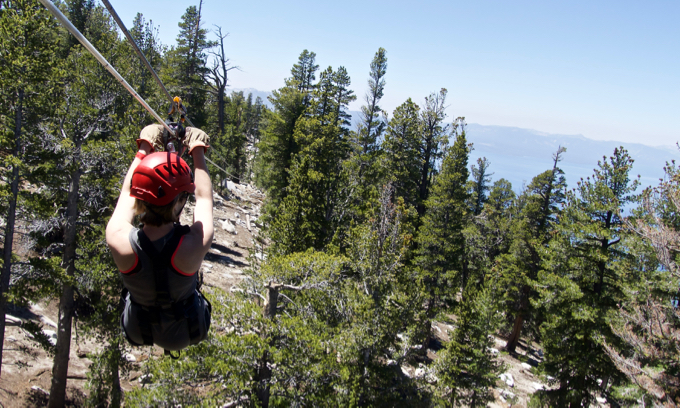
Jessie Marchesseau flies along one of the ziplines at Heavenly with Lake Tahoe in the distance. Photo/Kathryn Reed

By Kathryn Reed

Zip on” –  it’s a phrase being echoed through the trees at Heavenly Mountain Resort.

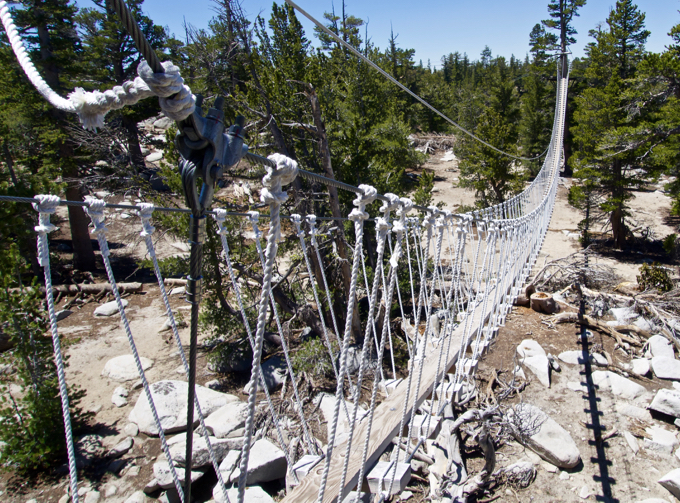
At speeds of 35 mph it’s almost like Lake Tahoe is a blur of blue flying by. A series of seven ziplines and two sky bridges on the Skyway zipline tour are hidden in the woods; starting behind the Tamarack Lodge and finishing just below the midway station of the gondola. The longest being 950 feet.

On this particular day four members of the Lake Tahoe News team had an opportunity to tryout whatever we wanted at Epic Discovery, the summer playground Heavenly has created at the top of the gondola.

None of us had been on the Skyway; in fact, this was a first for Jessie and Terra to experience any of the summer amenities. For Sue it was her inaugural time on a zipline.

There is no arguing this is an incredibly scenic and unique way to experience the Tahoe forest.

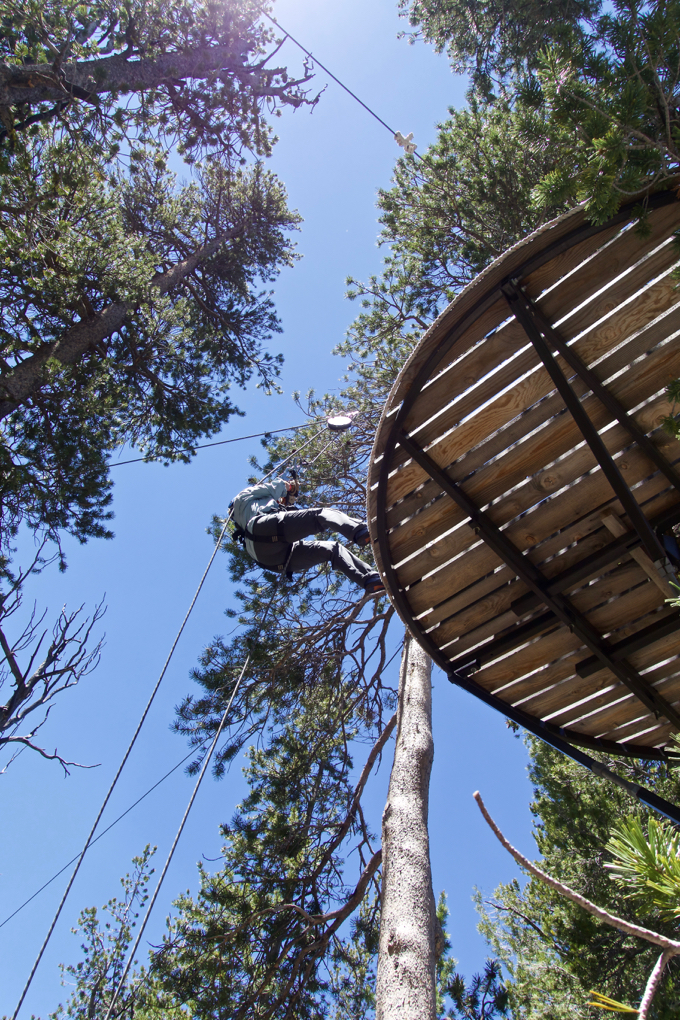
Sue Wood on belay as she descends the last tree platform. Photo/Kathryn Reed

It takes about three hours to complete the tour. This does not include getting the gear on and off. It definitely takes a certain amount of fitness to even walk to the starting point with harness et al, and then to be able to pull yourself in on the line.

We took a little longer than usual because one person had to leave early and therefore be belayed from one of the tree platforms, and another didn’t stop correctly so she had to be pulled in by one of the guides.

A big shout out to Mikey and Jackson who were exceptional guides. Their instruction, patience and encouragement were outstanding.

After a bite to eat we took a spin down the tubing hill. While at the bottom it doesn’t look like much, it goes faster than you expect. Ask the attendants at the top for a spin to make it even more fun.

One of two bridges to cross along the Skyway zipline tour. Photo/Kathryn Reed

While Jessie and I were up for doing more, we didn’t want to take the time it would to complete one of the ropes courses. We figured if there were a next time, we’d do the ropes course first and then one of the zipline courses. However, there is a limited number of people allowed on many of the apparatuses and some require reservations, so timing could be tricky.

Even though the Skyway had views of the lake, the Silver Rush zipline actually seems better because it has fewer (five ziplines, longest 1,510 feet). The seven seemed like too many, with a bit of redundancy.

Unfortunately, my favorite element of summer fun, the coaster, was not open that day, though it is now. It was closed all last summer because it had to be completely rebuilt after Mother Nature ripped it apart in the winter of 2016-17.

Tubing is one of the activities at the top of the gondola. Photo/Kathryn Reed

Before going make sure everything you want to do is operating. Just like in winter when Heavenly charges full price when a fraction of the mountain is open, in summer it’s full price no matter the amenities that are functioning.

The three of us at the end assessed whether we would have paid the $199 each (fourth person is free) for what we did. No – was the answer. That fee included one of the zipline tours, three ropes courses, coaster, tubing, and rock climbing wall. Extra are the two single ziplines and the expedition tours. Yes, it was our choice not to do more. Maybe had we paid we would have found the gumption to go on one of the ropes courses. We called it day, still wondering if we would recommend all of this to our out of town guests who would be arriving with disposable income for something like this.


Opinion: ACA changes and pre-existing conditions

By Marcia G. Ory, The Conversation

A widely shared New Yorker cartoon heralded “70 as the new 50” with the implications that being 50 was a joyous and healthy age. More than 10 years later, we are seeing that being in one’s 50s may have its drawbacks, at least in terms of current American political debates around repealing key provisions of the Affordable Care Act.

Coverage for pre-existing conditions, which has reduced the uninsured rate by an estimated 22 percent, has been a cornerstone of the ACA. It is generally viewed as the most popular element of ACA by proponents and opponents alike.

But now, that coverage is imperiled by proposed challenges to mandated health insurance coverage. The Justice Department in June supported lawsuits filed by attorneys generals in 20 states that claim that coverage for pre-existing conditions was eliminated when the administration’s tax bill was passed in December 2017. In that bill, Congress repealed the penalty, starting in 2019, for people who do not have health coverage.

While the jury is still out on the ultimate fate of the ACA, dismantling preexisting coverage would be particularly troubling for those in their 50s and early 60s who have not yet reached 65, the age at which most people become eligible for Medicare.

As a researcher focused on public health and aging issues, I think it’s important that health care needs for our aging population be viewed within a broader family and societal context. Additionally, it’s important to recognize that aging is a lifelong process. Health and well-being in the later years are largely determined by what are known as the social determinants of health, or factors within a society that influence a person’s health. These factors include such things as race, ethnicity, education, income, employment and even neighborhood environments.

I research these social determinants and how they affect people’s access to health care and their health. I see several issues at the intersection of aging, health, and health care policy and research that can inform this debate.

Far-reaching consequences

According to a recent Kaiser Family Foundation report, it is likely that more than a quarter of American adults under age 65 have pre-existing health conditions that would make them uninsurable for individual market coverage under pre-ACA underwriting practices. But it is those 55 to 64 and who number more than 40 million, who would be most affected.

Upward of 80 percent of people in the 55 to 64 age group have conditions such as high blood pressure, high cholesterol, heart conditions, asthma/chronic lung disease, diabetes, cancer or behavioral health disorders that would affect their qualification for insurance. This generation, also referred to as “Generation Jones,” are one generation behind those already eligible for Medicare and hence less affected by such policy changes. Those in Generation Jones because of their health and employment status are likely to be most impacted if mandates against pre-existing exclusions are overturned.

Chronic diseases increase with age

Most chronic conditions are aging-related, meaning they are more prevalent in the later years of life. However, chronic disease rates start accelerating in mid-life. About 50 percent of people between 45 and 64 have multiple chronic conditions, compared to 18 percent among those 18-44 years of age. The early onset and progression of unchecked obesity-related common chronic conditions, such as heart disease, diabetes and cancer, are linked to increased governmental health care costs once eligible for Medicare.

Without access to health care, the near-elderly are less likely to take advantage of proven clinical preventive services, such as mammograms, influenza vaccines or counseling to increase physical activity and referrals to community exercise programs, that can help detect many chronic conditions, delay their onset or reduce disease progression and further complications.

The negative consequences of health care coverage policy changes, while concentrated among the near-elderly, will not be universal. Public health experts note that effects will be more pronounced among those with lower incomes or racial and ethnic minorities. These groups are likely to find it most difficult to obtain affordable insurance if pre-existing conditions were grounds for denying coverage.

Why the Joneses are so vulnerable

On the surface, Generation Jones may look like a more stable group relative to younger groups in terms of workforce participation and insurability. However, many in Generation Jones have less access to coverage than the first wave of boomers who have already crossed into the Medicare safety net.

Concerns about job security have always been a hallmark for Generation Jones. Low-income Joneses are especially vulnerable being in jobs without adequate health care coverage. Or, even if currently covered by employee health insurance, Joneses are at risk of losing coverage if they lose their jobs or decide to retire before 65. Despite recent upticks in the economy, people 55 and older if unemployed still find it harder to find comparable jobs

Rescinding or denying health care coverage for pre-existing conditions impacts Joneses and their family members too. An estimated 50 percent of Americans live in households where a family member would be denied coverage for pre-existing conditions. Concerns about health care coverage are impacting critical life choices for families. Even those who are Medicare age are reluctant to retire because they want to keep employee-sponsored health care coverage for their younger spouses who have pre-existing conditions.

Solutions for the near-elderly

Many think tank institutes and aging advocacy groups, such as AARP, are calling attention to the probable plight of the near-elderly if protections for pre-existing conditions are eliminated in future health care insurance policy mandates – reiterating many arguments heard in the early 2000s.

I believe it is critically important to keep these issues in the forefront, especially as policies are being debated. Generation Jones may not be as visible as their older baby boomer siblings, but they have the potential to be active players in this debate, as they have already demonstrated in prior elections.

Our society can not overlook untoward consequences for those in the 55-64 age group who become uninsurable. Moreover, I do not think the bigger policy questions can be ignored. For example, will saving money today result in short-term savings that only push the costs of care to another funding stream when Generation Jones become eligible for Medicare?

It is hard to imagine protection for pre-existing coverage for those 55-64 being overturned given the universal appeal of this mandate and the policy reports already being generated. The current health care coverage debate is part of a larger public health discussion about the health and productivity of future generations of Americans. The last wave of the baby boomers – Generation Jones – will not turn 65 and reach Medicare eligibility for another 10 years. Thus, I believe an enduring solution is needed now to address this long-term problem for the current group of near-elderly.

Marcia G. Ory is a regents and distinguished professor, associate vice president for Strategic Partnerships and Initiatives, Texas A&M University.


Driver rolls vehicle on Hwy. 50, severely hurt

A Sacramento man was seriously injured Saturday when his vehicle ran off the road just east of Horsetail falls along Highway 50.

The 38-year-old, whose identity has been withheld for unknown reasons, was airlifted to Renown Medical Center in Reno after the July 7, 5:30am single-car crash.

According to the California Highway Patrol the man was driving “at an unsafe speed.” The rate of speed was not revealed. He went around a corner, lost control, then the right righter hit guard rail before the vehicle rolled over embankment.

The driver was ejected, landing on the rock embankment. The vehicle landed on its wheels, with the left front wheel on the driver’s right hand.

In order to haul the vehicle out the tow truck was seen off the steep embankment just after 9am Saturday.

— Lake Tahoe News staff report