Suspect sought in stolen credit card caper

Detectives believe this man is using stolen credit cards. Photo/Provided

Credit cards stolen from a trailhead parking lot off Mt. Rose Highway have been used at multiple locations in Kings Beach, a gas station in San Ramon, and at several locations in Reno, including Walmarts.  

Washoe County sheriff’s detectives want help identifying the suspect in the vehicle break-in. It occurred Jan. 1. The suspect broke the window, stole a number of credit cards along with identification and keys.

Anyone with information is asked to contact the Washoe County Sheriff’s Office Detective Division at 775.328.3320 or Secret Witness at 775.322.4900.

— Lake Tahoe News staff report


Snippets about Lake Tahoe

·      South Lake Tahoe city councilmembers on Jan. 23 are expected to vote themselves as well as the elected city treasurer a 5 percent raise. This would bring each of their monthly stipends to $1,042.97.

·      State Sen. Ted Gaines, R-El Dorado, introduced Senate Bill 911, legislation that ensures killers of police dogs are prosecuted as felons.

·      Friends of the Douglas County Public Library’s annual membership meeting and reception is Jan. 27 from 11am-1pm. The Minden Library is located at 1625 Library Lane. 

·      The lack of snow is affecting business at Zephyr Cove Lodge. The restaurant is only open for dinner on Fridays and Saturdays.


Will the weather get worse in 2018?

By Lindsay Beevers, The Conversation

Last year unleashed some catastrophic weather across the world. At the beginning of 2017, Australia experienced one of the hottest summers on record in Sydney and Brisbane, followed by a killer summer heatwave across southern Europe and wildfires triggered by heat in California.

The Atlantic hurricane season was particularly active, recording three mighty category 5 hurricanes – Harvey, Irma and Maria – resulting in significant casualties. The cost of the damage across the American continent was in excess of $260 billion.

At the same time, the 2017 monsoon season brought considerable rains to the Indian subcontinent, and resulted in devastating floods in parts of India, Pakistan, Nepal and Bangladesh (one of the most flood vulnerable countries in the world), causing more than 1,000 deaths.

At the end of 2017, we could look back at the statistics and see that globally it was the warmest non-El Nino year on record. El-Nino is the warming part of the El-Nino Southern Oscillation (ENSO) cycle which affects global ocean and atmospheric currents and can create powerful storms and hurricanes.

In a world that is getting warmer, what does that mean and what might 2018 hold for weather across the globe? Are we destined to see more and more of these “unusual” and catastrophic weather events which result in significant devastation? What effect will climate change have on our weather and will this become the new norm?

Looking at the facts

First, we need to untangle the difference between weather and climate change, something President Trump seems to confuse. In a nutshell, the difference is time. Weather is the conditions in the atmosphere over a short period of time. Climate is how the atmosphere behaves over a longer period of time. When we talk about climate change, that generally means changes in long-term averages of daily levels of temperature and rainfall. So we may see a change in average or typical weather over a number of years, but we can still experience extremes in any one year.

Recently, scientists have used robust event attribution where natural or human influences on particular events are studied to understand the role climate change may play in particular weather events. This can help support future regional contingency planning.

This also helps us to understand the role climate change has played in past events such as heatwaves, wildfires, droughts, or extreme flooding and some of their large-scale drivers such as ocean and atmospheric patterns of warming and cooling, like El-Nino.

Looking at the past there are many factors which control the onset, spread and eventual impact of a big weather event. But not all of these factors are climatic and many relate to things such as urbanisation, engineering interventions or land-use changes.

What the future looks like

According to the Intergovernmental Panel on Climate Change IPCC, an international body set up to assess the science of climate change, we can continue to expect an increase in the average global temperature. That means we will be experiencing warmer years in the future.

But at the same time, we may see changes to the extremes, which could become more frequent in the case of high temperature or heavy rainfall, or less frequent in the case of extreme cold. This means that the distribution, occurrence and expected averages of our weather (for example, temperature and rain) throughout the year may change, resulting in warmer years on average with more extreme hot days, and fewer extreme cold days in the future.

This pattern has a direct link to such phenomena as heatwaves, which are caused by more extreme temperatures. The links to droughts or periods of extreme low flows in rivers are more complex. Global Circulation Models (GCMs) – a collection of numerical models that provide a 3D analysis of global climate interactions such as atmosphere, oceans, ice and land – predict increases in temperatures for some regions, such as southern Europe.

In terms of tropical cyclones, the effects of climate change on these phenomena is an active area of research as the processes are complex. For example, the Clausius-Clapeyron relationship which can be related to the water vapor-carrying capacity of the atmosphere, may have an impact on the strength and intensity of such storms.

The relationship states that for every degree rise in temperature, the water-holding capacity of the atmosphere increases by 7 percent, so in a warming ocean, the air above the water has a much greater capacity to hold water and thus store more rain that can feed more powerful storms.

But sinking cold air from the upper atmosphere may prevent storms from rising in the first place. If this happens more frequently with climate change then we can expect fewer such storms. That means in the future there may be fewer tropical cyclones forming, but those that do will be stronger and more intense.

Wet, wet, wet

In a warming world, we can expect it to get wetter. The distribution of the rainfall throughout the year could change as we experience longer, drier spells, although when rain falls it may be in intense bursts. Recent research by Newcastle University analyzed the results from finer scale GCMs climate projections and suggests we may expect more intense summer rainfall in the UK in future. New climate projections from GCMs are being prepared for the UK to help predict what the future climate may look like.

Flooding from intense rainfall or river sources has many complex drivers which cause the damage in catchment areas. For example, land use changes (such as intensive farming practices or deforestation) and the degree of urbanization both play a part in flood risk. Recent research for the UK suggests that we will see an increase in the frequency of extreme river flooding.

So what can we expect for 2018? Already Australia is experiencing extreme heat, while the eastern seaboard of the U.S. is suffering a severe cold spell, and the west coast devastating mudslides that have killed 17 people. So far 2018 seems to be picking up right where 2017 left off.

Governments need to recognize and absorb that extreme weather across the globe is likely to become more common and start to adapt accordingly, rather than treat it as shocking one-off events. Otherwise we risk increasing loss of life and environmental damage in the future.

Lindsay Beevers is a professor and chair of the Futures Forum at Heriot-Watt University.



Proposed Nev. wilderness could be Trump-era first

By Benjamin Spillman, Reno Gazette-Journal

Nevada’s Pershing County could become home to the first new wilderness designations of the Trump era.

A bill that cleared the House of Representatives by voice vote on Wednesday would designate seven new wilderness areas covering more than 136,000 acres in the northern Nevada county.

It still needs Senate approval and a presidential signature — or veto override — to become law.

Read the whole story


Local nonprofits benefit from Vail Resorts

Heavenly Mountain, Northstar and Kirkwood resorts gave money and product donations to 92 nonprofits in South Lake Tahoe, Meyers, Jackson, Stateline, Minden, Gardnerville and Carson City as well as organizations from Truckee, Tahoe City, Kings Beach and Incline Village.

For this year’s EpicPromise grant cycle, Vail Resorts — the parent company of the ski resorts — wanted to make sure its contributions were pertinent and addressed the community’s most critical issues.

Contributions:

South Lake Tahoe

·        Connecting youth to nature  |  Grants to the Tahoe Rim Trail Association, Tahoe Institute for Natural Science, Marine Research & Education and the Lake Tahoe Unified School District will each highlight different aspects of local ecology and will grow the next generation of environmental stewards.  

·        Mental health  |  By partnering with Live Violence Free, children who are victims of domestic violence and/or child abuse will receive positive adult role models and guidance towards establishing lifestyles.

·        Improving our community fabric  |  Support of Bread & Broth provides nutritious meals to families in need through the “Adopt-A-Day of Nourishment” and “Bread & Broth 4 Kids” programs. 

Truckee and North Lake Tahoe

·        After-school and life skills programs for youth  |  Grants to Adventure Risk Challenge, Aim High for High School, Arts for the Schools, the Boys & Girls Club of North Lake Tahoe, Girls on the Run and SOS Outreach will help local youth reach their fullest potential.

·        Environmental organizations  |  By partnering with the Truckee River Watershed Council on their mission and River Day event, grants will help bring the Truckee community together to restore, protect and enhance our beloved Truckee River.

·        Hunger and basic need  |  Support of Project MANA, Truckee Community Christmas and the Tahoe Food Hub provides nutrition to Truckee and North Lake Tahoe families year round.

·        Local school districts  |  Lift tickets to each school in TTUSD and Washoe County school districts and support of Sagehen Outdoor Education Program and the SWEP Program to promote sustainability.

New to EpicPromise this year, employees were asked to vote on the EpicPromise Kids Award for a nonprofit that was committed to making a tangible impact for kids of all demographics in the community in a way that meets critical needs. These $2,500 awards were given to Tahoe Youth & Family Services in South Lake Tahoe and Arts for the Schools in Tahoe-Truckee.


Tahoe Pyramid Bikeway nearing completion

By Janet R. Phillips, Reno Gazette-Journal

Two more miles to go and the Tahoe Pyramid Bikeway through the steep, rugged Truckee Canyon west of Reno will be complete, hopefully this year.

Planning and construction bidding documents are now being prepared for the two most difficult miles to complete – the area where Interstate 80 makes that long curved descent between Floriston and Hirschdale Road. Construction is expected to begin this spring.

Read the whole story


USFS wants input on OHV grant applications

The Eldorado National Forest will be submitting applications for Off Highway Vehicle (OHV) Cooperative Funds for the 2017-18 grant cycle.

The gorest is developing preliminary applications to the Off Highway Motor Vehicle Recreation (OHMVR) Division which includes a strong emphasis on trail maintenance and repair, law enforcement across the four Ranger Districts, printing and distribution of the motor vehicle use maps, restoration of impacted areas, planning, and education. 

There will be an open house Feb. 6 from 4-7pm to discuss the proposed preliminary grant applications. It will be at the Eldorado National Forest Supervisor’s Office, 100 Forni Road, Placerville.

Once completed, the preliminary grant applications will be available on the OHMVR website from March 6-April 2. To review the grant applications submitted go online.

The public may provide comments by emailing both Michelle Zuro-Kreimer at mzurokreimer@fs.fed.us and carbon copying the OHMVR Division at ohvinfo@parks.ca.gov.


Opinion: Touting success of TRPA Regional Plan

By Jim Lawrence

Conserving and restoring Lake Tahoe’s natural environment and revitalizing its communities requires a delicate balancing act. Historically, building consensus around how to strike that balance has been one of the region’s greatest difficulties.

Lake Tahoe reached its strongest-ever consensus on that balance with the 2012 Regional Plan and its focus on sustainable redevelopment to restore natural areas, bring legacy development up to modern environmental standards, and create walkable, bikeable, and vibrant town centers.

Jim Lawrence

This past December marked five years since the adoption of the landmark Regional Plan Update, and all around the Tahoe basin we are seeing signs of progress for the vitality of our communities and the health of Tahoe’s treasured environment.

Momentum continues to build. In February, the Tahoe Regional Planning Agency Governing Board will consider approving the Meyers Area Plan and its vision for improving the Meyers community in El Dorado County. If approved, it would be the fifth area plan adopted to implement the Regional Plan.

Plans bring progress

Douglas County has adopted the South Shore Area Plan, which covers the casino core and Lower Kingsbury. The city of South Lake Tahoe has adopted the Tourist Core Area Plan, which extends from Heavenly Village to Ski Run Boulevard, and the Tahoe Valley Area Plan, which is centered around the Y intersection of highways 50 and 89. Placer County has adopted the Tahoe Basin Area Plan, which covers all 72 square miles of the county in the Tahoe basin.

The Regional Plan offers communities with area plans a range of incentives to help revitalize their economies and restore the environment. Five years into the new Regional Plan, nearly one-quarter of the Tahoe basin and two-thirds of its town centers are covered by an area plan, and we are seeing a renaissance with hundreds of millions of dollars of private and public investment in these area plan boundaries.

Redevelopment continues at the Y in South Lake Tahoe with new retail stores and breweries, construction of new facilities at Barton Health, and a new climbing gym set to open this spring. The area is seeing major road improvements on Highway 50 and continued progress on the design and development of the Tahoe Valley Greenbelt, a project that will restore environmentally-sensitive areas, reduce storm water pollution, and provide new green space and shared-use paths for bicyclists and pedestrians.

Edgewood Lodge, which opened last summer in Stateline, is a prime example of how redevelopment can benefit the economy and environment. The project reduced blight, acquiring the development rights needed for the world-class destination resort by demolishing rundown motels. It also created 33,000 square feet of new stream environment zone on the Edgewood Tahoe Golf Course that provides fish and wildlife habitat and reduces the amount of polluted storm water reaching Lake Tahoe.

On the North Shore, the Tahoe City Lodge project approved with the Tahoe Basin Area Plan promises to bring a showcase redevelopment project to Tahoe City. The project will transform a blighted property into an energy-efficient lodge with a mix of hotel rooms and suites, a ground floor restaurant, a rooftop pool and bar, new conference facilities, a new clubhouse for the Tahoe City Golf Course, and parking lot charging stations for electric vehicles. In addition to building the first new North Shore hotel in nearly half a century, the project will reduce coverage at the site by more than 10,000 square feet and restore nearly two acres of sensitive stream environment zone.

Through partnership and collaboration and a growing recognition that the health of the environment and economy are inextricably linked at Lake Tahoe, we are seeing incredible progress around the basin. But we must do more.

From improving forest health to streamlining project permitting, creating a new shoreline plan, and guiding needed transportation and transit service improvements, the Tahoe Regional Planning Agency is working on strategic initiatives to help accelerate investment and project implementation to meet the Regional Plan goals for a healthier environment and revitalized communities.

Chief among those initiatives is the work we are doing to improve the unique development rights system that was put in place to stop the runaway development that threatened Lake Tahoe decades ago. While that system was effective in stopping runaway development, today it poses major hurdles for the redevelopment projects we need to revitalize our communities and restore sensitive natural areas like meadows and wetlands that play a critical role in Tahoe’s health.

Partnering with other public agencies, community members, investors, and environmental groups, the Tahoe Regional Planning Agency is working to move forward this year with changes to the development rights system that will help simplify investing in environmentally-beneficial projects at Lake Tahoe.

Lake Tahoe has much to be proud of five years after the adoption of the 2012 Regional Plan, but it has much more to do. By continuing to work together to implement this broadly-supported plan, I am confident we can make even greater strides for the health of our environment and communities in years to come.

Jim Lawrence is chair of the Tahoe Regional Planning Agency Governing Board.


Squaw Valley’s Mancuso retires from skiing

By U.S. Ski and Snowboard

After a storied 18-year career, Olympic champion Julia Mancuso  of Squaw Valley hung up her tiara and took a victory lap on Jan. 19 in Cortina d’Ampezzo, Italy – which happens to be the first track she podiumed on in January 2006.

Mancuso will move on to the next chapter of her career in PyeongChang, South Korea – this time not on the mountain, but with the NBC Olympics team in PyeongChang.

As a junior ski racer, Mancuso came blazing on to the scene – grabbing an American record eight Junior World Championship medals. A four-event athlete from the beginning, Mancuso started World Cup racing and was a NorAm champion at 16, competed in the Olympics at 17, set a U.S. record for Junior World Championships medals before she was out of her teens, and then started her twenties by capturing two World Championships medals.

Mancuso’s first FIS Ski World Cup was in 1999, and her first World Cup podium was a super-G silver in Cortina. Known for her renegade style and her ability to perform on the big stage, Mancuso donned a tiara on the podium in 2006 and 2010 when she won Olympic gold and silver.

Mancuso’s career highlights:

  • Most decorated big event American female athlete (nine medals: four Olympics, five World Championships)
  • Most Olympic medals for an American female ski or snowboard athlete (four)
  • Medals in three consecutive Olympic Games
  • Gold, giant slalom, Torino, Italy, 2006
  • Silver, downhill, Vancouver, Canada, 2010
  • Silver, super combined, Vancouver, Canada, 2010
  • Bronze, super combined, Sochi, Russia, 2014
  • Four Olympic Teams
  • Seven World Cup victories across four disciplines (city event, downhill, super-G, alpine combined)
  • 36 World Cup podiums
  • 398 World Cup starts
  • First World Cup start November 20, 1999 – Copper Mountain, Colo.
  • Nicknamed “Super Jules” and often sporting superhero attire, Mancuso led a fun-focused, unconventional career, splitting her time between surfing in Maui and traveling the world chasing snow in the winter. In between, she captured more major event medals than any other American woman with nine – four Olympic and five World Championship medals.

For Mancuso, it wasn’t just about fun on piste, though. In 2010, Mancuso proved to the snowsports world that she was one of the most well-rounded and gifted skiers, grabbing a third in the Extreme Verbier Freeride event. Growing up in Squaw Valley, Mancuso was always inspired by the mountain and had a love for freeskiing too.

Mancuso’s passion for the remoteness of backcountry slopes and deep powder were a big reason she participated in friend and Austrian free kier Sandra Lahnsteiner’s production “Shades of Winter: BETWEEN.” During the filming of the all-women ski film, she was able to fulfill a lifelong dream of skiing in Hawaii on Mauna Kea.

Since she was 18 years old, though, Mancuso battled issues with her hip. Hip surgery after the 2014-15 season had Mancuso sidelined from World Cup competition for two full seasons, but with an extreme fighter mentality, she made her return to competition in St. Moritz, Switzerland, in December 2017.

“It has been an epic battle with my hip injury, and the past three years I have put everything into returning to competition at the highest level and the goal to reach my fifth Olympic Games,” reflected Mancuso. “There have been really promising days during this challenging process, and I have kept my spirits up despite many who questioned or doubted me. Sadly, I haven’t found the progression to compete with the best in the world again, but I’m proud to have fought until the very end. It is with a heavy heart that I say goodbye to ski racing, but I do so with a full heart.”

Mancuso looks forward to the next chapter of her career, where she will join the NBC Olympics team in PyeongChang. Mancuso will contribute features on a variety of platforms including the Olympic Zone – a nightly 30-minute show that airs on NBC affiliates – and will also serve as a reporter, covering venues and locations throughout the Games. Mancuso worked for NBC in a similar capacity at the 2008 Beijing Olympics.

“I am so grateful for all the incredible opportunities I’ve been provided and the amazing friendships I’ve made along the way,” Mancuso said. “I’d also like to thank my family, sponsors, and my team for believing in me, my doctors and fans, and especially my husband who has supported me through these difficult times. I am happy that I got to ski my last race here in Cortina – one of my favorite stops on the tour. I had my first podium here, and now I get to say farewell. I’m excited to see where skiing and life’s adventure will take me next.”


Fire survival may depend on building’s construction

By Kathryn Reed

Houses have holes in them that owners don’t always think about, but which fire seems to know exist. That is one of the conundrums when it comes to fire prevention.

Building codes continually change to help suppress fire. Vegetation through defensible space has been a help for years.

Windows and vents are likely the next areas where fire prevention is headed.

“The next iteration is the shuttering concept,” South Lake Tahoe Fire Chief Jeff Meston told Lake Tahoe News. “I think this is where we are going. It will take a while. Then we will have a fire-proof house.”

Shutters over windows have existed for decades in Europe. They were instituted a century ago to protect buildings during the wars because of the fire bombings.

“We can’t legislate Mother Nature. She wins every time.”
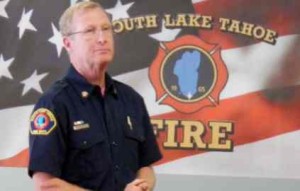
— South Lake Tahoe Fire Chief Jeff Meston


Most are made of aluminum or steel. They can drop automatically based on temperature, then gravity brings them down.

Murray Milne, a research professor of architecture at UCLA in a paper about designing a home to survive a wildfire, wrote, “Windows are the weakest link in defending your building, but there are clever ways to protect them. Radiant heat alone from the fire can shatter glass or ignite combustibles inside your living room, without the flames actually reaching your house. Single glazing is particularly vulnerable; a better choice is double glazing with tempered glass on the exterior. However, the safest solutions are roll-down metal fire doors built into the roof overhangs or side recesses, and released automatically by fusible links.”

Meston also recommends using tempered glass instead of plate glass because it can withstand higher temperatures.

Other holes, so to speak, are the outside vents on a building. If an ember enters this way, it’s easy to ignite insulation or some other combustible source. It could smolder for a while, without anyone knowing what is going on until the flames erupt in the attic or crawl space.

“Continuous roof ridge and soffit vents are very effective as attic ventilators, which makes them extremely difficult to protect from wind-driven sparks and embers,” Milne wrote in his paper.

While the vents are necessary to prevent wood decay, Meston suggests screens that prevent objects larger than one-quarter inch from entering.

With devastating fires becoming more the norm, especially in the West, people are looking at ways to keep structures standing.

Money will always be an issue. The more rules, the more expensive construction becomes. Retrofitting might not even be possible depending on what the regulations are.

Then there are those who would argue not everything is supposed to be saved. And firefighters know that not everything can be saved.

“When the wind blows hard there is not much we can do,” Meston said. “We can’t legislate Mother Nature. She wins every time.”

He pointed to how even when everything is done correctly, there are no guarantees a building will still be standing after the fire is suppressed. A Kmart in Santa Rosa that had sprinklers was reduced to ashes last fall.

That’s one of the conundrums – best practices aren’t always enough.

But what Meston, who is the president-elect of the California Fire Chief’s Association, and his peers are talking about is how to keep the fire from entering a house.

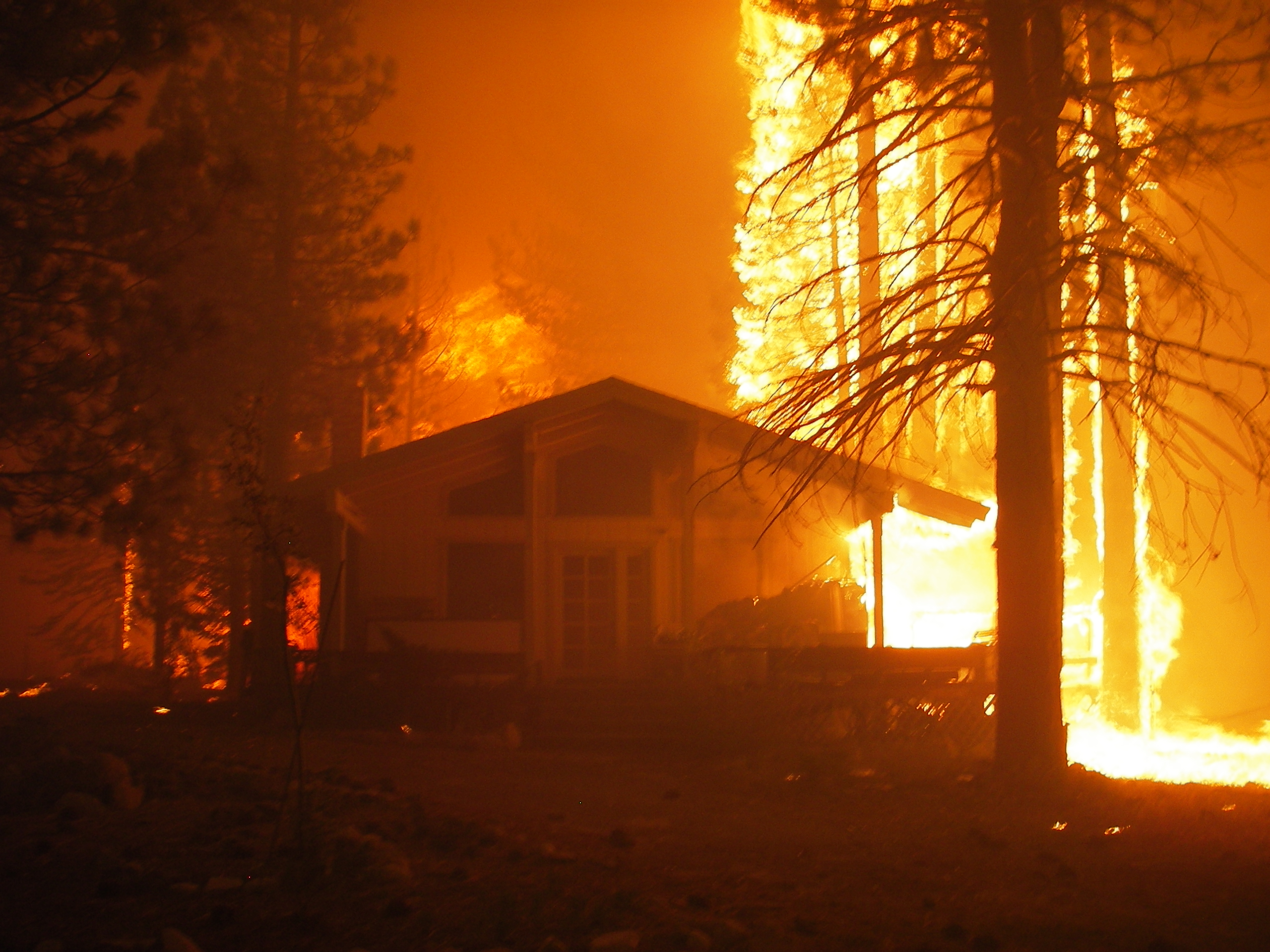
Ultimately 254 houses burned in the Angora Fire in 2007. Photo/LVFPD

South Lake Tahoe prepares

Meston is in the process of putting together a study called the Standards of Cover. The 18-month project is expected to culminate this summer. It is an in depth look at all the safety issues in the city. Every dwelling in the city is being recorded – including the type of siding, construction materials and vegetation.

Firefighters go into as many buildings as they can to see what they would encounter in an emergency. It’s called pre-incident planning.

Socio-economics play a role in all of this. Squalor is one way to describe some of the hotel rooms in town, even traditional residences. A match could torch these places; it wouldn’t need to be a horrific fire like those that ravaged the Wine Country and Southern California last year.

“Usually in a wildland fire you decide which you can save and which you can’t,” Meston said. Firefighters know which roads to bring rigs onto based on how easily they can exit.

When smoke is thick it’s hard to see obstacles, like trees in the middle of the road – which exist in the Al Tahoe area. And if firefighters are coming from out of town to provide aid, detailed data will help them be safe as they work to control whatever disaster is unfolding.

Once the report is complete it will be presented to the City Council and to the public.