Opinion: Too many reasons for women to march

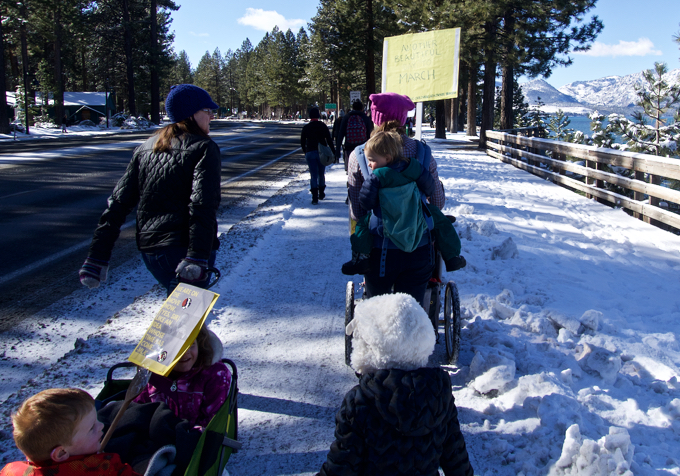
Nearly 400 people on Jan. 20 march from the Hard Rock in Stateline to Lakeview Commons in South Lake. Photo/Kathryn Reed

By Kathryn Reed

Last year those who didn’t understand the women’s marches across the globe thought it was all about the 2016 election. And in some ways it was. But it was also about the person elected, what he represents and that based on the popular vote he lost by millions. It was also about his belief that grabbing a woman’s pussy is his right.

Sexual assault is not a right. It is a crime.

It is not locker room banter.

Parents march for their rights and those of their children. Photo/Kathryn Reed

A year later, on Jan. 20 – the one-year anniversary of the last presidential inauguration – women, men, children and dogs took to the streets again. Today the outcry is the same, yet different. It’s not just about what is going on in Washington, D.C., as unbelievable as that seems at times, but it’s about the abuses women have been suffering for centuries that are just now coming to light.

What is it with men? Why do they think it’s OK to sexually, physically, emotionally or in any other way abuse women?

Does it really make you feel powerful? Do you really not care about the person you are victimizing?

A man holds a sign telling the world what he thinks. Photo/Kathryn Reed

By no means are men as a whole abusers. I’d argue more are gentlemen than not. At the marches it’s wonderful to see all the men standing right beside the multitudes of women. They are as appalled as the women at what is going on.

The marchers, they want men everywhere, not just politicians to figure out what the #MeToo movement is all about. To think hard if they have been part of the problem. No matter the answer, it’s time to be part of the solution.

South Shore women show their solidarity. Photo/Kathryn Reed

The president of the United States thinks there are shithole countries. The way he treats the office, women and people in general is appalling, degrading, shameful and embarrassing. Instead of making America great, he seems to be turning it into a shithole – at least when it comes to common decency.

Revelations about his sexual escapades keep making headlines, including interactions with multiple porn stars during the American Century Championship celebrity golf tournament in Stateline in 2006. This, while his wife was at home with their young son.

He has stained the oval office in a way that hasn’t been done since that famous blue dress.

A couple makes their opinions known at Lakeview Commons. Photo/Kathryn Reed

Even a consenting intern is not excusable. It’s still abuse of power, and certainly the office. Men degrading women crosses political aisles and permeates all professions.

It has to end. That is what these marches are about. It’s about no longer being silent. It’s about solidarity. It’s about making a statement for what is right. It’s about equality.

It’s time for change: march, vote, educate, stand up, speak out, say no, report the abuse, be intolerant of intolerance.


Deal cemented to bring broadband to Truckee

An agreement between Truckee Donner Public Utility District and Plumas-Sierra Telecommunications is bringing broadband coverage to the Truckee area.

PST will leverage existing TDPUD fiber optic infrastructure and facilities to expand high-speed internet services in Truckee.

PST is currently serving key commercial districts where TDPUD infrastructure and fiber is present. Tahoe Forest Hospital has been on the system since August, and PST is working to activate other accounts in the area.

The area around Highway 89 and Interstate 80 are well covered by PST services as well as the business districts. Residential areas may be served depending on the level of interest and the costs for PST to connect. Expansion of broadband services to new areas will also be facilitated by TDPUD’s expansion of its infrastructure.

There is an opportunity for homeowners associations and their members to work together to facilitate PST bringing services to subdivisions.


USFS rangers taking skiers on tours at Heavenly

The U.S. Forest Service’s Ski with a Ranger program at Heavenly Mountain Resort is resuming Jan. 26.

Tours begin at Tamarack Lodge every Monday and Friday at 1pm. The tours last approximately one-hour and continue through April 6, weather permitting. 

Participants must be intermediate level skiers/boarders or above and provide their own lift ticket. No reservations are required. Attendance is on a first-come, first-served basis. Group size will be limited to 12. Meet at the top of the Heavenly gondola outside of Tamarack Lodge. 

These conservation education programs are offered to educate the public about the mission and role of the Forest Service in ski area management, to improve public understanding of natural resource processes and issues, and to promote environmental literacy and stewardship. Programs are led by U.S. Forest Service conservation education staff and volunteers, and operate through a cooperative effort between Heavenly Mountain Resort and the City of South Lake Tahoe. 

For more information, contact Jaclyn Tain at 530.543.2730, email jtain@fs.fed.us.


The way snow is falling and melting is changing

By Daniel Rothberg, Bloomberg

Between droughts and floods, the last decade has offered water managers in the southwest a preview of how climate change could impact a supply largely dependent on winter snow. This year’s disappointing snowpack has them worried again. 

“Water and climate change are joined at the hip,” said Brad Udall, a researcher at Colorado State University who published a paper earlier this year showing how climate change has reduced flows in the Colorado River. “One of the primary impacts of a warming atmosphere are changes to our water cycle.”

Snowpack is 50 percent lower than the average at this point in the winter at dozens of basins in the region. It’s a major concern in a region with a growing population where water supplies are often pushed to their limits, even in good years. In addition to fueling the West’s winter tourism industry, the snow provides a steady supply of water for the Colorado River, which serves 40 million people spread from Denver to Los Angeles.

Read the whole story


LTBMU proposes 3,800-acre tree thinning project

The U.S. Forest Service Lake Tahoe Basin Management Unit is seeking comments on a proposal to reduce excess vegetation on approximately 3,800 acres on the South Shore.

The purpose is to reduce the risk of wildland fires and create healthier forests. 

Treatments would include forest thinning using hand and mechanical methods, cable yarding and prescribed fire operations involving pile and understory burning. Tree planting may also occur in some areas to promote tree species or forest structure diversity. Treatments would take place in areas thinned within the last 25 years and in areas that have not been previously treated.

Hand thinning would take place on steeper slopes not accessible to mechanical equipment and generally steeper than 30 percent.

Mechanical thinning operations would include cut-to-length and whole tree removal. 


Work could begin this spring. It will take approximately eight years to complete. 

The proposed action available online. Comments will be taken until Feb. 16.


Time to comment on Mt. Rose’s expansion plans

Humboldt-Toiyabe National Forest officials are seeking comments on the Mt. Rose Ski Tahoe Atoma Area Expansion draft environmental impact statement.

The draft EIS analyzed the environmental effects of expanding the ski area permit boundary and associated facilities to improve the quality of recreational offerings. The purpose of the expansion project is to provide additional terrain that is comfortable and appropriate for lower-level skiers and improves the ski area’s ability to provide a consistent and quality snow surface on key ski terrain throughout the season.

The draft EIS analyzed three alternatives: no action, proposed action (Alternative 2) and the Forest’s preferred action (Alternative 3). Alternative 2 and 3 are similar in that they would amend the existing special use permit by approximately 112 acres to incorporate a portion of the Atoma Area located on the north side of Mount Rose Highway. In addition, a chairlift and skier bridge across the highway, 11 new ski trails, and a 5 million gallon water tank to support snowmaking would be constructed.

A Forest Plan amendment would also be required for both action alternatives, which would restrict future commercial development on approximately 3,446 acres of NFS lands in the area known as Galena Land Exchange with the exception of the 112-acre Atoma and 168-acre Chutes areas.

The difference between the two action alternatives is that Alternative 3 would require a two-chair lift configuration to service the Atoma Area. The lift configuration would require one chairlift to cross over the skier bridge rather than directly over the highway. Additionally, a restroom would be located on NFS land instead of on private land.

The comment period ends April 18. The draft EIS is online.


Community rallies behind Bread & Broth

Hundreds of people on Jan. 18 help raise money for Bread & Broth 4 Kids at the chamber’s mixer at Riva Grill. Photo/Kathryn Reed

By Kathryn Reed

Food that rivals most restaurants on the South Shore – that’s how good dinners are at Bread & Broth.

While it’s only open one day a week, it is a lifeline for so many in the community. It’s not unusual for 100 people to show up at St. Theresa’s Grace Hall in South Lake Tahoe on a Monday. Many are there every Monday.

Everyone is invited. No proof of income, or lack of it, is required.

Seconds are available for those who are still hungry. The stragglers are often able to leave with leftovers. Plus, there are always bags of food for the taking.

It requires money to keep this 29-year-old nonprofit in business, especially as it has expanded its services through the years. Bread & Broth has a partnership with the Presbyterian Church in town, which serves soup on Fridays. And now there is Bread & Broth 4 Kids.

The youth oriented program provides weekend food bags to more than150 students in grades K-8. With more than 60 percent of the students in Lake Tahoe Unified School District eligible for a free or reduced lunch, it means many of them have little to eat when school isn’t in session.

Bread & Broth 4 Kids is designed to be that bridge between Friday and Monday. Much of the food items are things youngsters can easily make for themselves like soup, macaroni and cheese, tuna and other canned products. It includes packets of applesauce and protein bars – things that can be eaten on the go, or stuffed into a pocket.

Bags of donated food will help feed local students. Photo/LTN

The community came together Thursday to help these kids. The evening marked the ninth annual charity mixer put on by the Lake Tahoe South Shore Chamber of Commerce. For the past few years Bread & Broth has been the recipient, with the Jan. 18 event specifically for Bread & Broth 4 Kids.

“We choose Bread & Broth as the recipient because their supplies are often depleted after the holiday season, and we understand the importance of helping to alleviate the food insecure on the South Shore,” Brittani Curtis with the chamber told Lake Tahoe News. “Through the help of the South Shore community, we raised $1,299 at the 2017 Connect for a Cause Charity Mixer.”

The goal this year was to raise $1,500. The tally from the entrance fee, raffle ticket sales and silent auction have not been tallied yet.

The chamber hopes to host more Connect for a Cause Mixers with different nonprofit organizations. 

In addition to raising cash for Bread & Broth 4 Kids, guests were asked to bring non-perishable food items. Bags and bags filled a table and the space below it.

While the kids are getting quick items, those who show up for the Monday hot meal receive a well-balanced dinner that includes a protein like beef, chicken or fish, vegetables, bread, salads, and dessert. The latter is provided by area businesses.

All ages – including families – partake in the Monday meal.

While it’s a restaurant grade kitchen where the cooking takes place, there are plenty of things besides the clientele that separates Bread & Broth from a traditional dining establishment. Cooks often don’t have formal culinary training. Instead of having the luxury of a set menu to work from, they arrive that day to see what is in the kitchen and pantry. Creativity is essential.

(This reporter works one day a month at Bread & Broth serving food and working cleanup.)

The nonprofit might think about inviting a broader cross section of the community and charging a nominal fee or asking for a donation from those who can afford to give. The food is worth it.

For more information about Bread & Broth, or to donate or volunteer, go online.


Opinion: States won’t protect endangered species

By Alejandro E. Camacho and Michael Robinson-Dorn, The Conversation

Since the Endangered Species Act became law in 1973, the U.S. government has played a critical role in protecting endangered and threatened species. But while the law is overwhelmingly popular with the American public, critics in Congress are proposing to significantly reduce federal authority to manage endangered species and delegate much of this role to state governments.

States have substantial authority to manage flora and fauna in their boundaries. But species often cross state borders, or exist on federal lands. And many states either are uninterested in species protection or prefer to rely on the federal government to serve that role.

We recently analyzed state endangered species laws and state funding to implement the Endangered Species Act. We concluded that relevant laws in most states are much weaker and less comprehensive than the federal Endangered Species Act. We also found that, in general, states contribute only a small fraction of total resources currently spent to implement the law.

In sum, many states currently are poorly equipped to assume the diverse responsibilities that the U.S. Fish and Wildlife Service and NOAA Fisheries (collectively, “the Services”) handle today. In our view, therefore, devolving federal authority over endangered species management to the states will almost certainly weaken protections for those species and undermine conservation and recovery efforts.

Science-based decisions

The Endangered Species Act requires the Services to list and then protect endangered fish, wildlife and plants and their habitat, working with expert scientists, state authorities and citizens. It prohibits anyone from harming any listed species, and requires decisions about whether a species is endangered to be made “solely on the basis of the best scientific and commercial data available.” While costs are clearly relevant to protecting at-risk species, the law is clear that determinations about whether a species is endangered or likely to be harmed by a particular activity should not be based on the decision’s potential economic impacts.

In addition, the act directs the Services to cooperate as much as practical with states on conserving listed species. This may include actions such as signing management agreements and providing funding to state agencies. The law also allows citizens to petition to list species as endangered and file lawsuits to help enforce the act.

Congress takes aim

Critics argue, often with little proof, that federal endangered species protection is too cumbersome and costly, and that the agencies act without sufficient input from states and localities. Some contend that endangered species protection can be more effectively and efficiently accomplished by state agencies alone.

The House Natural Resources Committee, chaired by Utah Republican Rob Bishop, has approved five bills that would weaken key provisions of the Endangered Species Act. These measures would:

  • Allow the Services to deny that a species is endangered (and forgo protection of that species) due to economic impacts of listing.
  • Require the Services to classify indiscriminately any data submitted by states, tribes or counties for listing decisions as “best available science.”
  • Make it harder for citizens to challenge government actions under the ESA by limiting recovery of attorneys’ fees in citizen suits.
  • Remove protection for at-risk non-native species within the United States.
  • Lift federal protection for gray wolves in the Great Lakes states and Wyoming.

Observers expect similar legislation to be introduced in the Senate. And Utah Sens. Mike Lee and Orrin Hatch have reintroduced a bill that would remove all federal ESA protection for species found within the borders of a single state. Such action would eliminate federal protection for hundreds of currently listed species, including the Florida panther and Florida manatee.

These legislators argue that states should play a larger role. When a federal appeals court found that the Endangered Species Act barred the Services from transferring management of federally threatened prairie dogs in Utah to the state in 2016, Bishop asserted that “Utahns have proven they can maintain prairie dogs. The only thing impeding the state is federal meddling.”

More recently, Wyoming Sen. John Barrasso said, “Endangered species don’t care whether the federal government, or a state government, protects them. They just want to be protected.”

State laws are weaker and narrower

Our review shows that most states are poorly positioned to assume primary responsibility for endangered species protection. State laws generally are weaker and less comprehensive than the Endangered Species Act. West Virginia and Wyoming do not protect endangered species at all through state law. In 30 states, citizens are not allowed to petition for listing or delisting of a species.

Only 18 state laws protect all federally listed endangered species found in that state. Another 32 states provide less coverage than the federal statute. And 17 states do not cover endangered or threatened plants.

Only 27 states require use of scientific evidence in listing and delisting decisions. In 38 states, regulators are not required to consult with the state’s wildlife experts for state-level projects.

 Unlike the Endangered Species Act, 38 state laws do not authorize regulators to designate critical habitat for threatened or endangered species – areas essential for those organisms to survive. Only two state laws require recovery planning, only five state laws restrict harm to important endangered species habitat, and only 16 states protect endangered species on privately owned lands.

Finally, state-reported expenditures make up only five percent of all annual spending to implement the Endangered Species Act. In short, states will need to massively increase spending to maintain current levels of protection.

Better ways to enhance state roles

We agree that there is a need for better collaboration between states and federal agencies. States and tribes may have important knowledge and data that can complement the substantial expertise and resources provided by federal authorities. But that information alone should not substitute for the science-based decision making required by the ESA.

Furthermore, the Endangered Species Act already provides ample opportunities for federal and state collaboration. Many charges of poor coordination appear to be thinly veiled attempts to reduce protections, rather than efforts to promote meaningful collaboration. In our view, effective coordination under the ESA requires an enduring commitment to conservation and recovery by both the Services and the partnering state.

Congress should find ways to provide more incentives for conservation on private lands, which provide habitat for nearly 80 percent of listed species. The Endangered Species Act already encourages federal collaboration with states and private landowners, and there are many examples of successful partnerships.

Several studies have shown that listing species and developing conservation and recovery plans improves their status, provided that recovery efforts are funded. Rather than dismantling the Endangered Species Act, Congress needs to provide more resources to achieve its goals. The most productive strategies would be increasing funding for listing, conservation and recovery; systematically implementing and enforcing the law; and developing strategies for managing looming stressors to ecosystems, such as global climate change.

Alejandro E. Camacho is a professor of law and director of Center for Land Environment and Natural Resources at UC Irvine and Michael Robinson-Dorn is a clinical professor of law at UC Irvine.




Tahoe’s Smaine wins freeski halfpipe

By Tom Kelly, U.S. Ski and Snowboard
 
On a night when it really counted, Brita Sigourney (Carmel) came through with a Toyota U.S. Grand Prix win in the Visa freeski halfpipe at Mammoth Mountain and a ticket to PyeongChang. California crowd favorite Kyle Smaine (South Lake Tahoe), the 2015 World Champion, finally nailed his run on the third try to take the victory for the men.

Sigourney, who stepped it up last weekend at Aspen-Snowmass to finish second, was strong and consistent all night, putting down a 91.20 on her second run for the victory over Olympic champion Maddie Bowman (Meyers) and Devin Logan (West Dover, Vt.). All three qualified objectively for PyeongChang. It will be a repeat Olympics for Sigourney, who was sixth in Sochi. Bowman won gold in Sochi, while Logan won silver in Slopestyle. It will be Logan’s first Olympic halfpipe appearance.

“I don’t know, I just have been feeling really good,” said Sigourney, looking back on her last two weekends of qualifying. “I think it’s all just confidence. I got a couple good results and I think it goes a long ways.”

Sigourney joins a very strong team anchored by Bowman, who won gold four years ago. “I am so stoked on our team that qualified,” she said. “Devin and Maddie are my best friends, so couldn’t be happier to be going with them.”

Smaine came through on his third and final run to lay down a 92.20, winning over Alex Ferreira (Aspen, Colo.) and Torin Yater-Wallace (Aspen, Colo.). All three had their podium performances on the third run. Ferreira and Yater-Wallace will join Olympic champion David Wise of Reno to the Olympics, qualifying objectively. It will be Ferreira’s first Olympics. He set himself up well with a win in the Dew Tour a month ago. Yater-Wallace will be going back for his second Olympics.

“I can not believe it, I seriously can not believe it,” said a jubilant Ferreira, who narrowly missed out on the 2014 team. “I am the happiest human in all the land and so happy to be here and along for the ride.” 

What made it even sweeter for Ferreira was that his longtime Aspen friend Yater-Wallace was coming along too. “It’s really special to be going with Alex to the Olympics,” said Yater-Wallace. “Unfortunately last time around he was skiing insanely well, but so was the rest of the field. Being his first Olympics, it’s just an unreal feeling, I am just really proud of him, it’s been a long time in the making of Alex really blowing up in the scene and he’s capitalizing now. He’s proved that he has at the top level and he’s been getting podiums.”

Yater-Wallace had a lot to reflect on himself with the medical challenges he has endured over the last few years. 

“It’s a very special night locking in my confirmation to the Olympics team,” he said. “It’s really an honor to get one of the first three spots this time around vs a discretionary position like Sochi. That was one of the big things in my head was to actually prove that I could ski and get there. For myself, it’s been kind of a tough year, there was a lot of pressure being as I won the first selection event, and since we have had a lot of strange halfpipes working against us with the lack of snow along with a slight foot injury that I have been working on, I am just so glad it all came together and couldn’t be more thankful. I am really happy to be feeling better and skiing like myself again.”

Logan came away from Sochi with slopestyle silver, but had really wanted to double up in halfpipe,. “It’s definitely a relief,” said Logan. “Four years a go I didn’t make the pipe team and I was so close and really wanted it. Now I’ve come out four years later and will be headed to the Olympics for pipe. Slope is still undecided, but this is definitely weight off the shoulders, I am feeling confident and hopefully get another spot and go for two.”

She was optimistic about the upcoming Olympics, with the opening ceremonies just three weeks away. “I am so excited to go back to Korea – the people, the culture, it’s all amazing there,” she said. “It was the best pipe I have ever ridden, and last year I got 2nd in the test event. Hopefully I can take this confidence into the Olympics and keep it all rolling.”

A possible fourth spot for men or women may be announced next week. On the men’s side, the competition was fierce and deep with both 2014 Olympian Aaron Blunck (Crested Butte, Colo.) and Youth Olympics Games medalist Birk Irving (Winter Park, Colo.) made strong bids.


Atmospheric rivers aid the West — and imperil it

By Emily Benson, High Country News

When a rainstorm slammed California’s Russian River watershed in December 2012, water rushed into Lake Mendocino, a reservoir north of San Francisco. The cause? An atmospheric river, a ribbon of moisture-laden air that can ferry water thousands of miles across the sky. When the tempest hit, the state was on the brink of an exceptional drought. But instead of storing the surge the storm brought for the dry days to come, the reservoir’s owner, the U.S. Army Corps of Engineers, let it run downstream.

They had to. Army Corps rules say Lake Mendocino must be partly drained during the winter, leaving room for the next deluge to prevent downstream flooding. But in 2013, that space ended up being superfluous, mostly because drought conditions kicked into high gear and the rainy season essentially ended after the December downpour.

“We lost that water,” says Shirlee Zane, who serves on the board of the Sonoma County Water Agency, which delivers water from Lake Mendocino to nearby homes. The agency estimates that more than $2 million slipped down the river. It was a loss that might have been prevented if the Army Corps had known they could safely store the water — and one managers would hate to repeat. “We lose millions of dollars of water if we don’t have better forecasting,” Zane says.

Read the whole story