Free radon presentation in Stateline

The University of Nevada Cooperative Extension’s Radon Education Program is offering educational presentations and free radon test kits across Nevada.

One presentation is scheduled for 6pm Jan. 23 at the Tahoe Regional Planning Agency offices in Stateline. University of Nevada Cooperative Extension has partnered with the California Radon Program, so free radon test kits will be available at the event for residents of both states.

Radon is a naturally occurring radioactive gas that is colorless, odorless, and tasteless. It comes from the ground and can accumulate in homes, raising the risk of lung cancer. The U.S. Environmental Protection Agency estimates 21,000 Americans die each year from radon-caused lung cancer, killing more people than secondhand smoke, drunk driving, house fires, and unintentional carbon monoxide poisoning combined.

In Nevada, one in four homes tested show radon concentrations at or above the EPA action level. The potential is higher in Stateline, where 67 percent of homes tested have an elevated radon level. Experts say living in a home with radon concentrations at the action level poses as much risk of developing lung cancer as smoking about half a pack of cigarettes a day.


This year’s flu exposes flaws in medical system

By Morten Wendelbo and Christine Crudo Blackburn, The Conversation

Flu season in the U.S. typically peaks in February, but this year’s outbreak is already one of the worst on record. As of Jan. 6, 20 children have died from the flu, and overall mortality caused by the flu is already double that of last year’s.

One reason the flu is so severe this season is that the dominant strain is H3N2, which has an impressive ability to mutate and is particularly aggressive against Americans over 50.

Making the threat worse is the fact that most of the IV saline bags used in common medical treatments and procedures – including severe cases of the flu – are made in Puerto Rico, which is still reeling from Hurricane Maria. Hospitals in some areas around the country that are operating at or above capacity because of the flu are quickly running low on saline, resorting to time-consuming and potentially dangerous treatments of patients.

The IV saline shortage is unlikely to cause a life-threatening breakdown of medical treatments. But the shortage does expose a dangerous flaw in the medical supply chains that everyone relies on to counter disease outbreaks or bioterrorism. Many different types of important medical equipment and medicines either come from abroad or rely on a single producer.

Global supply chains

Globalization has changed the way we produce, transport and store almost anything, including medicines and medical supplies. Now that it’s inexpensive to transport goods, many can be easily produced abroad at substantially lower costs. In nearly all cases, that benefits producers and consumers alike.

For the medical industry, approximately 80 percent of all pharmaceuticals used by Americans are produced overseas. The majority of this production takes place in China and India.

Forty-three percent of saline in the U.S. comes from Puerto Rico. The U.S. was already running below optimal levels of saline when Hurricane Maria hit.

Rapid transportation of goods also allows most industries to rely on “just in time” deliveries. That means goods arrive only shortly before they are needed, rather than arriving in large shipments.

In most situations, and for most goods, that causes few issues. However, when there’s an insufficient stockpile, delivery delays can be life-threatening. Many of our hospitals receive shipments of critical pharmaceuticals three times a day.

Unhappy coincidences

As researchers studying how countries can prepare for disease and disasters, it’s clear to us that the IV saline shortage is just the tip of a gigantic iceberg.

There are two ways the “just in time” system can be disrupted: an unexpected surge in demand or a delay in delivery. In this case, both occurred simultaneously. The U.S. is dealing with an unusually potent strain of the flu, while Hurricane Maria brought production in Puerto Rico to a grinding halt. If only one of the two had occurred, it’s unlikely the U.S. would have experienced a shortage.

Now, hospitals overrun with flu patients have to turn to alternatives to IV saline. One is an IV push procedure, in which medications are manually “pushed” into the IV line. This can be deadly if not done correctly.

In the case of IV saline, the simultaneous occurrence of both demand and delay was accidental. Unfortunately, it’s not only possible that such confluence will occur in the future – it’s likely. In the case of pandemics or biological warfare, there will likely be both a surge in demand for important goods and a simultaneous disruption of production and delivery.

If a pandemic disease severely affected China or India, where large shares of medicines come from, production could be knocked out or slowed. That would leave the rest of the world vulnerable to the disease’s spread, because there would be no supply of crucial medicines to combat it. The 1918 influenza pandemic caused disruptions that prevented coal from being delivered to the northeastern U.S. That left some without heat in the height of winter, causing people to freeze to death and compounding the deadly pandemic.

Today, such a breakdown could leave hospitals and other crucial infrastructure without electricity. If the spread of the disease is intentional, as in cases of bioterrorism or bio-warfare, adversaries could target global supplies of crucial treatments.

Preparing for problems

The destruction in Puerto Rico and the impact it has had on the supply of small IV saline bags in American hospitals is a warning. This time, it’s IV saline. Next time, it might be electricity to run intensive care units or critical antibiotics to treat infections.

Global supply chains are a massive puzzle, but public health and emergency preparedness officials need to, at a minimum, understand every link in the chain of critical goods. Without a thorough understanding of the supply chain, it’s difficult to preempt problems that could arise in times of emergency. Hospitals and other crucial infrastructure, such as power plants and the transportation industry, may want to diversify their suppliers of critical goods and encourage those suppliers to not focus production in a single area, especially not to an area prone to natural disaster. A final, but far more costly, option is to ensure we can produce most of these goods domestically in times of emergency.

In our view, the solution depends on a partnership between government and industry. Federal, state and local governments have to alter procedures, but private companies involved in the production and delivery of critical goods have to plan ahead for emergencies.

If these weaknesses in our global supply chains are not addressed, especially as they relates to medical supplies, pharmaceuticals and other critical goods, we are headed for disaster.


Morten Wendelbo is a lecturer at Bush School of Government and Public Service at Texas A&M University. Christine Crudo Blackburn is a postdoctoral research fellow at Texas A&M University.


Letter: Bread & Broth thankful for donation

To the community,

Returning for his second Adopt a Day of Nourishment sponsorship of the year, Jeremy Woodford hosted Bread & Broth’s Monday meal on Jan. 15. Woodford returned with Barbara and Craig Brittain, who also volunteered at his Jan. 1 sponsorship.   

This trio of helpers assisted the B&B volunteers in serving the 76 dinner guests who came to St. Theresa Grace Hall for a hot, nutritious meal. At the Mexican themed dinner, the diners had a choice of beef enchiladas, pork enchiladas, refried beans, festive veggies, green salad, fruit salad and a variety of pies, cookies and cakes for dessert. 

Woodford believes that “helping others is the best way to feel better!” As a young boy, he and his family would attend B&B weekly meals and now as an adult he is able to help others and is doing so by feeding those in need. With Woodford’s $300 sponsorship donation, not only is he helping to provide full-course meals, his contribution also helps fund the purchase of fruits, vegetables and dairy products for the food giveaway bags.

B&B is very thankful to Woodford and his helpful crew for their support of the organization’s mission of easing hunger. As a nonprofit, all volunteer organization, B&B relies on the on-going donations it receives to continue its service to those struggling with hunger. Thanks to our very generous donors, B&B in addition to serving its Monday meal at Grace Hall, also provides a dinner at Second Serving, a soup and simple entrée meal served every Friday from 4-5pm at Lake Tahoe Community Presbyterian Church.

Carol Gerard, Bread & Broth


STMS students learn through making

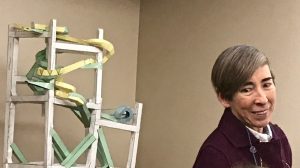
Teacher Jackie Tan and a roller coaster students made. Photo/LTN

By Lake Tahoe News

Jackie Tan’s class at South Tahoe Middle School might be the only one where failure is encouraged, even rewarded.

“It’s normal to encounter failure. We work through things,” Tan said.

When something goes awry in class the students are encouraged to learn from their mistakes by trying again, and perhaps again.

Journaling is part of the learning. Students record what worked and didn’t; using the information to document the process.

Tan and a handful of seventh-graders presented to the Lake Tahoe Unified School District board last week about the school’s Maker Lab. This is a blending of science, technology, engineering, math and art – or STEAM.

Right now it is a standalone class, but what Tan would like to do is incorporate it into the curriculum. After all, STEAM crosses into the academic spectrum.

Electricity is one of the main things the students work with. Coding is something they all learn.

Through grants Tan has been able to buy more equipment and tools for the class for the students to use. One thing she is looking to do is purchase a new 3D printer because what they use now is rather dated.

The other thing Tan is working on is getting more girls to participate in the Makers Lab.


Anderson wins slopestyle in Mammoth

By Courtney Harkins, U.S. Ski and Snowboard

In the Toyota U.S. Grand Prix, both the U.S. men and women swept the snowboard slopestyle podium at Mammoth Mountain. With Olympic spots on the line, Kyle Mack (Bloomfield, Mich.) led the men, clinching his spot in the Winter Olympics, while Jules Marino (Westport, Conn.) and Hailey Langland (San Clemente) took second and third, respectively, for the women to grab their spots in Korea.

Red Gerard (Silverthorne, Colo.), who qualified for the Olympics at the Toyota U.S. Grand Prix at Snowmass last week, took second place. Brock Crouch (Mammoth Mountain) was third.

Mack, who was sitting in third place in the Olympic standings behind Gerard and Chris Corning (Silverthorne, Colo.), locked up his spot with a clean run. “I’m feeling just amazing, unbelievable right now,” said Mack. “Red is one of my best friends—he’s been such a homie, and I couldn’t be more excited to be heading to Korea with him. I’m just excited to go and be a part of it and represent my country.”

In the women’s event, Jamie Anderson (Meyers) had already qualified for the Olympics in the Dew Tour in December, but still went all out to take the win.  

“I knew I would be going with Jules and Hailey,” said Anderson, after her run. “They are just so talented and young and filled with good energy. They’re just amazing people and riders”

Langland and Marino were equally as excited to attend their first Olympics. “This is a really surreal moment right now,” said Marino. “It definitely hasn’t sunk in. Before Hailey and dropped in for our last run we knew we were going to the Olympics together. We’re 17 and 20 and we are going to the Olympics. That’s insane. It’s such a big event and I can’t believe it. We were so stoked and just gave each other a hug and couldn’t be happier that we get to experience it together.”

The fourth spot on the U.S. Olympic snowboard slopestyle team will be named at the beginning of next week.


Opinion: March to the Polls — it matters

Publisher’s note: This is South Lake Tahoe Mayor Wendy David’s speech at the Jan. 20 women’s march.
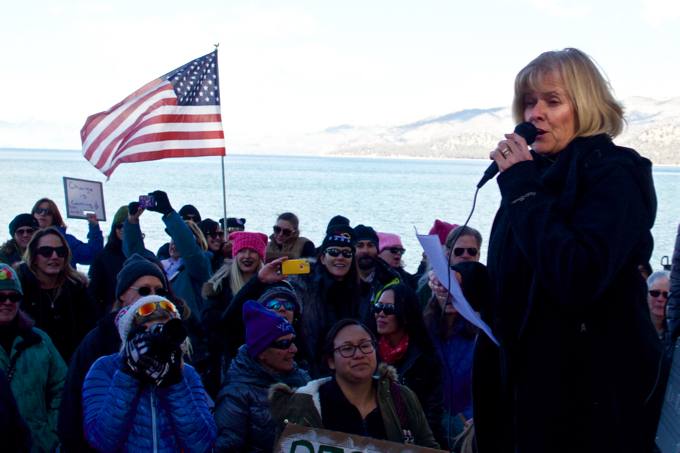
South Lake Tahoe Mayor Wendy David rallies hundreds on Jan. 20 to make sure they vote to make their voices heard. Photo/Kathryn Reed

By Wendy David

When I was 16, the 1964 Republican National Convention was held at the Cow Palace near San Francisco. The Republican presidential candidate was Barry Goldwater, running against Lyndon Johnson. 

Now I can remember very little about the speeches, the platforms, the protests, but I can remember being on the floor (I was a floor page, a helper) and the excitement, everyone covered in the pins of their favorite candidate, the signs bopping up and down all over this cavernous, livestock arena, like they were actual human beings, jumping up and down. I can’t actually remember why I got to go, but it was an experience never to be forgotten by this 16-year-old girl.

President Kennedy had been assassinated the November before the convention. There were civil rights protests going on. Protesters, civil rights activists, were being ejected from the convention. I had never seen anything like it. 

I tell this story because it set in motion for me a life of never, never, ever missing the right and gift of the opportunity to vote. Never!

I had to be 21 to vote. Heck, by then I was already married with one child and three weeks overdue with the next.

In 1972, I got to vote in my first presidential race, which didn’t turn out so well for me.  Richard Nixon won with 520 electoral votes to George McGovern’s 17.  Now that I think of it, it ultimately did not turn out well for Nixon either.

But, still I voted. 

I ask myself, what is different today, from 44 years ago. Were we more compelled to vote because of the times of radical change? Was it President Kennedy, Martin Luther King, Robert Kennedy all being assassinated before our eyes? Was it the Vietnam War, the unjustness of our friends being injured or killed for what? Where was the reason? Was it that our parents’ generation had just fought in WWII, literally preserving our free world. I know my dad was in Europe for the first four years of my parents’ marriage.

Whatever it was, we voted, we voted, we voted. We voted for democracy, equality for all races, equal rights in solidarity with all our heroes that fought much more publicly than us! Other women encouraged us as women to stand up, to sit in, to burn our bras! Or just not wear these contraptions to begin with! That alone was a freedom.  

Seriously, could all of these freedoms voted for, marched for, sacrificed for, be at risk?  Unbelievably, yes. Can we change this? With our vote, yes we can!

Voting is the right we were given by our nation’s fathers and then mothers for us as men and women, preserved and protected for us by generations that have fought for these rights.  

When the precious right to vote is taken for granted, ignored, or forgotten, while knowing it is vital and integral to who will lead us, and determines how we will be taxed and supported through our government, how health care will be delivered and protected for all and how we fund public education and those that seek a higher education to better themselves, support their families and make the United States a better country, it is time act.   

When we are complacent, women’s rights, equal rights, human rights suffer. We stand together today because we can no longer afford to let others decide, others vote, others change the progress of the last decades.

Just an aside, our last local election, the vote for our roads initiative, a mere 22 percent of registered voters, voted. One minute, one item on the ballot, one check mark, one decision forfeited to others when we do not vote!  

I was fortunate to be able to travel to Kenya in 2012. It was presidential election time in Kenya. Kenya has extreme corruption in its leadership, the government misappropriating funds allocated to the public schools, for roads, for infrastructure. As we rode in our bus through the little villages on voting day, we saw hundreds of Kenyans walking along the most desolate dirt roads, miles and miles from their huts, dressed in their best, brightest robes and tunics, scarves and skirts, in stark contrast to the dry and barren landscape. Heads high with hope for a better future, they were walking to their polls, an all day walk to vote. They have a very high voting percentage in Kenya, much higher than here in the U.S.

Our walk is shorter; our resolve must be even stronger.  

One year ago our first women’s march joined hundreds of thousands across the nation to march as well. A march has a purpose, to move forward with resolve, to make a difference and to do it publicly, proudly gaining strength from all others that have joined. Last year we marched in solidarity for our democracy, for our country, committing to each other to make a positive difference where we live.

One year later, and oh, what a year it has been, we march again. We walk with purpose. The theme of this year’s march is March to the Polls. Our power has always been our vote. We must march to the polls, educate, contribute, speak up and speak out with our vote, encourage women to run for office, elect women to office, ensure that there is not one elected official anywhere, anymore that has ever used their power to sexually abuse women, has bragged about their stature, has attempted to role back almost 50 years of progression.  We must vote to ensure that our nation of immigrants, for we are a nation of immigrants, continues to welcome the huddled masses, yearning to be free.

The time really is up. Time is up for being complacent, waiting for others to lead. We cannot be lazy, tired, ignorant or uninformed. We cannot be quiet.  he time is up for being quiet! 

One year from the first Women’s March has been a year nothing short of beyond belief. The Me Too movement exposed and kicked sexual abuse in the workplace, government, entertainment, and professional sports out of the darkness and into the light. And it has been glaring! We are here to make sure that no woman or girl ever experiences this evil darkness again. 

We can do so much. We have amazing, engaged people. Look at the power here today. Let’s band together in electing qualified progressive leaders and if there are good women (and there are), support them as they lead locally so that someday, they may lead us nationally.

Time is up for standing by, for keeping mute, for tolerating less in our leadership. We must continue to march to the voting polls, and by doing so, refuse to tolerate racism, sexism, cronyism and ever, ever supporting or tolerating a candidate that does not respect all women, all races, all colors, all religions, all ethnicities, all genders and the equal rights given to all citizens of the United States. The time was up for that when this nation was formed … we must preserve it.

I am so proud to be here with all of you. Today you are already making 2018 a year of change.  Women all over the United States are saying enough! Let us continue to support each other.  Time is up, it is a new time, this is our time!


Opinion: Big media licking their chops

By Amanda Lotz, The Conversation

The year 2017 ended with a flurry of news affecting all aspects of the media industry. A shift in net neutrality policy and Disney’s planned purchase of several Fox assets capped a year that also witnessed the pending merger between Sinclair Broadcast Group and Tribune Media.

As someone who teaches and writes about the media industry, I’ve been following these developments closely. Whether you’re simply concerned about your cable and internet bill, or you’re wondering how the elimination of net neutrality will influence access to your favorite websites, here are some key stories and developments you should tune into in 2018.

Buckle up for ‘fast lanes’

The repeal of net neutrality – the rules that prevent internet service providers from charging websites to secure preferential treatment – hasn’t gone into effect just yet, and legal challenges are in the works. But if the rollback goes through, as it’s expected to do, it will likely affect companies and consumers in a couple of ways.

First, the business models of internet-reliant services such as Netflix and Spotify have always assumed that they would have free, unfettered use of the internet. They are among the first places that ISPs could target with fees, and these sites would feel compelled to fork over the money in order to reach consumers at the fastest speeds. At the same time, to offset these new costs, these internet-reliant services will likely pass these costs on to their customers.

Meanwhile, if paid “fast lanes” become standard practice, consumers will also notice that accessing sites that don’t or can’t pay – such as government, education, libraries and other non-commercial sites – might seem slower or more difficult to use.

Also, expect to see internet service companies leverage the content they’ve purchased to encourage more subscribers. Companies that own content – whether it’s TV channels or film franchises – will be able charge lower prices than those that license it. (This is at the heart of the AT&T-Time Warner merger discussed below.) For example, if AT&T succeeds in buying Time Warner – which includes HBO – it will likely offer HBO to AT&T subscribers at rates well below what their competitors like Comcast will charge, because these competitors must pay AT&T before they can offer HBO’s content.

Investments and mergers galore

Though we’re in the midst of an unpredictable regulatory environment, it seems likely that Disney’s purchase of Fox assets will proceed.

This won’t immediately bring big changes for consumers. As a content company, Disney’s primary goal is to maintain and accumulate content assets: television series, films and brands like Star Wars, Marvel and DC. The more it owns, the better positioned it is to negotiate with companies such as Comcast and AT&T that make most of their money from distributing content (via internet, phone, cable service), but are also increasingly purchasing content of their own.

Companies built on owning content don’t want to be left behind, so their goal is to be able to possess content so valuable that consumers demand that all distributors offer it. Just as Disney has long used used the popularity of ESPN to secure access for less popular channels like ESPN Classics or Disney XD, the more essential content Disney owns, the more leverage it has to charge high fees and ensure distribution for content that’s less in demand.

The mergers likely to have a greater impact on consumers are the Sinclair-Tribune and AT&T-Time Warner mergers. Sinclair and Tribune aren’t household names, but they do own several local television stations. Sinclair already owns the most television stations in the U.S. – 193 stations in 89 markets that reach 40 percent of American households. Buying Tribune’s stations would enable it to reach 72 percent of American households, even though current rules cap national reach at 40 percent.

The Federal Communications Commission – with its current makeup geared toward deregulation – has signaled its intention to revise ownership rules to enable the merger to proceed. This scale of broadcast ownership is unprecedented in the United States and reminiscent of the late 1990s, when limits on national radio station ownership were eliminated and massive consolidation occurred.

Many have since decried this shift in radio ownership rules. The consolidation led to local job losses, and a recent change in rules allows conglomerates to operate without local studios. Sinclair has already been criticized for forcing all its stations to air the same editorials. This is contrary to broadcast policy that has long prioritized upholding the right of local stations to deliver programming attuned to the interests of their audiences.

The AT&T-Time Warner merger has been in the news for over a year now. The Department of Justice announced plans to sue to prevent the merger in November 2017 and the deal awaits court consideration. This merger deserves a closer look, because like Comcast’s 2011 purchase of NBCUniversal, it allows a distribution company (AT&T) to own content: Time Warner’s assets include HBO, CNN and the Turner networks. The Comcast merger was ultimately permitted, but it included a number of provisions to maintain a competitive marketplace.

Although much has been made of President Trump’s hostility toward CNN as a possible reason for the Department of Justice lawsuit, the potential anti-competitive actions AT&T could take as owner of Time Warner’s most lucrative asset – HBO – is a much better explanation. AT&T could refuse to allow competing services such as Comcast to offer HBO, or make it far more expensive to consumers that subscribe to a different ISP.

Over the next year, we’ll see media conglomerates continue to bid for assets and push to roll back rules in an effort to accumulate more power and profit. At the same time, ISPs – many of which already operate as local monopolies or with limited competition – now have permission to delegate access and raise fees.

If history is a guide, consumers will be the big losers.

Amanda Lotz is a fellow at the Peabody Media Center and professor of media studies at the University of Michigan.


Study: Cyclists are more law-abiding than drivers

By Peter Flax, Outside

If you live in the U.S., you’ve surely heard an oral history of naughty cyclists. There’s a widely held perspective that city and suburban streets are overrun with lawbreaking riders—a swarm of oblivious, entitled cyclists rolling red lights, blasting through stop signs, slaloming down one-way streets, then (hypocritically!) flipping off drivers. 

As someone who has driven hundreds of thousands of miles over the past 34 years, and ridden a bike for even longer, my point of view is different. Everyone seems to break the rules, whether they’re on two wheels or four. The big difference is that some do it on an 18-pound bicycle and some do it in a 4,000-pound SUV that can cause exponentially greater harm. 

But people who don’t bike don’t see it that way—they just see people on bikes charging through those stop signs. And it’s nearly impossible to combat their perceptions or even engage in meaningful debate without hard evidence of a different reality. And to date, very little research has produced quantifiable data comparing how drivers and cyclists actually behave on the road.

Read the whole story


NIAA board votes against proposed 5A Class

By Jim Krajewski, Reno Gazette-Journal

If you were a proponent of facing the biggest and best schools in state athletic competitions, you got your wish.

But, if you preferred not facing Bishop Gorman — or any other large-school Southern Nevada powerhouses — you will have to suffer for at least two more years.

The Nevada Interscholastic Activities Association board of control voted, 7-2, Thursday to not create a new 5A Class in high school sports in the fall.

Read the whole story


Snippets about Lake Tahoe

·      Mount Aukum Winery is closing on Jan. 31.

·      Sierra Speaker Series: The Donner Party Chronicles with Frank Mullen is Feb. 17 from 5-6:30pm at the Donner Memorial State Park Visitor Center in Truckee. Cost is $5.

·      Vanetta Van Cleave is now the CFO for the North Tahoe Public Utility District.

·      Here are the El Dorado-Tahoe and Sierra roadwork schedules from Caltrans for the next week.

·      President Trump signed legislation introduced by Rep. Tom McClintock, R-Garden Valley, designating a mountain in the John Muir Wilderness of the Sierra National Forest as Sky Point. The bill honors Marine Staff Sgt. Sky Mote of El Dorado, who was killed in action in Afghanistan on Aug. 10, 2012.