Polystyrene ban could be broader than SLT

By Kathryn Reed

The South Lake Tahoe City Council at its Feb. 6 meeting is expected to solidify its desires for a ban of polystyrene, also known as Styrofoam.

Four tiers are expected to presented to the electeds, who last fall asked for staff to bring back details about what such a ban might look like.

Members of the South Lake Tahoe Basin Waste Management Authority were given a preview of what the council will be presented. The idea is that perhaps a basinwide ban might be contemplated. This group’s members are South Lake Tahoe, El Dorado County and Douglas County.

It was suggested the presentation be made to the Local Government Committee of the Tahoe Regional Planning Agency when it meets in Stateline at the end of February.

The tiers to be considered by the city include:

·      Ban polystyrene single-use containers used for take-out food.

·      Ban retail sales of polystyrene, which would include items like foam coolers and food containers.

·      Ban all products using polystyrene on goods packaged outside the city limits like egg containers and trays meat comes on.

·      Ban all polystyrene products at special events.

The latter is already part of the special use permit, so it would be included in any future ordinance or resolution the council comes up with.

Any combination of these ideas could be implemented.

Tracy Franklin, the city’s communications guru, in her presentation on Jan. 19 said many restaurants are already using a biodegradable, sometimes compostable material for to-go containers. She has spoken with other eateries and explained how the price point is not much greater to make the transition.

More than 100 cities or counties in California already have some sort of ban on polystyrene. The material is bad for the environment and people’s health, especially if they reheat the food in the container.

Franklin said in speaking with local retailers the response was that their corporate offices are already used to how Californians operate — meaning they will adapt if the city says certain goods can’t be sold or used here.

She added that the Poultry Council is asking for a two-year grace period to work on coming up with a suitable alternative packaging material.

Officials with South Tahoe Refuse were at the Friday meeting. While they agreed polystyrene is not recyclable and does not breakdown, they want to make sure whatever is used next that there is a market for it.

Still, even if the “new” products can’t be recycled, at least they will eventually breakdown at a landfill, something polystyrene will never do.


Opinion: What’s behind this year’s crazy winter weather?

By Jennifer Francis

Damage from extreme weather events during 2017 racked up the biggest-ever bills for the U.S. Most of these events involved conditions that align intuitively with global warming: heat records, drought, wildfires, coastal flooding, hurricane damage and heavy rainfall.

Paradoxical, though, are possible ties between climate change and the recent spate of frigid weeks in eastern North America. A very new and “hot topic” in climate change research is the notion that rapid warming and wholesale melting of the Arctic may be playing a role in causing persistent cold spells.

It doesn’t take a stretch of the imagination to suppose that losing half the Arctic sea-ice cover in only 30 years might be wreaking havoc with the weather, but exactly how is not yet clear. As a research atmospheric scientist, I study how warming in the Arctic is affecting temperature regions around the world. Can we say changes to the Arctic driven by global warming have had a role in the freakish winter weather North America has experienced?

A ‘dipole’ of abnormal temperatures

Weird and destructive weather was in the news almost constantly during 2017, and 2018 seems to be following the same script. Most U.S. Easterners shivered their way through the end of 2017 into the New Year, while Westerners longed for rain to dampen parched soils and extinguish wildfires. Blizzards have plagued the Eastern Seaboard – notably the “bomb cyclone” storm on Jan. 4, 2018 – while California’s Sierra Nevada stand nearly bare of snow.

This story is becoming a familiar one, as similar conditions have played out in four of the past five winters. Some politicians in Washington D.C., including President Trump, have used the unusual cold to question global warming. But if they looked at the big picture, they’d see that eastern cold spells are a relative fluke in the Northern Hemisphere as a whole and that most areas are warmer than normal.

A warm, dry western North America occurring in combination with a cold, snowy east is not unusual, but the prevalence and persistence of this pattern in recent years have piqued the interests of climate researchers.

The jet stream – a fast, upper-level river of wind that encircles the Northern Hemisphere – plays a critical role. When the jet stream swoops far north and south in a big wave, extreme conditions can result. During the past few weeks, a big swing northward, forming what’s called a “ridge” of persistent atmospheric pressure, persisted off the West Coast along with a deep southward dip, or a “trough,” over the East.

New terms have been coined to describe these stubborn features: “The North American Winter Temperature Dipole,” the “Ridiculously Resilient Ridge” over the West, and the “Terribly Tenacious Trough” in the East.

Regardless what it’s called, this dipole pattern – abnormally high temperatures over much of the West along with chilly conditions in the East – has dominated North American weather in four of the past five winters. January 2017 was a stark exception, when a strong El Niño flipped the ridge-trough pattern, dumping record-breaking rain and snowpack on California while the east enjoyed a mild month.

Two other important features are conspicuous in the dipole temperature pattern: extremely warm temperatures in the Arctic near Alaska and warm ocean temperatures in the eastern Pacific. Several new studies point to these “ingredients” as key to the recent years with a persistent dipole.

It takes two to tango

What role does warming – specifically the warming ocean and air temperatures in the Arctic – play in this warm-West/cool-East weather pattern? The explanation goes like this.

Pacific Ocean temperatures fluctuate naturally owing to short-lived phenomena such as El Niño/La Niña and longer, decades-length patterns. Scientists have long recognized that those variations affect weather patterns across North America and beyond. 

The new twist in this story is that the Arctic has been warming at at least double the pace of the rest of the globe, meaning that the difference in temperature between the Arctic and areas farther south has been shrinking. This matters because the north/south temperature difference is one of the main drivers of the jet stream. The jet stream creates the high- and low-pressure systems that dictate our blue skies and storminess while also steering them. Anything that affects the jet stream will also affect our weather.

When ocean temperatures off the West Coast of North America are warmer than normal, as they have been most of the time since winter 2013, the jet stream tends to form a ridge of high pressure along the West Coast, causing storms to be diverted away from California and leaving much of the West high and dry.

If these warm ocean temperatures occur in combination with abnormally warm conditions near Alaska, the extra heat from the Arctic can intensify the ridge, causing it to reach farther northward, become more persistent, and pump even more heat into the region near Alaska. And in recent years, Alaska has experienced periods of record warm temperatures, owing in part to reduced sea ice.

My colleagues and I have called this combination of natural and climate change-related effects “It Takes Two to Tango,” a concept that may help explain the Ridiculously Resilient Ridge observed frequently since 2013. Several new studies support this human-caused boost of a natural pattern, though controversy still exists regarding the mechanisms linking rapid Arctic warming with weather patterns farther south in the mid-latitudes.

More extreme weather ahead?

In response to the strengthened western ridge of atmospheric pressure, the winds of the jet stream usually also form a deeper, stronger trough downstream. Deep troughs act like an open refrigerator door, allowing frigid Arctic air to plunge southward, bringing misery to areas ill-prepared to handle it. Snowstorms in Texas, ice storms in Georgia and chilly snowbirds in Florida can all be blamed on the Terribly Tenacious Trough of December 2017 and January 2018. 

Adding icing on the cake is the tendency for so-called “nor’easters,” such as the “bomb cyclone” that struck on Jan. 4, to form along the East Coast when the trough’s southwest winds align along the Atlantic Seaboard. The resulting intense contrast in temperature between the cold land and Gulf Stream-warmed ocean provides the fuel for these ferocious storms.

The big question is whether climate change will make dipole patterns – along with their attendant tendencies to produce extreme weather – more common in the future. The answer is yes and no.

It is widely expected that global warming will produce fewer low-temperature records, a tendency already observed. But it may also be true that cold spells will become more persistent as dipole patterns intensify, a tendency that also seems to be occurring.

It’s hard to nail down whether this weather pattern – overall warmer winters in North America but longer cold snaps – will persist. Understanding the mechanisms behind these complex interactions between natural influences and human-caused changes is challenging.

Nevertheless, research is moving forward rapidly as creative new metrics are developed. Our best tools for looking into the future are sophisticated computer programs, but they, too, struggle to simulate these complicated behaviors of the climate system. Given the importance of predicting extreme weather and its impacts on many aspects of our lives, researchers must continue to unravel connections between climate change and weather to help us prepare for the likely ongoing tantrums by Mother Nature.

Jennifer Francis is a research professor at Rutgers University.


Bowman, Wise on 15-member U.S. Olympic Freeski Team

By U.S. Ski and Snowboard

A strong and deep U.S. Olympic Freeski Team is headed to PyeongChang for the 2018 Olympic Winter Games. U.S. Ski & Snowboard on Jan. 22 announced the selection of 15 halfpipe and slopestyle freeski athletes who will compete at the Games beginning Feb. 9.

Highlighted among the 2018 U.S. Olympic Team athletes are defending halfpipe gold medalists David Wise (Reno) and Maddie Bowman (Meyers), defending slopestyle silver medalists Gus Kenworthy (Telluride, Colo.) and Devin Logan (W. Dover, Vt.), and defending bronze medalist Nick Goepper (Lawrenceburg, Ind.). The selections will be confirmed by the United States Olympic Committee when it formally names Team USA this Friday.

“My first trip to the Olympic Games was a true lifetime highlight. If anything, qualifying for the team this time was even harder. It is an unbelievable honor to be among this great team of Americans going to South Korea to represent our country,” Wise said.
 
Athletes qualified for the team through a series of five selection events beginning in February and concluding at Mammoth Mountain this past weekend.

Logan, who won silver in slopestyle at Sochi, will return in both slopestyle and in halfpipe.

Of the 15 athletes named to the team, 10 were members of the debut Olympic squad at the 2014 Olympic Winter Games in Sochi, including six of the eight halfpipe team members named.

The freeski team will have its first competition on Feb. 18, with women’s slopestyle qualifications. Finals are on Feb. 19. 
 
Team facts

  • The team won six medals in 2014.
  • Wise and Bowman return for their second Olympics to defend their halfpipe skiing Olympic gold medals from the 2014 Olympics in Sochi.
  • Voisin will be returning to the Olympics with redemption on her mind. She injured her ankle in Sochi during training and was unable to compete. This will be her second chance to make an Olympic podium.
  • Logan, who competed in slopestyle at Sochi, will be representing Team USA for the first time in halfpipe – the only dual event Olympians for the U.S. Freeskiing Team.
  • After nearly missing the 2014 U.S. Olympic Team, Alex Ferreira found redemption by locking in an objective position in halfpipe at Mammoth Mountain.
  • Torin Yater-Wallace will be returning to the Olympics, this time healthy and as an objectively qualified athlete vs. a discretionary pick in 2014.
  • 2014 slopestyle medalists Kenworthy and Goepper qualified for the 2018 Games on the final day of the selection period, with Kenworthy coming from behind in dramatic style, winning in Aspen-Snowmass and then taking second in the Mammoth Mountain finale.

2018 U.S. Olympic Freeski Team

Slopestyle 
Men:

Nick Goepper, Lawrenceburg, Ind.
Alex Hall, Salt Lake City,
Gus Kenworthy, Telluride, Colo.
McRae Williams, Park City, Utah

Women

Caroline Claire, Manchester Center, Vt.
Devin Logan, W. Dover, Vt.
Darian Stevens, Missoula, Mont.
Maggie Voisin, Whitefish, Mont.

Halfpipe
Men

Aaron Blunck, Crested Butte, Colo.
Alex Ferreira, Aspen, Colo.
Torin Yater-Wallace, Basalt, Colo.
David Wise, Reno

Women

Maddie Bowman, Meyers
Annalisa Drew, Andover, Mass.
Devin Logan, West Dover, Vt.
Brita Sigourney, Carmel.


Cortez Masto talks shutdown, spying and pot

By James DeHaven, Reno Gazette-Journal

Count Sen. Catherine Cortez Masto, D-Nev., among those with who hope to hear more from Dayle Elieson.

Masto — in a wide-ranging Friday interview that touched on everything from the shutdown to government spying — said she was still looking forward to meeting and talking more with Elieson, the ex-Texas prosecutor and U.S. Attorney who now holds the fate of Nevada’s nascent legal marijuana industry.

Elieson was named as Nevada’s top federal prosecutor on Jan. 5, one day after the Trump administration issued a memo that freed up U.S. prosecutors to enforce federal laws against marijuana, even in states that have legalized use of the plant.

Read the whole story


Snippets about Lake Tahoe

·      Liberty Utilities has scheduled an outage in the Glenshire area along Crown Circle/Archery View in Truckee for Jan. 23, 8am-4pm.

·      Jim Holmes was chosen to serve as chair of the Placer County Board of Supervisors for this year.

·      University of Nevada Cooperative Extension will offer free gardening classes for anyone who wants to garden – those with big yards, small yards, or just patio or balcony space. The classes, offered in partnership with Washoe County Regional Parks and Open Space, run 6-8pm every Tuesday, Feb. 6-March 27 at Bartley Ranch Regional Park in Reno.

·      The annual Kings Beach Snowfest Parade is scheduled for March 10, 11:30am-12:30pm on Highway 28 in downtown Kings Beach between Secline and Coon streets.


Despite legality of pot, stoned driving hard to detect

By Brad Branan, Sacramento Bee

When a 22-year-old Hayward man allegedly slammed his Cadillac into a California Highway Patrol vehicle and killed Officer Andrew Camilleri on Christmas Eve, he was under the influence of alcohol and marijuana, officials said.

CHP reported that Mohammed Abraar Ali had a blood-alcohol level of .11, above the state limit of .08 for motorists. While it’s not clear how the agency documented Ali’s cannabis consumption, he said he got high at a Christmas party, authorities said.

Proving intoxication from weed is more difficult than it is with alcohol, as law enforcement does not have a device like a breathalyzer for alcohol. Without such a tool, law enforcement must rely more on roadside sobriety tests.

Read the whole story


First impressions of Super Bowl 52 betting line

By Case Keefer, Las Vegas Sun
 
Bettors who zinged punchlines at Nick Foles at the end of the regular season must have felt a lot like Bill Belichick after he bear-hugged Matt Patricia on Sunday evening.

Both seemed like great ideas in the moment, but turned out to be quite miserable. The Patriots’ notoriously standoffish coach appeared to recoil once he was deep in his defensive coordinator’s arms celebrating his team’s 24-20 win over the Jaguars on Sunday to reach Super Bowl 52.

Those who faded Foles throughout the playoffs also wish they could have pulled themselves away before the backup quarterback led the Eagles to a 38-7 victory over the Vikings in the NFC Championship Game. Between the win over the Vikings and the divisional-round triumph against the Falcons, Foles completed 77 percent of his passes for 9.5 yards per attempt to lead the Eagles to their first Super Bowl appearance in 13 years.

The run should reiterate one of the most important lessons of sports betting — Never over-react to what you see last.

Read the whole story


UNR imaging microscope to enhance advanced manufacturing, research

By Mike Wolterbeek

A group of UNR scientists and engineers is getting a million dollar microscope, the only one of its kind in Nevada.

It’s the latest generation of focused ion-beam scanning electron microscope. Several projects are under way at the university that will use the new equipment, and it opens new avenues of materials and advanced manufacturing research.

Professor Dhanesh Chandra has been trying for several years to get funding for this specialized microscope. He just finished a three-year research project using FIB and Atom Probe tomography analyzing materials, and had to travel to Northwestern University in Illinois to use their machine for his work.

“Having this machine on campus will enhance the research productivity immensely, both for our students as well as for others here at the university who need it for their research,” Chandra, who works in the materials and chemical engineering department, said.

The room-sized system, funded through the Major Research Instrumentation grant from the National Science Foundation, meets a critical need as a tool for synthesis, characterization and fabrication for materials and devices at the nanometer-to-atomic length scales. It can produce ultra-high resolution images for characterization and the fabrication of these structures.

“It has very broad applications; it’s interesting to basic science, as well as applied science,” Sid Pathak, assistant professor in the chemical and materials engineering department and team leader of the proposal-team, said. “This will give us more information on the structure of material, allow us to fabricate thinner samples and much higher image resolution.”

Pathak is one of several researchers who has projects that will use the dual, ion-beam microscope. Others are Mario Alpuche in the biology department, Bin Li in the chemical and materials department, and Andrew Geraci in the physics department.

Projects slated for the new scope include research on structures of galvanized, high-strength steels for automotive applications; studies at the atomic scale of glassy metals to better understand atomic arrangements or clusters; probing nanoscale damage gradients in irradiated materials, measuring non-Newtonian gravity behavior at the nanoscale with devices built using the microscope; studying laser generated strain rates of nanomaterials; and investigation of nanostructured catalytic materials for transformation of biomass to biofuel.

It will also attract new research. The microscope is essential for the research cluster for advanced manufacturing at the university, which was recently established in response to the resurgence of manufacturing at the state and national level. Applications of the focused ion-beam microscope to the ongoing research in materials science, physics, chemistry and other disciplines is expected to result in new advances and breakthroughs along these fronts.

It will advance multidisciplinary research programs in science and engineering, ranging from structural engineering materials, energy and functional materials to nanostructured materials and devices and fundamental physics.

The ion-beam microscope was funded with a 70/30 cost-share grant from the National Science Foundation, which awarded the university $640,000.

Mike Wolterbeek works for UNR.


Letter: Tahoe City Lodge transparency lacking

Publisher’s note: This letter was sent to Placer County and TRPA officials. It is published with permission.

To the North Lake Tahoe Community: Placer County & TRPA Legal Counsel and Staff,

I provided public comment at the Placer Board of Supervisors Jan. 9, 2018, meeting on agenda item 4A: granting 60 Tourist accommodation units (TAU) from the county inventory to Kila Properties for the Tahoe City Lodge project.

The county deferred to the applicant, Kila Properties, to answer my question about the introduction of three bedroom suites which will now be lock-off units for the Tahoe City Lodge which I had stated were not analyzed as part of the Tahoe Basin Area Plan and Tahoe City Lodge EIR/EIS or for public comment. I have asked Kila Properties to provide accountability of all 118 units as additional TAUs may be required for the proposed lock-off units: no response.

Also be aware that the TAUs are being provided to the applicant under an economic sustainability program pool that Placer County purports is necessary due to the tough financial climate in Tahoe to assist developers that need a kick-start. The TAUs are being paid back with transit occupancy tax collected by the condo-hotel with a term of 15 year and is a forgivable loan at a rate of 1.59 perecnet for almost $900K ($879).

It’s astounding to me that the applicant doesn’t just come out and explain the changes to the proposed room designs. Market demand is an answer, but be upfront with the public that supported you as well as those concerned about its size not being the right fit for such a small area. Understanding the developer must pencil out return on investment, the applicant should be transparent that a condo-hotel of this magnitude (and it being the applicants first project of this size) will have some changes.

The project should have been 78 hotel rooms and 40 condo-hotel rooms, not the other way around as Tahoe City purports to desperately need a new lodging property. The public has been mislead into believing this is a boutique hotel. It’s a condo project and hotel rooms are ancillary. The 78 condo owners can utilize their investment for up to 90 days with restrictions on the number of consecutive days. Hmmm: I say, prime season days will be utilized by the owners.

Recognize  and address that the Bechdolt Building, BofA and Savemart businesses and patrons, etc., will be affected by the increased volume of vehicles to the hotel, new golf course clubhouse (if it ever gets built), restaurant and new commercial entities. There will be loss of general parking and dedicated business parking which will impact all surrounding businesses. Loss of parking in favor of project only parking is not economically favorable or sustainable to those affected. Is the Tahoe City Lodge Project getting special treatment?

The issues surrounding the multiple use of the easement must be resolved in the interest of public health and safety. Three lanes of traffic where there is only one today is an issue that cannot be ignored.

Where is the criteria and analysis for a valid circulation analysis? Making a left-hand turn from the property on to Highway 28 will be troublesome with line of site issues (at the very least) which will be virtually impossible during the summer and even more dangerous in the winter with icy roads. The majority of the condo and hotel patrons will figure out they need to use the Savemart exit point and no analysis was done for that exit point in the EIR/EIS.

A master plan of how circulation, ingress and egress and shared parking that benefits all the businesses must be drafted and agreed upon. Along with snow removal plans not just for the hotel and golf course.  The Tahoe City Lodge project site is not a blank slate. Other businesses do exist adjacent to and nearby the project site.

I still believe that the criteria used to state 132 parking places is adequate is flawed due to the unknown check-in time of guests and golfers along with night time winter activities, employees coming and going all hours of the day/night, restaurant patrons, etc. Furthermore, the variance granted for compact cars did not account for vehicle type utilized in the winter. Can you say snow? Lots of SUVs.

Be transparent that the project envisioned owning the Bechdolt Building as early renderings showed the Bechdolt Building having golf carts stored there and possibly an administrative office for the golf course MOU partners and a small restaurant.

I also provided comment at a recent Tahoe City PUD board meeting about issues between Kila Properties and the TCPUD about the clubhouse component of the project. Will it be rebuilt at current location or will a new building be erected and relocated as stated to the public during environmental analysis? What type of materials will be used to make the clubhouse a quality looking building?  Who will run it? And many more: link to 45-minute public comment between TCPUD and Kila properties to better understand issues.

I requested the Placer BOS have staff conduct a design review of the TC Golf Course clubhouse component of the Tahoe City Lodge Project to resolve design, location, materials, parking, etc. issues: not scheduled as of Jan. 21.

Ellie Waller, North Shore resident and Citizen Advisory Team member Tahoe Basin Area Plan


Road Beat: 2018 Mazda 3 Grand Touring — still impressive

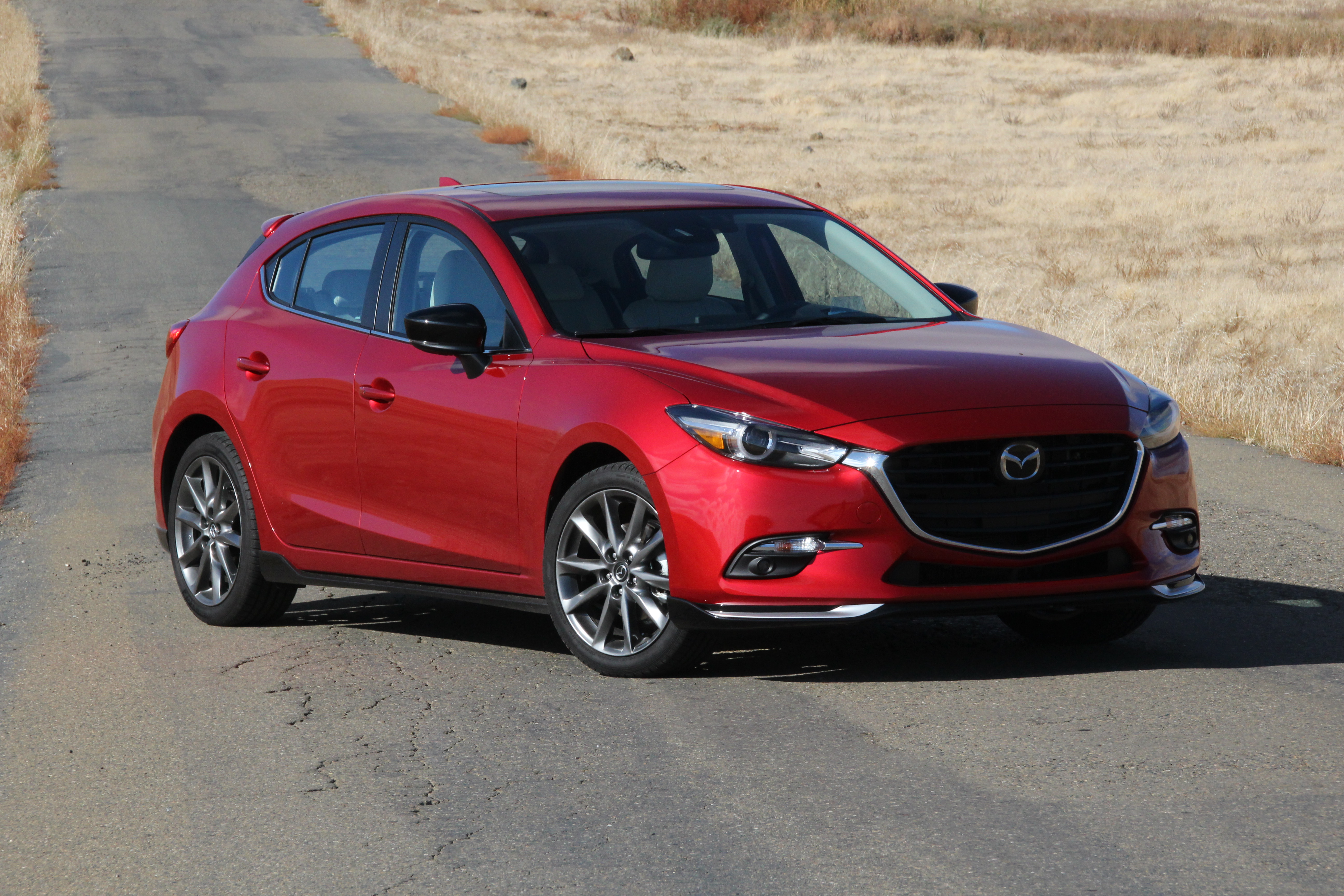
The 2018 Mazda 3 Grand Touring, five door is still the best of the best. Photos/Larry Weitzman

By Larry Weitzman

They are cowboys, but they sure can breed them right and ride them the best. I am not talking about cows or horses, but the car company from Japan that the other major manufacturers refer to sometimes as cowboys. With their swagger and panache, you would think they were an American company with 500 hp V-8s, but no, the biggest engine they produce is a 2.5L inline four and in a turbo version it produces a maximum of 250 hp. Normally aspirated, that number drops to either 187 or 184 depending on the installation. How could a car company whose biggest engine is a 2.5L four and 250 hp be called a cowboy? If you are Mazda, that’s what the others call you, and for good reasons.

First, is the out of the box styling, Mazda calls it Kodo, but it is the result of a concept car called the Takeri. Mazdas are bold, aggressive and beautifully proportioned with each line creating a new shapely delight in the body. It starts with the best front end in motordom, aggressive and strong with character lines moving rearward shaping an almost “coke bottle” look that was created by NASA in about 1954 which was the result of the discovery of the “area boundary rule” that allowed air force fighter jets to easily exceed the speed of sound. Look at the fuselage of an early F-102 Delta Dagger and a later F102A or the very similar F-106 Delta Dart. With essentially the same engine, top speed was nearly doubled in the F-106 over the original F-102. Later F-102s were modified with the area boundary rule fuselage allowing them to go supersonic.

The bottom line is that the Mazda3 five door is the best looking compact in the business. Size-wise, the Mazda3 five door (meaning hatchback wagon) is a minuscule 176-inches long by 71-inches wide and 57-inches tall, which makes it slightly shorter than the compact car rule of 180 inches. That’s a bonus as its internals dimensions are not compromised.

Specifications
Engine
DOHC, 16 valve inline 2.5L four 184 hp @ 5,700 rpm
185 ft-lb of torque at 3,250 rpm
Transmission
Six speed torque converter automatic, with paddle shifters
Six speed manual
Configuration
Transverse mounted front engine/front wheel drive
Dimensions
Wheelbase 106.3 inches
Length 175.6 inches
Width 70.7 inches
Height 57.3 inches
Track (f/r) 61.2/61.4 inches
Ground clearance 6.1 inches
Weight 3,046 pounds
Weight distribution (f/r) 60/40%
Fuel capacity 13.2 gallons
Cargo capacity (rear seats up/down) 20.2/47.1 cubic feet
Steering lock to lock 2.57 turns
Turning circle (curb to curb) 34.78 feet
Turning circle (wall to wall) 37.07 feet
Wheels 18X7 inch alloys
Tires 215/45X18 all season radials
Co-efficient of drag (sedan/hatchback) 0.26/0.28
Performance
0-60 mph 6.92 seconds
50-70 mph 3.43 seconds
50-70 mph uphill 5.31 seconds
Top speed 130 mph electronically limited
Fuel economy 26/35/30 mpg city/highway/combined. Expect 32 mpg in rural country driving and over 37 mpg on a level highway at legal speeds.

Under hood is, you guessed it, Mazda’s 2.5L Skyactiv DOHC, 16 valve inline four that creates 184 hp at 5,700 rpm at full boil. Redline extends to about 6,500 rpm. Torque of 185 pounds of twist is developed at a low 3,250 rpm meaning this is a strong down low engine and its performance numbers demonstrate that power. Skyactiv’s most significant feature is direct injection.

Zero to 60 mph arrives in under 7 seconds at 6.92 seconds. Passing performance is also outstanding with 50-70 mph acceleration taking 3.43 seconds and the same run up a steep grade (6-7 percent) just slowing that time to 5.31 seconds. Fifteen to 20 years ago a 5-second run on level ground was considered good. In other words, the Mazda3 with the 2.5 engine is the strongest performer in the compact class save for a couple of the new turbo Hondas which in the Si model is a bit quicker.

In comparison to the six-speed manual Mazda3 five door GT, the automatic is quicker as the manual posted numbers a year ago as follows: 6.98, 3.95 and 6.12, respectively, for the same three performance parameters. Go with the six-speed torque converter automatic which comes with paddle shifters as well. It is responsive and super smooth. This Mazda3 will push you well back in the seat even with part throttle. It feels powerful and that makes it lots of fun.

Fuel economy as rated by the EPA cycle is 26/35/30 mpg. Mazda has the title as the most fuel efficient company, followed closely by Honda. In real life at 70 mph on a level highway and making a 20-mile two-way run, the Mazda3 returned 37.3 mpg. Overall 30-32 was the averaged for 600 miles and in a 200-mile run from Placerville to Carson City over the Sierra on Highway 50 in aggressive driving the Mazda3 averaged 36.9 mpg. The speed limit is 55 mph on Highway 50, but there were more than a dozen full throttle passes.  Amazing economy considering its very high performance, or even not considering the Mazda3’s amazing performance as a compact.

Suspenders are state of the art independent, no torsion beam rear axle. It’s a true independent, which makes a difference when pushing the vehicle hard at maximum performance. And this Mazda3 can be pushed in the twisties. It’s no wonder that more Mazdas are raced than any other brand, especially Mazda3s and Miatas.

We have a huge Miata champion right here in El Dorado County in the form of Mark Hoover who races a highly modified Miata and consistently wins at the national level. He is a Mazda expert. Just drop by European Performance where he is preparing his Miata for the upcoming season. He will also tell you when it comes to grooving corners, Mazdas do them best. Steering, tracking and roll control are as close to perfect as you can get. Mazda3 gets it done.

On the flip side, the Mazda3 rides on the firm side of the equation, smoothing out road imperfections with aplomb. It is smooth and quiet with little road noise; no wind noise and the engine is silent as it turns a low 2,000 rpm at 70 mph and has a pleasant growl when you get your foot into it.

Safety is not compromised as all the acronyms are present and includes a rear back up camera. Brakes a very strong with large four-wheel discs and air bags abound. Special mention needs to be made about the LED headlights with standard auto high beam and AFS that track with steering. The auto dim and tracking are part of the $1,600 Premium package that also gets you lane departure warning, lane keep assist, radar cruise, smart braking and more. It’s a bargain.

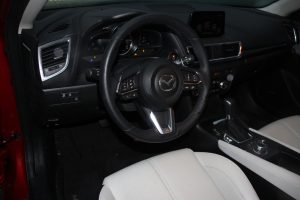
Interior quality is magnificent, with contrasting, comfortable, leather bucket seats, great instrument panel, heads up display and a center stack that I now use as if second nature. It’s as nice inside as it is outside.

Pricing is set at $24,975, plus $875 for the boat from Hofu, Japan. With the Premium package, Appearance package ($1,750), go fast Soul Red metallic paint ($300) and a few other items brought the total to $29,770. Mazda3 is the best of the best in this highly competitive compact category. End of story.

Larry Weitzman has been into cars since he was 5 years old. At 8 he could recite from memory the hp of every car made in the U.S. He has put in thousands of laps on racetracks all over the Western United States.