Snippets about Lake Tahoe

·      Lake Tahoe South Shore Chamber of Commerce raised $2,550 for Bread & Broth at the charity mixer this month.

·      The 2018 Spartan World Championship returns to Lake Tahoe on Sept. 29-30, drawing some of the world’s best endurance athletes to the rugged mountains of Squaw Valley. The seventh annual event is the culmination of Spartan’s 2018 Global Championship Series, which will see competitors battling obstacles on five continents for the largest cash purse in obstacle racing history.

·      There’s Magic in the Air is the theme of the El Dorado County Fair that will run June 14-17 in Placerville.

·      Kirkwood is offering free cross country skiing to all El Dorado County veterans. Contact Debbie Waldear at 209.258.7248. Proof of veteran status is required.

·      South Tahoe Brewing Co. is having a fundraiser for Heavenly’s avalanche dog program on Feb. 9 from 6-10pm.


Pioneering snow-sports filmmaker Warren Miller dies

Warren Miller’s legacy as a snow-sports icon will live on. Photo/LTN

By Ron Judd, Pacific NW Magazine

Warren A. Miller, the pioneering snow-sports filmmaker whose infectious zeal for the “pure freedom” associated with skiing, snowboarding and other pursuits inspired multiple generations of adventure-seekers around the globe, died Jan. 24 at his home on Orcas Island. He was 93.

A quick-witted, self-taught filmmaker who first filmed his own scenes for an annual self-narrated ski movie shown in small venues, Mr. Miller produced more than 500 adventure-sport films. His name, carried forward in a sports-media company, Warren Miller Entertainment, from which he was disassociated in his later years, became synonymous with snow sports across North America.

To his legions of fans, Mr. Miller’s annual ski flick amounted to cinematic manna from heaven — an overdue shot of cold air and deep snow to stoke the fires within winter warriors who had suffered through the long, hot months of snowless summer.

Read the whole story


LTCC seeking directors, actors, designers for plays

Lake Tahoe Community College is looking for directors, actors, and theatrical designers to be part of this spring’s four one-act plays.

The four selected directors will get the chance to choose their sets, lighting, and costumes, and will be given full reign and support to create a theatrical event. The final result will be a two-week run of performances in LTCC’s Duke Theatre with all four one-act plays featured each night. 

LTCC will conduct an open interview process on March 7 at 7pm in the Duke Theatre to select the four directors. To be considered, potential directors should have a one-act play already chosen that takes approximately 30 minutes to perform and that doesn’t require significant set needs. No prior directing experience is required, but interviewees should be familiar with the rehearsal process and ready to approach their chosen material from a director’s point of view.

For more information or to request an interview appointment, send your name and the name of the one-act play to David Hamilton at hamilton@ltcc.edu by March 6. The four directors and plays will be selected by March 9.

For those interested in set, lighting or costume design, submit your name and a description of your experience or a resumé to Kurt Munger at munger@ltcc.edu. You do not need to have significant design experience to be considered, but you should have a good working knowledge of your chosen field. After the directors are chosen on March 9, they may contact potential designers to work on their individual productions. If you are not chosen by a director, you may still be added to the general crew list if you wish. 

For newer directors and designers, director-producer David Hamilton and technical director Kurt Munger will provide instruction and guidance to help with the process.

Actors who wish to perform in one or more of the four one-act plays may audition April 10 at 7pm in LTCC’s Duke Theatre. More information about the shows and featured parts will be posted by March 15. Play rehearsals will be  on Tuesday and Thursday evenings, and performances will be June 14-16 and June 21-24.


EDC launches website just for cannabis

El Dorado County has launched of a website focused on cannabis issues.

It includes information about personal and commercial guidelines, the county’s regulatory history of cannabis, state and county policies about cannabis, code enforcement process, frequently asked questions and answers, and more.

The ad hoc Cannabis Committee is scheduled to meet Jan. 31 from 3-5pm at the county Planning Commission conference room, 2850 Fairlane Court, Building C, Placerville.


Schools open, resorts prepping for powder day

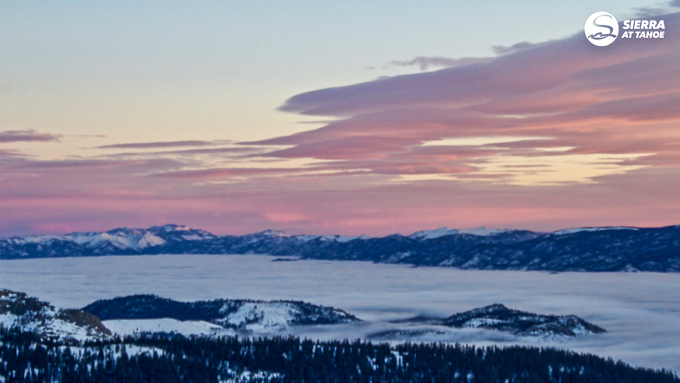
Sunrise on Jan. 25 at Sierra-at-Tahoe. Photo/Sierra-at-Tahoe

Even though Mother Nature dumped just less than a foot of snow overnight, all schools in Lake Tahoe Unified School District, Douglas County School District and Tahoe Truckee Unified School District are open on Thursday.

Incline Village schools are on a two-hour delay.

A winter weather advisory remains in effect through 4am Friday. Snow showers are expected to resume this afternoon, with another 3-7 inches at lake level and the possibility of a foot of snow above 7,000 feet.

Expect some delayed openings at the ski resorts as they work to clear the snow off chairs and implement avalanche control measures. Call the resort or check their websites for specifics.

Sierra-at-Tahoe is reporting 15 inches of new snow and Northstar received 13 inches up top and 11 inches mid-mountain.

Chain controls are up on the highways in and out of the Tahoe basin. Click on the state icon on Lake Tahoe News’ home page for current conditions.

— Lake Tahoe News staff report


Recycling grants available in Nevada

The Nevada Division of Environmental Protection’s Recycling Program has $50,000 in grant funding available for projects to increase recycling, public awareness of the importance of conserving natural resources, and for the reduction, reuse and recycling of solid waste.

NDEP encourages action-oriented projects rather than projects oriented toward research and development. The funding comes from the Solid Waste Management Account which receives $1 per retail tire sold in Nevada.

Preference will be given to applications that provide the greatest regional coverage and demonstrate a likelihood of on-going success. Grantees may be offered partial funding, and while matching funds and in-kind contributions are not required, they are encouraged.

Proposals will be accepted from municipalities, nonprofit organizations, schools, school districts, the Nevada System of Higher Education, and other public institutions.

More information about the grant program and application process is available online. The deadline to submit an application is Feb. 26.


Panel: Tahoe snowfall a casualty of climate change

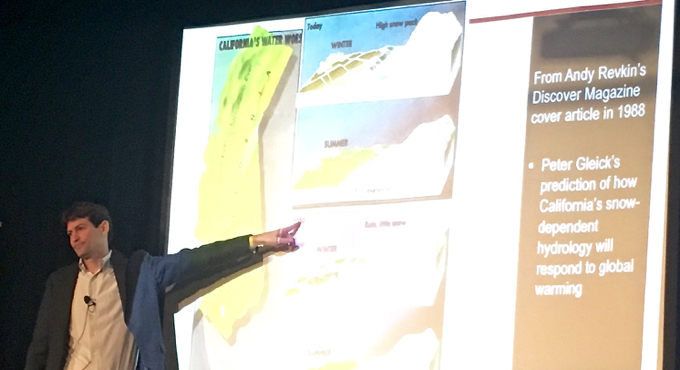
Noah Diffenbaugh, a professor at Stanford University, talks climate change Jan. 23 at Harveys. Photo/Terra Breeden

By Terra Breeden

STATELINE – In Lake Tahoe, warm weather patterns are affecting snow levels. A panel of weather experts pointed out the difference between the snowfall in 2017 and current snow conditions as an example of extreme weather events.

“When you have snow in November last year and now it’s January and there’s no snow, you can call that extreme weather,” meteorologist and CNN weather supervisor Brandon Miller said.

Miller is one of several people in town this week for Operation Sierra Storm, a national weather conference. In part the participants are addressing global climate change and the growing occurrence of extreme weather events, like the recent California drought.

The conference on Jan. 23 was led by keynote speaker Noah Diffenbaugh, a geoscientist and professor of earth system science at Stanford University, and included a panel of renowned meteorologists from U.S. news sources.

One of the reasons for having the conference in Lake Tahoe is to discuss how global warming is affecting snowfall conditions and how extreme weather events contribute to visitation and the economy of the community. National trends in climate change were addressed as well.

“The National Weather Service asserts that climate change is happening, and it is caused by mankind. The question we cover is what does that mean for the future,” Paul Goodloe, a TV meteorologist for the Weather Channel said.

Goodloe, who covered the winter storm in Tahoe last week for the Weather Channel, said that the heavy rain and lack of snow was caused by a warm tropical air mass at 8,000 feet. He asserted that as global warming continues, weather will be prone to “wild swings” in California at high elevations, as seen in the substantial difference between last year’s snowfall and this year’s.

“This is the type of pattern caused by climate change,” he said. “You start to see snow levels at higher feet and more drought in California.”

Goodloe pointed to Louisiana towns currently being threatened by rising seawater and major storm events in Alaska and North Dakota as other instances of extreme weather caused by global warming.

“Eventually, it’s going to mean relocating people from their native land,” Goodloe said.

Diffenbaugh began his presentation at Harveys by pointing out that humans are altering the chemistry of the atmosphere and ocean by emitting greenhouse gases.

“As scientists we know this because we can measure it,” he said. “Altering carbon dioxide levels alters the Earth’s temperature.”

2017 was the second warmest year on record, with 2016 being the warmest. Scientific research taken from different studies points to humans as the cause.

Diffenbaugh lives in California and has studied the California drought extensively. Although droughts do happen naturally in the state, research shows that drought occurrences have doubled in California in the last century. Diffenbaugh believes that the extreme weather related to the last drought was caused by global warming.

“The California drought was a severe event for the state’s economy. It also killed over 100 million trees and led to the wildfires we’ve experienced,” he said.

Warmer temperatures and less precipitation means less water in California. Diffenbaugh noted that we can expect warmer weather patterns and events as global temperatures rise. This could mean warmer winters and less snow in Tahoe.

“We are getting to the point where every year is a warm year,” he said. “If we look to the future, what we find when we look at climate change models for California is that the likelihood of another warm year is 100 percent.”

It seems as if extreme weather events like the California drought will become the “new normal” as global temperatures rise. Although there are still people who deny the existence of climate change, many people now consider global warming an impending threat.

“Polls tell us that people trust scientists more than politicians,” Angela Fritz, meteorologist and deputy editor of the Washington Post, said. “They know that climate change is happening and that they have to make changes to accommodate it.”

Over the years, public opinion has shifted on global warming, going from outright denial to a widely accepted fact, which has made climate change easier for journalists to cover. However, 10-15 years ago, it wasn’t that way.

Miller shared a personal anecdote about how he had a conservative upbringing and denied the existence of climate change for many years. Even as a young meteorologist, when he witnessed the growing number of extreme weather events such as storms and floods, he didn’t accept that the events were caused by climate change. It took years of seeing weather patterns grow warmer for him to believe in climate change.

Miller’s story related to the current White House administration’s climate change denial, which all the panelists agreed would not affect the progress the U.S. has made to adapt to and moderate global warming.

“The administration can do as much as they want to unravel the progress we’ve made in the last decade, but industries and the public are already on the same page,” Fritz said. “They’re going to do what’s in their and everyone else’s best interest.”

To demonstrate how industries are already adapting to climate change., Goodloe showed a short video about an automobile manufacturing plant in Ohio that is harnessing wind energy as a source of renewable power.

The panelists also addressed the U.S. withdrawal from the Paris Agreement, an agreement within the United Nations to aggressively curb greenhouse gas emissions and limit global warming by 2 degrees Celsius. The meteorologists admitted that the U.S. withdrawal created a setback for climate change, especially when America is the second largest contributor of greenhouse gases in the world.

However, the panelists pointed to states like California that continue to honor the Paris Agreement despite the decisions made by national leaders.

“California is setting the standard and it will be a leader and trend-setter for the nation,” Goodloe said.
Opinion: Oprah for Santa Barbara County supervisor

Dear Oprah,

You might become a fine president. But you and your state, California, would be better off if you ran for Santa Barbara County supervisor instead.

That’s no joke. If you want to tackle our nation’s greatest problems, there’s no need to trudge through the D.C. swamps. You can stay right at home in your Montecito mansion.

Joe Mathews

A local government position in a small place 90 miles north of L.A. might sound like a comedown for a billionaire. It isn’t. For all its wealth and natural beauty, your county of 445,000 is now the most challenged place in California. That was true even before two recent disasters—the massive Thomas Fire that forced you to evacuate, and the subsequent mudslides that killed 20 people— occasioned soul-searching about emergency response, infrastructure, and development in the county.

I realize that being a local politician was the furthest thing from your mind in 2001 when you bought a 42-acre spread there and named it The Promised Land, a nod to Martin Luther King Jr.’s final speech in 1968. No, you loved the idea of Santa Barbara as a magical quasi-island on the land—a place cut off from the world by the sea and the mountains, but still close enough to take a lunch meeting in Hollywood. 

But that geographic isolation makes Santa Barbara’s problems more complex and costlier. Consider the area’s chronic water troubles. Santa Barbara remains in drought even after last winter’s rains. Why? The landscape that makes Santa Barbara so dramatically beautiful—high mountains next to the ocean—also makes it hard to capture water.

When rain lands, it rushes out to sea, too quickly to be captured by reservoirs or seep into the aquifer. Rising ocean water is seeping into the region’s freshwater supply. Santa Barbara has responded by buying more water and installing a desalination plant. (This is why your laidback neighbor The Dude—Jeff Bridges—was reportedly angry when he learned you had dug a new well on your property.)

Santa Barbara also lacks strong infrastructure to connect it to the rest of the state (the 101 is a parking lot, the Amtrak train is slow, and the airport has been losing flights). And county government is hamstrung by persistent budget shortfalls. (It could use your Midas touch.)

This reflects the area’s badly imbalanced economy. Santa Barbara, which mixes wealthy transplants and low-wage workers in agriculture and tourism, has the second worst income inequality in California after the Bay Area. And by advanced statistics—which account for Santa Barbara’s high housing costs and its people’s relatively low levels of income from government programs—it has the highest childhood poverty rate in California.

Santa Barbara poverty looks different than the poverty you grew up with in Milwaukee. But it’s damaging nonetheless.

Drive up to Santa Maria, the county’s most populous city. You’ll see pretty parks and single-family homes. But when you knock on doors, you’ll discover two and three families packed into many houses. You’ll also hear plenty of concerns about crime in neighborhoods with high murder rates. And you’ll also find children who can seem cut off from their beautiful region.

So, while you’re there, make some young friends and drive west on Main Street until you reach the Rancho Guadalupe Dunes Preserve, a county park that sits right on the ocean. You’ll find that many Santa Maria kids, haven’t experienced the roaring waves or the 550-foot dunes, the tallest on the West Coast, even though they live 10 miles away.

That’s the kind of thing you could do as a county supervisor that you couldn’t do as president.

Yes, the White House offers awesome power. But you’d also find yourself constrained by partisan polarization. To take that job, you’d have to give up your media empire—unless you want to be criticized and investigated as ceaselessly as the self-enriching current president is.

As a county supervisor, you could keep your businesses while serving your community. You’d be less constrained in pursuing your agenda—county supervisors in California are both the legislative and executive branches, so supes who can collaborate with colleagues can make a ton of difference.

And then there’s the power of your example. Americans spend far too much time obsessing over the madness of our crazy national politics, while ignoring the more fundamental and important work of local governance. You, by becoming a local supervisor, would inspire imitators all over the country.

You’ve been successful in life because of your ability to bridge the experiences and aspirations of the wealthy and the poor, the fortunate and the not so fortunate. Santa Barbara County needs more bridges like that. Is there any higher public service than to save the place you call home?

Your fellow Californian,

Joe Mathews

Joe Mathews writes the Connecting California column for Zócalo Public Square.


This amphibian – loved for its legs – threatens its Calif. cousins

By Jane Braxton Little, Sacramento Bee

Quincy American bullfrogs, native to the eastern United States, are hopping around Northern California ponds, gobbling up lizards, snakes, bats and birds – anything that fits in their mouths.

Among their prey are the adults and tadpoles of endangered native amphibians: Sierra Nevada and foothill yellow-legged frogs, said Colin Dillingham, a wildlife biologist with the Plumas National Forest.

He has applied for a state permit to eradicate bullfrogs in Snake Lake, Spanish Creek and other aquatic sites in the Meadow Valley area 16 miles west of Quincy. The plan is to use nets, hooks and air guns several nights a month over three or four years.

Read the whole story


Man found dead in Incline Village residence

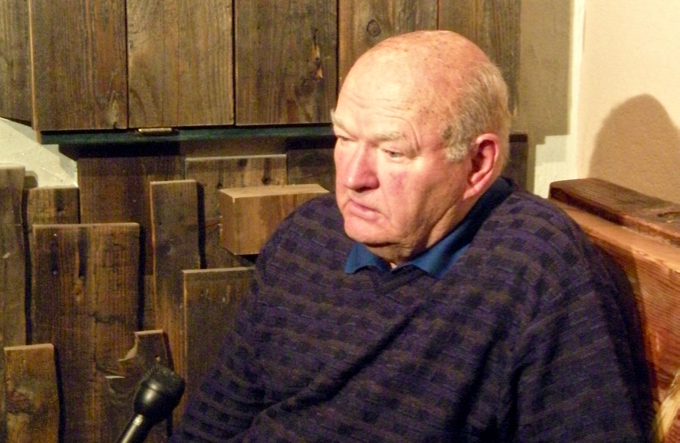
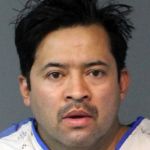
Ismael Resendiz-Moreno

One person is dead and another is in custody as Washoe County sheriff’s deputies continue to investigate the suspicious death in Incline Village.

Investigators found a man deceased on Jan. 23 in a residence near Southwood and Tahoe boulevards. The victim’s name has not been released.

Ismael Resendiz-Moreno, 44, was apprehended at the location. He was charged with battery with a deadly weapon.

The relationship between the two has not been released.

Anyone with information is asked to call Secret Witness at 775.322.4900.

— Lake Tahoe News staff report