Renowned musician to play in Truckee

Arts for the Schools in Truckee is bringing Rahim AlHaj, a virtuoso oud musician and composer who was born in Baghdad, Iraq, and began playing the oud (the grandfather of all stringed instruments) at age 9, to town on Feb. 2.

In 1991, after the first Gulf War, AlHaj was forced to leave Iraq due to his activism against the Saddam Hussein regime and began his life in Jordan and Syria. He moved to the United States in 2000 as a political refugee and has resided in Albuquerque ever since.

In 2015 Rahim was awarded the National Endowment for the Arts National Heritage Fellowship, the highest honor for traditional arts in the United States.

This show is for an audience of all ages. It will be from 7-9pm at the Community Arts Center, 10046 Church St., Truckee.

Purchase tickets online.


Rotarians putting on high school speech contest

South Lake Tahoe Rotary Club is putting on a speech contest in March for high school students.

Ages 14-18 may enter the Rotary District 5190 speech contest. Speeches must be 5-7 minutes in length with the topic Rotary is making a difference. What about me?

Winners of the local contest will progress to the area contest and then district event. The local contest will take place on March 21 at noon at the Tahoe Mountain Lab in South Lake Tahoe. Area contest will take place April, with time and location TBD. District contest will take place at 2:30pm on May 19 at the Atlantis in Reno. Contestants must be available to speak at all three. A student may only speak at one club in each area.

For more contest rules and entry forms, contact Kevin Sommerfeld at ksommerfeld@laketahoegc.com


Snippets about Lake Tahoe

·      South Lake Tahoe on Jan. 30 set a record high of 56 degrees, according to the National Weather Service in Reno. The old record of 52 was from 1989 and 2012.

·      Kenny Chesney is returning to Harveys on July 3. Country musician Chris Stapleton will play at the Stateline venue on July 26. Joining him will be Marty Stuart and Brent Cobb.

·      Corinna Osborne is now Edgewood Tahoe’s general manager.

·      El Dorado County Supervisor Sue Novasel is asking constituents to take this survey.

·      Achieve Tahoe’s annual Ability Bash fundraising event, celebrating the achievements of winter and summer adaptive sports athletes and raising money to continue their programs for children and adults with disabilities at all ability levels, will be Feb. 10, 6-10pm at the Olympic Valley Lodge. For more info or tickets, go online.

·       

·       


Ski conditions decent despite scarcity of snow

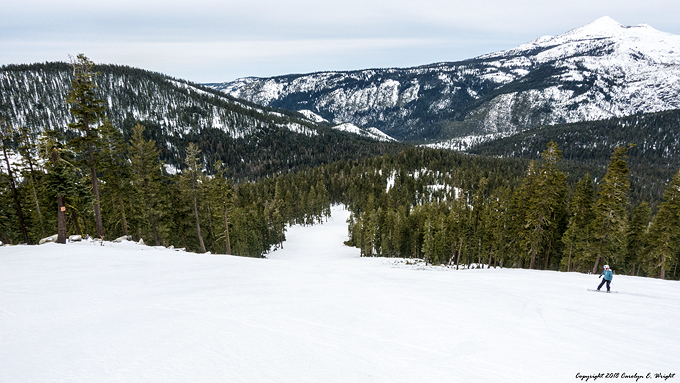
It’s as though the trail of snow leads to the top of Pyramid Peak. Photo Copyright 2018 Carolyn E. Wright

By Kathryn Reed

TWIN BRIDGES – Perfect corduroy. Slightly crusty powder. Hard pack. Soft, pillowy snow. Dirt and twigs.

Ski conditions are so variable right now in the greater Lake Tahoe area that it depends on the run, not just the ski resort.

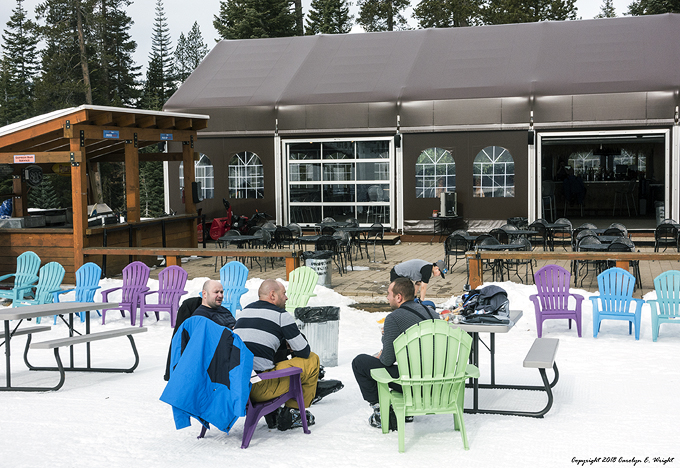
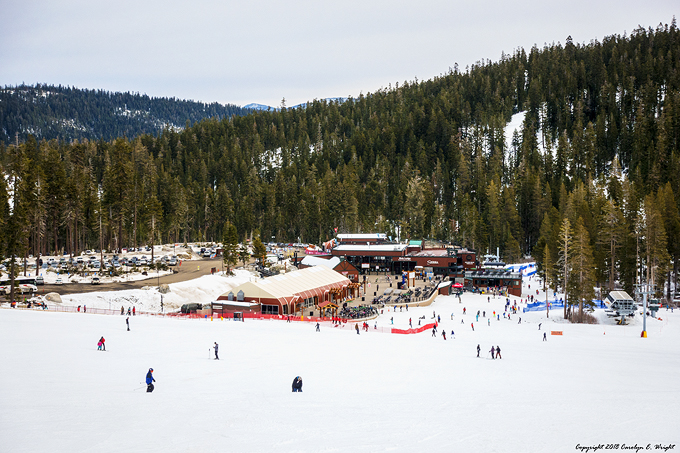
Sierra-at-Tahoe on Monday was a mixed bag, with mostly pleasurable moments. And considering the mountain was devoid of the masses that were here during the weekend, it meant wide-open runs, no lift lines, and no waiting for a cocktail.

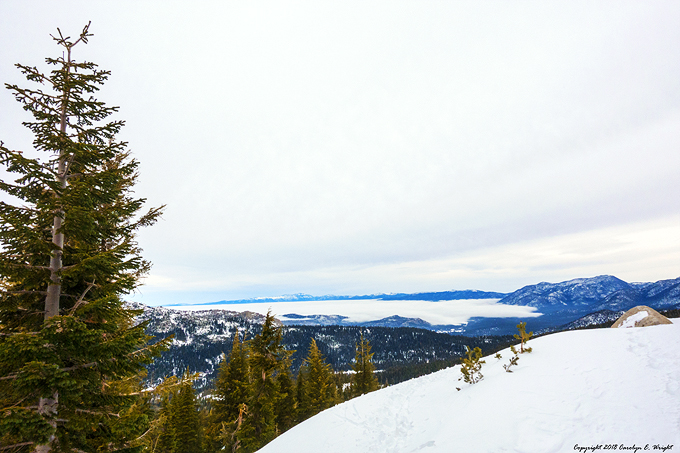
Fog covers Lake Tahoe on Jan. 29 as seen from the 360 Smokehouse at Sierra. Photo Copyright 2018 Carolyn E. Wright

Lower Main had been transformed into a race course for high school teams, with the public side a mogul lover’s dream.

As with most seasons when Mother Nature is remiss at providing ample white stuff, the groomers and snowmakers can save a season.

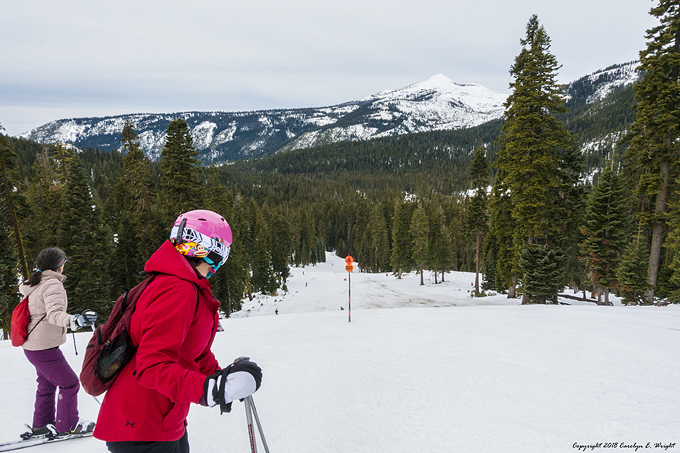
Skiers assess the terrain on Beaver where coverage is lacking a bit. Photo Copyright 2018 Carolyn E. Wright

The groomers are being put into overdrive right now while an inversion hangs over the area. It means temps at lake level are colder than they are on the slopes. Snowmaking requires a certain temperature; it hasn’t dropped low enough the past few nights for the guns to be fired up.

It wasn’t until last week that the West Bowl area of Sierra opened; the back side is also open. This is super late in the season for these areas to be accessible.

Time to shed layers at West Bowl in the warm temps. Photo Copyright 2018 Carolyn E. Wright

All resorts in the region were able to open more terrain after last week’s dump. The problem, though, is the forecast is dry through at least Valentine’s Day. The love from the snow god’s just hasn’t been here this season for the resorts, which are coming off a record snowfall a year ago.

Going down Dogwood off the West Bowl chair it was near perfect conditions. There is no indication there is a lack of snow. But then when the trail merges onto Beaver it’s another world. A lot of brown snow can be found here. Still, it’s manageable. No rocks could be seen.

Skiing in closed areas is never a good idea. Photo Copyright 2018 Carolyn E. Wright

Upper Powderhorn was super – plenty of snow (all white) – and nicely groomed.

Sierra does an excellent job of posting signs about conditions ahead. Pay attention.

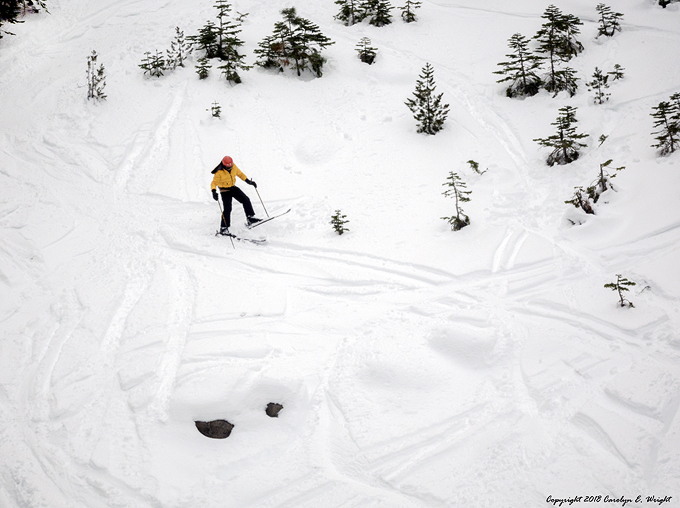
One yahoo decided to duck under the roped off area of Clipper that said “closed.” Observing from the chairlift, he was in way over his head. These are the people that end up unnecessarily putting ski patrollers’ lives at risk.

Nearly the entire mountain at Sierra is open for skiing/snowboarding. Photo Copyright 2018 Carolyn E. Wright

Tree skiing is always risky; it’s even more so when there isn’t ample snow. And closed, means closed. Those powder stashes aren’t worth it.

Considering February and March are two of Tahoe’s better months for skiing, it’s possible plenty of powder days are still to be had this season.


Opinion: L.A. is not Latin America, but it could be

By Joe Mathews

Los Angeles is not Latin America.

Such a statement should be as uncontroversial as a map of the western hemisphere. But in L.A., elite conventional wisdom runs the other way.

Joe Mathews

Lewis D’Vorkin, the Los Angeles Times editor, recently promoted L.A. as “the northern capital of Latin America” in a staff memo. Organizers of L.A.’s recent bid for the Olympics used a similar formulation.

In its Pacific Standard Time series, the Getty Foundation supported 70-plus exhibitions—from Santa Barbara to San Diego—under the title: “LA/LA”—for Latin America and Los Angeles. In its publicity material, the Getty called L.A. “a Latin American city of long duration.”

The impulse to pump up L.A. is understandable; after all, it’s not even the capital of California. But here’s a reality check. Los Angeles isn’t a part of Latin America—or of anyplace else.

Helen Hunt Jackson, author of the 19th-century novel “Ramona,” famously termed Southern California “an island on the land.” The 20th-century California chronicler Carey McWilliams borrowed Jackson’s line for the title of a 1950 book, in which he wrote that Southern California “is as distinct, as unlike any other part of the state, as though it were another country.”

Yes, L.A. has a Spanish colonial and Mexican past. Yes, it has long drawn Latin American artists. And yes, nearly half of Angelenos either are immigrants from Latin America or are descended from them.        

But Los Angeles, for almost its entire history, has been a walled-off and peculiar place. When L.A. has bothered to define itself, it has done so in opposition to the world—and to Latin America in particular.

When whites built Los Angeles as a “city of the future” they nearly obliterated its Mexican history and Mexican-American people. As the historian William Deverell wrote, “Understanding Los Angeles requires grappling with the complex and disturbing relationship between whites, especially those able to command various forms of power, and Mexican people, a Mexican past, and a Mexican landscape.”

Unfortunately, that whitewashing left a permanent separation. In his book “The Labyrinth of Solitude,” the Mexican author Octavio Paz described the city as having a “vaguely Mexican atmosphere” that felt distant, like it was “floating” in the air.

“I say ‘floats’ because it never mixes or unites with the other world, the North American world based on precision and efficiency,” Paz wrote, adding: “It floats, never quite existing, never quite vanishing.”

Today this city still floats nebulously, without quite landing. L.A. might pride itself on its diversity, but the town’s culture is still ruled by predominantly white Hollywood. The center city and Westside—the parts of L.A. most familiar around the world—are far whiter than the U.S. as a whole.

While L.A is not a Latin American city, it is a profoundly Latino one. But as immigration diminishes, its Latinos are becoming less Latin American. Today, more than 60 percent of L.A. County’s Latinos are native-born. If you want to see a truly Latin American U.S. city, you should visit Miami.

The town’s population trends work against Latinization. One of the two biggest demographic stories in Los Angeles in this century has been the rapid decline in the number of children, including Latino children. The other big story is the increase in the number of whites in the city—by nearly 40,000 between 2010 and 2014—outpacing the rise in the number of Latinos.

Since the 1990s recession, Latin American immigration here has dramatically declined, while the regional economy has tilted away from Latin America. International trade here is dominated by East Asia.  Mexico is the third-largest trading partner of the United States, but ranks 10th as an L.A. trading partner, behind Germany.

The weakness of ties between L.A. and Latin America now seems like a real vulnerability, as the California-hating Trump administration deports immigrants and retreats from the world. León Krauze, a Mexican journalist who is an anchor for Univision in L.A., said the Trump threat may force closer ties, as Angelenos and Latin Americans realize they must be allies in protecting immigrants from the U.S. government.

At the same time, there is something cynical about the “L.A. is Latin America” messages of L.A.’s elites. Many Southern California institutions have celebrated prominent Latin Americans while being slow to include L.A.’s own Latinos. Take the motion picture academy, which has been giving Oscars to film directors from Mexico—Alfonso Cuarón, Alejandro González Iñárritu, and, perhaps soon, Guillermo del Toro—while doing little for Latino filmmakers.

Still, it would be wiser to embrace the “Latin America–Los Angeles” narrative as aspirational. After all, Los Angeles would have much to gain from deeper ties to a region that has seen gains in democracy and in its middle class over the past two generations.

Building those ties would take sustained work, including creating more spaces for preservation of the Spanish language. More broadly, making L.A. a Latin American city would require the same freedom of movement in the western hemisphere as the European Union enjoys, so that Latin Americans could visit, study and live here with ease.

But, first, L.A.  would have to obliterate the walls that have long surrounded it.

Joe Mathews writes the Connecting California column for Zócalo Public Square.


Blue moon, supermoon, total lunar eclipse rolled into one

By Associated Press

The moon is providing a rare triple treat this week.

On Wednesday, much of the world will get to see not only a blue moon and a supermoon, but also a total lunar eclipse, all rolled into one. There hasn’t been a triple lineup like this since 1982 and the next won’t occur until 2037.

The eclipse will be visible best in the western half of the U.S. and Canada before the moon sets early Wednesday morning, and across the Pacific into Asia as the moon rises Wednesday night into Thursday.

Read the whole story


Task force to boost oversight of casino emergency plans

By Jeff German, Las Vegas Review-Journal

State officials have created a task force to spur oversight of casino emergency response plans following the Oct. 1 massacre outside Mandalay Bay on the Las Vegas Strip.

The effort is a result of a Review-Journal investigation last month that found the Nevada Division of Emergency Management for years had not reviewed the plans for most casinos in Nevada.

The task force will conduct its first meeting next week, Caleb Cage, the division’s chief, told members of the Nevada Homeland Security Commission on Monday.

Read the whole story


Life after ski patroller’s death at Squaw Valley

By Megan Michelson, Co-op Journal

Exactly one year ago, Joe Zuiches kissed his half-sleeping wife, Mikki, on the forehead as he left his house in the dark, at 3:30 in the morning on Jan. 24, 2017. Joe was on his way to his job as a ski patroller at Squaw Valley. He’d once read that you live longer if you kiss your spouse before you leave the house each day, so he always made a point to do so.

Later that morning, as a golden sun was rising over a brilliant blue sky—after days on end of pounding storms and feet upon feet of snow—Joe texted Mikki to say, “Another patroller blew his knee out, so I’m the supervisor.” He was doing avalanche control work to ready the snow-drenched mountain for the day’s onslaught of skiers and riders.

She responded, “Be safe.”

Read the whole story


Rotary putting on music contest for students

South Lake Tahoe Rotary is looking for high school students ages 14-18 to enter into the Rotary District 5190 Youth Instrumental Music contest.

Songs are to be 3-8 minutes in length.

The music contest consists of three rounds (local club contest, area contest and district contest) with the winner of the district contest receiving $1,000, second $750 and third $500. The local contest prizes will be: $100, $75 and $50.

The local contest will take place March 7 at noon at Lake Tahoe Golf Course in Meyers. Area contest will take place April 3 at the Brewery Arts Center in Carson City; time TBD. District contest is May 19 at Atlantis Casino in Reno.

Contestants must be available to play at all three.

For more contest rules and entry forms, contact Kevin Sommerfeld at ksommerfeld@laketahoegc.com.


Douglas County recruiting search and rescue members

Douglas County sheriff’s search and rescue is having an academy in April for potential members.

Rescuers are essentially on call 24/7; working in the county and helping neighboring rescue teams.

DCSAR is accredited by the Mountain Rescue Association and responds to high/low angle rope rescue events, reports of lost or injured backcountry snowshoeing, skiing, snowmobiling and hiking incidents. The volunteers also handle fire evacuations, river or flood rescues and lost/overdue off road drivers. Any previous experience in any of this areas are useful, but not a requirement to attend the academy.

Anyone who enjoys the outdoors, is over 18 year of age and has a desire to serve their community in times of emergency may apply. Comprehensive training is provided to ensure all members are safe and capable. There is no testing for physical limitations, however members must be able to go out into the back country in any type of weather.

The academy begins April 6. Applications are available online. They are due March 1.

For more info, email dcsar@douglasnv.us.