The new rules of dog ownership

By Wes Siler, Outside

Human society is made possible by rules, both written and unwritten. Yet there’s no such series of concrete, accepted rules for dog owners, and that’s becoming a problem.

Take my experience this past weekend. In need of a quick getaway, my girlfriend and I booked a room at the Kimpton Goodland in Santa Barbara with our two mutts. All Kimpton hotels are incredibly dog friendly, which makes the boutique chain a unique resource for dog owners. There’s no extra deposit or fees for dog owners, and the pups are allowed anywhere in the hotel. (Except for the restaurants.) It’s a unique opportunity to enjoy a nice hotel with your dogs.

But this weekend, even we were annoyed with the behavior of other dog owners. Dogs locked in rooms unattended barked persistently. Owners let their small untrained and unsocialized pets bark at other guests in the lobby and hotel bar. Some took their dogs to the poolside lawn for bathroom breaks. 

Read the whole story


Meadow damage from 4-wheeler

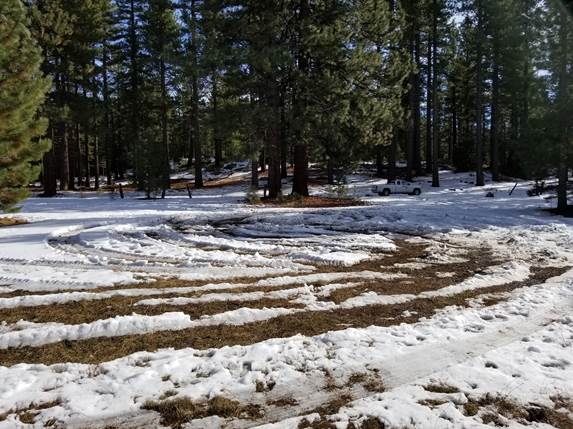
Damage to a South Lake Tahoe from a vehicle. Photo/Paul Potts/USFS

The meadow near Heavenly Creek off Pioneer Trail in South Lake Tahoe was recently damaged by someone driving on it.  

If the person is caught, he or she could face a citation punishable by a fine of $5,000 or more and/or six months in jail.  

The U.S. Forest Service said it will continue to monitor areas throughout the Lake Tahoe Basin for compliance to protect natural resources.


Calif.’s other drought: Major earthquake is overdue

By Richard Aster, The Conversation

California earthquakes are a geologic inevitability. The state straddles the North American and Pacific tectonic plates and is crisscrossed by the San Andreas and other active fault systems. The magnitude 7.9 earthquake that struck off Alaska’s Kodiak Island on Jan. 23 was just the latest reminder of major seismic activity along the Pacific Rim.

Tragic quakes that occurred in 2017 near the Iran-Iraq border and in central Mexico, with magnitudes of 7.3 and 7.1, respectively, are well within the range of earthquake sizes that have a high likelihood of occurring in highly populated parts of California during the next few decades.

The earthquake situation in California is actually more dire than people who aren’t seismologists like myself may realize. Although many Californians can recount experiencing an earthquake, most have never personally experienced a strong one. For major events, with magnitudes of 7 or greater, California is actually in an earthquake drought. Multiple segments of the expansive San Andreas Fault system are now sufficiently stressed to produce large and damaging events.

The good news is that earthquake readiness is part of the state’s culture, and earthquake science is advancing – including much improved simulations of large quake effects and development of an early warning system for the Pacific coast.

The last big one

California occupies a central place in the history of seismology. The April 18, 1906, San Francisco earthquake (magnitude 7.8) was pivotal to both earthquake hazard awareness and the development of earthquake science – including the fundamental insight that earthquakes arise from faults that abruptly rupture and slip. The San Andreas Fault slipped by as much as 20 feet (six meters) in this earthquake.

Although ground-shaking damage was severe in many places along the nearly 310-mile (500-kilometer) fault rupture, much of San Francisco was actually destroyed by the subsequent fire, due to the large number of ignition points and a breakdown in emergency services. That scenario continues to haunt earthquake response planners. Consider what might happen if a major earthquake were to strike Los Angeles during fire season.
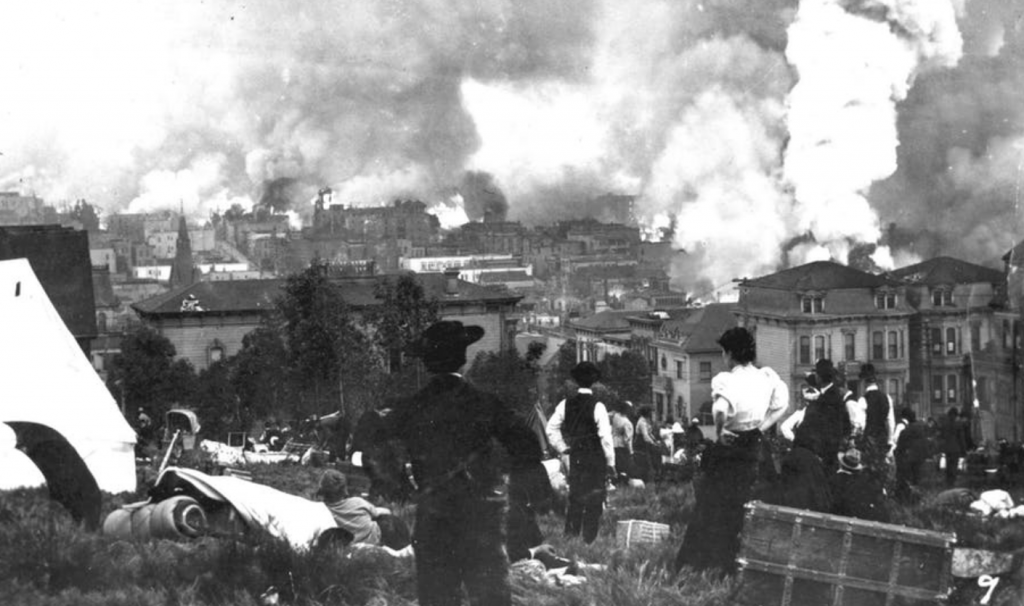
 

Fires break out across San Francisco after the 1906 earthquake. Photo/USGS

Seismic science

When a major earthquake occurs anywhere on the planet, modern global seismographic networks and rapid response protocols now enable scientists, emergency responders and the public to assess it quickly – typically, within tens of minutes or less – including location, magnitude, ground motion and estimated casualties and property losses. And by studying the buildup of stresses along mapped faults, past earthquake history, and other data and modeling, we can forecast likelihoods and magnitudes of earthquakes over long time periods in California and elsewhere.

However, the interplay of stresses and faults in the Earth is dauntingly chaotic. And even with continuing advances in basic research and ever-improving data, laboratory and theoretical studies, there are no known reliable and universal precursory phenomena to suggest that the time, location and size of individual large earthquakes can be predicted.

Major earthquakes thus typically occur with no immediate warning whatsoever, and mitigating risks requires sustained readiness and resource commitments. This can pose serious challenges, since cities and nations may thrive for many decades or longer without experiencing major earthquakes.

California’s earthquake drought

The 1906 San Francisco earthquake was the last quake greater than magnitude 7 to occur on the San Andreas Fault system. The inexorable motions of plate tectonics mean that every year, strands of the fault system accumulate stresses that correspond to a seismic slip of millimeters to centimeters. Eventually, these stresses will be released suddenly in earthquakes.

But the central-southern stretch of the San Andreas Fault has not slipped since 1857, and the southernmost segment may not have ruptured since 1680. The highly urbanized Hayward Fault in the East Bay region has not generated a major earthquake since 1868.

Reflecting this deficit, the Uniform California Earthquake Rupture Forecast estimates that there is a 93 percent probability of a 7.0 or larger earthquake occurring in the Golden State region by 2045, with the highest probabilities occurring along the San Andreas Fault system.

Can California do more?

California’s population has grown more than twentyfold since the 1906 earthquake and currently is close to 40 million. Many residents and all state emergency managers are widely engaged in earthquake readiness and planning. These preparations are among the most advanced in the world.

For the general public, preparations include participating in drills like the Great California Shakeout, held annually since 2008, and preparing for earthquakes and other natural hazards with home and car disaster kits and a family disaster plan.

No California earthquake since the 1933 Long Beach event (6.4) has killed more than 100 people. Quakes in 1971 (San Fernando, 6.7); 1989 (Loma Prieta; 6.9); 1994 (Northridge; 6.7); and 2014 (South Napa; 6.0) each caused more than $1 billion in property damage, but fatalities in each event were, remarkably, dozens or less. Strong and proactive implementation of seismically informed building codes and other preparations and emergency planning in California saved scores of lives in these medium-sized earthquakes. Any of them could have been disastrous in less-prepared nations.

Nonetheless, California’s infrastructure, response planning and general preparedness will doubtlessly be tested when the inevitable and long-delayed “big ones” occur along the San Andreas Fault system. Ultimate damage and casualty levels are hard to project, and hinge on the severity of associated hazards such as landslides and fires.

Several nations and regions now have or are developing earthquake early warning systems, which use early detected ground motion near a quake’s origin to alert more distant populations before strong seismic shaking arrives. This permits rapid responses that can reduce infrastructure damage. Such systems provide warning times of up to tens of seconds in the most favorable circumstances, but the notice will likely be shorter than this for many California earthquakes.

Early warning systems are operational now in Japan, Taiwan, Mexico and Romania. Systems in California and the Pacific Northwest are presently under development with early versions in operation. Earthquake early warning is by no means a panacea for saving lives and property, but it represents a significant step toward improving earthquake safety and awareness along the West Coast.

Managing earthquake risk requires a resilient system of social awareness, education and communications, coupled with effective short- and long-term responses and implemented within an optimally safe built environment. As California prepares for large earthquakes after a hiatus of more than a century, the clock is ticking.

Richard Aster is a professor of geophysics at Colorado State University.


TRYP hosting mixers in SLT and Incline

Tahoe Regional Young Professionals has two networking mixers this month.

The South Shore mixer will be Feb. 13 at Outpost Brewery inside Basecamp Hotel from 6-9pm. The North Shore one is Feb. 20 at The Local in Incline Village from 5:30-8:30pm.

All members of the community are invited to attend these events, regardless of age. They are free for members, $10 for others.

The South shore one will have a Mardi Gras theme that will include Southern inspired appetizers. Those who attend wearing a mask will receive an additional raffle ticket. Do not bring any glitter including any that may fall off a mask or costume.


Nevada bridges rank as nation’s best

By KRNV-TV

The American Road and Transportation Builder’s Association recently released an analysis of the Department of Transportation’s bridge inventory data.

Nevada ranked best with only 1.6 percent of bridges receiving a ‘structurally deficient’ rating. The national average is 8.9 percent.

These bridge elements are rated on a scale from 0 to 9, with 0 representing a failed condition and 9 representing an excellent condition.

Read the whole story


Placer supes to vote on Kings Beach Center

Placer County supervisors on Feb. 6 could approve the purchase and sale agreement of the 3.5-acre Kings Beach Center.

There will be a public hearing regarding the matter.

The supervisors meet in Auburn, but Tahoe residents may participate in Tahoe City.

San Diego-based C.W. Clark/Kalthia Group want to buy the property, build a hotel and other businesses.

But not everyone is thrilled with how the process because they contend the public has had no voice in the matter. Plus, there are residents wondering why other competitive offers are not being considered, and not being brought to the public’s attention.

Chris Gray-Garcia, the county spokesperson, told Lake Tahoe News, “There is a long history of very public engagement over years of effort to seek a buyer for this property. Presenting this particular proposal to the board is – if they vote to approve the agreement – only the beginning of what would be a very thorough and public review process before any sale is actually completed.”

A petition is now being circulated so people can comment.

Here is a link to the agenda item.

— Lake Tahoe News staff report


Deal with SnowGlobe regarding field up to council

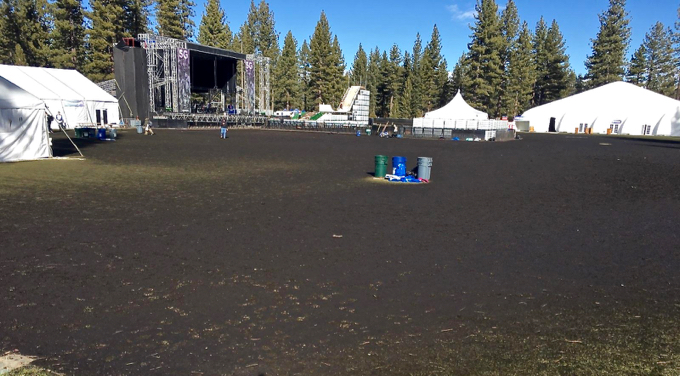
The grass field post-SnowGlobe. Photo/LTN

By Kathryn Reed

A settlement agreement with the producer of SnowGlobe regarding the damaged field is on the Feb. 6 South Lake Tahoe City Council agenda.

It is on the consent agenda. This is where slam dunk items that are not discussed get placed. However, it is possible for anyone – even a member of the public – to pull a consent agenda off so there can be dialogue.

The agreement states that Chad Donnelly, who owns the three-day music festival, will pay the city $250,000 until it is determined how much it will actually cost to repair the field.

The original contract stated that SnowGlobe must return the field to the condition it was in prior to vendors setting up. The city took pictures of what the site looked like before the concerts so there would be proof.

The performance bond secured from SnowGlobe was for $250,000, which is how that figure in the settlement came to be.

“The settlement agreement allows the city to manage and oversee the restoration of the field to ensure the field is restored to the city’s expectations and more easily access the $250,000 deposit,” City Manager Nancy Kerry told Lake Tahoe News.

The Dec. 29-31 festival was on grass fields. By the time it was over the fields were dirt, with little evidence any sod ever existed.

While some protective covering was used, it did not cover the entire area. More than 10,000 people were walking and dancing on the cover/grass/dirt for three straight nights. And there was no snow to act as another layer of protection.

Tuesday’s staff report written by interim City Attorney Nira Doherty states, “In 2017, the fields were finalized with installation of the turf, including soil preparation. The cost for soil preparation and turf installation was approximately $270,000. Initial damage to the field as a result of the festival indicate approximately 20 percent to 30 percent of the turf may need to be replaced, other portions of the field may need leveling utilizing top dressing and importation of other materials for restoration.”

The settlement agreement calls for the city to determine by June 30 the exact cost of repairing the field. If the bill is less than $250,000, the city will have 30 days to return to SnowGlobe the difference between that quarter million dollars and the exact cost.

The settlement further states if the cost to repair the field were to exceed $250,000, SnowGlobe would not be liable for it.

The City Council at some date will have to decide if the controversial festival that just concluded its seventh year has a future at that location or anywhere in the city limits.

Staff is expected to present the council with a more comprehensive report on SnowGlobe at the Feb. 20 or March 6 meeting.


Ranger led snowshoe at Sugar Pine Point

A California State Park interpreter will lead snowshoers along a 90-minute walk on the West Shore on Feb. 10.

Participants will discover what attracted Tahoe’s earliest settlers and uncover secrets of the Hellman-Ehrman Estate in Sugar Pine Point State Park.

Meet near the restrooms in the day use side of Sugar Pine Point State Park (lake side entrance off Highway 89). Wear warm layered clothing, waterproof hiking boots, and bring snowshoes. If there is minimal snow, the hike will proceed without snowshoes.

While event is free, the $5 parking fee still applies. The event is from 11am-12:30pm.


Snippets about Lake Tahoe

·      At the Tahoe Institute for Natural Science’s annual eagle count in January the tally was 16 adults and six immatures.

·      Carson’s Got Talent is having auditions for the April 14 show at Forever Dance in Carson City on Feb. 11. Check in is at 9am, auditions begin at 10am. For more details, go online.

·      Sugar Bowl Resort is introducing the Hump Day Hump on Feb. 28, March 21 and April 4. The cost to participate is $10 per person. It includes uphill access and a draft beer at the end for those ages 21 and older. Registration starts at 3pm, the climb is from 4-5:30pm. More information is online.

·      Sierra Watch has released this report on what traffic would be like if the proposed development at Squaw Valley comes to fruition.

·      State Sen. Ted Gaines, R-El Dorado, scored 100 percent on the National Federation of Independent Business/California’s 2017 Legislative Voting Record for his support of small business. He was one of 22 state legislators out of the 120 Assembly and Senate members to receive the perfect score.


FBI offering academy for high school juniors

The Federal Bureau of Investigation Sacramento Field Office is putting on a Teen Academy for high school juniors attending class within the 34 counties the office serves.

The full-day academy will be March 23 at FBI Sacramento Field Office headquarters in Roseville. There is no cost to attend.

Applications are available online. The deadline to apply is Feb. 22, 4pm.

The FBI Teen Academy offers students a unique view into the FBI and its mission, values, investigations, and partnerships with local, state and federal law enforcement. Discussion topics may include cyber safety, terrorism, active shooter situations, cyber investigations, and civil rights investigations. Activities may include simulated experiences with the FBI’s evidence response team, special agent bomb technicians, and the firearms training system room.

Students also engage in candid conversations about online communication and its risks as well as lifestyle choices required to be eligible for careers at the FBI with FBI personnel.