USFS approves draft for Heavenly to make upgrades

The U.S. Forest Service Lake Tahoe Basin Management Unit issued a draft decision for proposed improvements to existing skiing and snowboarding terrain at Heavenly Mountain Resort.

People have until March 21 to file objects with the decision.

Proposed improvements would include selective widening of ski trails, removing trail obstacles and relocation and/or realignment of some portions of existing snowmaking air and water pipelines to improve user experience, maintain user safety, increase energy and water efficiency, and maintain native species.

Ski trail widening to reduce bottlenecks and improve skier flow, would include tree removal and selective boulder relocation on approximately 12 trails, with grading required in two locations to match the widened area to the grade of the existing trail. Due to the widening, any existing snowmaking lines would be relocated to the new edge of the trail. Removal of obstacles, such as boulders, stumps and logs, would take place on 11 trails to improve natural snow surface coverage.

Project work is expected to begin this year.


Kids to be featured for entire week at Squaw

The 9th annual Kid-O-Rama festival returns to Squaw Valley on Feb. 17-24.

This kid-focused event features live family-friendly music, complimentary treats, a daily game and craft room, skiing and riding for a good cause and more.

Disco tubing will make its Kid-O-Rama debut this year, where evening snow tubing comes alive with colorful lights, lasers and live music. The full schedule of events is available online.


Humor to be the subject of talk in Incline

The psychology of humor will be the topic of an April 26 talk in Incline Village.

From mockery (the Darwin awards) to sarcasm (National Sarcasm Society – like we need your support), comedy can be viewed as a diagnostic tool for the investigation of enduring questions about the human condition. 

Kim Bateman, executive dean of the Tahoe-Truckee Campus of Sierra College, is known for her engaging and entertaining presenting style. Her research interests include organizational psychology, bereavement, and humor.

The program will begin at 6pm, with refreshments and no-host bar from 5:30-6pm at the Tahoe Environmental Research Center on the campus of Sierra Nevada College. Seating is open at 5:30pm to guests who have preregistered, open seating starts at 5:50pm.

Cost is $5.


Sierra snowpack on pace to shatter record low of 2015

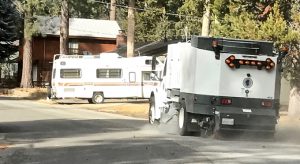
Street sweepers have been more prevalent this winter than snowplows in South Lake Tahoe. Photo/LTN

By Kurtis Alexander, San Francisco Chronicle

As relentless sunshine continued to pound California on Thursday, the Sierra Nevada hit a reckoning point: There’s less snowpack now than on the same date three years ago, when the winter went down as the driest in recorded history and sent shudders through cities, farmlands and the state Capitol.

The troubling lack of snow during the winter of 2014-15 not only shortchanged the state’s drinking-water reservoirs but left the Sierra nearly unrecognizable. Normally white-blanketed forests and meadows remained a springtime green, and mountain roads were free of ice.

 The picture has become increasingly similar this year. Tahoe’s ski resorts have been forced to close many low-elevation runs while working their snow-making machines overtime, and rangers at Yosemite National Park have had to apologize to guests for the lack of snow powering famed waterfalls.

Read the whole story


Placer County needs planning commissioners

Resignations have left two vacancies on the Placer County Planning Commission, including the position representing Lake Tahoe.

Each of the seven members serves for four years.

The Planning Commission is the principal advisory body to the Board of Supervisors on land use and related matters.

The commission meets the second and fourth Thursdays of each month at 10am in Auburn.

Anyone residing in District 2 or District 5 who is interested should fill out this application.


Agreement could bring hotel to Kings Beach

The Placer County Board of Supervisors this week approved an agreement that could result in the development of the first new hotel in Kings Beach in decades.

In a 4-0 vote, the board approved a $3 million purchase and sale agreement with developer Kings Beach Center LLC, represented by Craig Clark, to redevelop Placer County’s Kings Beach Center property in the Kings Beach town center. Supervisor Jennifer Montgomery was absent from the meeting due to illness.

The 3.5-acre parcel on North Lake Boulevard and Salmon Avenue includes vacant land, residential and commercial buildings.

The development concept negotiated in the purchase agreement includes a hotel with 80 to 150 rooms, 10 to 40 condominiums, 15,000 square feet of retail and 2,000 square feet of space for public use, with a library among the options being considered for that space.

The Feb. 6 decision does not complete the sale of the property or approve the project, but sets the conditions for its eventual sale if and when a project is formally approved.


Student career workshop in Truckee

Pathways to Aviation and the Truckee Tahoe Airport invite all high school and college students to attend a career workshop on Feb. 15 from 5-7pm at the Truckee Tahoe Airport.

Students will meet business executives, learn what college and career recruiters seek in students, and learn about aviation. The session will feature industry presentations and interactive discussions to identify hard and soft skills, and write compelling resumes.

The workshop is free and open to all high school and college students, regardless of career plans or interest in aviation. Those who attend become eligible for a unique scholarship based on participation in the program.

For details go online and to RSVP mail Pete Parker at pparker@pathwaystoaviation.org.


Bowman, Wise praise coach as Olympics begin

By Kathryn Reed

Like all athletes, even skiers need coaches. Maddie Bowman and David Wise, who in the next two weeks will try to defend their Olympic gold medals, credit Andy Woods for some of their success.

Woods was first named as a coach to the U.S. Freeskiing Halfpipe Team in 2011. This was in advance of the 2014 Olympic debut of the sport.

Under his tutelage leading up to the last Olympics, Bowman, who grew up in Meyers and still has family there, was on top of the podium at the Sochi Olympics in halfpipe skiing. Wise, a native of Reno, collected gold in the same contest for the men.

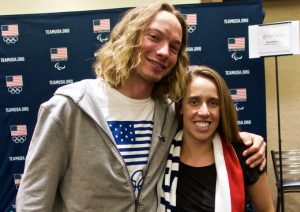
David Wise and Maddie Bowman will represent the Reno-Tahoe area in the Olympics — again. Photo/LTN

Bowman said of Woods that they are very much alike in balancing a “laid back style with an attention to detail.” She told Lake Tahoe News she is impressed with how far he’s come, going from “just a skier” to accomplished coach.

Before the 36-year-old was hired, several members of the U.S. team were consulted. This was in part because some knew him so the higher ups wanted to make sure there would be a symbiotic relationship.

Plus, Woods didn’t have any coaching experience prior to then.

“He and I have an amazing relationship. We are both introverted,” Wise told Lake Tahoe News. “He and I will obsessively watch video over and over again. We will pick apart different pieces.”

Woods grew up in Vermont, with his home resort being Smugglers’ Notch. He went from moguls, to doing tricks. At age 19 he and some buddies planned to go to the U.S. Open at Vail. They flaked out, he went. His parents went along, too. What a show they got to see.

He finished in the top 20 in slopestyle, and then competed in the big air event.

“I had the idea in my head of doing a 1260, thinking, ‘Maybe if I do this, I can get past the first couple rounds’,” Woods told Powder magazine. He fell. He tried again. This time he landed it. He also landed on top of the podium.

In that same event it was Jon Olsson who placed second and Squaw Valley’s Jonny Moseley in third. (Moseley had won gold at the 1998 Olympics in moguls, he was fourth in 2002.)

Woods continued to compete for several years, winning multiple events. But injuries forced him to stop competing in 2007. He went on to be a judge at various events. Then the call came from the U.S. Ski Team – he’s never looked back.  

—–

Notes:

Opening ceremonies for the PyeongChang, South Korea, Olympics are tonight. Here is a link to the entire NBC television schedule.


Opinion: Sessions’ war on pot could speed up legalization nationwide

By Paul Seaborn, The Conversation

Attorney General Jeff Sessions recently clarified how the Trump administration intends to treat states that have legalized pot, which remains illegal on the federal level.

The Obama administration eventually took a relatively hands-off approach to this enforcement conundrum. But Sessions instructed all United States attorneys to treat cannabis-related activities like any suspected crime, instead of making them a low priority if they comply with state laws.

This bureaucratic salvo is stirring fears that the Trump administration could be on the verge of a crackdown that could potentially jeopardize the nation’s growing number of legally operating pot businesses. However, based on my research and what I’ve learned while teaching the first U.S. college course on the marijuana business at the University of Denver, I see no reason for supporters of legalization to panic.

In fact, I believe that Sessions may have actually accelerated the process toward federal marijuana legalization.

First, a little history.

California became the first state to legalize medical marijuana in 1996. Alaska, Oregon and other states soon followed.

Since the federal government considers pot to be a Class 1 controlled substance and makes using and selling marijuana for any reason a crime, this put the authorities in an awkward position. Key members of the Clinton administration responded with harsh rhetoric. Gen. Barry McCaffrey, the drug czar, said at the time, “We should ask ourselves whether we really want Cheech and Chong logic to guide our thinking about medicine.” Raids and high-profile indictments followed.

President George W. Bush’s administration also expressed hostility toward medical marijuana, making its growing number of raids on legal dispensaries come as no great surprise. In 2005, as his second term began, the Supreme Court ruled that federal powers trumped states’ rights in this regard.

As a presidential candidate, Barack Obama suggested that he might not interfere with the power of what was by then about a dozen states to allow medicinal marijuana sales and use. In 2009, his deputy attorney general, David Ogden, released a memo that furthered this impression. It said that small-scale operators in states where medical marijuana was legal were a low enforcement priority.

But Obama’s administration executed dozens of dispensary raids anyway, disappointing legalization proponents.

During Obama’s second term, the number of states that had legalized medical marijuana climbed past the 20 mark. A handful, starting with Colorado and Washington, also legalized recreational weed. Meanwhile, support for legal pot continued to build in general.

Four years after the Ogden memo, James Cole, another deputy attorney general, issued a more comprehensive memo. It directed all U.S. attorneys to treat marijuana businesses operating “in clear and unambiguous compliance” with state marijuana laws as a low enforcement priority.

While still somewhat ambiguous and falling short of support for full federal legalization, Cole’s guidance made cannabis businesses in states that had legalized the product feel less vulnerable.

Rather than fight for more protection against federal raids, marijuana entrepreneurs and social activists at that point instead generally chose to focus on compliance within state laws and continuing to increase public support.

The strategy seemed to pay off with additional states legalizing pot for medical and recreational purposes. While full legalization remained an appealing long-term goal for many Americans, the status quo during Obama’s second term seemed quite workable for states with legal markets. And it took away the impetus to push for more rapid federal change.

Trump takes over

As soon as President Trump named Sessions as his pick for attorney general, the Alabama Republican’s long-held anti-pot views triggered speculation that the federal government would crack down in states where it was legal.

Instead, Sessions waited almost a full year to make a move. Meanwhile, legal cannabis businesses continued to generate tax revenue and create jobs. California launched its recreational marijuana market, the world’s largest. And more and more Americans were exposed to the industry in their home states or while traveling.

Indeed, a Pew Research Center poll conducted in October found that 61 percent of Americans supported legalization – up from 57 percent a year earlier and nearly double the backing for legal pot in 2000. For the first time, Gallup polling determined, a majority of Republicans support legalization.

Even when Sessions finally acted, he took a relatively mild step. Rather than launching a more severe crackdown, such as immediately raiding marijuana businesses, he merely rescinded Cole’s guidance.

Bigger coalition

The way state lawmakers, attorneys general, industry participants and other stakeholders reacted to even this small gesture demonstrated something that Sessions seems to have failed to consider – that the coalition in support of marijuana legalization had grown considerably.

State lawmakers in California, Colorado, Massachusetts and other states, and even some of the Republicans in Congress, objected. A group of 54 House and Senate Democrats sent Trump a letter urging him to reverse course.

“This action has the potential to unravel efforts to build sensible drug policies that encourage economic development as we are finally moving away from antiquated practices that have hurt disadvantaged communities,” they wrote.

State attorneys general, who do not report to Sessions, such as those serving in Colorado, Washington, Pennsylvania and Michigan, have shown no interest in modifying their current practices.

And 19 of them urged Congress to change banking laws so that marijuana businesses in their states would no longer have to rely solely on cash to handle billions of dollars in legal pot transactions. That way, they wrote, their revenue could be fully tracked, aiding taxation and limiting criminal activity that targets cash-intensive businesses.

All in all, the fierce reaction across the political spectrum reaction shows two things: Sessions’ memo is an empty threat and pot’s days as an illegal drug are numbered.

To be sure, the Sessions memo does seem to have scared away some investors who were considering new pot investments. But by adding to the air of uncertainty around marijuana businesses, Sessions seems have only strengthened the resolve of pro-legalization forces.

I believe it will ultimately bring about federal legalization sooner rather than later.

Paul Seaborn is an assistant professor with the department of management of Daniels College of Business at the University of Denver.


Calif.’s chief marijuana regulator predicts more issues with supply

By Brad Branan, Sacramento Bee

California’s top cannabis regulator said the state deserves credit for a successful rollout of retail marijuana sales, but acknowledged that significant issues loom in the near future.

One month after the start of recreational marijuana sales, Lori Ajax, chief of the state Bureau of Cannabis Control, gave an assessment of the state’s performance for a few hundred people at the International Cannabis Business Conference.

She praised her employees, who worked through the weekend before the Jan. 1 beginning of legal sales, granting licenses to dispensaries eager to start. Employees continued to work on Jan. 1, expecting to receive complaints from license applicants and holders, but they never came, Ajax said.

Read the whole story