Snowboarding: From outcast to Olympic darling

By Rachel Axon, USA Today

In 1995, the addition of snowboarding to the Olympics wouldn’t have foretold the mainstay the sport would become at the Games. Known for being counterculture, the sport was banned at many ski resorts. The X Games were a little more than a year away from holding its first winter edition.

Less than a decade after Time had called snowboarding the “worst new sport,” the International Olympic Committee sought it and the youthful audience it promised.

Since its introduction at the Nagano Olympics in 1998, the soulful sport has boomed. Participation has skyrocketed. Resorts now cater to snowboarders. And in the Games, the sport’s success paved the way for freeskiing and delivered on the coolness the Olympics lacked with a younger generation.

Read the whole story


Tahoe’s Bennett doesn’t let height hurt him on slopes

By Elliott Almond, Bay Area News Group

They dismissed him as too tall.

They said his size 15 feet were too big an obstacle. They told his parents it just couldn’t be done.

But 6-foot-7 Bryce Bennett dreamed of growing into a top downhill ski racer anyway.

“There’s a first time for everything,” he once told his father.

Now the Lake Tahoe skier is the tallest of the 242 U.S. athletes competing at the Winter Olympics in South Korea. Bennett, 25, has emerged as America’s top alpine speed skier by whooshing past the doubters and forging his own track in an unusual journey to Mount Olympus.

Read the whole story


Driver in fatal Cave Rock crash faces 4 felonies

A Carson City woman has been charged with four felonies related to the accident last summer near Cave Rock that killed a woman from Thailand.

The preliminary hearing for Kimberly Ann Davis, 40, is scheduled for Feb. 15 in Douglas County. Charges include driving a vehicle while under the influence of alcohol causing death and three counts of driving under the influence and causing substantial bodily harm.

According to the Nevada Highway Patrol, Davis was going east on Highway 50 when her vehicle crossed a double yellow line and struck the westbound vehicle head-on. Killed was 52-year-old Sranthon Bunnag, a passenger in the oncoming vehicle.

The NHP report showed Davis with a blood alcohol level of 0.22 90 minutes after the June 26 crash.

— Lake Tahoe News staff report


Fast, cold storm to strike Lake Tahoe area

A quick moving storm is set to blow through the region today into Monday. Expect temperatures to drop and snow to fall.

Snow levels are likely to reach the Carson and Reno areas as well. The wind is expected to pick up before the moisture arrives in Tahoe. A lake wind advisory is in effect Sunday from 10am-10pm.

“A quick burst of snow is possible along the cold front, making for a potentially slick and icy commute Monday morning,” according to the National Weather Service in Reno. “Inside slider storms like this typically have limited moisture and sporadic areas of accumulating snow.”

The sun is expected to return Tuesday. Temps will be in the teens overnight, with highs in the 30s through Tuesday. By Thursday the basin could see 50s again.

The hazy air on Saturday was mostly dust being kicked up. With it being a dry winter, winds are picking up dirt and carrying it for miles.

— Lake Tahoe News staff report


The first USFS ranger station at Tahoe

By Don Lane

Four years after it was discovered in 1844 by explorer John Charles Fremont, the Lake Tahoe Basin saw an influx of people attracted to the 1848 discovery of gold nearby. Fortunately, there were few gold nuggets in the streams around the lake and the basin was largely left unchanged.

However, just a few years later, in 1859, another great discovery to the east of Lake Tahoe, the Comstock Silver Lode, would have a substantial impact. The Tahoe basin would never be the same. 

Wood for the Comstock mines came from Tahoe basin forests, and over the next 35 years, over two-thirds of the basin’s forests were logged. The timber was used for the mines, railroads, and growing cities of the West.

Voices of concern grew louder as the lands around Lake Tahoe were being changed forever. Finally, after the rich veins of ore from the mines ran dry, a movement arose to try and save what was left of the forests around the basin.

In response to petitions from the Sierra Club, Stanford University, and prominent individuals, the Lake Tahoe Forest Reserve was established by President William McKinley in 1899, six years before the establishment of the U.S. Forest Service.

The designation encompassed nearly 240 square miles of land and included 37,000 acres located in the southwest portion of the Tahoe Basin. 

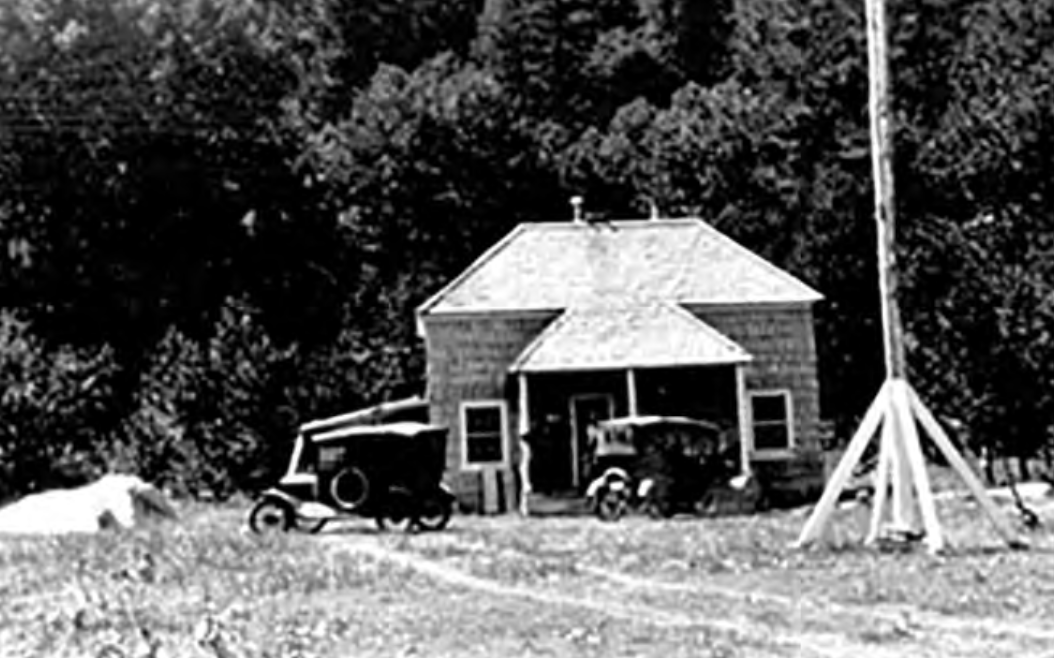
Rangers first had a permanent home in the Tahoe basin in 1920 in Meyers. Photo/USFS

The first Lake Valley rangers

After the establishment of the Forest Service in 1905, the Lake Tahoe Forest Reserve was managed by three men: Assistant Forest Ranger James Stout, Forest Guard Lester Walker, and Deputy Forest Ranger Raymond Tyler, who served as the first Lake Valley District ranger. 

The Lake Valley rangers reported to the ranger in charge, Samuel L. Ellis, who was located in Sonora on the Stanislaus Reserve. Their headquarters was a primitive camp three-quarters of a mile below the Echo Post Office in Strawberry Valley, which was approximately 10 miles west of the Tahoe basin.

For the rangers, Lake Tahoe Forest Reserve summer duties consisted of patrolling for and extinguishing fires, surveying boundaries, posting boundary signs, building and managing trails, and managing incoming cattle and sheep.

Managing the Lake Tahoe Forest Reserve from the Strawberry Valley location proved difficult. Supplies and official communications from the Sonora office were transported via stagecoach and the long commute between Strawberry Valley and the basin was a challenge to say the least.

In addition, living accommodations within the reserve were poor. The cold winter rain and snows of late spring and fall made living in tents difficult during these seasons. The rangers frequently had colds and the horses grew unhealthy due to the icy winds.

Plans for new cabin

As the years passed and interest in the Tahoe basin grew, it became apparent that a permanent structure was needed from which the rangers could more effectively manage the Lake Tahoe Forest Reserve.

In 1911, after a half-dozen years of commuting and using temporary camps, Lake Valley Rangers’ dreams were about to come true.

In July that year, Eldorado National Forest Supervisor Evan Kelly sent a letter to the current Lake Valley district ranger, J.P. McMillan, saying money was available and plans had been drawn up for the Lake Valley Ranger Station and barn. Kelly asked whether lumber could be obtained for the building.

Kelly sent out requests for bids to construct a cabin and barn in Lake Valley. They called for all materials and work to be furnished by the contractor and the station and barn to be completed for occupancy on or before Sept. 15, 1911.

In August, a bid received from Marshall Hughes came in at $398 for construction of a 14-by-28-foot station and $212 for an 18-by-26-foot barn. Another bid received from Al Smith for both the station and barn was for $638.

Kelly sent a letter to the Lake Valley rangers stating that the bids were rejected because they were too high.

Construction would not begin that season. He said they’d need to wait for a mill to be built in the vicinity to provide reasonably priced lumber.

So it was that in 1912, in early summer, the first Lake Valley Ranger Station was finally built. However, the barn would take a few more months to complete. 

A new era

The Lake Valley rangers continued to carry out their duties in the rapidly growing Tahoe basin. By the 1920s, the need for a year-round ranger station at Lake Tahoe became apparent.

The decision was made to move out of the rustic cabin to a new location three miles away in Meyers.

A local doctor, Frank Avery, was authorized to use the former station for $30 a year. It was noted that when the Forest Service needed it back, the cabin would revert to the agency.

The Avery family occupied and maintained the structure as a summer residence until Jan. 31, 1959, when they relinquished the cabin to the Forest Service. The Forest Service then utilized the cabin to accommodate backcountry and trails staff and to store its equipment.  

For many summers, the cabin was occupied by a Forest Service packer named James Hawksworth and the adjacent meadow was used to graze the horses and mules used during the summer months to support the Forest Service wilderness and trails program.

Hawksworth and his wife, Donna, resided at the cabin for over 30 years while serving the Forest Service.

In the early 1970s, due to concerns for the aging condition of the building, a nearby tent platform was constructed to house Hawksworth, along with a bathroom to replace the original outhouse. 

In 2004, the pack station was renamed Hawksworth Pack Station in honor of the long-term Forest Service packer.

The original Lake Valley Station has been preserved and today stands as a proud reminder of the early days of the Lake Valley Ranger District. The cabin is now used as an equipment storage site for the Lake Tahoe Basin Management Unit’s wilderness program, and has been evaluated and considered to be eligible for National Register of Historic Places status.

Don Lane is the recreation and wilderness program manager for the Lake Tahoe Basin Management Unit. This article is republished from the winter 2017 edition of Tahoe In Depth.


Editorial: We all have a stake in saving the Sierra

Publisher’s note: This editorial is from the Feb. 5, 2018, Sacramento Bee.

Given the huge sums California has spent staving off wildfires, curbing greenhouse gas and ensuring clean air and clean water, it is surprising that more attention hasn’t been paid to the one factor those challenges have in common: trees.

California’s forests, and in particular the massive forests of the Sierra Nevada, play a role that is as critical to California’s environment as it is misunderstood and taken for granted.

Now a report issued Monday by the governmental watchdog Little Hoover Commission sounds the alarm on the state of the state’s forests, noting something we have warned of before: The Sierra Nevada forests are being mismanaged in ways that affect every Californian. Our approach must change.

Read the whole story


When Kansas was America’s Napa Valley

By Pete Dulin

Located in the northeastern corner of Kansas, Doniphan County’s eastern edge is shaped like a jigsaw puzzle piece, carved away by the flowing waters of the Missouri River. The soil is composed of deep, mineral-rich silty loess and limestone, making it ideal for farming—and, it turns out, for growing grapes and making wine.

California wasn’t always America’s winemaking leader. During the mid-19th century, that distinction went to Kansas and neighboring Missouri, where winemakers and grape-growers led the U.S. wine industry in production. Bold entrepreneurs, industrious Kansas farmers—many of them German-speaking immigrants—produced 35,000 gallons of wine in 1872. That volume jumped more than six-fold by the end of the decade.

But the growth in Kansas’s wine industry (and its sister industry, brewing) coincided with dramatic changes in the state. From 1860 to 1880, Kansas’s population mushroomed from 107,206 to nearly 1 million people. Kansans battled over slavery in the Kansas-Missouri Border War (1854-1861) and again during the Civil War (1861-1865). Kansas vintners faced a dynamic and challenging moral, social, business, and political climate. The region’s civic and religious leaders railed against the use of alcohol, which they believed contributed to moral decay and spiritual rot, leading them to implement the first statewide prohibition on selling and manufacturing alcohol in the United States in 1881. For more than a century, this ban caused a slowdown from which the Free State’s winemakers are only now beginning to emerge.

For centuries, Wild Catawba, Concord, Norton, and other grapevines thrived, uncultivated, in the rich soil of the territory. When the explorer Étienne de Veniard de Bourgmont ventured to northeastern Kansas in 1724, Indians supplied his expedition with wild grapes from the Missouri River bluffs, which the captain and his men used to make wine. 80 years later, Lewis and Clark encountered summer and fall grapes at the very same site.

Several thousand German-speaking immigrants who settled nearby in the mid-19th-century sought a “new Rhineland,” a fresh start that offered religious freedom, economic opportunity, and refuge from political and military turmoil in their homelands. These immigrants not only brought large numbers of people, but also cash to foster trade in emerging frontier towns and the know-how to grow grapes and produce wine. Several skilled winemakers and vineyard nurserymen came to Doniphan, Kansas, from Deidesheim, a town in the German Palatinate region known for its winemaking and viticulture since the 13th century. Hardworking and entrepreneurial, they transformed small-scale farm vineyards and wineries into a burgeoning industry.

Winemaker Adam Brenner emigrated from Deidesheim and settled in Doniphan in 1857. As proprietor of Doniphan Vineyards, he manufactured native wines and brandies that were known “world-wide” for their “medicinal qualities.” According to William G. Cutler’s “History of the State of Kansas”, Brenner’s vineyards spanned 50 acres and had their own cellars, press houses, warehouses, bottling, and packing rooms. One cellar, used for sales, could hold 30,000 gallons of various wines. Two more cellars stored an additional 30,000 gallons each. Later his brother and his nephew both opened vineyards producing thousands of gallons of wine annually, some of it for sacramental use.

No records indicate what the Brenners’ wines tasted like. Since they were commonly sold for medicinal and sacramental purposes, and sugar was an expensive commodity, the wines were likely dry, sweetened only by natural sugar from the grapes. But whatever their aesthetic qualities, they were clearly highly-regarded. By the early 1880s, vineyards in and around Doniphan produced one million pounds of grapes and 75,000 gallons of wine every year. They grew 24 varieties of native American and American-bred grapes and shipped wine to customers in Kansas, Iowa, Missouri, Nebraska, Colorado, Texas, Michigan, and Montana by steamboat and later by rail.

Other parts of Kansas produced wine, too. In “A History of Wine in America,” a definitive account of winemaking in the United States, author Thomas Pinney noted that a man named A.M. Burns established a nursery specializing in grapevines in Riley County, west of Topeka, in 1856. Within a decade, Burns’ catalog offered more than 150 grape varieties to farmers, including many that he had bred and developed himself.

In 1866, Burns wrote with exuberant optimism about the relationship between Kansas and grapes. “I now think I can with safety predict a glorious future for the grape in Kansas,” he boasted. “It is only a matter of time, and some who, when I commenced to test the vine, sneered at the idea, may yet live to see the day when our bluffs will be teeming with millions of dollars of wealth, while they ought to hang their heads with shame at their own ignorance.” For a time, it seemed that his vision would come to pass. In 1880, the Kansas State Board of Agriculture reported that Kansas produced a whopping 226,000 gallons of wine and reached its peak as a leading producer in the industry.

But just as the optimistic prognostications of A.M. Burns and others seemed to bear fruit, a wave of moral and political action unleashed drastic upheaval in the state. Temperance spread west throughout the U.S., fueled by organizations such as the Woman’s Christian Temperance Union. During its early statehood and explosive population growth, Kansas was awash with wineries, breweries, and saloons—as well as large numbers of gamblers and prostitutes who frequented them. Prohibition proponents, especially women, loathed the lawlessness and vice. Men who drank had a reputation for being abusive, and poor providers. By 1855, the Kansas Territorial Legislature passed a law “to restrain dramshops and taverns, and to regulate the sale of intoxicating liquors.” Citizens voted in special elections on local liquor laws. And in 1871, even the Kansas State Horticultural Society had initiated discussions against the use of grapes for winemaking in the state.

Prohibition also appealed strongly to evangelical Kansans who viewed alcohol as an obstacle toward gaining eternal salvation—and who regarded the German winemakers, some of whom were Catholic, with suspicion. By the late 1870s, Kansans regularly heard anti-alcohol rhetoric at church revivals. Many were swayed to the temperance cause by the fiery, religion-fueled oration of reformed drunk Francis Murphy of Portland, Maine, who addressed a large crowd in August 1879 at a national temperance rally at Bismarck Grove, near Lawrence, Kansas. Kansas Women’s Christian Temperance Union president Drusilla Wilson, who was present at the rally, also won many converts to the cause. An indefatigable speaker and advocate, driven by her Quaker beliefs, she traveled 3,000 miles across Kansas by carriage to enlist support for state Prohibition. She organized 13 temperance unions, led efforts to obtain petition signatures for a prohibitory state amendment, and later worked to ensure the legislature passed the amendment in a general election.

In an address to the state Legislature in January 1879, Gov. John P. St. John framed temperance as an economic, moral, and social issue. “Could we but dry up this one great evil that consumes annually so much wealth, and destroys the physical, moral and mental usefulness of its victims,” he suggested, “we would hardly need prisons, poorhouses, or police.”

Kansas amended its state constitution on Nov. 2, 1880, to prohibit “the manufacture and sale of intoxicating liquors … except for medical, scientific and mechanical purposes.” The statute went into effect from in May 1881 and preceded national Prohibition by four decades. Most Kansas winemakers, brewers, and other alcohol manufacturers went out of business. Some relocated across the state line to Missouri. As late as 1900, 20 years after state Prohibition, grape growers in Kansas continued to cultivate thousands of acres of grapes, selling them to bootleggers in Kansas or to winemakers working legally in Missouri, or for consumption as fruit.

A temperance poster, circa 1903, claimed that Kansas “reduced the annual consumption of intoxicants from the U.S. average of 16 gallons per capita” to less than 2, that the state saved an average of more than $6 million “which otherwise would go to the saloon,” and that Prohibition saved annually “more than 1,200 persons from drunkards’ graves.”

Of course, Prohibition—in Kansas and throughout the United States—did not result in a more morally-driven society. The law unintentionally spawned criminal activity by bootleggers and their customers, and ultimately lost support during the Great Depression. National Prohibition was repealed in 1933. In Kansas, too, people drank. But the state remained officially dry, with its voters in 1934 vanquishing a proposed state constitutional amendment that would have legalized alcohol use. Kansas didn’t repeal statewide prohibition until 1948. Some counties still do not allow liquor sales.

Kansans haven’t exactly raced to revive the state’s wine industry. With the earlier generations of winemakers long gone, and the state’s lingering moral and political distaste for alcohol persistent, there was little incentive for investments in new vineyards or wineries. Meanwhile, grape-growing and winemaking have flourished in Missouri.  

In the mid-1970s, a horticultural research center near Wichita conducted experiments on soil and climate, and planted trial grapevines with promising results. Encouraged, Robert Rizza of Halstead, Kansas, planted a vineyard in 1978 and began advocating for the passage of a law that would allow farms to again produce wines on site. In 1983 the state Legislature finally approved a farm winery law and amended it in 1985 to reduce costly fees and to permit tastings and sales at wineries as well. The state Department of Agriculture established an advisory program on viticulture and enology, and Kansans began to apply for official licenses and established wineries.

Two decades later, 13 licensed farm wineries in Kansas were harvesting 170 total acres of grapes to produce 50,000 gallons of wine. By 2010, wine production had more than doubled to 107,419 gallons. Today winemakers throughout Kansas plant native and hybrid grapes in the same mineral-rich soils that their 19th-century forebears once so fruitfully worked, producing an impressive range of wines from French-American hybrid and native grapes. A long-abandoned way of life, practiced by some of the state’s first frontier entrepreneurs, is on the rise again.

Pete Dulin is the author of “Expedition of Thirst: Exploring Breweries, Distilleries and Wineries Across Central Kansas and Missouri,” and “Kansas City Beer: A History of Brewing in the Heartland.”


CalPERS facing hit as charter schools consider leaving

By Adam Ashton, Sacramento Bee

One of the state’s largest charter school organizations is exploring whether it wants to withdraw from CalPERS, raising alarms among unions and public pension officials who fear a gradual weakening of the fund.

Aspire Public Schools, which operates 36 schools in California, opened talks with the California Public Employees’ Retirement System after the charter school organization’s board of directors unanimously voted in November to consider leaving the $345 billion pension fund.

Wayne Davis, a CalPERS spokesman, confirmed that Aspire had contacted the agency to request information about how it can terminate its participation in the fund. Organizations that leave CalPERS pay hefty termination fees that are invested into low-risk pools to support pensions owed to their retirees and workers.

Read the whole story


How a thrill-seeking personality helps Olympic athletes

Mikaela Shiffrin may compete in five events this Olympics. Photo Copyright 2018 Carolyn E. Wright

By Kenneth Carter, The Conversation

One of the main draws of the Winter Olympics is the opportunity to witness some of the most exciting and nail-biting athletic feats.

The daring events include the bobsled and downhill skiing. Then there’s the terrifying skeleton: Imagine barreling down a narrow chute of twisted ice-coated concrete at 125 miles per hour. Now imagine doing that head first, like a human battering ram.

Athletes train for years for these events, but most of these elite athletes possess something that helps them succeed during these high-stakes events: their personality.

Some people have a personality trait that helps them focus in highly chaotic environments like the ones you’ll see during the Winter Olympics. It’s called a high sensation-seeking personality, and it’s a trait that, as a psychologist, I’ve long been fascinated with.

Calm in the face of danger

To some extent, we all crave complex and new experiences – that is, we all seek new sensations.

Whether it’s our attraction to the latest shiny gadget or the newest fashion trend, novelty tugs at us. But even though we all share an interest in new sensations, what sets high sensation-seeking personalities apart is that they crave these exotic and intense experiences to an extent that they’re willing to risk their health.

What’s amazing is that some high sensation-seeking individuals experience less stress and are fearless and calm in the face of danger. For example, 2014 Olympic slalom gold medalist Mikaela Shiffrin tears down mountains at speeds of 80 mph. But she recently told Sky magazine that the experience can feel like it unfolds in slow motion while she’s “finding a way to control the controllable.”

There’s neurological evidence to back up the sense of calm that athletes like Shiffrin feel in midst of chaos and danger.

You may have heard of cortisol – it’s the “fight or flight” hormone, and it can make us feel stressed and overwhelmed.

However, when people with high sensation-seeking personalities have intense experiences, they don’t produce that much cortisol. On top of that, they produce higher levels of “pleasure” chemicals like dopamine.

What’s more, researchers have found that people with high sensation-seeking personalities have increased sensitivity to things that could be rewarding (like landing a perfect switch backside 1620) and decreased sensitivity to potential dangers (like the fear of wiping out after doing a triple jump).

High sensation-seeking isn’t exclusive to Winter Olympians, of course. It can creep into every aspect of life, influencing the way you interact with other people, the things you do for fun, the music you like, the way you drive and even the jokes you tell.

Leaping before you look

In the 1950s, while studying sensory deprivation, psychologist Robert Zuckerman stumbled upon this sensation-seeking trait. Zuckerman was eventually able to show that sensation-seeking is made up of four distinct components.

Each contributes to an individual’s unique way of seeking (or avoiding) sensation. (And you can actually take a test to see where you fall for each of these four components on the sensation-seeking scale.)

The first two – thrill-seeking and experience-seeking – were mentioned earlier. But the sensation-seeking personality trait also involves disinhibition and boredom susceptibility.

Disinhibition has to do with our willingness to be spontaneous and our ability to let loose. People with low levels of disinhibition always look before they leap. Those high in disinhibition? They just leap.

Boredom susceptibility boils down to your ability to tolerate the absence of external stimuli. Those with high scores in boredom susceptibility dislike repetition: They tire easily of predictable or dull people, and they get restless when forced to perform mundane tasks.

This last component might be the toughest thing for Olympic athletes who are high-sensation seekers to deal with. In order to be a successful Olympian, you need to spend countless hours practicing dull, repetitive workouts and drills.

It’s easy to see how all of these aspects of sensation-seeking personalities might exist in Olympic athletes, whether it’s a snowboarder experimenting with a daring new trick or a hockey forward navigating a puck through a maze of defenders.

People with high sensation-seeking personalities don’t just crave these situations. In those moments, they’re in their element. Where a low sensation-seeking person might crumble, they thrive.

So when you’re watching the Winter Olympics and wondering how the athletes can handle the pressures and dangers of competition, just remember: For some of them, chaos and intensity are secret weapons of success.

Kenneth Carter is a Charles Howard professor of psychology at Oxford College at Emory University.


Guilty verdict in killing of Placer County deputy

By Don Thompson, AP

A man in the United States illegally was convicted Friday of killing two Northern California deputies in a case that helped fuel the national immigration debate.

Luis Bracamontes was found guilty of murder in the shootings of Sacramento County sheriff’s Deputy Danny Oliver and Placer County sheriff’s Detective Michael Davis Jr. in 2014. He also was convicted of attempted murder, carjacking, weapons violations and other crimes.

“Yay,” he said softly after first verdict read, looking around at the victims’ families and jurors with a slight smile.

Read the whole story