Opinion: Pay attention around school buses

By National Transportation Safety Board

As a brand new school year begins, the U.S. Department of Transportation’s National Highway Traffic Safety Administration (NHTSA) reminds parents, students and motorists to be alert and to put safety first in school zones and near school bus stops.

School buses are the safest means of transportation for getting to and from school and keep an estimated 17.3 million cars off the roads every year. Even so, students need to be careful when entering the “school bus danger zone” – 10 feet in front, behind or on either side of the bus. In addition, motorists need to be alert and always stop for a school bus when flashing lights are illuminated.

According to NHTSA data, over the past 10 years, 44 school-aged children and teens between the ages of 5-19 were killed in school zones traveling to or from school. Out of that number 77 percent (34) were pedestrians either struck by a school bus or another vehicle.

Teach children how to stay safe around a school bus:

• Stand at least six feet (three giant steps) from the approaching school bus while waiting at the bus stop.
• Wait to board the bus until the driver says it is safe.
• When getting off of the bus, cross the street in front of the bus and make sure the bus driver sees you.
• Always watch for oncoming traffic when approaching or leaving the bus.

How motorists can keep kids safe around the school bus:

• When driving in neighborhoods with bus stops, schools and school zones, watch out for children walking or bicycling to school.
• Slow down. Look for children walking in the street, especially if there are no sidewalks in the neighborhood.
• Remember, children do not easily estimate vehicle speeds and often misjudge when it is safe to cross the street when a vehicle is approaching.
Learn and obey the school bus laws. Obey the “flashing signal light system” that school bus drivers use to alert motorists of pending actions:
• Yellow flashing lights indicate that the bus is preparing to stop to load or unload children. Motorists should slow down and prepare to stop their vehicles.
• Red flashing lights and extended stop arms indicate that the bus has stopped, and that children are getting on or off. Motorists must stop their cars and wait until the red lights stop flashing, the extended stop sign is withdrawn, and the bus begins moving before they can start driving again.


Yosemite fire brings smoke to Tahoe

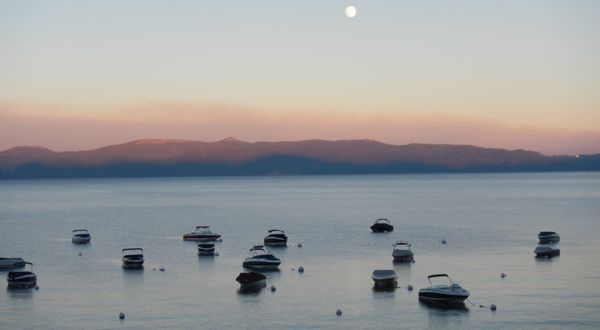
Smoke from a fire in Yosemite is visible in the Lake Tahoe Basin. Photo/Kathryn Reed

Smoke from a fire in Yosemite is visible in the Lake Tahoe Basin. Photo/Kathryn Reed

By Anderea Castillo, Modesto Bee

Hikers in Yosemite National Park were evacuated by helicopter after a wildfire spread Sunday afternoon.

Tim Ludington of the National Park Service said the Meadow fire, which was started by lightning in mid-July adjacent to Mount Starr King, grew with strong winds and hot temperatures, creating a spot fire.

The fire has since dropped into Little Yosemite Valley and crossed the Merced River. About 400 acres have burned on both sides of the valley.

Gary Wuchner, also of the Park Service, said evacuations were underway for hikers near the Sunrise Trail, where the fire was burning behind Clouds Rest. He said four Type 1 helicopters carrying 1,000 gallons of water, three Type 2 helicopters carrying 200-gallon buckets and one air tanker carrying at least 1,000 gallons of fire retardant were attacking the fire.

Wuchner said six Hotshot crews of 20 people each were expected to arrive Sunday evening along with Yosemite fire crews. He said it takes firefighters about a day to hike into the remote area.

Ludington said the fire is expected to keep growing.

“We just got unbelievable crazy winds and unexpected hot conditions,” he said. “The fire behavior totally changed. There is a huge plume.”

Read the whole story


Thinning project to impact TRT users

The U.S. Forest Service Lake Tahoe Basin Management Unit will begin a large-scale tree removal project Sept. 8 near Page Meadows off of Chamonix Road.

The project uses a masticator to reduce material left behind after fuels reduction thinning. A masticator is a large lawn-mower type of heavy equipment that runs over debris and chops it up into smaller pieces. Flying debris from mastication equipment is common and large chunks of woody material can be thrown up to 500 feet.

Approximately 375 feet of the Tahoe Rim Trail crosses through the project area and there will be a one- to three-day period when equipment will be working near the trail. For public safety, hikers may experience a short delay while the equipment is stopped to allow safe passage.

Project work is expected to take approximately six weeks to complete and work will occur on weekends.


Death Valley’s Racetrack seems otherworldly

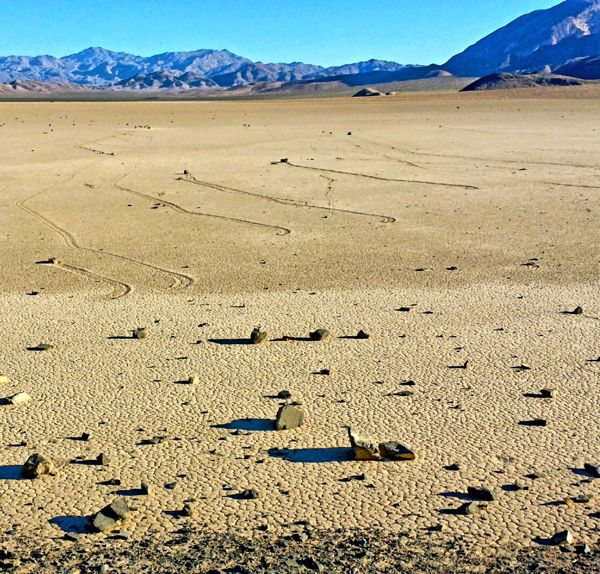
The Racetrack in Death Valley is mesmerizing. Photos/Toogee Sielsch

The Racetrack in Death Valley is mesmerizing. Photos/Toogee Sielsch

By Toogee Sielsch

DEATH VALLEY NATIONAL PARK – “It’s your call Ian. Do you want to spend the night around here and check out Scotty’s Castle in the morning, or should we drive the 27 more miles on dirt roads, in the dark, and check out that Racetrack thing in the morning?”

“Racetrack!(?)” Ian replies.

“Good answer!”

The Racetrack – a true scientific enigma until just this last year. Located in the northwest end of the Death Valley National Park, but many miles from Death Valley proper. The Racetrack is a dry ancient lakebed that sits at 3,600 feet. Its playa runs almost due south to north, is just less than 3-miles long by almost 1½-miles wide.
It’s also extremely flat. The difference in altitude from the south to the north end is barely 1.5 inches (4cm), which is basically attributed to a larger buildup of fine sediment at the north end.

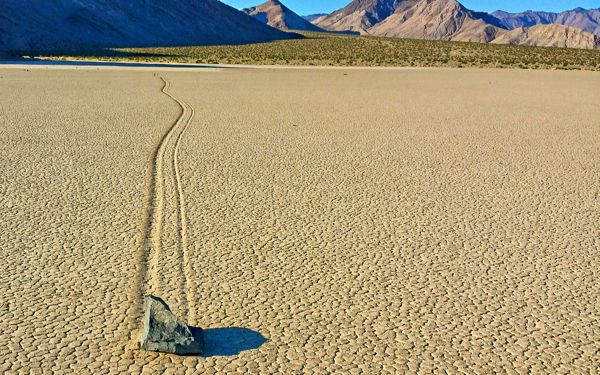
It’s in a basin that is surrounded by spectacular colored mountains rich in minerals and even has evidence of an abandoned mining operation above the playa to the southeast side. Named “The Racetrack” for the rocks, called sailing stones, that somehow travel in a mostly south to north pattern across the playa leaving, depending on the size of what is moving across the lake bed, ruts in the rock hard, cracked dirt playa surface. We even found some thick tumbleweed branches that had felt inclined to join the rocks in their quest for the north end of the playa.
Rocks find their way onto the playa.

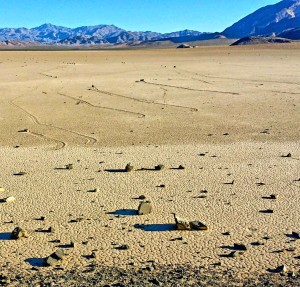
Rocks find their way onto the playa.

There have been many different stories and interpretations of this phenomenon, and most were centered on three elements. The perfect combination of water on the playa turning its surface into a slick and wet mud flat, freezing temperatures create a thin ice layer above the mud, and strong wind. But until just recently when a research team from UC San Diego used video, attached GPS units on some rocks they introduced onto the playa, and were even lucky enough to witness the phenomena, no one knew just exactly how, or even how fast these playa objects moved. Rocks varied in size from those weighing an ounce to those weighing upward of 100-plus pounds. The team clocked some of the rocks moving up to 20 feet per minute. That figure is not a typo. Up to 20 feet per minute, and some movement with winds as light as 10 mph. And as evidenced by their trails, their movement is only sometimes in a straight line. To paraphrase Bob Dylan, “These rocks don’t need a weatherman to know which way the wind is blowing!” The phenomenon takes place on the backside, or thawing phase, of a wet/freeze/thaw/wind event.

Never had I thought too hard about, but I had thought about it before on occasion, the question as to where the rocks came from. As we drove toward The Racetrack in the dark on fairly well maintained dirt roads the question grew in my mind. Along the drive something that stood out under the dark star-filled sky was the silhouette of the peaks and ridges all around us. Not the nice rolling landscape in meadow scenes, but stark hill and mountainsides with steep rocky inclines. By the time we arrived at the southern end of the playa, which was about 10:30pm, our first order of business was to walk out onto the playa a couple hundred yards and get a feel for the place. The sliver of a moon had already set, but the crystal clear sky was literally dirty with stars that emitted more than enough light to get a feel for the landscape that surrounded the playa. We even found a couple of small racers with their tracks leading off into the dark to the south of us.

It was time to hit the sack and get some rest. Sleep came fitfully, in part because of my excitement of what the morning light would reveal, coupled with a night sky literally overflowing with stars making me reluctant to close my eyes for fear of missing something.
Toogee and Ian Sielsch explore The Racetrack.

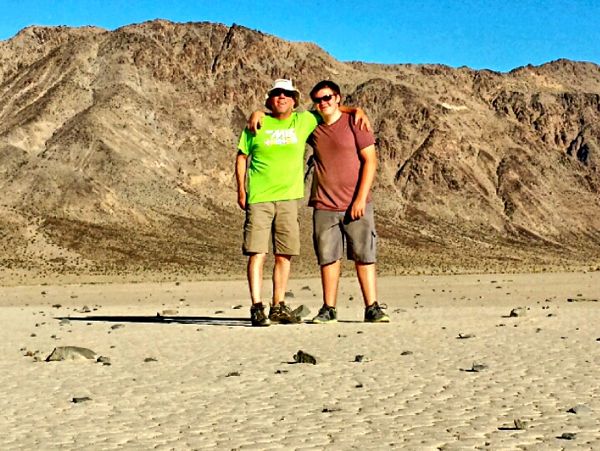
Toogee and Ian Sielsch explore The Racetrack.

First light roused me from a deep sleep, and looking over at my navigator/co-pilot/ favorite youngest son, Ian, I knew he was an hour plus from waking. Time to go explore before the sun heats things up. Walking out on the hardpack cracked playa in the early morning with little air movement had an eerily calming effect akin to looking at sheer glass on Lake Tahoe in the early morning. Becoming more alert with every step onto the playa my attention was drawn to the south and southeast end of the playa, all the while walking among the “sailing rocks” and their trails. Now I want to clarify that the playa is not “littered” with these hapless racers. But the closer I approached the southern end, and many more racers are present, the answer to my nagging question was revealing itself. On that southern end and on the southeastern edge, there are steep inclines of rock outcroppings that sit about 6 feet back from the playa surface. The landscape around the rest of the playa, although ringed with steep ridges, has a gentler incline running hundreds of yards to the base of the inclines. Within that six feet sits a gravely pebble field.

Now I’m pretty sure that the scientists studying this phenomenon were quite content that the answer to my inner question was so rudimentary that they felt no need to highlight this point. But as I inspected this area that seemed to produce the highest amount of racers I felt that it was a very important part of the equation. This six-foot zone was the make or break for many of our rock racing friends. Without actually contacting the surface of the playa, it was quite evident that there would never be a chance of it being part of the legacy of rock racers. Which brought me to the conclusion that – tada – a rock, or a multiple rockslide must have enough velocity as it runs down a 30-plus percent grade (I’m guessing) to cross a rock strewn surface almost completely flat measuring about six feet to become a “Playa Player”!

Without being on the cracked, hard packed surface of the playa that rock’s dreams will never have a chance to be realized.

And in my world, rocks have hopes and dreams!

—-
Getting there:
If entering the park on California Highway 136 from Lone Pine, continue onto Highway 190 through Stovepipe Wells, then turn left about 6.3 miles on the road north to Scotty’s Castle for about 33 miles. When arriving at the junction, take a left to the Ubehebe Crater, than enter the dirt road on the Ubehebe Crater loop to the 27 miles to The Racetrack. The route we took was out of Big Pine taking Highway 168 to the Death Valley Road turnoff, and then on to the Scotty’s Castle Junction that is 76 miles, 60 miles or so on well cared for dirt roads. Then take a right to the Ubehebe Crater Loop.


Time to give kids more freedom to explore

By Katie Arnold, Outside

Even if you’re not ready to yank your kid out of fourth grade to let them run loose in the woods, there are plenty of ways to give your kids more freedom to learn on their own while still sending them to school.

Start at home by encouraging them to follow their passions and explore subjects that interest them.

“It doesn’t matter where or when you do it. The main thing is to show kids that they can teach themselves,” says Leo Babauta, 41, father of four unschooled children ages 8 to 17 and founder of the blog Unschoolery. “Learning is everywhere: parks, museums, nature trails, online, libraries, even video games, like Mind Craft, which are a great way for kids to control what they’re learning.”

Outside the home, numerous alternative and nature-based schools and programs around the country incorporate the essential tenets of unschooling — curiosity, intellectual independence and child-directed learning — into their curricula. Others have no formal curricula at all.

Read the whole story


Award-winning poet to speak at LTCC

On Oct. 8 at 7pm Bona Fide Books will launch St. Louis poet Travis Mossotti’s award-winning collection “Field Study” at the Lake Tahoe Community College’s Writers’ Series. The reading is free and open to the public.

Mossotti’s second collection, “Field Study” won Bona Fide’s 2013 Melissa Lanitis Gregory Poetry Prize, offered annually in honor of the local artist who died in 2009. Written in the tradition of American naturalists, “Field Study” chronicles a courtship through the vehicle of carnivore conservation efforts.

Mossotti was awarded a cash prize, publication and a reading at Lake Tahoe. Previously, he was awarded the May Swenson Poetry Award by contest judge Garrison Keillor for his first collection of poems “About the Dead”, and his chapbook “My Life as an Island” was published by Moon City Press in 2013. Mossotti is the poet-in-residence at the Endangered Wolf Center in St. Louis.

Books will be available for signing and purchase in the Aspen Room at LTCC. Mossotti will be reading with prize-winning novelist Josh Weil, author of “The Great Glass Sea.”

For more information, contact Kim Wyatt at editor@bonafidebooks.com.


Leisure, hospitality employment growing in Nev.

By J.D. Morris, Las Vegas Sun

Next year, the number of people employed in Nevada’s leisure and hospitality sector could return to the highest level it had reached before the recession hit.

Since falling to a low point of slightly fewer than 304,000 employees in November 2009, the state’s leisure and hospitality labor force has rebounded back to 335,500 people in July of this year, data from the U.S. Bureau of Labor Statistics show. Leisure and hospitality employees include casino, hotel, restaurant, nightlife and entertainment workers.

July’s level is only 7,100 jobs lower than the sector’s peak of 342,600 workers in December 2007. If employment grows at the current rate, the sector should close that gap in the second half of 2015.

“Basically, because the recession impacted consumer spending and disposable incomes so much, that sector was very hard hit. We’ve turned a corner, and we’ve been adding jobs the past couple of years,” said Bill Anderson, chief economist for the research and analysis bureau at the state Department of Employment, Training and Rehabilitation. “We think that reaching the pre-recessionary peak is in sight.”

Read the whole story


Snippets about Lake Tahoe

trta• On Aug. 23 the final phase of the Rim to Reno project, a spur trail to Mt. Houghton Summit, was completed.

• University of Nevada Cooperative Extension’s Living with Fire Program received $495,000 from the Nevada Bureau of Land Management to continue and enhance the current program.

• CVS this month pulled cigarettes from its shelves – a month sooner than originally planned.

• Gov. Jerry Brown appointed Danjel Bout, 41, of Cool as assistant director of response at the Governor’s Office of Emergency Services.

• Mike’s Exxon on Kingsbury Grade is now a Chevron. Prices are the same.


Roller derby tournament at Bijou Park

The 3rd annual Deep Blue Roller Derby Tournament is Sept. 13-14 in South Lake Tahoe.

Ten teams will be battling it out on the flat track at Bijou Community Park for two days.

It is free to watch. Bring lawn chairs, food and drinks to the track.

Competition is from 8:30am-5pm on Saturday; 9am-4pm on Sunday.


U.S. becoming a nation of tea drinkers

By Roberto A. Ferdman, Washington Post

There’s a quiet, and lightly caffeinated, trend brewing in America.

The U.S. market for tea has more than quadrupled during the past twenty-plus years—from just under $2 billion in 1990 to just over $10 billion last year—according to the U.S. Tea Association. Demand for the herbal beverage has now been growing at a healthy clip for decades. By weight, Americans now drink almost 20 percent more of the herbal beverage than they did back in 2000, according to market research firm Euromonitor.

As a result, tea imports, to the benefit of major tea producing nations like China and India, are soaring—they have grown by roughly 40 percent over the past 10 years, nearly 70 percent over the past 20 years, and more than 700 percent over the last 50 years, according to data from the U.S. Department of Agriculture.

Read the whole story