King Fire acreage grows, perimeter holds

The King Fire, which is still not completely under control east of Pollock Pines, has blackened 97,718 acres of forest. The increase in acreage is from burning inside the perimeter.

Firefighters have completed a line on two of the last three large areas of active fire near the fire’s perimeter. Today firefighters will focus on the last remaining hot spot near the perimeter west of Loon Lake.

The fire is 95 percent contained.

Less than 2,500 people are extinguishing the remaining fire or repairing areas that were damaged. Eighteen miles of hand and dozer lines, and 19 miles of roads used for fire suppression activities have been repaired. Much of this repair work in the northern part of the fire area has been completed.

Since the reported arson started Sept. 13, 12 houses were destroyed, 68 outbuildings, and 11 people have been injured.

— Lake Tahoe News staff report


USFS loosens fire restrictions

The U.S. Forest Service Lake Tahoe Basin Management Unit lifted fire restrictions on National Forest System lands beginning starting today.

Campfires are still not allowed in any wilderness areas including the Desolation Wilderness. In 2004, the LTBMU adopted a set of fire regulations that restrict where campfires are allowed year-round. Most of the Lake Tahoe backcountry is “stove only” with a valid campfire permit.

For more information about backcountry fire regulations and how to obtain a campfire permit, call 530.543.2694.

To learn more about residential burning, contact CalFire or your local fire department or fire protection district.


Trail to put cyclists-walkers along waters’s edge

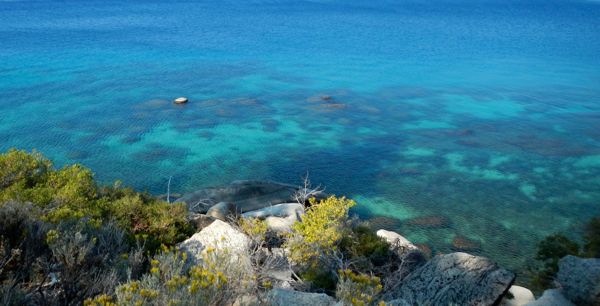
Lake Tahoe's multitude of colors are along the Incline trail. Photos/Kathryn Reed

Lake Tahoe’s multitude of colors can be seen where the Incline trail will go. Photos/Kathryn Reed

By Kathryn Reed

INCLINE VILLAGE – It’s possible people won’t be able to pedal the Incline Village to Sand Harbor bike trail that is slated to break ground next summer.

And it has nothing to do with the grade – that is expected to be no more than 5 percent. Nor even the length to begin with – it will be three miles when this demonstration plot is finished in what could be 2016.

It’s the views that may keep people from progressing far at once. People likely will be pulling over to snap photo after photo.

From the road this windy stretch of Highway 28 looks like it could fall into Lake Tahoe. The truth is there is a wide swath of land before reaching the water – and not just in drought years. This is where the bike path is going to be built.

The Incline section is one small part of what eventually will be the 30-mile Stateline-to-Stateline Bike Path. It will encompass all of Nevada at the lake. The even larger plan is to have a path around the entire lake.

The first phase of the Stateline-to-Stateline trail was completed in 2013 with 2.2 miles that go from Rabe Meadow in Stateline to Round Hill Pines Beach.

This past summer the Tahoe Fund launched a fundraising drive to secure $750,000 to help leverage $12 million in public dollars for the project as well as put some aside for a future endowment fund for maintenance. Tahoe Transportation District is the lead agency to get the trail built, but this section would be Nevada State Parks responsibility for upkeep.
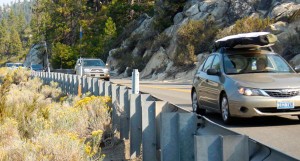
The trail will mean no longer having to walk along the highway.

The trail will mean not having to walk along the highway.

The nonprofit raised the money in seven weeks. The 16 vista points ranged from $15,000 to $100,000 depending on size and access. Those with more modest budgets can still donate $100 to have recognition at the start of the trail, and donors will also be recognized at kiosks at different locations.

Near where Tunnel Creek Café sits today will be the addition of 90 parking places. Already a bike trail exists on Lakeshore Drive. Eventually the Stateline trail will go to Crystal Bay.

The section breaking ground in May will head from the café on the mountain side. Where the actual Tunnel Creek flows is where cyclists/walkers will cross Highway 28 – either underground or via a bridge. This is about one mile from the café. People will be adjacent to the lake the rest of the way to Sand Harbor.

Amy Berry, CEO of the Tahoe Fund, said, “It’s like building a highway alongside the highway.”

This is because it will be 10-feet wide, entails potential over and underpasses, cantilever bridges, grades to meet American with Disabilities Act rules, signs and other necessities. Plus, building at Tahoe – and so close to the water – requires hurdles to be leaped before contractors are hired.
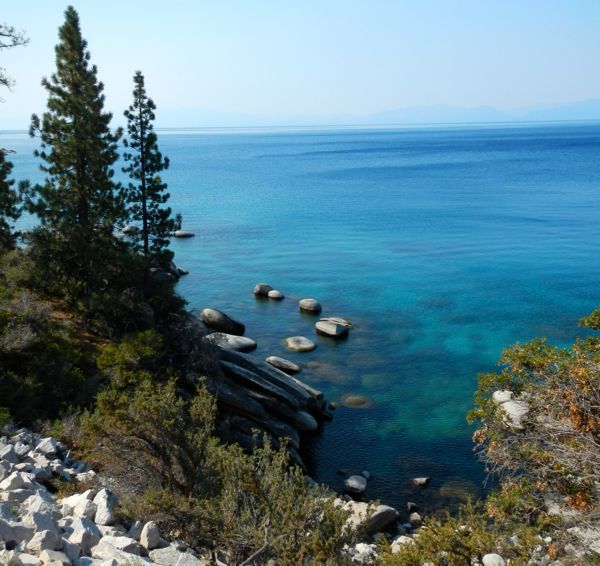
Scenery will be a main draw to this route.

Scenery will be a main draw to this route.

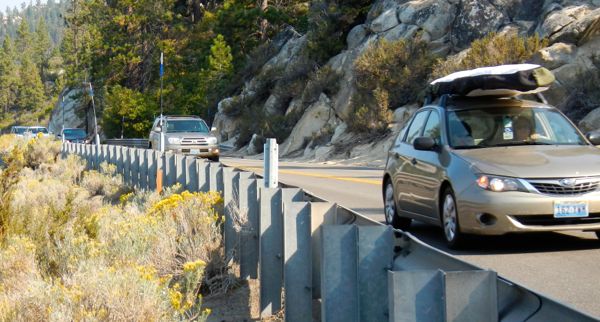
People will be walking or riding at a level that is lower than the state highway. And while this may sound noisy, the normal passenger car just made a hum on a recent morning. The beauty, even on a smoky day, could not be interrupted or derailed by anything above.

There will still be spots for motorists to stop, like at Memorial Point.

Stairs descend from the road to the water. Not all of these will be saved or in their same configuration when the trail is built. Besides getting people from Point A to Point B, the route is designed to stop people from parking on the narrow highway, reduce accidents, improve the environment and get people closer to Lake Tahoe. Estimates are that 100,000 people will use this trail once it is in the ground.

“It is a trail that takes you someplace, but the journey is the destination,” Berry said.


Workshop focuses on renting v. buying

The October professional workshop for Tahoe Regional Young Professionals is about the pros and cons of renting and buying.

A panel of real estate, property management and finance gurus will talk Oct. 15 from 5:30-6:30pm at Inn by the Lake in South Lake Tahoe.

TRYP workshops are free for members and $5 for non-members.

For more info, email TahoeTRYP@gmail.com.


Drought causing pumpkins to ripen early

By Anjali Hemphill, CBS 13 

DIXON  — A Dixon farm says the drought is certainly affecting this year’s pumpkin crop and some other holiday favorites.

Usually owners at Cool Patch Pumpkins tell customers not to buy their pumpkin now because they aren’t ready. But this year, the advice is the exact opposite.

Matt Cooley says it’s almost frightening how fast his pumpkins are turning this year.

“Usually the bigger ones take longer, but this year they are already ready,” he said.

The persistent drought and lack of winter rain has caused his pumpkins to ripen two to three weeks early.

Read the whole story


Calif. probes near-death escape of 12 firefighters

By Steve Gorman, Reuters

LOS ANGELES — California forestry officials have opened an inquiry into a life-threatening ordeal faced by 12 firefighters who were nearly engulfed by flames in the Sierra Nevada last month before a helicopter pilot flew to the scene and led them to safety.

The team had already crawled into foil-lined personal fire shelters — a survival measure of last resort — before they were spotted by the pilot as columns of fire raced up a canyon at them, igniting whole trees along the way.

The incident, which came close to becoming the deadliest California firefighting tragedy in nearly five decades and recalled the loss of 19 firemen in Arizona last year, unfolded on the third day of the King Fire.

Cal Fire, swiftly began a “near miss review” of the Sept. 15 incident, but the story was not widely reported at first.

Read the whole story


Murderer tied to Tahoe dies in prison

By Associated Press

LAS VEGAS — A Nevada inmate serving two life sentences in the 1989 killing of a California real estate agent has died in prison.

Nevada Department of Corrections officials say 67-year-old John Colwell died of a chronic medical condition Oct. 1 in High Desert State Prison.

Clark County coroner’s officials were called, and an autopsy was planned.

Colwell was convicted of kidnapping 52-year-old Modesto real estate agent Dorothy Greene while she showed a vacant house, then shooting her in the head and dumping her body in Lake Tahoe.

Authorities said he was arrested after withdrawing money from Greene’s account at an ATM.

He was convicted in Douglas County of first-degree murder, kidnapping and robbery, and has been in the prison system since 1991.


Letter: Squaw should honor $1 pass

To the community,

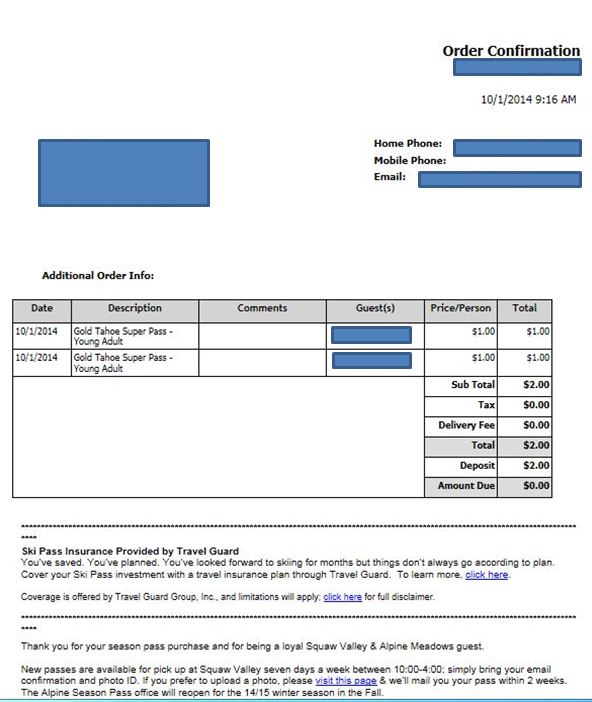
Not sure if you’re already aware of this, but (Oct. 1) Squaw Valley Resort had a glitch in their online season pass system that allowed ~500+ patrons to purchase gold level season passes for $1. Normally, this pass costs $809, however it was significantly discounted to a low, low price of a single dollar.

Like any other incredible opportunity that comes my way, I purchased two gold passes for a total of $2. It’s been brought to my attention that Squaw will likely not honor the advertised price and is in the process of refunding the 500+ passes purchased. However there seems to be some conflicting issues that has arisen that I feel needs to be brought into the light of the media/news:

1. A few people have already successfully received their gold passes and confirmed they only paid $1. They went to the pass office (Oct. 1), took their photo, and received their passes — with no hassle or questions asked.

2. One person has received a rejection email stating that Squaw will immediately reject and refund the $1 pass purchase for their order, however no one else who purchased their tickets (that day) has received this email. Image 1Since no one else has been notified, the rest of the consumers, like myself — who purchased these passes are under false pretenses that they have in fact, a real season pass.

3. If they honored the pass price for the select few people who received their season passes yesterday — isn’t there some sort of consumer protection law that justifies Squaw to honor all season passes that were purchased for $1?

My concern is that Squaw will quickly brush their mistake under the rug with little to no negative impact on their brand loyalty from other customers – simply because no one is aware of this situation.

Although I might have spent only $1 on this pass, if Squaw honored it — I would likely spend close to $500 throughout the season on food, merchandise, cocktails, etc. I don’t believe that granting the ~500+ passes will significantly impact their bottom line revenue considering most of these folks will spend money when they’re at the resort since they can justify their spending with, “I only paid $1 for this pass.”

I’ve never snowboarded at Squaw nor visited it simply because it was always out of my budget to get a season pass. I purchased this $1 pass because it was a phenomenal deal and I intend to visit Squaw often this season. I live in Incline Village and have many friends that come up to visit during the winter specifically to snowboard and ski. Normally we go to Northstar, however with this Squaw pass I have incentive to take my friends to Squaw instead. My friends of course would have to purchase a daily pass for themselves, and rental gear, and food, and drinks – so if Squaw just honored my $1 pass – they would still make money off this error since I’m bringing in new revenue from customers who usually go elsewhere to snowboard.

This isn’t the first time a glitch in the system has occurred for a major company. Take for instance United Airlines back in 2013, they had a system glitch for two hours where flight prices were advertised and purchased at $0! With the help of the news/media outlets bringing this mistake to light and potentially damaging their brand, United inevitably honored those prices and acknowledged that they made an error on their part, but to keep customer satisfaction high and to keep their brand in tact — they granted those folks who purchased flights at the advertised $0 price.

Please help us to demand Squaw to do what is right, and honor the $1 season passes before it is too late and they simply decline all of our passes today!

Sincerely,

Jessica Perez, Incline Village

Image 2


Donations pour in to help King Fire victims

The King Fire Fund has given out nearly $30,000 to local organizations.

The fund was established by the Sacramento Region Community Foundation to provide support and future recovery efforts to those affected by the King Fire in El Dorado and Placer counties.

Grants to the El Dorado Community Foundation, People for Animal Welfare in El Dorado County (PAWED), the Food Bank of El Dorado County, and the American Red Cross Capital Region are designed to augment immediate relief needs as well as support a pathway for recovery as people return home.

“It was just recently that we made the decision to open the fund. We were completely gratified by the outpouring of support from our fundholders, corporations and the general public who – with donations ranging from $10 to $10,000 – once again demonstrated just how generous this region is,” foundation CEO Linda Beech Cutler said in a statement.

The Sacramento Region Community Foundation has covered all processing and transaction costs, including credit cards fees, so that 100 percent of the donations will go to nonprofits that directly support King Fire victims and recovery in the future.


Calif. ends 1 of driest-ever water years

By AP

SACRAMENTO — California officials are urging residents and businesses to keep conserving water as the state ends another extremely dry “water year” with no guarantee the coming year will be any wetter.

The 2014 water year that ended Tuesday was one of the driest on record, with the state getting less than 60 percent of the average precipitation, according to the state Department of Water Resources. The 2015 water year began Wednesday.

The state’s major reservoirs collectively held only 57 percent of average water storage on Sept. 1, officials said.

Department Director Mark Cowin said “day-to-day conservation – wise, sparing use of water – is essential as we face the possibility of a fourth dry winter,” which is typically California’s rainy season.

Water officials say recent storms, while encouraging, haven’t eased the state’s water woes and forecasters can’t predict if California will get enough major storms to end the record drought.

Earlier this year, Gov. Jerry Brown declared a statewide drought emergency and called on residents to reduce water usage. The state and federal government have drastically reduced water deliveries to Central Valley farms, and the state water board approved fines of up to $500 for wasting water.

In September, the governor signed legislation that would for the first time regulate groundwater in California, prompted by concerns that increased pumping is depleting aquifers and causing land to sink.