Film explores food sustainability in the Sierra

By Kathryn Reed

TRUCKEE – Food is one of the basic needs to survive. Usually it is something people living the Lake Tahoe-Truckee region import.

But what if it didn’t have to be trucked in?

Mayumi Elegado, publisher of Truckee’s Moonshine Ink, and Stacy Caldwell with Tahoe Truckee Community foundation started exploring that concept earlier this year. Their brainstorming led to the creation of the 25-minute movie “Elevate Tahoe”.
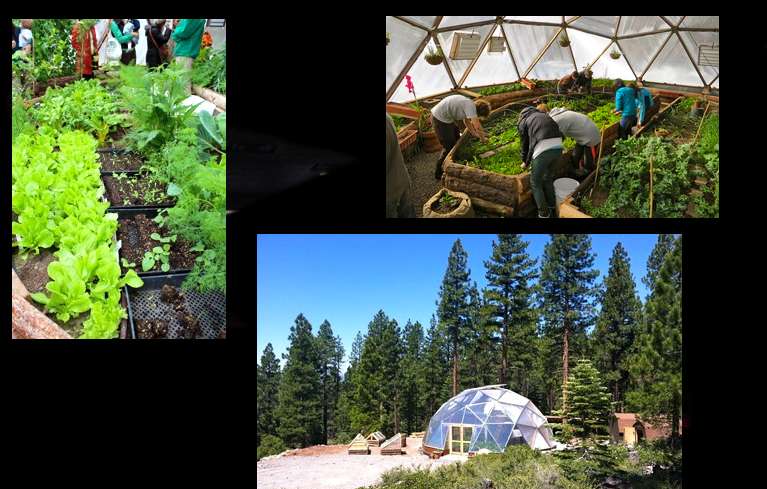
The Truckee growing dome is featured in the film "Elevate Tahoe" . Photos/Provided

Truckee’s growing dome is featured in “Elevate Tahoe”. Photos/Provided

SBS Media House created the film that profiles locals who are creating a sustainable food system. They raised more than $5,000 through KickStarter to fund the project.

On the KickStarter page, it says, “In our Elevate Tahoe film, we will feature a program that gets kids to like kale and even request fresh vegetables to be put on the home grocery list, a farmer takes us underground to extend the growing season, and a forager dishes on the bounty that can be found in the woods and your backyard, and how you can bring it home. All of these things are going on every day at the hands of normal people driven to improve the food they, their families, and their communities consume.”

While many people have small gardens in the summer, the film explores how food can be grown in this region throughout the winter, how to harvest native plants – including Manzanita, and how to preserve food so it can be used in the winter.

One segment of the film focuses on the growing dome that Truckee has. This was the inspiration for the two that will be built at Sierra House Elementary School this fall.

Another installment has organic farmer Gary Romano talking about what it takes to grow vegetables year-round.  For much of his segment he is holding a copy of the book “Why I Farm” which was published by Bona Fide Books in Meyers.

Alicia Funk with the Living Wild Project shows how powder from Manzanita berries can be used as a flour or natural sweetener. The other bonus to native plants is they are drought resistant.

Elegado and Caldwell are making the film available to various entities, with the latest showing being Oct. 14 during the Truckee-Donner Chamber of Commerce breakfast. Their goal is to soon have it available via iTunes.



Tahoe Tails — Adoptable Pets in South Lake Tahoe

Alice

Alice

Alice is one of three puppies still at the shelter. Mom is also awaiting her new home. She is a Shiba Inu mix, the puppies’ dad hopped the fence.

All are used to other dogs and kids, and chase squirrels and birds so they would do best in homes without small animals or kittens. Mom, Carol, needs a cat-free home.

Alice is spayed, microchipped, tested for heartworm, and vaccinated. She is at the El Dorado County Animal Services shelter in Meyers, along with many other dogs and cats who are waiting for their new homes.

Go to the Tahoe animal shelter’s Facebook page to see photos and descriptions of all pets at the shelter.

Call 530.573.7925 for directions, hours, and other information on adopting a pet.

For spay-neuter assistance for South Tahoe residents, go online.

— Karen Kuentz


Opinion: Colleges should invest in software, not buildings

By Donn Davis, Washington Post

For decades, America’s colleges and universities have been on a massive spending spree, building new dorms, student centers, sports complexes, and academic buildings. Despite all these expenditures, the key metrics are not much better. Graduation rates haven’t increased at the pace of much of Europe and Japan. According to the Organization for Economic Cooperation and Development, the percentage of young Americans who are less educated than their parents exceeds other leading nations.

What if the leaders of our colleges and universities had channeled just a fraction of this edifice-complex capital into technology improvements instead?

In technology terms, higher-education has spent massive amounts in “hardware” while dramatically under-investing in “software.” Software is the technology, tools and systems that make any business or organization more effective and efficient. Ask any of the tens of millions of students back on campus this fall at any of the thousands of universities and colleges: “How has technology been used to improve the classroom or enhance the learning experience” and you will get a blank expression. Technology has infused and changed every part of this generation’s life – except for education.

Despite an increase in edtech spending, up 11 percent from 2012 to $13 billion, 62 percent of that is still spent on laptops, tablets, and netbooks, which can only service one student at a time and quickly become outdated. With more and more students in the position to provide their own devices it is important to not overspend on hardware and allocate money to software programs that can run on multiple devices and be used by thousands of students at once. Schools will still need to provide a small pool of school-owned devices to be borrowed but this mentality will reduce costs.

Read the whole story


Soroptimist looking for grant recipients

Soroptimist International of South Lake Tahoe has money to give away.

SISLT’s goal is to fund quality projects that serve clearly identified needs of women and children in the South Shore community. New programs, improvements and enhancements to current programs will be considered.

The service club has $25,000 to give out, with the smallest installment being $1,000.

The deadline to apply is Dec. 15. Applications are available online. For more information, email  sisltfoundation@gmail.com.

SISLT’s grant funding comes from the annual wine tasting, which is Nov. 7 this year at Harrah’s Lake Tahoe.


Childhood dream evolves into chocolaty success

By Bernie Pacyniak, Candy Industry

For Dorinda Vance, it started early on in life. As a 12 year-old girl, she learned to make crave-inducing, chocolate-covered cherries. That skill ignited a passion in Vance that eventually steered her toward learning the art and refining the science of chocolate.

The mother of four boys, she homeschooled her sons until they reached high school.

When her last two sons were in 7th and 8th grade, Vance decided to pursue her dream and love for chocolate. She first attended Ecole Chocolat in San Francisco before traveling to Chicago for further hands-on education at the Barry Callebaut Chocolate Academy.

From there, she fine-tuned the process, putting her own artisanal touch on the craft and winning “People’s Choice” and “Most Original Taste” awards at a Lake Tahoe chocolate competition for her Sea Salt Caramels. Those acccolades earned her the title, “Duchess of Chocolate.” Shortly thereafter, Vance opened her first storefront in Truckee with her son, Dustin, joining her to help run the business.

Recently, she moved her shop to a picturesque Truckee River location in nearby Reno, and opened her second storefront in Squaw Valley.

Read the whole story


Study: Ski industry a $564 mil. boon for Tahoe

By Dale Kasler, Sacramento Bee

The ski industry generated $564.5 million worth of economic impact on Lake Tahoe’s economy last season, according to a study by San Francisco State University.

The study of the 2013-14 ski season comes as the Tahoe region struggles with a long slide in tourism, the result of the rise of Indian casinos in Northern California. Tahoe has been trying to reinvent itself as an international tourism destination, and the study notes that overseas travelers accounted for 3.4 percent of skier visits.

Read the whole story


Desalination not a cheap water solution

By Matt Weiser, Sacramento Bee

CARLSBAD  — Along this patch of the Pacific Ocean, welders and pipefitters nearly outnumber the surfers and sunbathers. Within sight of the crashing waves, the laborers are assembling what some hope will make water scarcity a thing of the past.

They are building the Carlsbad Desalination Project, which will convert as much as 56 million gallons of seawater each day into drinking water for San Diego County residents. The project, with a price tag of $1 billion, is emerging from the sand like an industrial miracle. In California’s highly regulated coastal zone, it took nearly 15 years to move from concept to construction, surviving 14 legal challenges along the way.

The desalination plant is being built by Poseidon Water, a private company, and will be paid for in large part by rate increases on San Diego County water customers. On the surface, the plant resembles any other major construction project: Construction cranes scrape the sky as concrete foundations are poured; the giant new blocky building could be any warehouse or parts factory.

Inside, the truth of the project is revealed. The building will house more than 16,000 reverse-osmosis membranes – salt filters, essentially – that will convert the Pacific Ocean into drinking water suitable for making coffee and watering lawns.

Reverse-osmosis desalination was invented in California in the 1950s. But other nations with fewer natural freshwater supplies – Israel, Australia, Saudi Arabia and others – embraced the technology first and built dozens of projects over the past few decades. When the Carlsbad plant begins operating in 2016, it will be the largest desalination project ever built in the Americas. Desalination on this scale is so new, said MacLaggan, that Carlsbad will be operated initially by an Israeli subcontractor, which will help train a staff of California workers.

The eyes of a thirsty state are trained on this project: It is a crucial test for an industry eager to expand in California, where residents are famously protective of their coastline and also accustomed to relatively cheap water. In short, the Carlsbad project is challenging California’s status quo while also offering the tantalizing prospect of relief from drought.

One of the big challenges is energy demand. Desalination requires more electricity than nearly any other water source, because water must be forced through reverse-osmosis membranes by high-pressure pumps. The San Diego County Water Authority committed to the Carlsbad project partly because it anticipates imported water will become more expensive over time and eventually reach parity with desalination.

Others view that equation differently. Four years ago, the city of Long Beach abandoned its desalination plans because of the energy cost. The city of Santa Cruz, with no imported water to shore up its supplies, rejected desalination after an uproar from residents concerned about the cost and environmental risks. The Marin Municipal Water District also decided for similar reasons in 2010 not to pursue desalination, and it boosted conservation efforts instead.

About a dozen new desalination projects are in various planning stages throughout the state. Only a few are as large as Carlsbad. The nearest to construction is another Poseidon project, proposed in Huntington Beach. A final permit from the state Coastal Commission comes up for a vote late in 2015.

Anticipating more proposals, the State Water Resources Control Board is drafting new regulations to govern desalination. The rules focus primarily on two crucial operating features: seawater intakes and outfalls.

Read the whole story


Fundraiser to help man hurt in dirt bike accident

Marhefka

Matthew Marhefka

On Aug. 26 local resident Matthew Marhefka was in a serious dirt bike accident on Powerline Trail. He shattered three vertebrae and is paralyzed from the neck down.

Even after a successful surgery to stabilize his spine, he is a quadriplegic.

Marhefka spent seven weeks in the trauma ICU at Renown Medical Center in Reno battling pneumonia and breathing complications. With his lungs now clear and getting stronger, he was flown to Santa Clara Valley Medical Rehabilitation Center to begin a six-week program that will help him cope with this life changing injury and to begin learning how to live the rest of his life.

Family and friends will be hosting a fundraiser with live music from Molly Mae Dellalo and South Shore Riot, a raffle and silent auction, as well as a portion of the Classic Cue’s proceeds that day being donated into Marhefka’s trust. All money raised will go directly to his for home modification and equipment.

The fundraiser is Nov. 1 from 1-4pm at Classic Cue, 1965 Lake Tahoe Blvd., Suite B, South Lake Tahoe.

Donations can also be made directly at any US Bank branch to the Matthew Marhefka Benefit Account.

For more info, call Jessica Knab-Irish at 530.307.2530 or Jason Fenley at 530.318.6557.


Snippets about Lake Tahoe

snc• Sierra Nevada College Water Ski Club took seventh in the overall category at the Western Regional’s Ironwood Mixer on Oct. 3-5.

• Here are the Caltrans roadwork schedules for El Dorado-Tahoe and Sierra for the coming week.

• The annual Women’s Wellness Weekend at Granlibakken in Tahoe City is Nov. 8-9. For more info, go online.

• Creative Cocktail is a networking event put on by the North Lake Tahoe Chamber on Oct. 29 from 5-7pm at Bowl Incline in Incline Village. Cost is $5 for members, $10 for non-members.

• There will be a benefit for Kathy McWilliams on Nov. 3 from 4-9pm at Lake Tahoe Airport. She has been diagnosed with Burkitt Lymphoma, a rare, digressive form of non-Hodgkin’s lymphoma.


Tallac Site upgrades may start in 2015

Work to revitalize the Tallac Historic Site could begin in May.

“This project will reduce environmental impacts and improve recreational opportunities at the Tallac Historic Site,” Lake Tahoe Basin Management Unit Forest Supervisor Nancy Gibson said in a press release. “Upgrading these facilities will help us meet current and projected recreational demands and comply with legal requirements for accessibility.”

Depending on funding, the work could take a decade to complete.

The Forest Service will implement a variety of water quality projects, upgrade paths, improve accessibility, install informational signs and remove some user-created trails removed. Crews will construct a split-rail fence between the Tallac Point beach area and the Taylor Creek Marsh and a restroom will be built near the parking area.

The project will improve vehicle circulation by reconfiguring the three entrances along Highway 89 (Valhalla, Tallac Site, and Taylor Creek Visitor Center) into two entrances connected by an internal road, which allows visitors to enter the site and access all areas without returning to the highway. Parking areas at the Tallac and Valhalla sites will expand and the existing unimproved parking area near the Valhalla entrance will be paved.

The project will also include construction of a non-motorized, multi-use trail adjacent to the new internal road and parking lot access roads.