Hwy. 50 delays next week on West Slope

Full overnight lane closures of Highway 50, first in the westbound direction and then eastbound, are scheduled for next week to accommodate work on El Dorado County’s Silva Valley Parkway interchange project.

On Oct. 28 and Oct. 29, westbound Highway 50 will be closed from Bass Lake Road to El Dorado Hills Boulevard from 11pm-5am and the westbound on-ramp at Bass Lake Road will be closed from 10:30pm-5am.

On Oct. 30 and Oct. 31, eastbound lanes from Latrobe Road to Bass Lake Road will be closed from 11pm-5am and the eastbound on-ramp will be closed from 10:30pm-5am.

During the closures, traffic will be detoured via El Dorado Hills Boulevard, Serrano Parkway and Bass Lake Road. Motorists should expect an additional 10-15 minutes of travel time.


Gaming industry likely to keep expanding

By J.D. Morris, Las Vegas Sun

In the not-too-distant past, Nevada and New Jersey were the only states with casinos.

Now, 39 states have some form of casino gambling — and the industry’s presence continues to evolve this year.

And as Las Vegas’ major gaming companies are considering further domestic growth, states such as Massachusetts, New Jersey and California are themselves debating the expansion — or retraction — of gambling.

At issue is a question as old as the gaming industry: morality versus money.

This year, that debate is playing out most prominently in Massachusetts, where next month voters will determine the outcome of a ballot measure that would ban casinos in the state.

With similar arguments underway elsewhere, too, it’s no surprise that this year the American Gaming Association launched a “Get to Know Gaming” campaign aimed at promoting the industry’s impact on communities.

The trade association is trying to boost the industry’s public perception by drawing attention to things like its $240 billion economic impact, which is touted in a recent study released by the AGA.

Read the whole story


Judge: N.J. can’t launch sports betting

By Bob Jordan and Steve Edelson, Asbury Park Press

TRENTON, N.J. – A federal judge says Monmouth Park can’t cash in Sunday on Gov. Chris Christie’s plan to launch betting on NFL football at the Oceanport racetrack.

But track officials said they are considering taking bets in future weeks on soccer, NASCAR racing and other sports not covered by the ruling.

U.S. District Court Judge Michael Shipp late Friday put in place a temporary restraining order that will prevent the track from taking bets on this weekend’s NFL games, and also applies to NBA, NHL, Major League Baseball and NCAA games.

Track officials said they were expecting a crowd of 10,000 Sunday to bet on Jets-Bills, Eagles-Cardinals and other NFL games. The track was scheduled to open 7am Sunday in order to accommodate customers wishing to wager on the Lions-Falcons game being played in London at 9:30am.

Read the whole story


Nev. judge puts brakes on ridesharing Uber

By Michelle Rindels and Kimberly Pierceall, AP

It didn’t take long for Uber to come to a screeching halt in Nevada. District Court Judge James Russell in Carson City has blocked Uber from offering any rides in the state through at least Nov. 7. A hearing is set for Nov. 6.

The state’s attorney general sought the temporary order late Friday afternoon.

The car company — whose smartphone app remained active late Friday — responded to the order with a statement calling on state officials to “embrace innovation, support powerful job creation, and stand with the people of Nevada who need them most.”

“For far too long, the people of Nevada have been denied access to the reliable, safe and affordable transportation options millions of other Americans are enjoying. We’ve already received overwhelming demand and support from thousands of residents who have downloaded the app, and drivers looking to meet that need,” company spokeswoman Eva Behrend said in a statement.

Uber launched its service in Las Vegas, Reno and Carson City on Friday after months of rumors that included recruitment posts on Craigslist and cryptic front-page newspaper advertisements.

The company contends it’s not a taxi company but rather a technology company facilitating a way for drivers and would-be passengers in need of a ride to meet.

The company faces a fierce battle with the state’s highly regulated and influential taxi industry.

Four cars driven for Uber had been impounded statewide for not being licensed as of midafternoon and faced fines of up to $10,000, said Teri Williams, a spokeswoman for the Nevada Taxicab Authority.

Uber spokeswoman Eva Behrend called the impoundments “unjust” and said the company will have its drivers’ backs financially and legally. Uber is the only ridesharing company now operating in the three metro areas. Las Vegas has been among the few metropolitan cities in the country to not be served by the company.

The company tiptoed around Nevada until its Friday launch. A multitude of regulations govern the state’s taxicab industry, and there are limits on the number of cabs that can operate and where they can pick up passengers. In Las Vegas, unlike other metropolitan cities that draw tourists, cabs can’t be hailed from the sidewalks along the Strip, for example. They have to pick up and drop off passengers at the individual hotel properties.

Behrend said that hundreds of drivers in the state have already signed up and passed background checks and vehicle inspections that clear them to respond to requests for rides via smartphone. Before the court order, drivers could pick up passengers from anywhere in the service areas, except from the Las Vegas Strip between the Mandalay Bay and SLS casinos and from McCarran International Airport. They can drop off customers anywhere.

Uber rides are generally 10 to 20 percent cheaper than taxi fares — a competitive advantage especially in light of an 8 percent cab fare hike approved earlier this week in Las Vegas.

An early afternoon Uber ride from downtown Las Vegas to Mandalay Bay at the south end of the Strip cost $22.50. Drivers don’t accept tips, just a ranking of one to five stars. A taxi ride back to downtown Las Vegas cost $28.50, including a $3 fee for a credit card charge. The cost didn’t include a tip.

Uber has often been met with strident opposition from taxi companies, and heavily regulated Las Vegas is no exception.

Bill Shranko, an executive at Yellow Checker Star taxi company in Las Vegas, asked regulators with the Nevada Taxicab Authority in April to warn Uber and similar companies that the city has hefty fines for operating unlicensed cabs and maintained that the company was operating illegally.

About 2,000 cabs fill the streets of Clark County, including the Las Vegas Strip, Shranko said.

He criticized Uber for picking and choosing customers, saying, “They’re taking all the cream off the top.”

As of early Friday afternoon, just a few cars were visible on Uber’s app.

Marco Falchi’s Mazda 6 was among them. He excitedly picked up some of the company’s first Vegas passengers, greeting them with a “Ciao” text. The chatty Italian has never driven a traditional cab before, but six months ago, he applied to be a driver for Uber, submitting his license, insurance and driving record.

His first customers were two young men heading from a suburban condo to downtown Las Vegas for the three-day Life is Beautiful music festival that starts Friday.

“Here the politics are really tough,” Falchi said, referring to the Vegas area’s taxi industry. But he’s undeterred. “If you work more, you make more money.”

Sun reporter Pashtana Usufzy contributed to this report.


Letter: Prop. 46 deserves a ‘no’ vote

To the community,

California Proposition 46 is costly and deceiving to voters. It would increase costs for patients, deter doctors from practicing in California, and threaten patient privacy. The consequences are also higher for rural communities like South Lake Tahoe. I have been a physician in South Lake Tahoe for over 34 years and I’m asking our voters and patients to take a closer look; Prop. 46 just doesn’t add up.

Prop. 46 will escalate insurance rates and, ultimately, increase healthcare costs for patients. The non-partisan California Legislative Analyst’s Office estimates that Prop. 46 would cost patients an additional $9.9 billion annually, that’s $1,000 a year for a family of four.

The second part of Prop. 46, also considered the “sweetener” to woo voters, would require random drug testing on physicians. While this may seem like a valuable safety measure, data shows that a minuscule percentage of harm is done by impaired physicians and Prop. 46 would exclude testing physicians who practice in private offices. Medical facilities, including Barton Memorial Hospital, already have proven and effective safety measures in place to protect patients from harm.

Lastly, Prop. 46 would require doctors use a state-controlled database before prescribing certain controlled substances and to discourage patients who “doctor hop” for pain medication. But the Prop. 46 solution to this real problem is inadequate: the database is unreliable, understaffed, and lacks security measures. This will only burden medical providers to operate an additional program that is not ready or secure for statewide use.

I encourage voters to take a closer look at this proposition. Please join Barton Health and over 500 other organizations across party lines and vote “no” on Prop. 46 in the upcoming election.

Paul Rork, physician and board of director Barton Health


Supervisor candidates release financials

Here are the most recent campaign financial documents from the two candidates running for El Dorado County supervisor District 5:

Kenny Curtzwiler and Sue Novasel.


Tahoe Paradise Park board struggles with professionalism, how to get anything done

Tahoe Paradise Park's internal workings are becoming a bit dysfunctional. Photos/LTN file

Tahoe Paradise Park’s internal workings are becoming a bit dysfunctional. Photos/LTN file

By Jessie Marchesseau

MEYERS – Thirty-five community members were in attendance at the Tahoe Paradise Resort Improvement District board meeting on Thursday night, but by the time the meeting adjourned three and a half hours later only a few remained.

The larger than usual turnout may have been the result of some topics currently circulating through the community. One woman said she was there because of a notice she found on her door which said the park was closing. Someone else was concerned about what the new Assembly Bill 2762 would mean for the TPRID. Another person voiced concern over rumors that the county was taking over the park.

The board members assured attendees the park is not in danger of closing. Only one board member had even heard of AB2762 with no answers as to what it meant for the future of the district. And Norma Santiago, El Dorado County supervisor and board member, denied any plans for El Dorado County to take over the park.

“The county does not want this park,” she said, “this is a community park, this is your park.”

However, she did reveal that the governance committee has considered the possibility of asking El Dorado County for administrative support. This is still at the committee level and has not been discussed by the TPRID board. However, the committee reported there is a possibility the county could help with administrative tasks such as invoicing, insurance policies, legal services, personnel policies and so on for a year or so until things get back on track, possibly at no cost to the RID.

Currently, all administrative duties in addition to maintenance are handled by Steve Dunn, the park manager who lives on site. All the board members as well as Dunn agreed this was too much for one person to handle, but a previous attempt to hire a part-time administrative person was unsuccessful.

In his first meeting as a board member, Peter Nelligan voiced his concern about the complete lack of any sort of bylaws or policies and procedures for the RID. In its current operational and administrative state, Nelligan said he believes the park will not be able to sustain itself for more than a few years.

Nelligan and Victor Babbitt are new to the board this year and appear anxious for change.

“We have a park, we have assets, we have a budget, we have projects that need to get done,” Babbitt said Oct. 23.

He reviewed the short-term priority projects for the park, including painting the gate, cleaning up the planter boxes at the entrance, and restaining the recreation center and the residence among a numerous other maintenance items. Some of the projects have already been completed; others are still in the planning process.

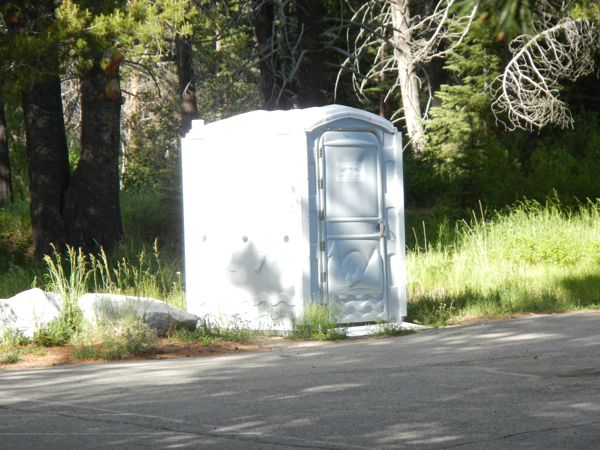
Park users will be using porta-potties for the foreseeable future.

Park users will be using porta potties indefinitely.

One of the larger projects in the works over the summer was installing a restroom at the south end of the park. The project was approved by the county, but then TRPA shot it down, according to those at the meeting. However, after the meeting, TRPA told Lake Tahoe News that no application to build the bathroom was ever filed. With the restroom off the table, the board now has to find other projects on which to spend their grant money before the March deadline. Without a qualifying project, the RID could face losing a big chunk of the $60,000 grant.

Board members bickered amongst themselves throughout the evening, with board Chairperson Judy Clot expressing the most disdain about being excluded from budget discussions and individual committees not keeping her in the loop. More than once attendees took the floor to ask members to take their arguing elsewhere.

Board and community members alike expressed concerns about adhering to the Brown Act which outlines requirements for open meetings, public input and accessible information. Clot said she has received several complaints recently. The fact that the only place meetings are consistently announced is on the park bulletin board and the only place one can get meeting minutes is by going to the park and asking Dunn to make them a copy, and that is assuming he has had time to transcribe the audio recording, suggests there is room for improvement. The board agreed to look into getting further Brown Act training from the county.

The meeting concluded with Babbitt making a motion to schedule a special meeting before the regularly scheduled meeting in January. He said there was too much to be done for them to take the next three months off. His suggestion was met with objections and scowls from some of the others. But in the end, a special meeting was tentatively scheduled for Dec. 11. An announcement will be posted on the park bulletin board at least 24 hours in advance.


Opinion: Working together for wildfire protection

By Cheva Gabor

September brought the reality of wildfires to the forefront in the Lake Tahoe Basin. The King Fire came within eight air miles of the U.S. Forest Service Lake Tahoe Basin Management Unit boundary, and as we all anxiously awaited its containment, the Cascade Fire broke out in the Desolation Wilderness.

Rain and snow quickly brought an end to both fires, but not before we were all sharply reminded of the risk we take by choosing to live surrounded by forest. Perhaps, as you anxiously monitored firefighters’ progress against the wildfires, you asked the question, “What are Lake Tahoe agencies doing to reduce the risk of a wildfire that could affect my home and family?”

Cheva Gabor

Cheva Gabor

The answer should come as a pleasant surprise. Since 2007, Lake Tahoe Basin agencies have worked closely together to prioritize and implement projects to reduce local wildfire risks, under the guidance of the Tahoe Fire & Fuels Team, using the Lake Tahoe Basin Multi-Jurisdictional Fuel Reduction and Wildfire Prevention Strategy. Participating agencies include the U.S. Forest Service, the Tahoe Regional Planning Agency, the land managers and fire services of California and Nevada and local fire protection districts.

In August 2014, the 15 agencies released an updated strategy that assesses the work done to date and sets forth a plan for the future.

At this year’s Lake Tahoe Summit, elected officials from both parties recognized the significance of this collaborative approach, signing a proclamation supporting the strategy and its benefits to forest health and the protection of life, property, and Lake Tahoe’s precious environmental resources.

The origins of the fuels reduction strategy date to 2006, when Congress passed the White Pine Amendment to the Southern Nevada Public Land Management Act (SNPLMA). The bill required Lake Tahoe Basin partners to develop priorities for fuels reduction in order to compete for SNPLMA funding to implement these projects.

Led by the U.S. Forest Service, the agencies rallied and began to build upon existing research, planning and treatment to prioritize future work. Then, in June of 2007, the Angora Fire burned 3,100 acres and 254 homes, pointing up the urgent need to treat wildland areas near communities as outlined in the strategy. Since it was finalized in December 2007, the document has fulfilled its goal of guiding wildfire risk reduction efforts.

The original strategy identified 68,000 acres as treatment priorities. Since 2008, nonfederal partners have treated 12,000 acres in the highest priority areas identified by the community wildfire protection plans, nearly doubling the average annual number of acres previously treated. The U.S. Forest Service has treated approximately 26,000 acres.

In 2013, the Forest Service convened the partners to update the strategy to address new issues and challenges that have arisen since 2007. The update responds to climate change, ensures coordination with national wildland fire policy, and addresses the loss of markets for biomass and other wood products that result from forest thinning.

Treating fuels in the critical area where our communities meet the wildland is projected to cost between $144 million and $156 million, with an additional $25 million to $35 million needed for work to ensure the continued effectiveness of previously treated areas. These amounts far exceed our agencies’ normal budgets. Our strategic approach will help us better compete for the funding we need to reduce the risk of catastrophic wildfire.

While not mentioned by name, there’s one last partner we need to successfully implement the strategy – you. The updated strategy recognizes the essential role that you as a property owner play in reducing wildfire risk when you complete your defensible space or retrofit your home so it’s more resistant to ignition by wildfire. To learn more about what you can do, go online.

The updated strategy facilitates the decisions that must be made by land management, fire and regulatory agencies to reduce the probability of another catastrophic wildfire in the Lake Tahoe Basin. The full commitment by partner agencies to support and implement the strategy will help protect our communities, our beautiful environment and the tourism-based economy that relies on it.

To read the Multi-Jurisdictional Fuel Reduction and Wildfire Prevention Strategy, go online.

Cheva Gabor, LTBMU public affairs officer


TRPA: Clam suffocation at Emerald Bay successful

Mats in Emerald Bay as seen from the air. Photo/LTN file

Mats in Emerald Bay as seen from the air. Photo/LTN file

It may take until the end of November for divers to remove the 5 acres of rubber mats that were laid on the lake bottom at the mouth of Emerald Bay.

This was done two years ago as a pilot project to control Asian clam populations in the area. The mats measure 10-feet-by-100-feet and weigh 300 pounds.

Boaters are asked to exercise caution when entering and exiting Emerald Bay and obey a no-wake zone that extends 600 feet from shore.

The mats were used to smother and kill the nonnative Asian clams by starving them of oxygen. Early sampling indicates at least a 90 percent mortality rate in the treated area, according to Tahoe Regional Planning Agency officials.

Asian clams can stimulate algae growth, displace a variety of native species, and increase the potential for other invasive species such as quagga mussels to establish in Lake Tahoe by increasing calcium concentrations in the water.

— Lake Tahoe News staff report


Placer County deputy gunned down

By Sam Stanton, Ryan Lillis, Ed Fletcher, Darrell Smith and Richard Chang, Sacramento Bee

Danny Oliver’s last shift ended with the veteran Sacramento sheriff’s deputy doing something he would have done countless times before in his career, walking toward a car to see what the occupants were doing on his beat.

The 47-year-old father of two never made it to the driver’s window Friday. At about 10:30am, a man armed with an AR-15 rifle aimed out of the car from the parking lot of a Motel 6 at Arden Road and Ethan Way and opened fire, killing Oliver with a shot to the forehead.

Over the next six hours, authorities say, 34-year-old gunman Marcelo Marquez eluded hundreds of officers from Sacramento to Auburn in a crime spree that left Oliver and Placer County sheriff’s Detective Michael David Davis Jr. dead. A third Placer deputy, Jeff Davis, was wounded and later treated and released from a hospital. A motorist was in serious condition from a gunshot to the head.

The carnage ended around 4pm Oct. 24 when Marquez meekly surrendered to deputies who converged on a home in Auburn where he had been hiding for hours as one of the largest manhunts in Sacramento history unfolded.

Marquez, who public records indicate is from Salt Lake City, was expected to be transferred to the Sacramento County Jail late Friday along with a woman who authorities say had accompanied him on part of his rampage.

Authorities say the couple were responsible for a drama that forced thousands of schoolchildren to spent the day either in lockdown or sheltering in place, left neighborhoods evacuated and forced sheriffs from Sacramento and Placer counties to step forward with somber announcements that they both had lost deputies.

Read the whole story

Read more here: http://www.sacbee.com/news/local/crime/article3348287.html#storylink=cpy