Letter: Domestic violence victim speaks out

Publisher’s note: Lake Tahoe News is withholding the letter writer’s name to try to protect her identity.

To the community,

My story was recently published in your newspaper and I’d like to write this for two reasons. Primarily, to say a special thank you to all the people who helped me, but also to bring light to a nasty subject, domestic violence.

First, I want to thank my neighbors and first responders. I especially want to thank (police Sgt.) Shannon Laney who I truly believe saved my life. He helped me focus and tried to keep me calm.

I want to thank the very competent and capable EMTs that responded so quickly. They did a great job.

I want to thank the entire staff at Barton Hospital; they were so supportive and comforting. Every nurse, even the dietician, made me feel they cared deeply. I especially want to thank the ICU team and Dr. (Kimberly) Evans. They saved my life. I couldn’t buy all these people enough flowers and gift baskets to show my appreciation.

Shelly, the social worker there, has a great big heart and I am grateful for her kind words of support and encouragement.

I want to thank the SLTPD as well for doing a great job serving and protecting, safely and quickly resolving the situation.

Thank you to Bryan and Yolanda and the others at the DAs office for your help and support. Thank you from the bottom of my heart to those who helped my baby. Thank you for keeping him safe and for continuing to do so while I heal.

I met so many kind people and I wish I could thank you all in person. I hope this will let you know how special you all made me feel.

However, the irony isn’t lost on me that October is domestic violence awareness month. I’m also writing this letter to hopefully reach that person out there that needs to see or hear about this story. Domestic violence is a two-way situation. If you see the signs in your life, you must get help as soon as you know. Whether you are victims or violators, seek help. Both deserve a healthy relationship and both need to heal. Do something before it’s too late because domestic violence is a life and death situation, and, yes, it really can happen to you.

I saw the signs and I lied to myself constantly. I thought my situation was somehow unique.

Please take action to stop DV. Show your support, wear the ribbons, and donate to DV related causes. Here in SLT we have Live Violence Free if you need help or if you’d like to help, I am sure they’d happily point you in the right direction.

Lastly, tell all our young men and women about the dangers and consequences of DV. Most important we all need to model these behaviors of healthy relationships to everyone we come across. That’s a tall order, I know, but I believe there are so many who’ve just never seen the behaviors we’re all expecting of each other. If you don’t see it, how can you learn it. I hope this letter reaches those who need it.

Again, thank you, thank God. I am grateful for a second chance.

South Lake Tahoe DV victim


Author to read at S. Tahoe library

Jennifer Quashnick, local author, will talk about her first novel “Sierra Nevada Trail of Murder” from her Mountaingirl Mysteries series on Nov. 18 at 6pm.

The premise: Chased by a killer, Rachel Winters, her dog Bella, and private investigator Luke Reed must uncover a deep-rooted environmental conspiracy stretching across multiple state lines.

Quashnick will sell and sign books following the free talk at the South Lake Tahoe Library, 1000 Rufus Allen Blvd.


Opinion: Tahoe Fund anything but altruistic

By Jacqui Grandfield

A couple of decades ago resort developers began their invasion of the Tahoe area. They bought homes in our communities, enrolled their kids in local schools and almost immediately became active locally by joining committees and doing volunteer work. Then they started offering “donations” to our local, struggling nonprofits.

Some far-sighted people, realizing that this was a thinly veiled attempt to buy their loyalty and cooperation for future development plans, declined to take the money. Some even resigned their jobs with non-profs they helped create.

Fast forward 10 years or so. These same resort developers began offering money to our local environmental and public agencies. Fearing these donations would constitute a conflict of interests and be seen by the public as bribes from special interest groups, the agencies danced around this issue for several years, publicly denying any money exchange.

The Great Recession of 2008 made these same local agencies desperate for money as government spending was drying up. Along comes the California Tahoe Conservancy’s new executive officer, with a “great” idea. He would start a nonprofit comprised of local environmentalists and developers to cooperate and provide financing for small, local projects … another idea of his, proved disastrous for the Delta Bay ecosystem (and the Delta Bay Authority) at a cost of over $3 billion to taxpayers.

Numerous calls to the California Attorney General’s Office and a CTC board member resulted in no answer to a simple question: Is it even legal for a state public environmental agency to start a nonprofit with such powerful special interest groups as Vail, KSL, JMA, et al?

TRPA tells us this public/private cooperation is the economic future for Tahoe.

Enter the Tahoe Fund. The picture that’s been painted for the general public is that of a nonprofit group of environmentalists and developers working together to help restoration efforts by providing funding, and presumably expertise, to all sorts of natural resource projects in the basin. The stated purpose of the Tahoe Fund is “to become a major source of private funding for environmental projects around the Lake Tahoe Basin …”

Sounds good at first, right? But, what’s really the difference from prior decades? Now they have communications and media experts who mislead the general public about their purpose and intent and the methods they use to achieve them.

In reality, this group is part of an “iron triangle”, a result of the sub-government structure that dominates in the basin. This “cozy triangle” as it is often called, consists of federal government, state and local government and special interest groups (pressure groups), both public and private. The public group wants resource protection and education while the private groups want profit.

The problem is these two pressure groups do not have equal resources in that private groups have much, much more money and thus way more influence. The Tahoe Fund is a perfect example of private special interests controlling the average Tahoe citizen’s life and environment. Add this to the fact that the majority of our local governments are run by non-elected, appointed officials. Where does this leave the less powerful public interest groups and the public in general? It leaves them virtually powerless in Tahoe’s cozy triangles.

A final insult to the public, but a great deal for developers is they can throw money or what amounts to their pocket change at small projects around Tahoe while proceeding with their mega developments. These projects, even those costing $10 million to $12 million, are great for a localized area but can in no way offset the widespread, massive environmental and cultural damage caused by huge, unnecessary developments.

What they can do is provide developers and other private investors with mitigation offsets, potential development right transfers, a nonprofit tax shelter and most egregiously, a powerful and cheap public relations tool to convince Tahoeans that developers are great people who support community, environment and economy.

Otherwise why is the Tahoe Fund board composed of ski industry CEO’s such as Andy Wirth and Art Chapman, CTC’s Patrick Wright, local government officials, venture capitalists and “token environmentalists” (who are also donors)? Why is the Fund’s CEO a public relations and marketing specialist? And, is it possible that these “special interests” receive favors for their monetary contributions in the form of extra TAUs, rezoning conservation areas, expanded coverage, height and so on?

The Tahoe Fund is not an altruistic entity. It is part of big developers’ strategy to influence public opinion in their favor.

Does anyone really trust these special entities to protect and enhance our communities and natural resources when their main goal is money? There are reasonable, effective solutions to combat the corruption and influence these types of pressure groups create. We could demand that more of our public officials are elected by the people, for the people and not appointed by questionable public agencies and special interests?

That’s one idea, what’s yours?

Jacqui Grandfield is a wildlife biologist and environmental policy expert who lives in Lake Tahoe.


Then and now: Van Sickle history

Ranching used to be a big part of Lake Tahoe.

But cows are no longer allowed in the basin for environmental reasons and only a few horses remain.

However, the history of the area is still visible. And names like Van Sickle have been immortalized through the bi-state park at the state line on the South Shore.

Here are photos from that area:

ngg_shortcode_0_placeholder (Click on photos to enlarge.)

— Bill Kingman


West Shore hike captures Tahoe’s raw beauty

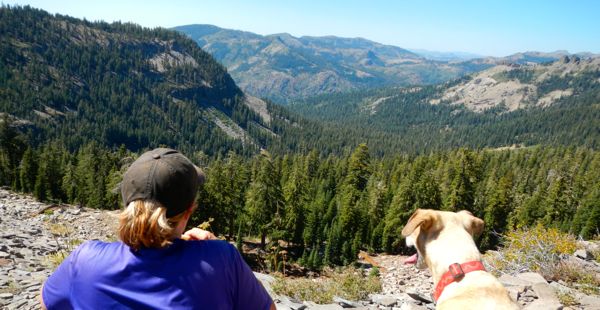
Sue and AJ enjoy lunch with a view of Granite Chief Wilderness Area. Photos/Kathryn Reed

Sue and AJ enjoy lunch with a view of Granite Chief Wilderness Area. Photos/Kathryn Reed

By Kathryn Reed

HOMEWOOD – Variety is what the trail to Twin Peaks is all about. The terrain and views seem to change around each bend.

Rugged at times, lush at others. Granite and volcanic rock. A few remaining wildflowers and a field of brittle dry mule’s ear. Wide-open expanses, closed-in by towering pines. Lake Tahoe in the distance.

This West Shore hike in the Desolation and Granite Chief wilderness areas also at times follows the Tahoe Rim Trail and Pacific Crest Trail.

The Barker Pass trailhead is at 7,500 feet. The end point is at 8,878 feet. But most of the climb is gradual, so the elevation gain is not a deterrent. There is a small stretch that requires going down a bit after climbing. This is never ideal because it means on the return there will be an uphill segment.

Not far in there is a side trail to the right. This provides the first view of Lake Tahoe. While it would have been easy to stop there and call it a day, we were glad we didn’t.

Not too much farther we come across a rock outcropping. The narrow trail with a significant vertical drop makes it not the best place to be for someone with a fear of heights. A little handholding and I get through it. More spectacular views of Lake Tahoe are the reward.

It would have been possible to climb the rocks, but we didn’t want to take the time and we had a dog with us. The mostly single-track trail is well maintained. At times it is soft dirt, other times it’s rocky. We are surprised to find water in a couple sections. This delighted AJ so she could stay hydrated without her people’s assistance.

The water provides for lush vegetation like ferns.

It’s a Saturday in early September and we see few people. One guy is on the PCT headed south. We are happy to just be doing what we estimated was a 6-mile round-trip.

No bikes or motorized vehicles are allowed, though we could hear dirt bikes at the start of the trip on the road we came in on.

We get to the peaks and stop for lunch on the saddle. The vastness of Granite Chief Wilderness Area is mesmerizing. It looks like the forest goes on forever. It’s easy to feel very small and insignificant, but also very appreciative to be able to embrace Mother Nature’s raw beauty.

—–

Getting there:

From South Lake Tahoe take Highway 89 north. Beyond Homewood and before Sunnyside in Tahoe City will be a sign for Kaspian Campground. Turn left there. The road goes for about 7 miles. Veer to the left and don’t go straight on the dirt road. At the end of the hill the pavement turns to dirt. Go beyond the start for the trek to Ellis Peak. Parking for the trailhead will be on the right.

ngg_shortcode_1_placeholder (Click on photos to enlarge.)


Editorial: Calm down, Ebola won’t kill us all

Publisher’s note: This editorial is from the Oct. 20, 2014, Los Angeles Times.

Texas university refuses to accept students from Nigeria, where there were a couple dozen Ebola cases before the disease was quickly stopped. Louisiana refuses to allow incinerated trash from the treatment of Texas’ first Ebola victim, Thomas Eric Duncan, into its landfills, as though the virus would survive immolation. A passenger on a cruise ship to Mexico who may have been exposed to lab samples from Duncan, but who appears to be healthy, is given a blood screening for Ebola even though the test isn’t reliable in people without symptoms.

Schools in Ohio and Texas have been closed and their contents bleached because of the remote chance that a single student or teacher might have been exposed to someone who carried the virus. The children and teachers involved had no symptoms, which meant they could not have been contagious even if they had been infected. There is no sign so far that they were.

Parents in Mississippi kept their children out of school after the principal traveled to Africa — not to one of the afflicted countries but to Zambia, in an entirely different part of the continent.

Concern about a disease as deadly as Ebola, for which there is no cure, is not misplaced. Any erring should be done on the side of caution. But there has been far too much frantic, irrational worry over what amounts to a handful of Ebola cases and a single death in the United States.

Read the whole story

Louisiana refuses to allow incinerated trash from the treatment of Texas’ first Ebola victim, Thomas Eric Duncan, into its landfills, as though the virus would survive immolation.

Some of the blame, of course, rests with federal authorities, especially those in charge at the U.S. Centers for Disease Control and Prevention, who failed to get their arms around the situation. In an attempt to avoid a public panic, they instead created a worse one by making assurances that were quickly shown to be wrong.


Winter Warm Up fitness event in Incline

High Altitude Fitness in Incline Village is hosting a Winter Warm Up on Nov. 6.

There will be fitness classes, personal training assessments, chair massage, climbing demonstrations, nutrition, wellness talks, and more from 4:30-8pm.

Classes will range from TRX, Pilates, cycling, winter sports conditioning to training for rock climbing. Information about
voice print nutrition analysis, essential oils, natural supplements, and more will be available

While the event is free, donations will be accepted to benefit High Fives Foundation.

For more info, email kyra@highaltitudefit.net or call 775.831.4212.


EDC has money for tourism promotion

El Dorado County’s Cultural and Community Development Grant Program is intended to encourage tourism, agriculture, and economic development  by supporting promotional, cultural, and community activities.

It is meant to facilitate smaller, discrete community projects and events rather than sustained marketing of the county.

The maximum individual funding award is $5,000 per cycle per applicant.

Applications are available online. They are due Nov. 21 at 5pm.


Weather takes toll on Calif. olive oil

By Tim Hearden, Capital Press

DAIRYVILLE — Despite some weather issues, olive oil producers in California hope to at least match last year’s mark of 3.5 million gallons, an industry expert says.

As the harvest of oil olives started about two weeks earlier than normal, growers anticipate “excellent” quality, said Patty Darragh, executive director of the California Olive Oil Council.

Last year’s production was a big jump from the roughly 2.5 million gallons turned out in 2012. But olives are an alternate-bearing fruit, and freezes, a wet spring and wind pressure may have hampered growth, Darragh said.

However, the drought that’s stymied production of many crops in California hasn’t affected oil olives as much, she said.

The Gerber-based Pacific Farms and Orchards, which produces Pacific Sun Olive Oil, anticipates a fairly light crop on the oil varieties because of poor chilling hours in the winter and warm weather during the bloom, general manager Brendon Flynn said.

Grower Larry Maben, who sells to the California Olive Ranch, said yield was down from his trees near Orland.

Read the whole story


Nev. issues 255 gay marriage licenses in 1 week

By Kimberly Pierceall, AP

Of the 2,344 couples who lined up at marriage license bureaus across Nevada in the seven days after courts put an end to the state’s gay marriage ban, about 255 were same-sex couples.

The figures were based on polling by the Associated Press of each county clerk.

The numbers don’t signal a matrimonial jackpot, but those with a stake in the wedding industry, like longtime Reno chapel owner George Flint, say it’s going to take time to see an impact on the state’s bottom line.

“Once the word really gets out that this is available in Nevada, I think we’ll get a lot more business than we’ve seen the last two weeks,” Flint said.

Northern Nevada could use the business. The 8,316 marriage licenses issued last year in Washoe County which covers Reno was the lowest the number has been since 1938.

“We needed the boost,” Flint said. Of the 99 weddings his Chapel of the Bells performed in the last two weeks, 12 were for same-sex couples.

Not surprisingly, the marriage license bureau serving the Las Vegas area in Clark County, open daily from 8 a.m. to midnight, still accounted for more than 80 percent of all the marriage licenses issued in that time, including same-sex marriage licenses. Washoe County issued 37 same-sex marriage licenses in seven days, about 18 percent of all the licenses that week.

“Frankly, we were expecting to issue more licenses than we have following the court ruling,” said Washoe County Clerk Nancy Parent.

In a few rural Nevada counties, not a single marriage license was issued for straight or same-sex couples in that time.

A June study from the Williams Institute at UCLA said the state could expect to see anywhere from 980 to 2,285 Nevada same-sex couples marry in the first year it was legal. The study said the new crop of weddings could bring $14.4 million to $33.5 million in spending in that time.

It’s the long-term impact that will be one to watch, said David Paisely, senior research director with Community Marketing & Insights, a San Francisco-based marketing firm that helps companies and organizations reach lesbian, gay, bisexual and transgender customers.

“You just can’t expect a frenzy anymore,” he said, noting the proliferation of states with marriage equality. What destinations like Las Vegas and others can do now is simply reach out to newly engaged couples in the initial throes of wedding planning, not unlike straight couples.

Sure, California had a bit of a head start on neighboring Nevada when gay marriages restarted in 2013, but it’s not too late for Las Vegas, he said. For a time, same-sex couples married in certain places because they needed to, lacking few options.

Now they can wed where they want to.

“All the old rules are gone now,” he said.