Tahoe Tails — Adoptable Pets in South Lake Tahoe

Harry and Lloyd

Harry and Lloyd are brothers who are just 9 months old, but act as calm as adults.

They are Lab-mastiff mixes, and are between 70 and 80 pounds each. We don’t think they’ll get too much bigger.

Harry is on the shy side at first, while Lloyd is very outgoing and looks for affection right away. Lloyd also instigates play a little sooner than Harry, but they play together nicely. It would be great for these boys to go to the same home.

Harry and Lloyd are neutered, microchipped, tested for heart worm, and vaccinated. They are at the El Dorado County Animal Services shelter in Meyers, along with many other dogs and cats who are waiting for their new homes. Go to the Tahoe animal shelter’s Facebook page to see photos and descriptions of all pets at the shelter.

Call 530.573.7925 for directions, hours, and other information on adopting a pet.

For spay-neuter assistance for South Tahoe residents, go online.

— Karen Kuentz


Van Arnum calling it quits after 40 years

By Kathryn Reed

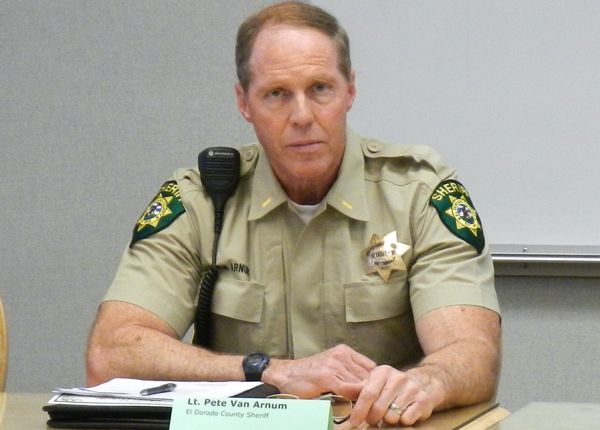
Name any of the significant criminal cases to have occurred on the South Shore in the last four decades and Pete Van Arnum was likely involved.

Van Arnum is turning in his badge Dec. 26, three days after he turns 61. He is retiring from the El Dorado County Sheriff’s Department, where he has been lieutenant of the Tahoe substation since March 2012.

His start in the field was a bit ominous. While he was at the Nevada Highway Patrol Academy he was assigned to Incline Village where Gary Gifford was going to be his trainer. They never met. A man who had robbed a bank in Round Hill killed Gifford near Cave Rock.

“That was a wake-up call for me … that this is serious stuff,” Van Arnum told Lake Tahoe News.

It was the beginning of a lot of seriousness.

One thing he won’t miss is the work of coroner. That is the job of the sheriff’s department. And for five years he was the coroner. In an area as small as the South Shore invariably he had to make death notifications to friends and acquaintances.

A harrowing case Van Arnum remembers is when three convicts escaped from state prison in Nevada and they came to Tahoe in a stolen vehicle. They broke into a home of the Edgewood Tahoe golf pro in Round Hill and took his wife hostage and stole her car.

“They came to a roadblock and opened fire on us and pushed through the roadblock,” Van Arnum recalled. “She was in the car. We didn’t know it at the time. She was tied up on the floor.”

Five Douglas County sheriff’s vehicles chased the bad guys east toward Spooner Summit.

“They were firing guns at us the whole time. We were returning fire. We shot out all of the tires. We ordered them out of car at gunpoint. They were wounded. The wife came rolling out. Luckily she was not injured,” Van Arnum said.

Pete Van Arnum will retire Dec. 26 after 40 years of being in law enforcement. Photo/LTN

Pete Van Arnum will retire Dec. 26 after 40 years of being in law enforcement. Photo/LTN

Before Douglas County built the current facility for DCSO in Stateline there was a substation in Zephyr Cove that could house about a dozen inmates.

They were all in one room that was overseen by a dispatcher. If there were a hanging or fight, it could take a while for a deputy to come to the station to deal with it. Van Arnum said it was so unpleasant that it acted as a deterrent for repeat offenders.

Van Arnum worked the Harveys bombing in the 1980s. In the late 1980s he went undercover for a year with the FBI and DEA for Operation Deep Snow that netted Mayor Terry Trupp and about 20 others in a drug trafficking and money laundering case.

“I remember sitting in on a wire tap and the mayor said the local cops are too stupid to catch him,” Van Arnum said. “That is what got the FBI office up here. They realized the need to have federal agencies up here because of all the drug trafficking.”

The most rewarding part of the job was when he worked at South Tahoe Middle School as the gang prevention officer. A wilderness program was created as well as a boxing program. Van Arnum still sees some of those kids – now with their own children.

Obviously he has seen a lot of changes in his 40 years.

“It’s definitely a lot more technical. I consider myself old school. We flew by the seat of our pants then,” Van Arnum said. “All reports were hand written. We didn’t have computers. The threats now are from active shooters. We never even thought about that when I started. Now I’m the SWAT team commander. You have to train and practice for a crazy person going into a school and shooting kids. It scares me to have to think about that for my grandkids.”

What he’ll miss when he leaves in two months is the people he works with.

“I think it’s going to be a loss because of his history. He knows the history of 40 years of working in Tahoe,” Douglas County Sheriff Ron Pierini told Lake Tahoe News. “One thing in law enforcement is gaining relationships. We know Pete, we can call him, we trust him and we know he will follow through.”

Van Arnum credits Pierini for keeping him in law enforcement. After graduating from CSU Sacramento, Van Arnum got a job with the Nevada Highway Patrol.

“I worked for NHP for three years and decided the work was not what I was interested in. I basically got a little irritated with NHP and just went down and quit and came home and told my wife I had quit,” Van Arnum said. “I was going to go into construction. Pierini called me up; he was captain at the time. He said come to work for him. He talked me into taking a job with him. It was probably a good move in the long run.”

He was with DCSO until 1984, and then went to South Lake Tahoe Police Department for 15 years before joining EDSO as a deputy.

“I want to personally thank him for his dedication and assistance in perseverance of the vision of the El Dorado County Sheriff’s Office and in my administration,” Sheriff John D’Agostini told Lake Tahoe News.

A replacement for Van Arnum has not been named.

Van Arnum will soon be busy hunting and fishing. Next summer he may put the uniform back on, though, but only to work the boat patrol.


Opinion: Measure M is misleading

By Larry Weitzman

During a presentation at the always-spunky Taxpayers Association of El Dorado County meeting, District 4 supervisorial candidate Howard Penn said he believed in a free market. But when asked to explain that philosophy with his contradictory support of Proposition M, Penn said something to the effect that he was not “that free market.”

A few days later during an interview with Penn he admitted that Measure M would not stop 33,000 homes, as there are about 17,500 buildable lots currently. Of those 17,500 lots many have unbuildable topography and many more have no utilities and need expensive offsite improvements, so the number of buildable lots is much less. But Measure M will only stop about 15,500 additional proposed lots if the conditions of Proposition M are not met. More on those conditions later.

Larry Weitzman

Larry Weitzman

Mike Ranalli, also vying for District 4 supervisor, says he is a free marketer as well and opposes the layers of bureaucracy and regulation that Measure M will bring, but he favors the General Plan as approved by the voters in 2004 and says that any General Plan amendment needs to be approved by the voters and that would include any zoning changed needed for large developments which Measure M seeks to prevent.

Ranalli said, “The General Plan is our contract with respect to our quality of life in EDC and we should live by it.”

Most, if not all, of those proposed 15,500 dwellings are now prohibited by the current existing General Plan anyway. To say that Ranalli is for the development of 33,000 homes because he is not for Measure M is absolutely untrue. The question becomes who is not telling the truth.

But that didn’t stop Penn from creating a campaign sign addition to his larger campaign sign that says, “Stop Mike Ranalli’s 33,000 Home Plan.” Penn knows it’s an exaggeration at best and at worst it’s slimy, sleazy and dishonest politics. In a phone interview when asked about the sign Penn admitted to it being a bit of an exaggeration. Ya, think? According to Ranalli, he has no plans to build any houses and he has nothing to do with Marble Valley, San Stinko or any other EDC development.

An analysis of Measure M shows it is fraught with pitfalls, the first being where, when, why and how Level of Service F, which is poorly defined in the measure, is controlling. The measure says “If Caltrans determines that traffic on any Highway 50 road segment west of Placerville has reached, or is forecast to reach, Level of Service F (LOS + F stop and go, gridlock) during weekday, peak-hour commute periods, then the county shall not approve single-family detached housing subdivisions of five or more parcels until cumulative Highway 50 traffic levels are improved and stay below LOS F.”

The first problem is Measure M becomes effective if anywhere on Highway 50 is declared LOS F, whether that problem is near downtown Sacramento, Rancho Cordova or Folsom or anywhere in between. Such a problem has nothing to do with El Dorado County. So if Rancho Cordova with new development creates LOS F at Sunrise or Mather, then El Dorado County suffers under the guise of Measure M. That is untenable. And LOS F doesn’t have to be real, it only needs to be forecast. It only needs to be prognosticated by a bureaucrat with a crystal ball and that could be very political.

Second is the fact Measure M does not prohibit attached or other higher density housing, it only prohibits single-family detached housing. That means Measure M will encourage even higher density development, which is the opposite effect of trying to stop development. Can you imagine El Dorado Hills full of townhomes and condos. Measure M would not prevent that, and by the elimination of single-family detached homes from the development palette, Measure M would encourage such higher density housing (townhomes, condos and apartments). In other words, Measure M would have the opposite intended effect.

Developers would love it and most residents of El Dorado County would loathe it. And developers would claim townhouse/condo development would certainly be more affordable and satisfy the demand for moderately priced housing. What politician doesn’t love the phrase “moderately priced housing and homes.”

Third, Measure M gives all discretion of determining LOS F to a giant bureaucracy, Caltrans; meaning people outside of EDC will make the decisions. The problem with that is that government is political and just a forecast of LOS F would stop development. Forecasts are nothing more than guesses. And then there is the adage that “liars figure and figures (can be made to) lie.” This provision will cause wasteful and costly litigation. And with telecommuting on the rise, LOS F will even be more difficult to forecast.

There is also a provision in M that forever freezes zoning of the current general plan. What if the General Plan gets amended by the voters, then what? More expensive and wasteful litigation. Measure M is a poorly written dangerous idea. It hasn’t been vetted as it should have been and it certainly shouldn’t be a litmus test of whether a candidate is for or against development and what kind of development.

Larry Weitzman is a resident of Rescue.


Letter: Meyers Catalyst Project renamed

To the community,

Meyers: Did you know the Catalyst Project is back on the table?

The following letter and referenced attachments will also be provided to the El Dorado County Board of Supervisors for the Oct. 28 meeting.

The Meyers community deserves a clear and transparent process:

Our efforts, along with others in the community, have focused on engaging the public, repeatedly requesting the county and TRPA to ensure full community involvement, including the use of a validated survey, and attempting to help convert the acronyms, ever-changing terminology, and “TRPA-speak” into terms the general public can better understand. There are many issues which have not yet been vetted with the Meyers community. In addition, the Meyers Community extends well beyond those who were able to attend a 9am meeting on a workday (Oct. 16), and members of the Nevada-side’s Tahoe Chamber.

We were told by our county supervisor that our community gets to decide what we want built here.

“What can be built in Meyers is up to the community of Meyers.” — Supervisor Norma Santiago, Feb. 23, 2014, guest column

We were also told the Catalyst Project was gone.

“The catalyst project is dead. You have my word on it. If you want, I’ll put it in writing.” – Supervisor Santiago, Feb. 26, 2014

“There is no catalyst project. There is no large development.” — Supervisor Santiago, Feb. 23, 2014.

However, the current recommendations to move forward with a plan that is contrary to most public feedback, that pushes TRPA’s new zoning on our community without full vetting with the public, and that recommends the inclusion of the provisions which allowed the “Catalyst Project” in the plan, run contrary to the promises made to our community.

El Dorado Planning Commission recommendations:

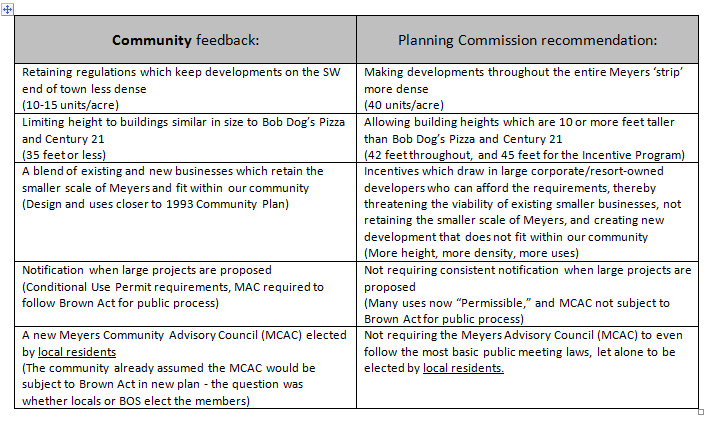
We are concerned the Planning Commission recommendations before you do not represent the outcome of a clear and transparent, communitywide process. On Oct. 16, your Planning Commission was presented with information about different drafts of the new Meyers Area Plan, and provided with “options” to pick and choose on for height, density, and other issues. However, the results of the feedback that had been obtained to date from the community – a great deal of it from TRPA and EDC’s own surveys – were not made clear, nor was the community ever told that once they made a selection, it could be easily overturned by one meeting. Many residents and business owners have volunteered extensive time and resources in an attempt to ensure a transparent and clear update process, as noted in the attached letter signed by several of us that were able to attend the Oct. 16 Planning Commission meeting. We also posted a summary of the results of the agencies’ own surveys along with ours on our website – we encourage you to read the surveys directly, including the hand-written comments. We have also previously submitted petitions with upwards of 200 signatures opposing the larger developments allowed by the January 2014 versions of the “Incentive Program.” Comparison: Community’s feedback vs. EDC Planning Commission Recommendations:
Meyers table 10.26

Continuing confusion of terms:

In the table above, which represents the language in the March surveys, the reference to the CIP “as is” in El Dorado County’s surveys referred to the January 2014 draft, or the “second draft” as it is now referred to, with the height, density, and other incentives (which your staff are now referring to as “the top Tier”); most surveys did not support it as it was outlined in the January 2014 aka 2nd draft aka Tier One of the Community Incentive Program (aka Catalyst Program).

In other words, the Catalyst Program was renamed to the Incentive Program; then the Community Incentive Program, then the Top Tier of the Community Incentive Program. The January 2014 draft is now referred to by staff as the “second draft,” and the June 2014 as the “third draft.” Worse yet, most people had no idea there were any new drafts until late January when we began our efforts. Therefore, the “new draft” was thought to be the January draft. Further, as most people appeared unaware that TRPA’s Regional Plan called for any changes to Meyers zoning and land use, references to “existing draft” or “existing plans” were often thought to mean the 1993 Meyers Community Plan; however for over 18 months, staff often made references to lowering height or density compared to the “existing plan,” which to the agencies, generally meant the first draft Meyers Area Plan that represented the RPU’s plan changes. Even professional planners would cross their eyes to follow these terms.

Yet the changes have been advertised in media messaging, as well as handouts for the public, as “reducing” height, density, etc. For example, we’ve attached the technical response to a handout provided to the public at our community-led meeting. One obvious example is pasted below:

EDC: “The Area Plan reduces maximum height limits to 35 feet for most projects, and in limited cases allows for up to 45 feet for projects that meet a series of requirements to ensure they improve walkability, benefit the environment, and provide other community benefits (Land Use and Zoning Ordinance section 70).” Our Response: “More apples and oranges. The ‘starting point’ height under the 1993 Plan was 26 feet; TRPA’s Town Center zoning raised it to 56 feet, so the draft Area Plan is simply less of a TRPA-proposed increase compared to the 1993 Community Plan. Regardless, the question now is, does Meyers want 45 foot tall (approx. 4 stories) buildings?”

We request you delay your recommendations and submissions for CEQA review until the community has been fully engaged in this process. This would not only provide the information needed to direct planners regarding the community’s interests, but it would also allow our community to have a new Plan we can be proud of, and which supports our vision for the future.

Sincerely,

Angie Olson, Jennifer Quashnick, Diana and John Sanders, Moya Sanders, and Diane Verwoest



S. Tahoe men 1st, 2nd at USTA Grand Prix

Two South Shore men came away with hardware from the 2014 USTA NorCal NTRP Grand Prix at the Gold River Racquet Club in Rancho Cordova.

Ryan Johnston, who was seeded second, took out the No. 1 seed to win the 4.5 men’s division. South Lake Tahoe resident Johnston beat Michael Don 6-4, 6-3.

Paul Bruso made it to the semifinal round in the 3.5 men’s singles. The South Lake Tahoe man lost in three sets to Kenneth Greene, the eventual winner. The score was 3-6, 6-2, 6-4.

Players had to be invited to the Oct. 18-19 and Oct. 25-26 tournament based on points they had earned throughout the year at a series of tournaments.

— Lake Tahoe News staff report


Truckee ready to help needy at holidays

The Truckee Community Christmas nonprofit organization is once again overseeing toy, food, and coat drives which provide staples during the holidays to local families and individuals who are struggling financially.

Residents who place donated items in collection barrels that are placed throughout the community between Dec. 1-18, and marked with the Truckee Community Christmas square red logo, can be assured that their contribution will directly help a local family in need.

The coat drive will be coordinated by Church of the Mountains UMC in downtown Truckee and Sierra Bible Church on Brockway Road. All collected goods are distributed to recipients who have undergone a thorough application and review process.

To help, go online.

For questions, call 530.587.2757.


Olympics delays crack down on human rights abuses

By Katie Rose Quandt, Mother Jones

Following widespread allegations of wrongdoing in both the Beijing and Sochi Olympics, human rights protections will be added to the contracts signed by future Olympic host cities. The International Olympic Committee’s president presented this change to Human Rights Watch at an October 21 meeting.

The new language will contractually require host countries to “take all necessary measures to ensure that development projects necessary for the organization of the Games comply with local, regional, and national legislation, and international agreements and protocols, applicable in the host country with regard to planning, construction, protection of the environment, health, safety, and labour laws.”

These changes make the human rights requirements for Olympic host cities more explicit than ever before, particularly with the mentions of health, environmental, and labor concerns. The new “international agreements and protocols” rule makes it clear that hosts will be required to abide by laws like the International Covenant on Civil and Political Rights, which prohibits forced labor, arbitrary arrest or detention, sentence without trial, and protects freedoms of assembly, religion, and opinion.

Read the whole story


2-day mountain bike trail building event

The International Mountain Bicycling Association’s Subaru/IMBA Trail Care Crew will be in Reno on Nov. 1-2 to share sustainable trail building techniques and other info with local mountain bikers, land managers and recreation specialists.

The visit, which was requested by the Poedunks/Biggest Little Trail Stewardship, is one of about 70 stops on the 2014 schedule.

The Reno visit will include a fun group ride on Peavine with the crew on that Saturday evening and the Trail Building School on Sunday. Participants will meet at the main ranch house at Rancho San Rafael Regional Park at 9am for the classroom session, and relocate after lunch to the field session to construct a new connector trail on Peavine.

The Trail Care Crew teaches “sustainable” trail building, which means building fun and lasting trails that require minimal maintenance. This helps reduce trail damage, protects the environment and enhances user enjoyment.

There is no cost to attend, but pre-registration is requested.


Snippets about Lake Tahoe

caltrans• Here are the El Dorado-Tahoe and Sierra roadwork schedules from Caltrans for this week.

• Bill Paxson of Gardnerville on Oct. 22 hit a $1 million jackpot at Casino Fandango in Carson City.

• This survey is about Tahoe Vista Recreation Area. Deadline to take it is Oct. 31.

• The draft environmental impact report for Canyon Springs in Truckee has been recirculated, with comments now due Nov. 20 at 5pm.


Survey: Harassment a common part of online life

By Barbara Ortutay, AP

NEW YORK — A study confirms what many Internet users know all too well: Harassment is a common part of online life.

The first-of-its-kind report by the Pew Research Center found that nearly three-quarters of American adults who use the Internet have witnessed online harassment. Forty percent have experienced it themselves.

The types of harassment Pew asked about range from name-calling to physical threats, sexual harassment and stalking. Half of those who were harassed said they didn’t know the person who had most recently attacked them.

Young adults — people 18 to 29 — were the most likely age group to see and undergo online harassment. Women ages 18 to 24 were disproportionately the victims of stalking and sexual harassment, according to the survey. And people who have more information available about themselves online, work in the tech industry or promote themselves on the Internet, were also more likely to be harassed.

Case in point: Celebrities. Stars such as the actress Jennifer Lawrence had nude photos stolen and posted online recently in a widespread hacking scandal in late August. Lawrence, 24, later told Vanity Fair that she considered looking at the pictures a sex crime.

It can be difficult for police to go after online bullies in part because “our legal system hasn’t quite caught up with technology,” said Elizabeth Dowdell, a nursing professor at Villanova University who studies online aggression. On top of that, adults are generally hesitant to report harassment because they might view it as a “child or teenage problem.”

“But the Internet has no age limits,” Dowdell said. “People look for outlets for aggression and the Internet is a wonderful place because it’s anonymous and you don’t have to be truthful.”

Social networking companies have sometimes been criticized for not doing enough to stop online harassment, even though it’s standard policy to ban threats, bullying and harassment. But they have at least tried to respond to complaints.

Twitter, for example, changed its policy recently after some users sent crude, altered images of Robin Williams to his daughter Zelda following the actor’s suicide in August. The company now says it can remove images of deceased individuals that circulate on its site.

Trendy new social networking site Ello, meanwhile, recently added tools people can use to block or mute users who are bothering them. The ad-free, decidedly anti-Facebook website was criticized early on for not providing blocking features that are standard practice for social networks.

Though online harassment is as old as the Internet itself, the Pew survey is particularly timely as conversations around it have grown louder in recent months — and not just because of the celebrity hacking scandal. Beginning this summer, people involved in an online campaign dubbed “Gamergate” have been harassing several prominent women in the video game industry and their supporters for criticizing the lack of diversity and how women are portrayed in games. One of the targets is Brianna Wu, a software engineer and founder of game developer Giant Spacekat. Wu, who is in her mid-30s, said she has frequently been harassed online, but it’s gotten worse this year.

Earlier this month, people threatened her and her husband with rape, death and castration on Twitter and posted her address online, she said, and they have been trying to impersonate her on the Internet to smear her reputation. She got so frightened that she left her home in Boston.

Wu went to the police, but most people harassed online don’t. According to Pew, just 5 percent of those who were harassed reported the incident to law enforcement, while nearly half confronted the person online. Forty-four percent said they unfriended or blocked the person.

But victims of harassment often don’t know where it’s coming from. Thirty-eight percent of people who were harassed online said a stranger was behind the threats, and another 26 percent didn’t know who the person was.

“You can have many different (personas) online,” Dowdell said. “So you might think ‘I’m going to block Scaryfriend123’ and Scaryfriend says ‘Fine, I’m going to use my other name Superniceguy’ and you just don’t know.”

Among other key findings from Pew:

  • Two-thirds of those who were harassed said the most recent incident took place on a social networking site or app, while 22 percent saw it happen in the comments section of a website. Sixteen percent, meanwhile, said it happened in online gaming.
  • Men were more likely to be called offensive names than women. Of all Internet users (89 percent of the U.S. population), 32 percent of men and 22 percent of women were called names. Men were also more likely to be physically threatened.
  • Not everyone said they were hurt by online harassment. While 14 percent of people found their most recent incident “extremely upsetting,” 22 percent said it was “not at all upsetting.” The rest of the people surveyed had reactions in between.

The telephone and online survey was conducted between May 30 and June 30 among 3,217 respondents. It has a margin of error of plus or minus 2.2 percentage points.

AP business writer Tali Arbel contributed to this report.