Head-on collision sends 2 to hospital

Two people were seriously injured when two vehicles collided on Luther Pass on Sunday.

Dustyn Isenberger-Farrell, 27, of Prunedale was headed north on Highway 89 about 11:25am Oct. 26 when his vehicle drifted into the southbound lane for unknown reasons. His Cavalier struck a Chevy Tahoe head-on about 2¼ miles north of the Alpine County line. The speed limit there is 55 mph, but it is unknown how fast either driver was going.

John Vanlarr, 31, of Ripon was driving the SUV and was not injured. However, his passenger – 30-year-old Lauren Vanlarr of Ripon – sustained major injuries. She was flown to Renown Medical Center in Reno.

Isenberger-Farrell also had major injuries. He was airlifted to Mercy San Juan Medical Center in Carmichael.

“Alcohol was not an issue, but (Isenberger-Farrell) was possibly under the influence of some type of drug. Charges are pending,” California Highway Patrol Officer Jeff Gartner told Lake Tahoe News.

— Lake Tahoe News staff report


Dance convention at MontBleu

The 16th annual Mountain Magic Dance Convention is Oc.t 30-Nov. 2 at MontBleu in Stateline.

There will be a mini intensive workshop with dance champion Melissa Rutz, as well as a dance party on Friday and Saturday nights.

West Coast Swing, Hustle, Nightclub Two Step and Country Two Step are some of the dances.

For more info, go online.


Gluten-free flours raising Kickstarter dough

By Rene Lynch, Los Angeles Times

Shauna Ahern, better known in the online world as Gluten-Free Girl, will tell you upfront: You can make gluten-free and grain-free flour blends yourself.

She has this DIY starter guide on her website. But, um, unless you’re an experienced baker with plenty of time for trial-and-error-type experimentation, it looks intimidating. And not a week goes by without readers reaching out to Ahern to ask whether they could just buy Ahern’s blend because they just don’t have the time, or energy, to take the DIY route.

“People kept asking us if we’d sell it, and finally we thought, ‘Well, maybe we should,'” Ahern said.

Ahern and her chef husband, Danny, have launched a Kickstarter campaign to see if there’s enough interest to launch their own line of gluten-free and grain-free flour blends.

With one week to go, the couple are roughly $10,000 shy of their $79,000 goal.

Read the whole story


Land dispute part of Nev.’s storied past

By Anne Knowles

CARSON CITY – Nevada’s statehood, celebrated this sesquicentennial year, came on the heels of a boundary dispute with California that left one person dead and the border that split Lake Tahoe still undefined.

“The battle took place in February 1863 and lasted just four hours,” Jeff Kintop, Nevada state archivist in Carson City, told Lake Tahoe News. “As soon as somebody was hurt, they decided to try something else.”

The Roop County War, fought over Susanville and Honey Lake, ended in an agreement to jointly survey the land, but it was more than 100 years before the line between the two states would be definitively settled.

The problem started on the eve of California statehood in 1849. A convention was convened to write a constitution for land known as Upper California that was acquired during the Mexican-American War. The land stretched as far east as Utah and included the Great Basin, but for various reasons the convention delegates decided to cut California off at the Sierra Nevada mountain range.

The clause inserted into the state Constitution defined the border by latitude and longitude without surveying it. With the Gold Rush on, California, ill defined as it was, became a state in 1850.

Then a few years later California’s ambiguous border came into play around another body of water.

“Susanville up around Honey Lake was first settled in 1854 and the people there basically refused to pay California taxes,” Kintop said. “They tried to create their own territory called Nataqua. There weren’t that many people there and it wasn’t recognized, but they didn’t want to pay taxes to Utah either.”
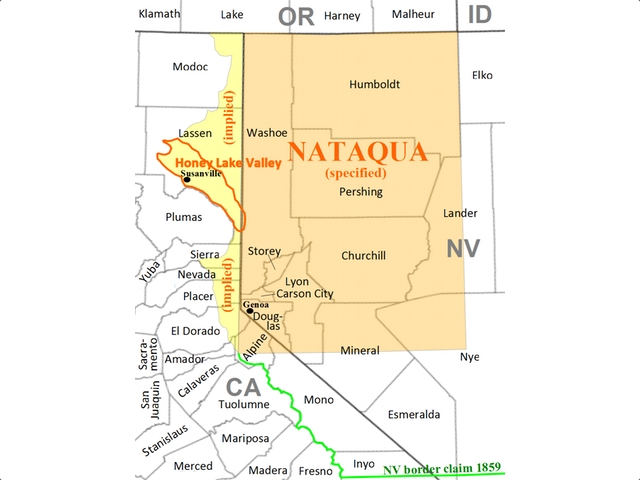
Nevada and California land disputes continued until 1980.

Nevada and California land disputes continued until 1980.

Nevada became a territory in 1861 and the area known as Nataqua became Roop County, named after Isaac Roop, the founder of Susanville, named after his daughter, and a member of Nevada Territory’s Senate.

“He was serving in the Legislature and didn’t try to organize the county until 1863,” Kintop said. “California said ‘No, we won’t rescind from this boundary.’ But no one knew where the boundary was. They hadn’t surveyed it yet and they thought Susanville was in Nevada and Aurora was in California.”

In 1863, the Roop County justice of the peace, John Ward, issued an injunction against the Plumas County, Calif., justice of the peace. In retaliation, the Plumas County sheriff arrested Roop County’s sheriff and justice of the peace. He was stopped by an armed group of men, according to Kintop, and then organized a posse of about 70 men and headed for Susanville.

“They were met with resistance by Isaac Roop and his men held up in Roop’s cabin, which they named Fort Defiant,” Kintop said. “They started shooting at each other. As soon as one person was killed and two people were wounded, they mutually called a truce.”

To resolve it, they agreed to appoint a surveying team — Surveyor-General J.F. Houghton acting for the state of California and Butler Ives, for the territory of Nevada.

The final report placed Susanville and Honey Lake in California and was accepted by California in April 1864 and Nevada in February 1865, five months after it became a state.

But that didn’t put an end to the bigger border dispute. Surveys continued, including one approved by the U.S. Congress in 1872 and another conducted from 1893-99.

Then in 1977, California sued Nevada. “California was trying to collect taxes on Nevada property holders whose property crossed state lines,” said Kintop.

The U.S. Supreme Court settled the case in 1980, using the 1872 survey done by Alexey Von Schmidt for the boundary from North Lake Tahoe to Oregon and the U.S. Coast and Geodetic Survey started in 1893 for the border from South Lake Tahoe to the Colorado River, leaving Lake Tahoe, as always, split between the two states.

—-

Notes:

Nevada turns 150 on Oct. 31. The state has been having celebrations all year. It culminates Saturday with a parade in Carson City. For more info, go online.


Letter: TAP thankful for dance group

To the community,

Tahoe Arts Project is excited to begin our 28th year of presenting performing arts in the local schools and community of South Lake Tahoe. We started our season with the Blue13 Dance Company and we would like to thank all involved.

Blue13 performed for over 4,000 students in our South Shore schools, teaching students about traditional dance from India. Close to 500 community members attended the public performance at MontBleu.

Thank you so much to MontBleu for providing the showroom and to the tech crew for all their expertise. A big thank you to Marcia Sarosik for opening her studio for rehearsal space and for sharing some of her Lake Tahoe Shining Stars with us. Pat Ronan donated lodging at Tahoe Lakeshore Lodge and Spa for the group. Thank you Pat, they loved their accommodations.

Thank you to all the volunteers who were there helping at the public performance, especially Girl Scout Troop 174. You girls were a big help.

We appreciate Tahoe Daily Tribune, Tahoe Mountain News, Lake Tahoe News, KRLT/KOWL, KTHO and Lake Tahoe Art Scene for helping us get the word out.

A big thank you to all of you who attended the show at MontBleu.

Tahoe Arts Project is a nonprofit organization whose mission is to provide cultural enrichment and diversity for the schools and community through performing arts education. If you would like to find out how you can help with our efforts, please call 530.542-.632.

Thank you,

Peggy Thompson-Blowney, TAP executive director


Carjacking suspect arrested in Truckee

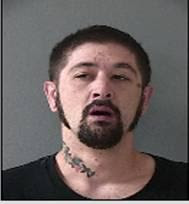
Nathan Daniel Jones, 29, of Las Vegas was arrested Oct. 28 in Truckee on multiple felony and misdemeanor charges, including two counts of attempted carjacking, felony battery, battery on a peace officer, resisting arrest, possession of an illegal weapon and possession of a pound of suspected marijuana.

A Truckee police officer was flagged down by a citizen Tuesday about 3:40pm who said someone was jumping on cars and breaking windows in the area of Bridge Street and Donner Pass Road. The officer drove to the area and interrupted an attempted carjacking in progress at the Beacon gas station. The officer said an adult male was trying to pull a female out of her car by her neck.

Nathan Daniel Jones

Nathan Daniel Jones

The officer got the suspect off of the victim and placed him into custody.

Officers said Jones appeared to be under the influence of a controlled substance and continued to act out violently after he was taken into custody.

Prior to this attempted carjacking, Jones allegedly attempted to enter another vehicle at the gas station occupied by a female adult. Officers said Jones broke out the driver’s side window before that victim was able to drive off. The victim female victim was not injured. Additionally, several parked cars nearby had windows broken and other vandalism.

The 29-year-old female victim from Truckee was treated for a minor neck injury and later released from Tahoe Forest Hospital.

— Lake Tahoe News staff report 


USFS seeks comments on Taylor-Tallac project

The U.S. Forest Service is asking for public input on plans to restore the Taylor and Tallac creek ecosystems, while maintaining or improving visitor services.

Located on Highway 89 on the South Shore, the Taylor-Tallac project area includes some of the most heavily visited recreation sites in the Lake Tahoe Basin. Baldwin Beach serves an estimated 2.5 million visitors each summer.

The area also provides habitat for numerous protected wildlife species and an important hydrological connection to Lake Tahoe.

Taylor and Tallac channels were historically connected through a series of four swales, which formed a large wetland complex. The Forest Service proposes to restore this connection by removing culverts that are impeding water flow and replacing them with crossing structures, and by recontouring and revegetating swales.

The project would include stream restoration in Taylor and Tallac creeks, such as renovating the fish ladder at the Fallen Leaf Lake Dam to support potential Lahontan cutthroat trout recovery actions, removing portions of the Lucky Baldwin Dam to restore connectivity between Fallen Leaf Lake and Fallen Leaf Dam, and modifying flow releases at Fallen Leaf Lake Dam.

The project proposes to improve wildlife habitat by eradicating or controlling aquatic invasive species, protecting Tahoe yellow cress through physical barriers, installing nest and perch structures for waterfowl and sensitive raptors, placing bat boxes and planting willows for willow flycatcher.

At Baldwin Beach, the Forest Service proposes to construct pedestrian pathways, formalize and upgrade the picnic area (including a pavilion or similar structure), provide foot-washing stations at restrooms and install water quality best management practices throughout the site.

Restoration efforts at Taylor Creek Visitor Center would include upgrading the stream profile chamber building to meet contemporary building codes and provide a more natural aquatic habitat and reconfiguring the Rainbow Trail to reduce impacts to the stream environment zone, such as by raising sections of trail or replacing them with boardwalks.

Comments on the project are due Dec. 5. The project is in the scoping phase of National Environmental Policy Act review.

For more info, go online or contact Sarah Muskopf at 530.543.2835 or smuskopf@fs.fed.us.


Beavers may be good where drought looms

By Jim Robbins, New York Times

BUTTE, Mont. — Once routinely trapped and shot as varmints, their dams obliterated by dynamite and bulldozers, beavers are getting new respect these days. Across the West, they are being welcomed into the landscape as a defense against the withering effects of a warmer and drier climate.

Beaver dams, it turns out, have beneficial effects that can’t easily be replicated in other ways. They raise the water table alongside a stream, aiding the growth of trees and plants that stabilize the banks and prevent erosion. They improve fish and wildlife habitat and promote new, rich soil.

And perhaps most important in the West, beaver dams do what all dams do: hold back water that would otherwise drain away.

“People realize that if we don’t have a way to store water that’s not so expensive, we’re going to be up a creek, a dry creek,” said Jeff Burrell, a scientist with the Wildlife Conservation Society in Bozeman, Mont. “We’ve lost a lot with beavers not on the landscape.”

For thousands of years, beavers, which numbered in the tens of millions in North America, were an integral part of the hydrological system. “The valleys were filled with dams, as many as one every hundred yards,” Mr. Burrell said. “They were pretty much continuous wetlands.”

Read the whole story


Winter storm headed for Tahoe

It may be hard to tell what the Halloween costumes are on Friday night unless a coat is part of the ensemble.

This is because winter is forecast to arrive at lake level. Rain will start the afternoon of Oct. 31, with it turning to snow. By Saturday the snow level is expected to drop to 4,500 feet.

Wind gusts of 35 to 50 mph could create hazardous driving conditions. For current road conditions, click on the state icons on the home page of Lake Tahoe News.

— Lake Tahoe News staff report


App could make government access easier

By By Alexa Capeloto, Columbia Journalism Review

Navigating government bureaucracy is painful, but filing Freedom of Information requests can be downright torturous—for journalists and members of the public alike. Requests might be ignored, bounced around, pegged with impossible price tags, or subject to other machinations while requestors wait (and wait) for a response.

Save a little sympathy, though, for the civic staffers inside the walls of government who face their own struggle: floods of FOI requests, many of them overly broad or duplicative, outdated paper-based processing, and no real communication or tracking across departments. The torture can go both ways.

So, too, can the tech-minded attempts to alleviate it. Open-source web applications like FOIA Machine and Alaveteli have built followings among records requestors. Now, another web app is drawing notice for its potential to help government agencies process, track, and release requested information through a public online portal—creating a new level of transparency for governments willing to embrace it.

Called RecordTrac, the system officially launched a year ago in Oakland, and is getting noticed in cities around the country, on up to the White House.

Read the whole story