Event at squaw benefits multiple sclerosis

Ski for MS, a daylong fundraising ski event benefiting families with multiple sclerosis, will hit the slopes of Squaw Valley on March 3.

One of six stops in a nationwide event series, the Ski for MS Squaw event benefits Can Do MS, a national nonprofit organization.

It includes amateur ski races, the Jimmie Heuga memorial ski down, and an apres party. New this year, Olympic cyclist Tyler Hamilton, ski cross Olympian Errol Kerr, and ski BASE jumper JT Holmes will be joining Ski for MS Squaw to ski, race, provide tips, and celebrate at the apres party.

Individuals may register online for $25. Participants are encouraged to create a team.


Reno-based ski companies having Olympic ‘Moment’

By Benjamin Spillman, Reno Gazette-Journal

By the time David Wise dropped in for his final run, the tension was palpable at both the venue and nearly 5,600 miles away at Wild Garlic Pizza in Reno.

That’s where a group of employees from Moment Skis, the Reno-based company that made Wise’s skis, gathered to watch the event.

“It was just the most nervous and the most excited I had ever been for a sport,” said Luke Jacobson, Moment’s CEO.


Moment didn’t make the bindings that gave Wise trouble, but that didn’t make the experience any less stressful for Jacobson.

Read the whole story


Ski industry talk in South Lake Tahoe

John Wagnon and Tim Cohee will be having a conversation about the ski industry on Feb. 28 at 7pm at Blue Angel Cafe’s upstairs loft in South Lake Tahoe.

After 45 years in the ski industry, Wagnon is now retired. He had virtually every ski job there is, most recently as the head of marketing for Vail Resorts in the Tahoe basin.

Cohee is one of the leading resort operators in the U.S., with 17 years as CEO of Kirkwood Mountain Resort. Now he is a partner at China Peak Ski Resort, and is director for Sierra Nevada College’s ski business and resort management program.

The discussion will include a look back at the last half century of skiing as a sport and business, as well as a preview for where the industry will go next.

Doors open at 6pm with happy hour. Admission is free. Donations will be accepted, with proceeds benefiting the Sierra Nevada Avalanche Center.


Feds want ideas on how to eliminate invasive mussels

Invasive mussels are marching into new territory, threatening water bodies across the West. Quagga and zebra mussels, which alter the underwater food chain and damage infrastructure, have been detected in Colorado and Montana in recent months.

They have yet to reach Lake Tahoe.

Until now, federal and state agencies have relied on awareness campaigns and boat inspections to warn recreationalists about the harmful impacts of infestation. Now they’re taking a new approach to prevent their destructive spread: crowdsourcing.

The U.S. Bureau of Reclamation is offering a $100,000 prize for the best suggestion on how to stop the spread of invasive mussels in large bodies of water that is cost-effective and environmentally sound. Ideas must be submitted by Feb. 28


Wildlife board funds conservation project near Truckee

At its Feb. 22 quarterly meeting, the Wildlife Conservation board  approved approximately $17.9 million in grants to help restore and protect fish and wildlife habitat throughout California, including in the Sierra.

Some of the 15 approved projects will benefit fish and wildlife—including endangered species—while others will provide public access to important natural resources. Several projects will also demonstrate the importance of protecting working landscapes that integrate economic, social and environmental stewardship practices beneficial to the environment, landowners and the local community.

Funding for these projects comes from a combination of sources including the Habitat Conservation Fund and the Wildlife Restoration Fund. Bond measures approved by voters to help preserve and protect California’s natural resources.

Funded projects include:

  • A $350,000 grant to the National Forest Foundation for a cooperative project with U.S. Forest Service, National Fish and Wildlife Foundation and Lahontan Regional Water Quality Control Board to thin approximately 140 acres of forest in the Tahoe National Forest, 10 miles northeast of Truckee.


Analysis: Trump’s attack on renewable energy, EPA hurts Nev.

By Ric Anderson, Las Vegas Sun

On the morning after his State of the Union address, in which President Trump told the nation that his administration had “ended the war on American energy,” he made news that suggested otherwise.

Citing draft budget documents it obtained from the White House, The Washington Post reported that the Trump administration was proposing to cut federal funding for renewable energy research and development by 72 percent.

“This couldn’t have been worse for this state,” said Robert Lang, an economic development expert and executive director of Brookings Mountain West, during a panel discussion examining the State of the Union address. “This is an actual assault on something that was one of the state’s largest job producers, one of the gainers in our economy, one of our points of pride.”

Read the whole story


Letter: SnowGlobe sound is painful

To the community,

It is hard to write about my experiences related to SnowGlobe.

I am not against SnowGlobe, but I think that it is to big, too loud and too dangerous to be held at the center of our city. It stands in the middle of a forest, which if ignited, may be an unstoppable disastrous blaze.

Certainly Chad Donnelly has good intentions and is willing to repair our ball fields, but take a look at the road to Emerald Bay. A forest fire that started in a December pouring rain storm.

Yes, his eyes mist over at the mention of the 19 year old girl who died as a result of attending SnowGlobe but he has not the ability to bring her back, to compensate her family or to prevent a disaster that staging this entertainment might cause.  Sorry Chad, but we need to get it out of our forest.

I first became aware of it’s presence by accident. I was working inside the city building on Rufus Allen Boulevard. A friend and I were remodeling it for Unity at the Lake, our church. It was  a construction site so there was a certain amount of noise. All of a sudden a freakish bellow shook the building. It was alarming and indescribable. I had never heard anything so loud and unidentifiable. In a few minutes, we realized it was a massive PA system.

I went home to face a blistering, pounding assault which had begun that afternoon and was to go on for eight or more hours each day and into the night even after midnight for the next three nights.

This was our New Year’s weekend. We had no warning and had made plans to stay home and avoid the dangerous winter driving and hazards of intoxicated or hung over revelers on the roads for that weekend.

The din was uncomfortable to put it mildly and my wife, who is a headache sufferer, was beaten for over 25 hours and could find no refuge. She couldn’t even put a pillow over her head as the bass waves were relentless and went through everything.

I was on the phone trying to get authorities and organizers to decrease the volume. It was a horrible experience. I made recordings of it from my deck and took dB measurements. I went to the venue and made measurements from the fence. When I was there, Bob Marley was the between set music and it was reaching 97dB regularly with the unstoppable bass pulverizing the audience, the forest, the neighborhood, the city. We were prisoners, unconsenting and unable to escape.

I have hours of thoughts about my experiences with SnowGlobe and I intend to relate them. Imagine being forced to listen to my lament for hours. It will be similar to being forced to listen to the event or being forced to leave your home to avoid it.

I will offer to play my recordings of the event at the recorded dB levels for our City Council and anyone who wants to hear what I hear for 25 hours on a winter weekend. Any takers?

I am 100 percent sure that the City Council cannot conduct a two-hour meeting while it plays so why should we be forced to endure 25 hours of it?

Let’s get real and not sacrifice safety and the peaceful environment we treasure, for money.

Respectfully,

Dory Smith, South Lake Tahoe


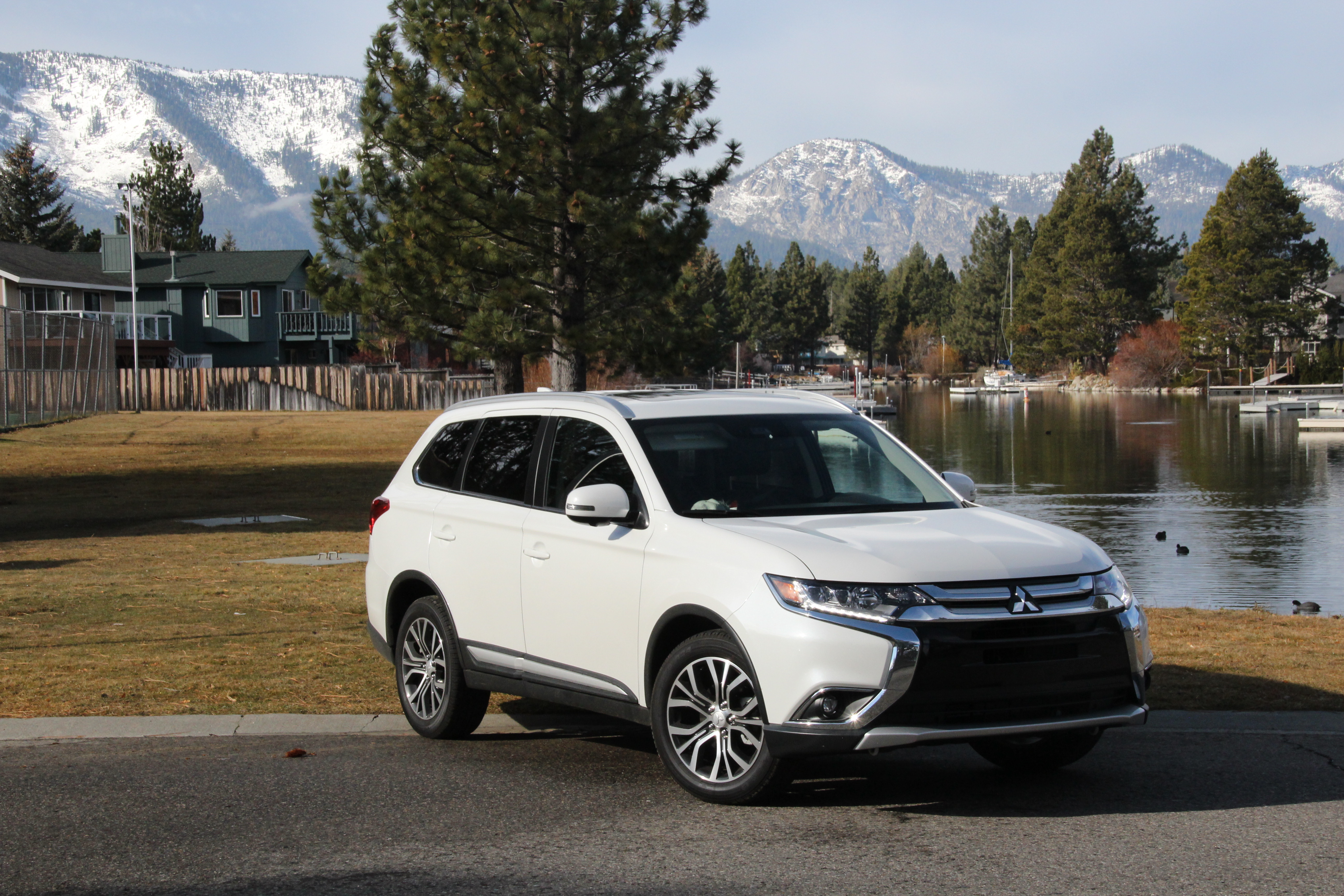
Road Beat: 2018 Mitsubishi Outlander is a steal

The 2018 Mitsubishi Outlander provides big bang for the buck. Photos/Larry Weitzman

By Larry Weitzman

We always hear the words bang for the buck or big value, but here is a vehicle that personifies the term, the 2018 Mitsubishi Outlander. First it has good looks. The lines are pleasant with no chances taken. Its proportions are also about perfect. The window line, the two-box shape, the sleek grille into which the body protrudes a bit as the fenders round into its simple design. Bright metal adorns its extremities and a single upper character line is used to tie the vehicle together in one cohesive package. It is a good-looking ride, taking little chances. Many people asked what kind of SUV is that? It’s all good and Mitsubishi should be happy.

But what really makes this is reality. The price, which I will discuss first as its most important, is just $32,260, including the boat from Okazaki, Japan, for this 99 percent Japanese produce CUV. And it’s got everything standard including the $3,000 SEL Touring package which gives it things like collision warning, land departure warning, adaptive cruise, automatic high beams (a superb feature), glass moon roof, Rockford Fosgate audio, Multiview camera system, LED headlights and fogs and even a heated steering wheel. It even has a GPS which gives you lat/long coordinates down to the second, so if you were searching for a sub in the Pacific it would be great. But it didn’t have a moving map. What’s up with that?

In other words, $32 large gets you a loaded, AWD, yes AWD, big compact SUV with three rows of seats. Leather is also standard. Not much else comes close in value, maybe a Mazda CX-5 which is the top of the class, but even the Mazda doesn’t have Multiview.
Specifications
Price $32,260 all in
Engine
Inline four cylinder2.4L SOHC, 16 valve 166 hp @ 6,000
162 lb.-ft. of torque @ 4,200 rpm
3.0L V-6 SOHC, 24 valve (GT model) 224 hp @ 6,250 rpm
215 lb.-ft. of torque @ 3,750 rpm
Transmission
CVT
Six speed automatic (V-6)
Configuration
Transverse mounted engine/front wheel/AWD
Dimensions
Wheelbase 106.1 inches
Length 184.8 inches
Width 71.3 inches
Height 67.3 inches
Ground clearance 8.5 inches
Track (f/r) 60.6/60.8 inches
Weight 3,527 pounds
GVWR
Weight distribution (f/r) 56/44 percent
Fuel capacity 15.8 gallons (AWD)
Cargo capacity (behind first row/2nd row/3rd row) 63.3/34.2/10.3 cubic feet
Wheels 18X7 inch alloys
Tires 225/55X18
Steering lock to lock 3.3 turns
Turning circle 34.8 feet
Performance
0-60 mph 8.78 seconds
50-70 mph 4.58 seconds
50-70 mph uphill 8.18 seconds
Top speed Who cares. It will certainly out run a Brink’s truck
Fuel economy EPA rated at 24/29/26 mpg city/highway/combined Expect 26 mpg overall in rural/country/suburban driving. 32 mpg on the highway at legal speeds.

So, what’s the catch? It’s only a 2.4L (a 3.0L V-6 is optional) inline four banger, an engine designed by a consortium of Chrysler, Hyundai and Mitsubishi. But it is surprising spunky, especially considering its meager 166 hp rating (at 6,000 rpm) and 162 pounds of twist at 4,200 rpm. But these are very big horses and pounds (sort of like the British pound in 1968). Driving all four wheels as the computer deems necessary via its all wheel control system through a CVT tranny there is no torque steer as it romps from 0-60 mph in 8.78 seconds. Not bad for a 3,500-pound CUV.

Passing is equally sprite with a 50-70 mph level run taking 4.58 seconds and the same run up a 6-7 percent grade only slowing that time by less than 4 seconds to 8.18 seconds. That’s what’s called overachieving. And it feels responsive, especially tip-in where it can sometimes really jump off the line. It has a very responsive throttle and during passing maneuvers going up the Sierra on Highway 50, the Outlander performed admirably. It is the little engine that could.

That little engine pays dividends in fuel economy, with an EPA rating of 24/29/26 mpg city/highway/combined, but it does much better averaging a good 26 mpg overall in aggressive driving and 32.1 mpg at a constant 70 mph on a level highway in a two-way run. The engine spins a reasonably low and inaudible 2,200 rpm at 70 mph. Backing those numbers up was a 30.3 mpg average for my entire 210-mile trip to Carson City and back, ascending the Sierras from both sides. Fuel tank is an average 15.8 gallons. A front wheel drive version gets 16.6 gallons. Go figure, it should be the other way around as the FWD should get another mpg or so.

If there is a downside to this Outlander, its handling. It has decent creds, all wheel independent suspension with stab bars at both ends, 18 x 7 inch alloys shod with 225/55 tires and it has a wide 61-inch track. But steering is a bit slow at 3.3 turns lock to lock and on center feel is only fair. There is too much play when going straight ahead, enough so I could notice and demonstrate with steering wheel movement. And handling seems more disconnect than other compact CUVs. If you are a boy racer, you might notice. Otherwise, I am just making mention. Turning circle is tight at under 35 feet.

Ride is another area the Mitsu suffers a bit. While it is smooth and quiet on smooth roads and even over mild undulations, heavy chop enters the cabin a bit more than in some others in this class. And it is running a slightly taller 55 series tire which should help. There is a bit more head tossing as well. Ten years ago, it would be considered a fantastic overall ride, but ah, progress.

Safety does not take a back seat even in the third row, Outlander has it all as mentioned about. About the only thing missing is lane keep assist, found in much more expensive rides. Its headlights are fantastic, with a sharp low beam cut off and a deep, wide breath. Even the LED parking/fog lights are remarkably bright. I almost drove with them only by mistake. Almost one foot in diameter disc brakes were excellent.

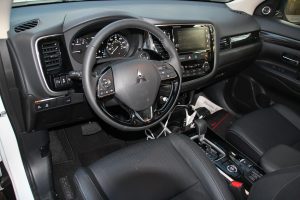
Interior is done with quality. Lots of soft touch on the dash and doors. Comfortable leather seats, while looking a bit flat actually do a great job in coddling your backside. Second row seat is also roomy, but the third row is good for pre-teens.

Instruments are simple, large, legible and well laid out with a tach and speedo flanking the multi-functional trip computer. Perfect. The center stack deserves special mention. While it’s a touch screen it is only of the most intuitive and easiest to use. The touch screen is basically electronic buttons. The HVAC below is knobs, dials and push buttons. Again, simple and perfect. It’s not a BMW which requires an instore “genius” a couple of hours to explain the systems.

Outlander can carry the load. Passenger volume is over 128 cubes and cargo behind the third row is still over ten cubes. Behind the first row with its flat floor is over 63 cubes and over 34 behind the second row. I had a 65-inch flat screen in the box easily stowed flat on the floor. It was during Black Friday and I got to the discount warehouse a half hour after opening at 7am, they had free coffee for everyone and I was in an out in about 15 minutes with a loader helping me put the TV in. Black Friday was a good Friday. He even knew how to drop the seats and asked about the Mitsu. He was impressed, more so when advised him of the sticker price.

It all adds up to the biggest bang for the buck, $32 large for a very competent, loaded, near luxo CUV. I can easily over look its small faults and just tell myself, so it won’t be my weekend track car, but it will do double duty as a fantastic family adventure vehicle, on and off road. And I won’t cry all the way to the bank.

Larry Weitzman has been into cars since he was 5 years old. At 8 he could recite from memory the hp of every car made in the U.S. He has put in thousands of laps on racetracks all over the Western United States.


Paralympian with Tahoe ties set to defend gold

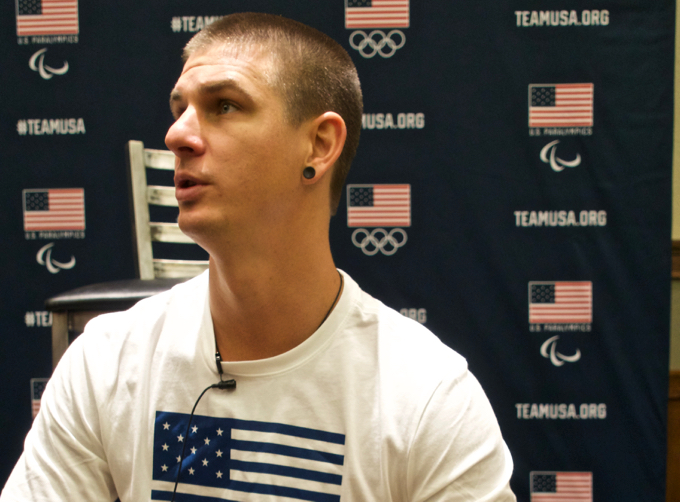
Evan Strong learned to snowboard at Northstar after losing part of his leg. Photo/Kathryn Reed

By Kathryn Reed

Evan Strong never had dreams of being a snowboarder. He was a beach guy, having grown up in Maui. Skateboarding was his sport of choice. He had sponsors at 13 and was on his way to being a professional skateboarder.

A drunken driver ended his career.

Part of Strong’s left leg had to be partially amputated after the motorcycle he was riding was struck head on. This was 10 days before he turned 18.

Today the 31-year-old hopes to defend his snowboard cross gold medal at the Paralympic Winter Games in PyeongChang, South Korea, next month. The Paralympics are March 9-18 where the able bodied Olympians just wrapped up their two-week stint.

“I’m in love with board sports and I want to play,” Strong told Lake Tahoe News. “I saw a snowboarding magazine and thought why I haven’t I done that.”

Living in a Hawaii was a main reason.

It was in 2007 that Strong arrived at Northstar to work and learn how to snowboard.

Strong describes Tahoe as “endless seasons of fun.” While living in the Truckee-North Shore area he also got into mountain biking.

He spends a great deal of time training in the Rockies, though he was out in the Tahoe area last season.

“Squaw Valley is as good as the Rockies,” Strong said.

He praised Boreal for its terrain park, Sugar Bowl for its terrain and Northstar for its glades.

In many ways he was a natural on the snow because of his affinity for board sports. Snowboard cross is what gives him the “biggest rush.” He has earned every title in the sport of para-snowboarding.

The sport was introduced at the 2014 Sochi Paralympic Winter Games.

In this Games he will compete in snowboard cross and banked slalom.


Opinion: The boys are not all right

By Michael Ian Black, New York Times

I used to have this one-liner: “If you want to emasculate a guy friend, when you’re at a restaurant, ask him everything that he’s going to order, and then when the waitress comes … order for him.” It’s funny because it shouldn’t be that easy to rob a man of his masculinity — but it is.

Last week, 17 people, most of them teenagers, were shot dead at a Florida school. Marjory Stoneman Douglas High School now joins the ranks of Sandy Hook, Virginia Tech, Columbine and too many other sites of American carnage. What do these shootings have in common? Guns, yes. But also, boys. Girls aren’t pulling the triggers. It’s boys. It’s almost always boys.

America’s boys are broken. And it’s killing us.

Read the whole story