Clean Tahoe dealing with bears in trash

Clean Tahoe has responded to a record-breaking number of animal-in-trash incidents in the past month.

In the fiscal year that ended Sept. 30 the South Shore nonprofit cleaned and issued courtesy notices for 265 animal-in-trash incidents, and issued warning notices to more than 200 additional animal-in-trash incidents. In the last year 603 yards of litter and debris were picked up. That’s more than six football fields of trash.

In addition to general roadside litter, field crew responded to 153 illegal dumping incidents and picked up:

  • 112 pieces of large furniture
  • 131 pieces of small furniture
  • 121 mattresses
  • 256 TVs/computer monitors
  • 36 tires
  • 24 appliances.

During the September river cleanup 1,366 pounds of trash and recyclables were collected. Items included:

  • Cigarette butts: 3,691
  • Beverage bottles (glass and plastic): 274
  • Food wrappers (candy, chips, etc.): 950
  • Bottle caps (plastic and metal): 1,006
  • Plastic bags: 244
  • Straws: 195
  • Take-out containers: 101
  • Plastic lids: 178
  • Cups and plates: 211
  • Balloons: 53
  • Pieces of construction material: 75
  • Tobacco wrappers/packaging: 81.

Volunteers also found part of car bumper, kitchen appliances, a dining room chair, rebar, a degraded buoy weight, and other large items.

Call 530.544.4210 if neighbors are leaving trash out or fill out this form. Field crews will clean the mess and provide educational materials for the property owner about securing their trash appropriately. Repeat offenders will be referred to the proper code enforcement agency.


Snippets about Lake Tahoe

license plate• People who purchase a new Lake Tahoe license plate in either California or Nevada could receive two free lift tickets to one of 13 Tahoe resorts participating in the program. More info is available online.

• Tahoe Regional Young Professionals’ mixer is Nov. 12 at 6pm at Azul Latin Kitchen in Heavenly Village in South Lake Tahoe. Admission is free for TRYP members and $10 for non-members.

• Tahoe Cross Country ski swap is Nov. 15 from 10am-4pm, 925 Country Club Drive, Tahoe City.

• The last day to purchase a fuel wood permit from the U.S. Forest Service Lake Tahoe Basin Management Unit is Nov. 14 and the last day to cut wood is Nov. 16. Permits cost $20 per cord, with a two-cord minimum purchase and a limit of 10 cords per household.

• Bill Hoffman, executive director/CEO of the Incline Village Crystal Bay Visitors and Convention Bureau for the last 16 years, is retiring. Andy Chapman, chief marketing officer for North Lake Tahoe Resort Association, will replace Hoffman.


How to spend water bond could be contentious

By Scott Smith, AP

LOS ANGELES — Passing a $7.5 billion water bond may turn out to be the easy part. Agreeing on how to spend all the money could be much harder.

California voters overwhelmingly approved Proposition 1, which aims to expand the state’s water storage capacity to better weather droughts like the one that has gripped the state for three years. Much of the money already is earmarked for specific uses.

But $2.7 billion is not and so the debate to decide what to do with it now starts in earnest. One option is to spend it all on two new reservoirs. Other possibilities include desalination plants and underground storage facilities.

“Now that we have the money, the challenge begins of expeditious and effective implementation of the bond,” said Lester Snow, executive director of the California Water Foundation, an advocacy group that pushes for sustainability for communities, farms and the environment.

Jay Ziegler, the Nature Conservancy’s director of external affairs, said he expects a variety of new ideas to emerge during discussions among state officials and a variety of special interests, including environmentalists and farmers.

“We’re hoping to have a genuine dialogue,” he said. “We don’t really know today what the right project mix is and how to optimize the system.”

The spending plan is intended to make more water available and to stabilize California’s water supply, even during drought periods Gov. Jerry Brown, who campaigned hard for the ballot initiative, said the margin of passage underscores that Californians want something done.

“Water is fundamental to life itself, to our economy, to our wellbeing,” he said Wednesday. “Proposition 1 is about investing in vital resources that make California the state it is.”

Some $725 million of Proposition 1 will be spent on water recycling and treatment projects, and $900 million will go toward cleaning up contaminated groundwater. Residents in poor California communities where wells have gone dry may be among the first to see some relief. Communities would have to apply for grants and be responsible for paying for a portion of the projects.

Central Valley farmers favor building the Sites Reservoir in Colusa County north of Sacramento and the Temperance Flat reservoir northeast of Fresno.

Mark Borba, 64, who tends 9,000 acres of almonds, tomatoes, melons and cotton in the Fresno County community of Huron, said he doesn’t expect to see any benefits of the ballot measure in his lifetime but nonetheless was glad it passed. Farmers like him rely on water pumped south from the Sacramento-San Joaquin Delta.

Borba said he is confident that contentious issues such as levee repairs and salmon restoration in the delta can be addressed with the bond money, enabling farmers to get the water they need for crops.

“Unless we can pump water, we’re dry,” Borba said. “All of those issues internal to the delta have to be addressed. There’s lots of money in that bond to help do that.”

The California Water Commission, a nine-member board appointed by Brown, ultimately will decide how the money is spent. It plans to take comments from the public as it weighs options.

Richard Stapler, a spokesman for the California Natural Resources Agency, said it could take 18 months to two years to determine which water storage projects will be funded.


Memoir writing workshop in Meyers

Former Random House senior editor and memoir writing coach Jennifer Basye Sander is putting on a writing event Nov. 23 called Holiday Memories: Learn How to Create a Family Memoir this Thanksgiving.

At this workshop, Sander will help people get that book project started. She’ll guide people through the process of putting memories onto the page and then turning them into a more structured personal memoir. Participants will be taught how to create a family memoir; capture, document and organize the stories; and, determine the theme of the memoir.

This is for writers, people thinking about writing a book, and those who just want to get out of the house for a few hours before the holiday madness sets in.

The workshop is from 6:30-9pm at Bona Fide Books, 1069 Magua St., No. 4, Meyers.

Register online. Cost is $30, $25 for seniors.

For more info, call Ingrid Lundquist at 916.719.1776 or email i.lundquist@events-TLC.com.


Antarctica presentation in South Lake Tahoe

The Tahoe Area Sierra Club is hosting a presentation about Antarctica by Brooks and Karen Martin on Nov. 20.

Brooks Martin was the onboard physician of the National Geographic ship Explorer for one month last December. The Explorer departed from Ushuaia, Argentina, and crossed the Drake Passage to the Antarctic Peninsula.

The couple will show a 30-minute video produced and edited by the onboard videographer and then share their slides of the trip. The presentation will highlight the wildlife and scenery.

The event is at 7pm at Unity at the Lake Center, 1195 Rufus Allen Blvd., South Lake Tahoe. All are welcome and the event is free.


Money available for trails in Nevada

The Nevada Division of State Parks is seeking grant pre-applications in anticipation of the 2015 federal funding of the Recreational Trails Program. Nevada could potentially receive $1.1 million in grant funds.

Submittal of a pre-application is recommended, but not required.

Grants may be awarded to counties, municipalities, state and federal agencies, private organizations, nonprofits and Native American tribal governments for the purpose of providing outdoor recreational trail activities. Because funding through this program is limited, allocation of these funds will be competitively determined by the Ad-Hoc Recreation Trails Program Committee.

Go online to review the manual and determine eligibility. Pre-applications may also be downloaded. They are due Nov. 30. Questions should be directed to Jenny Scanland at 775.684.2787 or jscanland@parks.nv.gov.


Scientists studying life below Tahoe’s surface

Geoff Schladow talks Nov. 6 about what is happening below the surface of Lake Tahoe. Photo/Kathryn Reed

Geoff Schladow talks Nov. 6 about what is happening below the surface of Lake Tahoe. Photo/Kathryn Reed

By Kathryn Reed

ROUND HILL – What is going on beneath the surface of Lake Tahoe?

Scientists don’t really know. Geoff Schladow, director of the Tahoe Environmental Research Center, said everything that is known could be told in a 45-minute presentation.

He gave two talks this week – one in Kings Beach, the other Round Hill – about what affects the water actions of Lake Tahoe. Tahoe’s circulation patterns are detailed in the NDEP-Tahoe Water Suppliers Association 2014 Risk Assessment Report.

Wind is the No. 1 driver.

“We all think wind is from the southwest,” Schladow told the packed room at the Tahoe Douglas fire station in Round Hill on Nov. 6. “And it is when it is measured at the airport.”

He showed a model depicting the wind movement on the lake and it is anything but the same across the whole water body. Farther north it swirls counterclockwise, while near the south it moves clockwise. And sometimes it is blowing straight across the water.

Thermal stratification and velocity are other factors.

“You may look at the lake and it is calm and placid, but it is always moving,” Schladow said.

Researchers are using a variety of tools to calculate that movement. Drogues are instruments that act like a big sail with a GPS device that measure where the wind current is carrying it.

Scientists did studies involving the intakes for Kingsbury General Improvement District and Edgewood Water Company. Part of this was to analyze how pathogens move from beaches on the Nevada side to the pipes taking water out for consumption by the South Shore districts.

While Schladow’s research showed the contaminants were well below the federal levels for concern, he said if the intakes were deeper, the threat of pathogens would be reduced.

One of the tests scientists did was to release particles at the Tahoe Keys to see where they would move. This was done over a 10-day period.

Some went west, others traveled deeper into the lake, and others hugged the shoreline going north.

The purpose of this study was to get a glimpse of where an herbicide might spread if it were to be used to rid the Keys of milfoil.

But Schladow stressed this experiment did not take into account several factors such as dilution of the chemical.

The least amount of knowledge is known about the near shore movement. This in large part has to do with the middle of the lake getting most of the attention in regards to any studies, but especially with water clarity.

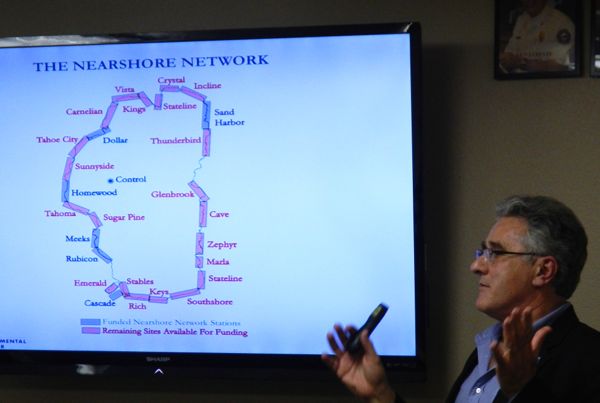
A near shore network has been created to gather data. However, only five locations are in the study area, with a sixth expected to come on board in the next couple weeks.

An instrument about 3-feet-long is placed in the water. Every 30 seconds data such as temperature, turbidity and dissolved organic material are being sent back to TERC.

Turbidity, or the cloudiness of the lake, is not always associated with storms. Schladow said that is something that needs to be investigated more.

With little data available regarding what is going on beneath the surface of Lake Tahoe, the whys of those occurrences are even more elusive. But more research is in the works.


Letter: David thanks community

To the community,

Quite simply, thank you for your support of my candidacy and election to your South Lake Tahoe City Council. I am humbled and honored by your support and will strive to represent you as residents and our city as a whole.

Thank you to all of the candidates that ran in this election. I learned so much from each of you. You have my respect and admiration as well.

Wendy David

Wendy David

We are seeing many visible improvements and it is buoying our spirits and our resolve to continue to enhance this incredible City that we are fortunate enough to call home. We have always known what we have: the best skiing, water sports, lake sports, beaches, biking and hiking trails of anywhere around the lake. What about our sunsets and sunrises, our schools and our community college? The list can go on forever with pride in our voices. You have voted about what is important to you and you are leading us into the future.

Thanks again for allowing me to represent your voice at the Council, along with so many others to make wise decisions, bold decisions, important decisions, all through thoughtful and collaborative discussion. Thank you for voting. You have exercised one of our greatest rights, the right to vote for your leaders. Together we will continue to work for the best for our community and City.

Gratefully,

Wendy David


Choirs to present winter concert

Tahoe Choir and Lake Tahoe Community College Chorus’ winter concert Celebrate the Season is Dec. 7.

The String Beings is the special guest.

The concert is at St. Theresa Catholic Church, 1041 Lyons Ave., South Lake Tahoe starting at 3pm.

Get tickets from choir members, or one hour before show. Tickets are $10 for adults, $8 for students and seniors, and free for children under 5.

For more info, call 530.541.2635.


UC on offensive to sell tuition increase

By Larry Gordon, Los Angeles Times

University of California administrators went on an offensive Thursday to sell their proposal to raise tuition by as much as 5 percent in each of the next five years but faced opposition from Gov. Jerry Brown, legislative leaders and student activists.

UC President Janet Napolitano sent out emails and other messages to alumni, faculty and donors seeking their support for her plan, which would end a three-year-long freeze on UC tuition, help pay for higher pension and salary costs and increase the enrollment of California students.

Unless state funding for UC rises enough to offset those increases, her plan calls for tuition for California undergraduates to rise next year to $12,804, not including room, board and books. By the 2019-20 school year, that could increase to $15,564.

Her plan won the support Thursday of UC chancellors and faculty leaders while important state legislative leaders such as Assembly Speaker Toni G. Atkins and Senate President pro tem Kevin de Leon expressed deep reservations.

Read the whole story