Fort Ross embraces Russian history on U.S. soil
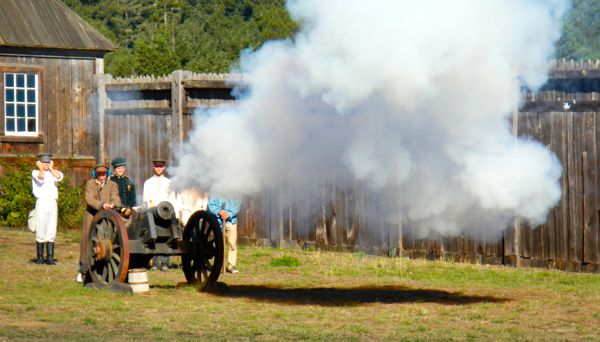
Firing of the cannons is a tradition at Fort Ross. Photos/Kathryn Reed

Firing of the cannons is a tradition at Fort Ross. Photos/Kathryn Reed

By Susan Wood

JENNER – More than two centuries later, one can still hear the Russian influence in the voices amid the grounds of Fort Ross State Historic Park.

Although lesser known in contrast to other California parks, this 3,386-acre park represents one of the oldest in the system. The Fort Ross Colony established it in 1812 through a cooperative company of U.S. and Russian settlers. With help from the Alaskan Alutiiq native Americans, the establishment 11 miles northwest of Jenner on Highway 1 became a large trading base for Russians seeking other venues to hunt fur-bearing marine mammals. They found them here on the wild Sonoma Coast.

The Russians and Americans worked together in building a colony with a stockade and homes for the settlers who tended a wheat farm and other crops. The cooperation lasted through the Gold Rush days until John Sutter bought the holdings in 1841. From there, Sutter sold to rancher George Call who exported apples, dairy products and wood supplies such as railroad ties. He, in turn, sold the property to the California Historical Landmarks Committee in 1903.

Coming out of the California State Park’s 100-year anniversary, one can still experience the spirit of that engrained cooperation today.
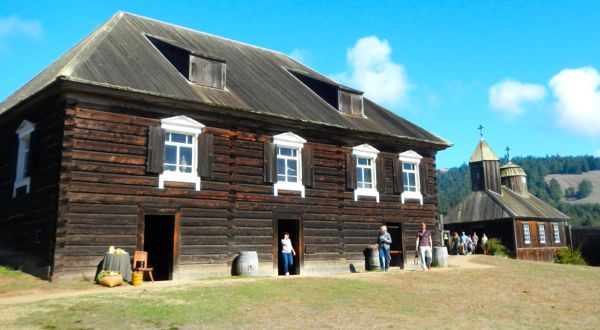
The original buildings still dot the landscape.

The original buildings still dot the landscape.

The park recently celebrated with its second Harvest Festival featuring a grand tasting of 11 local winemakers including the area’s own Fort Ross Vineyard and Tasting Room perched high up from the Sonoma Coast bluffs and featuring the oh-so temperamental Pinot Noir. There was also an artisan cheese maker from Freestone, along with tours and activities commemorating the park’s bountiful tradition.

The event can be a blast, literally.

“Fire in the hole,” many of the hundreds in attendance yelled, as park employees stuffed and lighted the cannon on the grounds of the stockade. The process appeared to take so long, one could almost imagine the enemy would have already climbed the stockade wall and attacked long before the cannon went off.

But today’s contemporary cannon blast is all in good fun. Attendees were instructed to cover their ears, along with dignitaries in attendance. Among them was Sergey Ivanovich Kislyak, who has served as Russia’s ambassador to the United States since 2008.
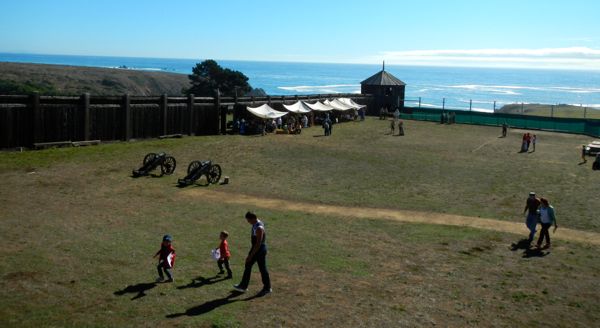
The acreage of the state park extends to the Pacific Ocean.

The acreage of the state park extends to the Pacific Ocean.

“It’s wonderful that a lot of Americans devote time to preserving Russian heritage and to try to pass that on from one generation to another,” Kislyak told Lake Tahoe News.

He then darted off to tour the grounds, complete with a general store, grain windmill and a residence built in 1836.

The ambassador was in Sonoma County for a conference on U.S.-Russia relations – diplomatic efforts intended to curb recent strained interactions around the world.

But Fort Ross represents a microcosm in relations of what could be in say a perfect world. At the festival, many Russian accents could be heard from visitors. This included one San Francisco couple who toured the site for the first time and declared their allegiance and support of preserving this heritage.

Notes:

• 19005 Highway 1, between Jenner and Timber Cove

• 707.847.3286.


Opinion: Rehearsing for death

By Launa Hall, Washington Post

“Remember that activity when we all get in the closet and pretend we’re not even there, so our principal can’t find us?” I choose my words carefully as I prep my pre-kindergarten students for the lockdown drill scheduled for that afternoon. These drills have become routine at Arlington elementary schools, and at schools across the country. After the latest school shooting, on Oct. 24 in Washington state, schools will no doubt be running through drills yet again. What can we do about all these shootings?, teachers ask each other. Lock the doors, we’re told, and assume the worst is coming.

When you’re guiding 4- and 5-year-olds through a drill, your choice of words can mean everything. “Activity,” not “game,” because we laugh during games, and I can’t risk introducing laughter. I don’t say “police,” because some little kids find police officers scary, and I can’t risk introducing tears. Instead, even though our principal isn’t there this day, I want them to picture his kind but purposeful face when they hear the police officers and administrators hustling down the hallway, testing the doorknob of each room. I don’t say “quiet,” because I can’t risk them shushing one another while they are crammed together, practically sitting in each other’s laps. And because it’s not quiet that’s required for this drill, but rather complete silence. As silent as children who aren’t there at all.

After lunch we hear a fiddling with the loudspeaker. Our well-meaning assistant principal is nearing retirement, and certain technologies, such as the many buttons on the intercom, are a strain on her. There is a low mumbling, which may be coaching from the office staff. More fumbling — perhaps a drop. Then, flustered, at last, the assistant principal says, “Lockdown, everyone, thank you.”

My eyes meet my assistant’s over the heads of our students. Usually, we get the announcement: “We are in a lockdown. This is a drill.” The assistant principal didn’t say the word “drill.” But of course it has to be. We were told about it in an all-staff e-mail hours ago. This is totally routine, I tell myself. I’m annoyed that I took even a split second to consider an alternative.

Read the whole story


Additional cell tower possible on South Shore

El Dorado County planning commissioners on Dec. 11 will discuss the possibility of adding a cell phone tower to the South Shore.

New Cingular Wireless/AT&T is the applicant for the special use permit.

The company wants to put a tower on the south side of Skyline Drive about one mile northeast of the intersection of Highway 50 and Pioneer Trail. The proposal is for a 113-foot monopine tower with nine panel antennas, equipment shelter, related ground equipment, HVAC units, sound barrier walls, and solid wood fence.

The meeting starts at 8:30am in Placerville.

Comments may be sent to El Dorado Planning Services, 2850 Fairlane Court, Placerville, CA 95667.


Will GOP surge impact online poker?

By J.D. Morris, Las Vegas Sun

More than a year and a half after Nevada legalized online poker, the game still hasn’t taken off here.

And Tuesday’s election results don’t offer much hope that Congress will help improve the situation.

Revenue from online poker has been notably sluggish since the state started disclosing numbers in February. Experts say the game would be more popular — and lucrative — if Nevadans could legally gamble online with pools of players from other states.

Sen. Harry Reid has supported federal legalization of online poker. But now that he’s losing his majority leader status amid the Republican takeover of Senate control, progress on the issue doesn’t seem likely anytime soon.

Read the whole story


CTC working to tag urban lots

The California Tahoe Conservancy began posting property tags this week to help better identify its lands.

The bright 4 x 6 inch signs featuring the Conservancy logo will be placed on trees on 1,000 lots in South Lake Tahoe and Meyers this fall and winter. The Conservancy will employ a phased approach to sign all 4,700 properties throughout the California side of the basin in the upcoming years.

In addition to signing properties, the Conservancy conducts year-round inspection, maintenance, and restoration projects on its urban lots. This year more than 2,415 properties were inspected, 63,000 square feet of disturbed area restored, and 33 restoration projects completed.

The Conservancy encourages neighbors to notify them at 530.542.5580 or via email at info@tahoe.ca.gov about any issues on these lands.


Staying alive in avalanche terrain

By Outside

Over the past few years, we’ve seen a sea change in terms of people’s attitudes, perception, and behavior about recreating in avalanche-prone terrain, especially skiing in the backcountry.

There are more of us out there than ever before, using increasingly fancy and sophisticated gear. But despite these advances, and a shift in how and what avalanche safety professionals teach, we’re not collectively making better decisions out there. Backcountry ski gear manufacturers, ski resorts, and avalanche forecasters and educators are acutely aware of the issue — and have just recently started taking industry-wide initiatives to help people make smarter choices in avalanche-prone terrain.

Here, we take a look at how the surge in popularity of backcountry users has altered the landscape, how to safely navigate slide-prone mountains, the tools and skills required to dig out someone buried by an avalanche, the advent of avalanche airbags, the human factors that can affect people’s judgement in the field, whether or not you should be concerned about inbounds avalanches at ski resorts, the tools professionals use to manage the snowpack, and a potentially game-changing new piece of avalanche safety gear.

The information we’ve gathered here is by no means everything you need to know to be an educated, safety-minded, and well-equipped backcountry user, but it’s a good place to start.

Read the whole story


Law enforcement adjusting to Prop. 47

By Kathryn Reed

The passage of Proposition 47 has California law enforcement agencies having to deal in a new way with those who allegedly commit crimes.

The proposition says many crimes that were considered a felony are now a misdemeanor. It also means instead of being arrested, people will be cited. The citations are similar to getting a traffic ticket.

Some of the felonies that are now misdemeanors include:

• Commercial burglary (theft under $950)

• Forgery and bad checks (under $950 value)

• Theft of most firearms

• Theft of a vehicle (under $950 value)

• Possession of stolen property (under $950 value)

• Possession of heroin, cocaine, illegal prescriptions, concentrated cannabis, and methamphetamine.

“Clearly, more bad guys who are now locked up will be getting out. It’s estimated 10,000 statewide,” South Lake Tahoe Police Chief Brian Uhler told Lake Tahoe News. “I’m not sure how all this will match with the Safe Neighborhoods and Schools Act. I guess smarter people than me have thought this through. I hope they’re right. The voters have spoken so we will, of course, follow the new law.”

Officers have been given an advisory on adjustments to the law.

“The law will allow inmates sentenced under old laws to file a motion with the courts to get their current sentence modified. I imagine there will be a flood of these motions forthcoming,” El Dorado County sheriff’s Lt. Pete Van Arnum told Lake Tahoe News.


Snippets about Lake Tahoe

veterans day• The American Legion in South Lake Tahoe will have a Veterans Day ceremony on Nov. 11 at 11am in the parking lot of the Legion. Tribute to our Veterans is the Placerville event for veterans. It is Nov. 11 at 11am at the El Dorado County Veterans Monument.

• Dec. 15 from 8am-5pm is the South Lake Tahoe Christmas bird count. Meet at Alpina Café in South Lake Tahoe.

• Tahoe Winter Wonder Grass is March 20-22 at Squaw Valley. Bands include Trampled by Turtles, Greensky Bluegrass, Nicki Bluhm & the Gramblers, Infamous Stringdusters, Elephant Revival and more. For tickets, go online.

• Kahle Community Center and Guy Yeaman will be starting a dog obedience class on Thursdays at the Stateline facility. Classes are Nov. 13-Jan. 8, 7-8pm. For more info and to register, call 775.586.7271.

• The movie premier of “Less” by Level One Productions is Nov. 23 at 6pm at Homewood Mountain Resort. The screening will take place outside the resort’s South Lodge by the fire pit. Tickets are $15 in advance or $20 at the door.


Lawsuit calls for quicker executions in Calif.

By Don Thompson, AP

SACRAMENTO — A victims’ rights organization sued California state officials on Thursday as it seeks to speed up executions that have been on hold since 2006.

Sacramento-based Criminal Justice Legal Foundation filed a petition in Sacramento County Superior Court asking a judge to order state corrections officials to adopt procedures for a single-drug, barbiturate-only method of execution.

State policy calls for using a series of three drugs to put condemned inmates to death. The Department of Corrections and Rehabilitation is drafting new lethal injection regulations after Gov. Jerry Brown said in April 2012 the state would switch to a single-drug injection.

However, department spokeswoman Deborah Hoffman said a nationwide shortage of execution drugs is slowing progress. She declined to comment on the lawsuit.

The foundation says the department is taking too long to adopt the new regulations. No executions can occur until the new rules are adopted.

It is asking the judge to order the state to adopt temporary regulations within 30 days and take immediate steps to adopt permanent regulations.

The foundation sought the court order on behalf of Kermit Alexander, whose mother, sister and two nephews were murdered in 1984, and Bradley Winchell, whose sister was raped and murdered in 1983, contending that as relatives of the victims they are affected by the continued delays.

Alexander and Winchell said in nearly identical letters to Corrections Secretary Jeffrey Beard in September that the murders of their relatives took place 30 years ago, yet there is “no end in sight” for the convicted killers solely because of the department’s failure to adopt the new regulations.

Executions in California have also been halted by a series of legal challenges over the last eight years, most recently when a federal judge in Los Angeles ruled in July that carrying out the death penalty takes so long that it amounts to unconstitutional cruel and unusual punishment. Attorney General Kamala Harris is appealing that ruling.

The judge noted that more than 900 people have been sentenced to death in California since the current death penalty system was adopted 35 years ago. But only 13 have been executed, leaving most condemned inmates to die of natural causes before their executions are carried out.


U.S. water consumption declining

By Dale Rodebaugh, Durango (Colo.) Herald 

The use of water, fresh and saline, in the United States in 2010 was the lowest in 45 years, a U.S. Geological Survey report says.

“The 45-year low shows the positive trends in conservation that stem from improvements in water-use technologies and management,” the report said.

In 2010, the latest data available, overall use of water, fresh and saline, was 365 billion gallons a day, the report said. This is a 13 percent reduction in use compared with a total of 410 billion gallons a day in 2005, which itself was the lowest annual use since before 1970.

Read the whole story