Add sparkle to your holiday décor

By Melinda Myers

Liven up your holiday décor with lights, a bit of glitz and some colorful blossoms this season.

Start by gathering greenery from your landscape. Use needled evergreens like pines and firs, broadleaf evergreens like boxwood, holly and evergreen magnolia as well as junipers and arborvitaes to create wreaths, swags, centerpieces and garland. And don’t forget to include cones, holly berries, crabapples and the bluish-colored fruit of junipers.

Be selective as you prune your trees and shrubs when collecting these materials. Use sharp bypass pruners that have two sharp blades and will make a clean cut that closes more quickly. Make your cuts above a healthy bud, where the branches join another branch, or back to the main trunk. Take only a few branches from each tree or shrub to maintain the plants’ beauty.

Place freshly cut greens in a cool location away from heaters, fireplaces and open flames. Set them on colorful fabric or paper to catch the sap and avoid damaging your woodwork and furnishings.

Greenery combined with decorative LED lights can brighten up holiday centerpieces and mantle displays. Photo/ Gardener’s Supply Company

Greenery combined with decorative LED lights can brighten  holiday displays. Photo/Gardener’s Supply Company

Check your greenery for freshness every few days. The needles, leaves and stems should bend, but not break. Replace dried greens with fresh materials.

Then brighten up the display with some cool burning LED lights. Create a mantle display or centerpiece with the help of LED pillar lights. Or add a string of LEDs to your garland. Look for something unusual like pinecone string lights to add sparkle and charm to your display.

If you have artificial greens that could use a facelift, add fresh berries, cones and seedpods for a more natural look. Increase the glitz with the help of silver and gold metallic paint or glitter. Paint milkweed, lotus and other pods and then tuck them into the greens. Painting allium seedheads white will add the appearance of flowery snowflakes in your indoor arrangements and outdoor container gardens.

And don’t forget the fresh flowers and flowering plants. Poinsettias are a long-time favorite, but you may want to change things up with Amaryllis, spring flowering bulbs and lily of the valley. Look for unusual varieties or combinations to increase your enjoyment. Combine large flowered amaryllis with small flowering bulbs like star of Bethlehem. Or go for a unique size shape or flower color like that of the Honeybee Amaryllis with its beautiful yellow flowers that are sure to brighten your days.

Add a few flowers to your greenery and houseplants for some instant color. Stick your greenery and flowers in dampened floral foam to create a long-lasting holiday centerpiece. Or place cut flowers in floral picks and set them in dish gardens and houseplants to brighten things up. Then swap out the flowers as they fade.

And consider making a few extra planters or centerpieces to give as holiday and hostess gifts this year.

Now is the time to put on your gardening shoes, grab the pruners and get started decorating for the holiday season ahead.

Melinda Myers has a master’s degree in horticulture and has written more than 20 gardening books.


Wood or plastic better for a cutting board?

By Alison Spiegel, Huffington Post

Ask any chef or home cook what the single most important tool in the kitchen is and he or she will almost certainly give you the same answer: a chef’s knife. One, dependable all-purpose chef’s knife — and knowing how to use it — is going to make the biggest impact on your cooking, whether you’re a newbie in the kitchen or an experienced restaurant chef.

What most people overlook when they give or receive this answer is the knife’s partner in crime: the cutting board. Often forgotten for its flashier, sharper-looking companion, the cutting board doesn’t always get the attention it deserves. People assume all cutting boards are alike, and may not give much thought to size or material. If you’ve been using the same cutting board for every dish, or if you’ve simply never considered the difference between a wood or plastic board, we’re here to correct your ill-informed ways.

Contrary to popular belief, plastic cutting boards are not automatically safer than wood. Studies have shown that wood can actually be more sanitary in the long run. People assume that because wood is a porous surface and plastic isn’t, plastic boards are more resistant to bacteria. This assumption doesn’t take into account the scars a plastic cutting board will get from daily use.

Read the whole story


NTPUD general manager let go

North Tahoe Public Utility District is in need of a general manager after ousting Paul Schultz this week.

The unanimous decision was made in closed session Nov. 25 during a special meeting.

Schultz has been general manager since April 2011, though he had worked as the manager of planning and engineering for a year prior to that.

CFO Larry Marple will be interim general manager during this recruitment process.

The personnel committee meets Dec. 2 at 2pm at the North Tahoe Event Center in Kings Beach to discuss the recruitment process. The full board meets again Dec. 9.

“We have full confidence in our staff to handle all aspects of the district’s operations during this transition. The board thanks Paul Schultz for his dedicated service and professionalism while working for the district over the last five years. We wish him the best in his future endeavors,” NTPUD board President Lane Lewis said in a statement.

NTPUD made headlines earlier this year when it went head-to-head with California State Parks and California Tahoe Conservancy regarding who operated what in Kings Beach. Ultimately NTPUD gave up operation of the events center.

Details of Schultz’s departure or reasons were not given.

— Lake Tahoe News staff report


Bread & Broth carves up 25 years of Thanksgiving memories with traditional meal

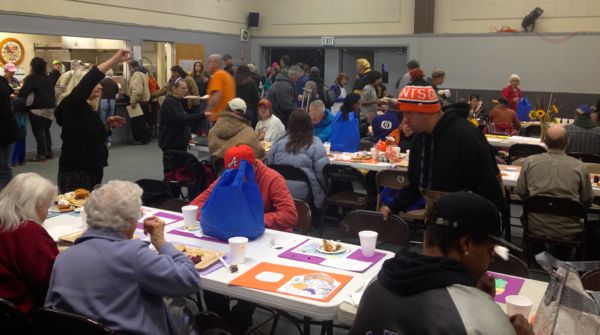
On Nov. 24 volunteers dished up more than 200 Thanksgiving dinners at Grace Hall in South Lake Tahoe. Photos/Kathryn Reed

On Nov. 24 volunteers dish up more than 200 Thanksgiving dinners at Grace Hall in South Tahoe. Photos/Kathryn Reed

By Kathryn Reed

An aroma wafted outside, making the cold, hungry diners even more eager to get inside. This was no ordinary dinner they were waiting for.

A buzz filled the kitchen. Placemats were at each setting. Cans of whipping cream were at the ready to top the pumpkin pie. Nearly 50 volunteers helped pull off the annual Bread & Broth Thanksgiving dinner.

Thanksgiving dinner is always the busiest dinner for this nonprofit that is celebrating its 25th year of serving a weekly community meal to those on the South Shore. While mostly it’s people in need who attend the Monday meal, it is open to anyone.

Most years more than 250 people line up outside Grace Hall in South Lake Tahoe for the traditional Thanksgiving dinner. This year was no different. Christmas Cheer cooked the Thanksgiving meal 25 years ago, but Bread & Broth soon took over because they were better organized to do so.

“It actually used to be higher 20 years ago – 300-plus. The whole community part took in the meal, it was an event of the season, still is to a certain extent,” Diane Weidinger, who runs the program, told Lake Tahoe News. “This year our Monday team will supply Second Serving with trays of the same dishes so people can enjoy another Thanksgiving meal on Friday.”

For Tonya Schmitt the helping was more than she could finish. She was taking the leftovers home.

“It reminds me of home; right down to the sweet potatoes with marshmallows,” Schmitt told Lake Tahoe News.

Like all the meals served at Bread & Broth, they are made from scratch by volunteer cooks. Monday’s meal consisted of turkey, dressing, mashed potatoes (with gravy), green beans, sweet potatoes, cranberries, green salad and dessert.

Jasmine Pereschica attended with her daughter and son. Like most kids, her daughter wanted dessert instead of the healthier items on her plate.

“You can tell someone put a lot of thought into it,” Pereschica said of the dinner. “The turkey is moist and not dry. The cranberries are really good.”

Stephan Moise, executive chef at Ridge Tahoe, and his culinary team make 10 gallons of gravy every year.

Students in Irene Kaelin’s fifth-grade class at Tahoe Valley Elementary School and kids from St. Theresa’s religious education class made the festive placemats.

Walmart donated reusable bags that the volunteers filled with groceries so those in need had more to eat as the week went on.

Each week bags of groceries are available.

Each week bags of groceries are available.

A quarter-century tradition

When Bread & Broth started is was under the ministry of St. Theresa Church. It has become more than that, even though St. T’s is still a big part of the overall concept.

Today, people from other churches and non-believers help.

“When they first started years ago, St. Theresa’s Church supported the program with a second collection several times a year,” Weidinger said.

Cash was never flush. The recession made things worse. Then the Adopt A Day of Nourishment program and partnership with the Food Bank of El Dorado County started. Those two changes have put the organization on stable ground.

The group also receives donations from grocery stories, businesses and individuals. It comes in the form of cash, food, bags for giveaways, and containers for leftovers.

“B&B is now giving back to the church with its recent – over the last two years – purchases of the following commercial equipment: stove, oven, freezer, refrigerator, warming oven, 50-gallon water heater, prep island, industrial meat slicer and vacuum cleaner. We now pay a percentage of the utility bills for Grace Hall as well as refuse and repair costs,” Weidinger said.

John Mauriello is a regular cook at Bread & Broth.

John Mauriello is a regular cook at B&B.

Expanding food offerings

People have the opportunity to eat at Lake Tahoe Presbyterian Church on Fridays. That program is called Second Serving.

Local restaurants provide 5 gallons of soup.

Volunteer cooks then whip up a sandwich or pasta dish to complement the soup.

The Presbyterian church was part of the original Bread & Broth team 25 years ago. Founding member Susan Baker is still involved as a Second Serving coordinator. Wendy David, one of the Bread & Broth cooks, has also been around since the beginning.

It takes a dedicated crew to pull off these meals each week. About 100 volunteers work for Bread & Broth, and another 25 for Second Serving.

A 17-person advisory board oversees the big picture. Nine committees make sure the nuts and bolts get taken care of.

“Unlike 25 years ago we have 20 cooks, plus seven from Second Serving, who cook once a week, once a month,” Weidinger said. “Years ago they had two cooks for each of the two days a week they served (Tuesday and Thursday), those four cooks would be in the kitchen every week. In the 1990s they had approximately 20 volunteers and eight board members.”

Placemats are from children.

Placemats are from children.

No ordinary meals

This is no simple fare being dished up each week.

While the cooks have license to be creative, they are also somewhat limited by what is in the pantry and cooler. They take inventory of what’s available a few days beforehand and lay out the protein they want to use.

“They arrive Monday morning to access what products were picked up from the grocery stores a few days earlier and then hope that Monday’s donations from other grocery stores will supplement the meal. They are making decisions on what to make and serve 3½ hours before the doors open at 4pm,” Weidinger explained. “If the donations are weak, they survey the canned products in the pantry and come up with a dish. Most cooks prepare a complete meal – protein, starch, at least one vegetable, salad – that is if greens were donated, otherwise canned fruit salad – hot garlic bread or rolls.”

The goal is to not purchase anything extra. Sometimes it’s necessary – like cilantro for a Mexican dish.

Dessert is usually donated by Raley’s or Safeway.

It wasn’t always this good. Meals used to be simpler.

“We currently serve meals that would be considered gourmet compared to the hotdogs, meatloaf and casseroles cooked in the early ’90s. We pride ourselves on serving a meal that our guests might order in a restaurant if they could afford it; chicken picatta with a lemon caper mushroom sauce, roasted root vegetables with a Moroccan apricot sauce (nothing was purchased for these sauces, it was all in the pantry), Ratatouille using fresh farmers market vegetables, mashed potatoes using fresh spuds, spice rubbed lamb, pizza from scratch – even the dough, beef stroganoff, shredded chicken enchiladas, fruit salad with summer ripe berries, salmon and pork shoulder.”

Going forward

Weidinger would like Bread & Broth to establish a scholarship fund for people to attend Lake Tahoe Community College’s culinary program.

“I believe that education is one of the keys that open doors of opportunity. Hard work and good ethics are two other keys, together with some luck and good fortune people from all social and economic backgrounds can have fulfilling careers,” she said.

Providing meals more days of the week is a desire by some.

And while it may not seem like a big deal, getting a washer and dryer on site is a goal. This is because as it is today all the dirty linens – and there are many with all the aprons, wash rags, potholders and other items – have to be washed at someone’s house.

Weidinger doesn’t believe the need for these types of food programs will go away.

“As long as people are underemployed, jobless and homeless, there will be a need. No one should have food insecurities,” she said. “The people we feed are our neighbors; we can’t let them go hungry when most of us are enjoying three meals a day.”




Opinion: Unthankful for many LTN commenters

By Kathryn Reed

At tables throughout the Unites States today people will be giving thanks.

But what about the other days? Do we just take things for granted the other 364 days of the year? Do we forget to slow down and pause to appreciate what we have?

Yes, many in the Lake Tahoe Basin and elsewhere are still struggling economically. Yes, the divide between haves and have nots is growing. Yes, there is plenty to wallow in.

We all have something we are dealing with that others may not be aware of – it may be an illness, relationship issues, work or the lack thereof, money woes, or any number of problems.

But it’s how we deal with our problems that define who we are. It’s how we interact with others – especially those who are different than us that define our character.

Sometimes it seems like our society has been devolving instead of evolving. We have forgotten how to have civil discourse. We have forgotten how to disagree with one another without being disagreeable.

It’s at all levels of our society – elected officials, managers, employees. It’s between family members.

We have forgotten how to express our opinions without calling others names. We have forgotten that others have a right to opinions that are different from our own.

Commenters on Lake Tahoe News are some of the worst offenders. Name-calling is rampant. The diatribe is getting old. You may think someone has a stupid idea, but that does not make that person stupid.

Why do so many things have to be conservative or liberal in nature? Why does a line in the sand have to be drawn?

I have liberal and conservative family members and friends. That isn’t what defines them. We can have lively discussions and still part friends or have a glass of wine together. Listening to one another we learn and grow. We don’t call each other names. We stick to the issue – we attack that, not each other.

It’s time for Lake Tahoe News commenters to learn to do the same. The anger and hate are getting old and tiresome.

I would be thankful if the commenters learned to be respectful, stick to the topic of the story and stop attacking others – and instead only attacked ideas and thoughts. And I would be most thankful if the commenters actually added to the discussion, presented ideas, solutions and ideas.

Happy Thanksgiving!


NDOT preps for winter storms

With a strong winter storm likely to hit the region on Sunday into Monday, the Nevada Department of Transportation is ready for whatever Mother Nature brings.

NDOT begins annual winter preparations in August by readying more than 80 snowplows and other pieces of snow and ice equipment for use in snow removal across northwestern Nevada.

More than 32,000 thousand cubic yards of salt and sand has been stockpiled, ready to be spread on winter roads for increased traction and safety. The sand is combined with salt and wetted with brine to create more dense sand that keeps roads ice-free at lower temperatures and will not as easily bounce off roadway surfaces. NDOT sand trucks calibrate the amount of salt and sand for precision and efficiency.

“Drivers will also see our NDOT vehicles spraying a liquid brine on the roads prior to certain storms,” NDOT Assistant District Engineer for Maintenance Mike Fuess said in a press release. “The brine is a solution of approximately 25 percent salt that we produce in-house at a substantial cost savings. Sprayed just before storms, the brine helps reduce how quickly the ice forms and sticks to the road.”

NDOT has 153 maintenance staff in northwestern Nevada. The department also has hired temporary winter maintenance personnel.

As storms move in, employees closely monitor meteorological forecasts detailing wind, rain, snow, ice and other weather on state roads. The updated weather readings help pinpoint precise sections of roads needing brine, salt and sand or snow removal.

During major winter storms, crews work in 12-hour shifts, rotating personnel to provide 24 hour-a-day snow removal.

NDOT has installed automatic anti-icing systems on four bridges on Interstate 580 between Reno and Carson City to help delay and prevent ice formation on bridge surfaces. When potentially freezing conditions set in, pavement sensors on each bridge activate spray disks embedded within the concrete. Each recessed disk sprays a potassium acetate anti-icing solution to help delay formation of ice.

NDOT will also use new tow plows on I-580 between south Reno and north Carson. The tow plow is a second, steerable snowplow blade towed like a trailer behind a traditional snowplow. The tow plow swings out to the lane next to the lead snowplow to clear a second lane of snow, saving an estimated $78 per hour compared to a single plow.

On average, more than 2,000 crashes occur statewide every year due to unsafe driving in snow, ice and other wet conditions, such as driving too fast for conditions, following too closely, or failing to maintain a lane and overcorrecting.


Green bean casserole popular on T-Day

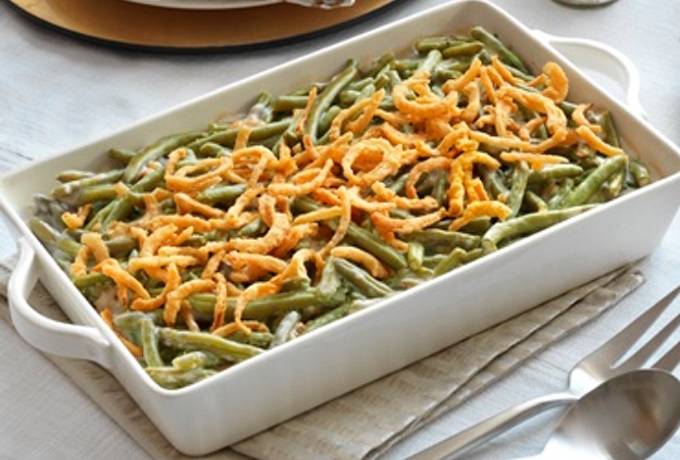
Green been casserole is a staple on many Thanksgiving menus, but they aren’t all the same. Some people use a secret ingredient to make the dish all their own.

Del Monte asked 1,500 people in the United States to share what their favorite special ingredient is as well as to rate their fondness for the classic side dish. Bacon is the No. 1 secret ingredient, with cheese, mushrooms, bread crumbs (including crouton and crushed crackers), and almonds rounding out the top five.

It’s estimated 30 million green bean casseroles will be served on Thanksgiving.

According to the survey, here are the percentages of residents in the following states who say they really like or love green bean casserole:

• Kentucky 78 percent

• Wisconsin 77

• Missouri 76

• Iowa 75

• Maine 74

• New Hampshire 73

• Florida 72

• Colorado 71

• California 69

• Mississippi 68.

Photo/Del Monte

Photo/Del Mont

Classic Green Bean Casserole

2 cans condensed cream of mushroom soup

1 C milk

2 tsp soy sauce

¼ tsp black pepper

4 cans green beans, drained

2⅔ cups French fried onions, divided

Stir soup, milk, soy sauce, black pepper, beans and 1 1/3 cups onions in a 3-quart casserole.

Bake at 350 degrees uncovered 25 minutes or until bean mixture is hot and bubbling. Stir bean mixture. Sprinkle with remaining onions.

Bake 5 minutes longer or until onions are golden brown.

— Lake Tahoe News staff report


Why it’s not OK to have second refrigerator

By Chris Mooney, Washington Post

Maybe this scene sounds familiar: It’s Thanksgiving, you’re sitting and watching the football game, and you want a beer. So what do you do? If you’re like many Americans, you won’t go over to the kitchen fridge, which is now crammed with leftovers. Rather, you’ll trek down to the basement or out to the garage to the second refrigerator (aka, the “beer fridge”).

Sure, it’s convenient. But the growing trend of having second refrigerators is a major national energy blight — not only wasting a lot of energy, but also potentially costing you hundreds of dollars.

From an energy standpoint, second refrigerators are bad news. The simple reason? They tend to be ancient. In fact, nearly 15 percent of U.S. homes have a second refrigerator that is at least 20 years old, which means it is virtually certain to be an energy hog when compared with today’s models.

Refrigerators are an appliance category that has seen very dramatic strides in energy efficiency in recent years, thanks to an ever tougher set of state and national energy standards, most recently tightened by the Department of Energy in September. “A fridge that just meets the new standards will use $215 to $270 less per year in electricity than a comparable unit that met the first state standards set in 1978,” writes Marianne DiMascio of the Appliance Standards Awareness Project (ASAP).

Read the whole story


Black Friday highlights rich-poor divide

By Shan Li, Los Angeles Times

In Northeast Los Angeles, 1,000 people huddled in the evening chill last Thanksgiving as they waited outside a Target store for the chance to snap up Black Friday deals.

Across town at the Grove, the mostly upscale stores such as Barneys and Nordstrom were closed that night. Holiday shoppers didn’t start massing until well into the next morning.

This year’s annual ritual of conspicuous consumption promises an even greater contrast.

Discounters and mid-priced chains, eager to gain an edge on competitors for limited gift budgets, have again moved their opening times earlier into Turkey Day, with Kmart leading the pack by launching specials at 6am. Higher-end retailers, however, are keeping their doors firmly shut until Friday.

Increasingly, the seasonal shopping surge has become a window into America’s class divide, in which high earners have benefited from a booming stock market and rising home prices as many others still grapple with stagnant incomes and lingering financial anxiety.

Consider these opposite scenarios: In 2013, Bloomingdale’s went against the grain by offering fewer Black Friday bargains than the year before, according to the advertising experts at bestblackfriday.com. At a Wal-Mart in Duarte, customers elbowed one another to get their hands on Crayola crayon sets, marked down to $11 from nearly $20. (A trending Twitter hashtag last Thanksgiving was #WalmartFights.)

Read the whole story


Road beat: Mitsubishi a responsive AWD

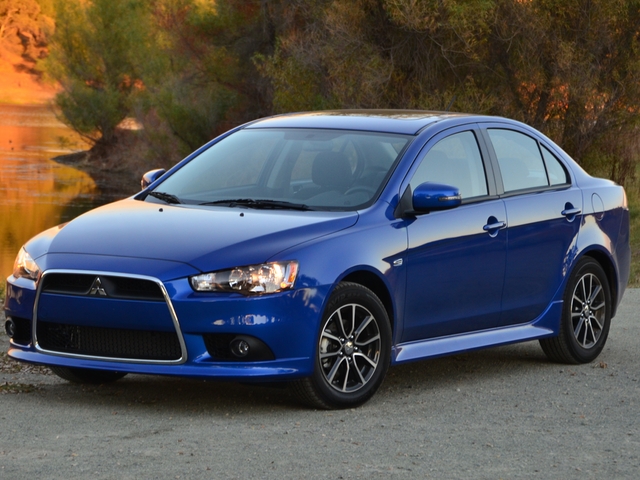
Mitsubishi's Lancer SE AWC is worth the money. Photos/Larry Weitzman

Mitsubishi’s Lancer SE AWC is worth the money. Photos/Larry Weitzman

By Larry Weitzman

Mitsubishi isn’t the biggest player in the automobile market, but that doesn’t mean it doesn’t deserve a hard look when choosing a small car or an SUV. The Lancer SE AWC is a solid reason why. AWC is another way of saying all wheel drive as AWC means all wheel control.

It’s an electronic system meaning it is fully selectable from economical front two-wheel drive, automatic all wheel drive and a locking system as well – all at the push of a button. Trick, sophisticated stuff. Only the small rear badge lets you know this Lancer has AWC.

Outside Lancer uses the same Concept-X shark nose design concept which is still fresh, sporty and edgy. The lines are clean and purposeful except for the rear window line hump which looks out of context in this otherwise outstanding design. While compact cars have been injected with growth hormones, Mitsu has maintained its compact industry standard of a 180 inch overall length on a 104-inch wheelbase. An original BMW 5 series sedan had an inch shorter wheelbase and was only an inch longer. Now the current 5 Series rides on a 117-inch wheelbase and is 193-inches long.

Specifications: Engine  2.4L DOHC, 16 valve inline four cylinder 168 hp @ 6,000 rpm  					167 ft.-lbs. of torque @ 4,100 rpm Transmission CVT  Configuration Transverse mounted front engine/AWD Dimensions Wheelbase 103.7 inches Length 180 inches Width 69.4 inches Height 58.7 inches Track (f/r) 60.2/60.2 inches Ground clearance 5.8 inches Weight 3,142 pounds Weight distribution (f/r) 59/41percent Fuel tank 14.5 gallons Trunk capacity 12.3 cubic feet Wheels 16X7 inch alloys Tires 205/60X16 all season Steering lock to lock 3.16 turns Turning circle 32.8 feet Performance 0-60 mph 7.61 seconds 50-70 mph 4.61 seconds 50-70 mph uphill 7.27 seconds Top Speed Don’t even consider finding out unless on a race track Fuel economy EPA rated at 22/29/25 mpg city/highway combined. Expect 34-35 mpg on the highway at legal speeds and about 27-28 mpg overall.
Specifications:
Engine
2.4L DOHC, 16 valve inline four cylinder 168 hp @ 6,000 rpm
167 ft.-lbs. of torque @ 4,100 rpm
Transmission
CVT
Configuration
Transverse mounted front engine/AWD
Dimensions
Wheelbase 103.7 inches
Length 180 inches
Width 69.4 inches
Height 58.7 inches
Track (f/r) 60.2/60.2 inches
Ground clearance 5.8 inches
Weight 3,142 pounds
Weight distribution (f/r) 59/41percent
Fuel tank 14.5 gallons
Trunk capacity 12.3 cubic feet
Wheels 16×7 inch alloys
Tires 205/60×16 all season
Steering lock to lock 3.16 turns
Turning circle 32.8 feet
Performance
0-60 mph 7.61 seconds
50-70 mph 4.61 seconds
50-70 mph uphill 7.27 seconds
Top speed: Don’t even consider finding out unless on a race track.
Fuel economy EPA rated at 22/29/25 mpg city/highway combined. Expect 34-35 mpg on the highway at legal speeds and about 27-28 mpg overall.

Width is an average 69.4 inches and height is a somewhat tall 58 inches.

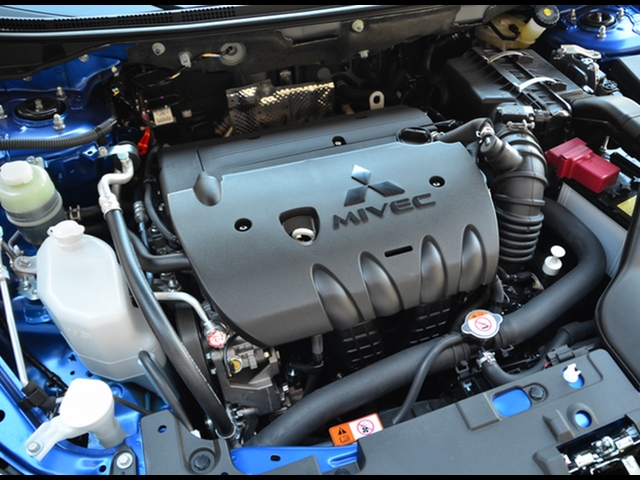
Power is by a world class 2.4L DOHC, 16 valve inline four cylinder engine that was jointly developed by Chrysler, Hyundai and Mitsubishi sometimes known as the Global Engine Alliance. It is still used in various forms by all three companies. In Mitsu form, it develops 168 hp at a low 6,000 rpm and 167 pounds of twist at an even lower 4,100 rpm. While it may not develop the highest peak hp of the family, it probably is the most flexible with a broad flat torque band actually making it feel peppier. Who drives around at 6,500 rpm anyway, unless you are racing SCCA. Most people will find their engines operating between 2,000 and 4,000 rpm and 4,100 is where the Mitsu operates at peak volumetric efficiency.

Performance is a bit behind the Lancer GT as the GT operates in front-wheel drive only and therefore weighs in at about 125 pounds less, but the times are very close. Zero to 60 mph stopped the watch at 7.61 seconds with commensurate passing times of 4.61 and 7.27 seconds in 50 to 70 mph simulated passing times on level ground and up a 6 percent grade. The Lancer GT times were 7.54, 4.37 and 6.12 seconds, respectively.

But fuel economy, which by the EPA ratings says that the AWC model will pay a 1 mpg penalty, did not materialize. EPA rates the Lancer AWC at 22/25/29 MPG city/highway/combined. Overall in varied driving the Lancer averaged between 26-29 mpg with almost no time on the highway. But once on a level highway at 70 mph it averaged between 34 and 35 mpg, about 1 mpg better than the GT. Fuel capacity is a large 14.5 gallons for a compact.

As with the GT, the Lancer makes enough power to induce torque steer at low speeds, but with the AWC in AWD, there is none. The hydraulic power steering rack is reasonably quick at 3.16 turns lock to lock, close to the 3.0 or less that I look for. The rest of the Lancer underpinnings are a fairly standard MacPherson struts up front with a multilink fully independent system out back. This is an upgrade over most compacts that use a semi-independent torsion beam out back. Wheels are stylish 16 inch alloys with 205/60 series tires. Not exactly racetrack rubber, but still quick sticky. Consequently the handling with the AWD engaged is fairly benign and powerful. It has no vices, just the ability to go where it’s pointed with good feedback. Turn-in is crisp in spite of the tall 60 series rubber and off and on center feel if very good. It is an easy car to drive aggressively. And as a bonus the turning circle is less than 33 feet.

Ride quality is firm, but still quite compliant. Those taller tires certainly help. About the only issue is road noise from coarse roads, otherwise its ride compares well to other compacts but it is preferable to this writer. Engine speed is a low 2,250 rpm at 70 mph and it is inaudible. With the tranny being a CVT , it only improves the overall smoothness of the Lancer experience.

Braking is done by four-wheel disc brakes, something that is not standard on all compact cars with ABD, EBD and BA. The system had a strong pedal and arrested forward progress from 40 mph in 43-44 feet. Other features enhance safety like stability and traction control, TPMS, seven airbags plus the Mitsu RISE body system in case of collision.

Inside the Lancer is a quality interior done with cloth seats that are surprisingly comfortable and manually adjustable in three axis. Instrumentation is routine with a large tach and speedo flanking a center information center with a trip computer and graphic ancillary gauges. A touch screen is used to control the excellent standard sound system. While not the biggest compact car with 93 cubic feet of interior volume and a 12 cubic foot trunk, it still has ample room for a couple of 6 footers in the rear. Three big guys would be doable as long as I am riding shotgun in front.

Pricing for this nicely equipped Lancer SE AWC with the CVT and 2.4L engine starts at $20,995 plus $810 for the boat from Kurashiki, Japan. The only option on my tester was Premium package for $1,700 that added a moon roof, an upgraded 710-watt Rockford Fosgate sound system, fast key entry system (nice feature) and some leather on the steering wheel and shift knob. If you want or need a responsive AWD small car, this is it. As an added bonus, all Mitsubishis come with substantial piece of mind in a 5 year/60,000 mile bumper to bumper warranty plus a 10 year/100,000 mile power train warranty.

Larry Weitzman has been into cars since he was 5 years old. At 8 he could recite from memory the hp of every car made in the U.S. He has put in thousands of laps on racetracks all over the Western United States.