Author to read Tahoe children’s book

“Gertrude’s Tahoe Adventures in Time” is a new children’s book about the natural history of Lake Tahoe.

With colorful and dramatic illustrations the book tells the story of Gertrude, a Tahoe girl who meets a magic maiden who takes her on a fast motion adventure through the history of Lake Tahoe. They watch glaciers march, volcanoes erupt and exotic animals graze while becoming forever friends. Children will be entertained as they learn.

Author Tim Hauserman will read the story and have books available for purchase and signing on Dec. 20 at 10:30am at the South Lake Tahoe Library, 1000 Rufus Allen Blvd.


Washoe Park trail upgrades improve access

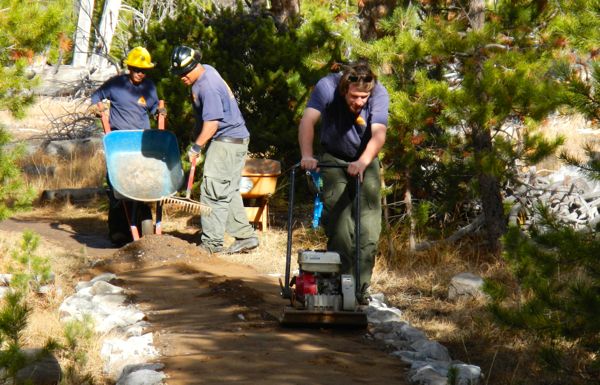
Erick Estrada, from left, Eddie Cuttman and Zackery Schell finish trail improvement at Washoe Meadows State Park. Photo/Kathryn Reed

Erick Estrada, from left, Eddie Cuttman and Zackery Schell finish trail improvements at Washoe Meadows State Park. Photo/Kathryn Reed

By Kathryn Reed

WASHOE MEADOWS STATE PARK – Trudging through water or creating a side trail is no longer necessary in sections of Washoe Meadows State Park.

Work was completed this month on about a mile of trail. Included is a rather major bridge over Angora Creek and smaller crossings to get people out of other wet areas.

“Now people have access to this section of the park longer and earlier,” explained Nathan Shasha with California State Parks.

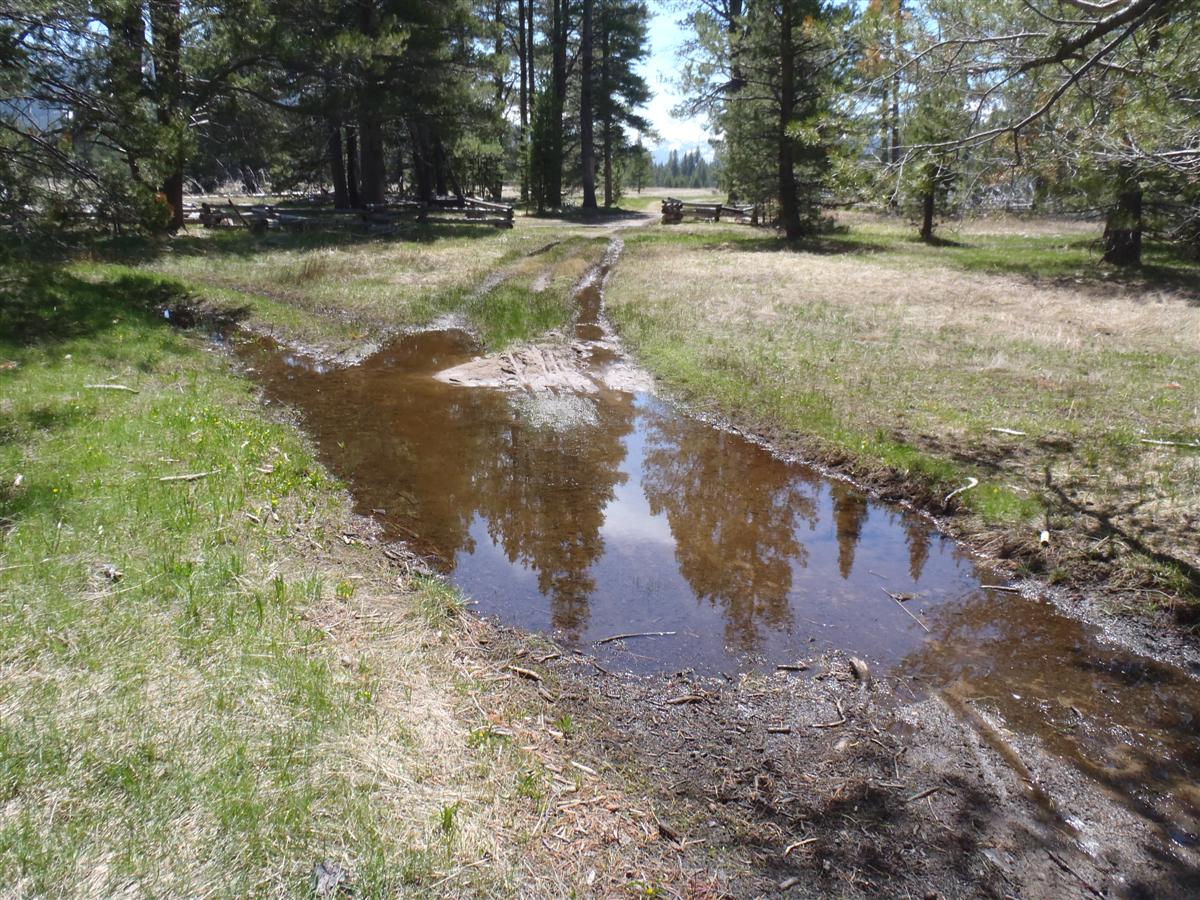
Water had been a barrier.

Before the work began the trail was impassable. Photo/State Parks

Before the work began the trail was impassable. Photo/California State Parks

This nearly 600-acre park on the South Shore is a bit of a secret to many because there are no signs, trailhead markers or parking. But for those who know about it, there are myriad walking, mountain bike, snowshoe and cross country trails, as well as a slew of entrances.

Carol Curran of South Lake Tahoe was walking in the park with her husband, Larry, and their dog last week. This was their second time to Washoe. When they looked up online how to get to it the directions had them go to Sawmill Road. But there is no access from that road.

When the general plan is created for the park basic amenities like signs are expected to be addressed. State Parks has taken inventory of the trails and everything else in the park so it knows what it has, but no plan has been created for what do with the park. Part of the holdup has to do with a lawsuit involving realigning the Upper Truckee River and moving holes of Lake Tahoe Golf Course.

Press_release_map_8_6_2014

The park and its access points.

The trail upgrades, which cost about $70,000, will allow for more recreation throughout the year. The money came from state agency, Tahoe Fund, Proposition 84 and Bureau of Reclamation.

“This is a hundred times better. There is an actual trail. Now I don’t have to deal with mud,” said Candace Raynar, who was jogging with her two dogs. She drives from Christmas Valley and parks on the Lake Baron side of the park to start her 11-mile run. “The transformation is amazing. It was so needed.”

The quickest way to access this improved section that park employees and California Conservation Corps members worked on is from Mountain Meadow Drive. Shasha said this section was chosen for rehabbing because it is a major thoroughfare and is heavily used.

Gone is a trail that was wide as a road with compacted dirt. Even with the limited moisture this fall puddling was occurring which made for less than a pleasant experience.

The trail is now more like a single-track, but it’s raised a bit in places. The crown will also help the trail last longer.

Chunks of asphalt were removed. Berms built by previous landowners are still evident.

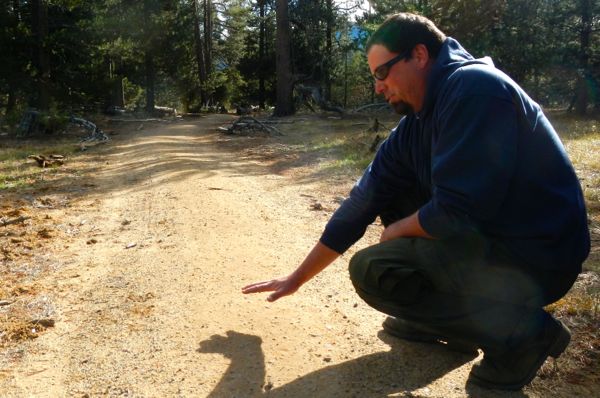
Nathan Shasha with State Parks shows the contour of the new trail.

Nathan Shasha with State Parks shows the contour of the new trail. Photo/Kathryn Reed

Shasha described creating it being like making lasagna, where various substances are put down in a layered manner – fabric, rock and dirt.

Rocks are on the side so water can run between them. The improvements should also allow more people into the area because of not having to wade into the water and giving access year-round. One user group Shasha would like to restrict is equestrians.

“I would like horses only on park roads. They have such an impact on our trails,” he told Lake Tahoe News.

Shasha and his crew will return in the spring to see how things held up and if any changes need to be made. By that time some vegetation should be sprouting along the trail sides.

Dirt used in the project has been stored at the park since it was brought in from the 2007 Angora Fire. This same dirt pile was used for the detention ponds by South Tahoe High School.

A sturdy bridge now crosses Angora Creek.

A sturdy bridge crosses Angora Creek. Photo/Kathryn Reed

The redwood bridge across Angora Creek is much heftier that what was there. The old one was made out of 2 x 6 plywood by neighbors. Two years ago a horse fell through that necessitated State Parks to do something.

If there were no structure, horses and others would likely still cross the water. The bridge was built for safety reasons as well as environmental. Angora Creek is the largest tributary of the Upper Truckee River.

The bridge is 35-feet long, while the entire crossing is 85 feet. It was built to State Parks specifications. Individual parks don’t have much say in how these things are constructed – same with the paths.


Opinion: Collaborate over good policy

By Steve Urie

In a recent op-ed released to regional news services (Lake Tahoe News, Nov. 20), Tahoe Regional Planning Agency Executive Director Joanne Marchetta wrote: “TRPA is taking partnership to the next level and is making ‘epic collaboration’ its central strategic goal.” She went on to say that the Compact between California and Nevada that created TRPA was to “harmonize the needs of the region as a whole so as to ensure equilibrium between the region’s natural endowment and its man-made environment.”

Steve Urie

Steve Urie

That may have been the intent, but it hasn’t been — nor will be — the reality. When TRPA was formed in 1969, on the Nevada side of the border a race was under way to see who could build the largest and gaudiest casino, and on the California side developers had already converted Tahoe’s most important wetlands into a 1,500-homesite marina community. Whether by shrewd planning or blind luck, in constructing TRPA the states agreed to a 15-member board of governors with seven voting members from each state and the 15th to be a non-voting federal appointee. Gridlock was assured, all development ceased, and the basin’s environment was spared further mass destruction.

The constant policy tug-of-war between developers, environmentalists, and agencies from two states and six local governments guarantees that only the very wealthy and very patient can afford to navigate Tahoe’s development process. And as a result, mercifully the basin’s land-use is locked in the 1970s. Contrary to Marchetta’s lofty goal, since its inception TRPA has been spectacularly unsuccessful in creating collaboration, much less harmony, between developers, environmentalists, and the Basin’s residents and three million annual visitors.

Even the two state legislatures that created TRPA are in constant conflict over Tahoe’s land-use and development policies. Less than two years ago, TRPA was precariously close to being shut down because there was no collaboration between Nevada and California. Seven times since 1975, Nevada has threatened to withdraw from TRPA when they believed the agency was unaccommodating to their needs. Only because California Gov. Jerry Brown understands that the bureaucratic standoff overseen by the TRPA Board of Governors assures that a 1960’s-style development free-for-all doesn’t return to the basin does TRPA still exist. At Lake Tahoe, it’s not collaboration that maintains environmental equilibrium, but contentious ongoing policy gridlock.

But that’s not to say that there is no collaboration at Lake Tahoe. Since 1997 when President Bill Clinton promised federal money “to protect Lake Tahoe’s environment, and with it the area’s economy and quality of life,” there has been epic collaboration between the more than 50 agencies, universities, and organizations that have cozied up with TRPA to share in the more than $100 million that has annually flowed to environmental programs managed by the federal agency.

That kind of serious money attracts those whose paychecks are underwritten by the public like pigs to slop and has bought major collaboration from the basin’s public service employees. But that money is drying up, and with Congress as contentiously gridlocked as the TRPA Board of Governors, the prospects of California Sen. Dianne Feinstein’s $415 million Lake Tahoe Restoration Act passing and replenishing TRPA’s environmental coffers continues to dim.

Of the $1.7 billion spent on environmental projects, more than $100 million has gone toward environmental research, monitoring, and technical assistance. One of the research and environmental program centerpieces implemented on Marchetta’s watch is the Asian clam control program. In her op-ed, she says of it: “At iconic Emerald Bay, divers are removing five acres of rubber mats that were laid down to control an infestation of harmful invasive Asian clams. The collaborative project not only reduces the population of non-native clams, but also studies the mats’ effectiveness as a way to control other invasive species populations in the lake.”

That summary of the multi-million-dollar program by the head of the agency responsible for scientific and fiscal oversight of the program is stunningly uninformed, self-serving, and naïvely wrong. By all measurements, the Asian clam control program was a disaster, and TRPA staff says that it’s probable that the 35 tons of rubber mats that covered Emerald Bay are currently being put into storage and will never be taken out.

Two years ago amid much media hype when the mats were rolled out, Tahoe Environmental Research Center Director Geoffrey Schladow said that the project was “already a scientific success.” Since then Schladow and three other researchers concluded in an obscure $264,000 Forest Service study that “it is difficult to understand the efficacy of a large scale [clam] treatment program. [And] a hypothetical 100-acre area for [clam] treatment indicates that total costs of treatment can range [up] to $26 million.” That’s a lot of money to kill tiny mollusks that cause no harm.

Yet at this summer’s Tahoe Summit, Schladow glossed over the project’s failures and boasted to the politicians and environmental stewards that 90 percent of the clams under the mats had been killed. He neglected to tell the 400 dignitaries and contributors that at least a dozen native species had been decimated along with the non-native clams, and that the clams would repopulate Emerald Bay in about the same time as it took to suffocate most of them.

Even though by all observations and measurements the $900,000 Emerald Bay project to “control” the benign clams was a complete disaster, in a thinly veiled appeal for more funding, Schladow recently said that whether Asian clams should be suffocated under rubber mats in the future is now “a community decision of do we want to try to control these [clams] at a cost, or throw up our hands and say, ‘that’s it.’”

It’s not only gratuitous but irresponsible for one of the basin’s leading environmental researchers to toss his failures back to the community and imply that because he didn’t receive enough money to continue his program, it’s not his fault if a project fails, but the community’s — an accusation sure to foster harmonious collaboration between the public and the scientific community. (Two years ago, Schladow started referring all attempts at technical collaboration from this correspondent to TRPA.)

The plan to eradicate Asian clams may be the most ecologically destructive invasive species control plan ever employed — and it not only didn’t work, but destroyed many times the number of Tahoe’s native aquatic animals as it did non-native clams. Yet, Marchetta points to it as a model project that underscores the value of TRPA’s Environmental Improvement Program.

TRPA is charged with oversight of the basin’s invasive species programs, and the report to the Forest Service says that all data was given to the Lake Tahoe Asian Clam Working Group. When asked who the working group members were and what was reported in their minutes. TRPA’s public information officer wrote: “No minutes are kept as this is an informal working group. We generally keep minutes for meetings where policy decisions are made. The meetings are open to all stakeholders. Each interested organization is represented by appropriate staff members, and there is no selection process for which organizations attend.”

If millions are spent to carpet the bottom of one of the world’s scenic wonders with rubber matting is not a policy decision, the public is not considered a Tahoe stakeholder, and environmental programs are determined by an informal group of various agencies’ staff at unpublished meetings, it’s concerning what other informal decisions TRPA is making.

And if TRPA and their scientific partners are going to blame environmental failures on a lack of funding and invoke the community’s best interests when launching new programs, it only seems equitable that the community be allowed to participate in the environmental decisions of how their money is spent.

TRPA wasn’t formed to create collaborations. Its charter is straightforwardly simple: the agency is to protect and restore the Tahoe basin’s environment for all. And hopefully, Marchetta’s plans for epic collaboration include the public in those decisions that most affect them and their environment.

In a September op-ed Marchetta said, “Tahoe is standing on a fiscal cliff and the ground is sloughing off beneath our feet. Staring straight into an impending breakdown in funding, we are seeking another breakthrough. To that end, we are bringing our best creative thinking, our greatest drives toward innovation, our entrepreneurial spirit, and our strongest collaborative skills to imagining new funding sources, new collaborations and partnerships.”

Harmonious collaboration would certainly make TRPA Executive Director Marchetta’s job much easier, and it doesn’t take much imaginative thinking or creative entrepreneurial skill to understand that the best way to get public support is to allow their participation, listen to their wants, spend their money wisely, and collaboration will then follow.

Steve Urie is a 40-year Tahoe-Truckee resident and is the author of “Tessie, Quagga Mussels, and Other Lake Tahoe Myths”. To learn more about Tahoe’s AIS programs and to sign a petition asking TRPA to perform an independent aquatic invasive species risk assessment, go online.

Work along Truckee River being proposed

The U.S. Forest Service Lake Tahoe Basin Management Unit  is accepting comments on a proposal to restore up to nine sections of the Truckee River near Tahoe City.

he Forest Service, the Truckee River Watershed Council and Placer County are working together to address and repair erosion and degraded water quality caused by users accessing the river and the adjacent paved trail from roadside pull-outs on Highway 89.

Under the proposal, the TRWC would restore approximately 900 feet of stream bank and wet meadow by reshaping the river banks through placement of woody material and boulders. The project would redirect access to the paved trail and the river. Restoration work would provide a more diverse habitat for waterfowl, fish and amphibians as well as vegetation such as mountain alder, willow and cottonwood.

The project area is on National Forest System lands on three sites along the Truckee River from approximately 1.3 miles below the Lake Tahoe Dam to just upstream of Alpine Meadows Road. T

Implementation could begin in 2015.

Comments are due by Dec. 23, 2014. For more information on the proposal and how to comment, go online.


Friends create memorial for McConkey in Italy

By Karin Carrasco, Moonshine Ink 

More than five years has passed since Tahoe and the skiing world lost the legendary Shane McConkey to a BASE jumping accident in the Italian Alps.

Friends of McConkey recently made a trip to the bottom of the cliff to set up a permanent memorial for the fallen skier.

On March 26, 2009, McConkey, 39, was attempting a wingsuit ski BASE jump off a 2,000-foot cliff in the Dolomite Alps while filming for Matchstick Productions. Reports show that after doing a double backflip, McConkey was unable to release one of his skis. By the time it released, it was too late to open his parachute.

Paul Arthur, McConkey’s first ski coach at Squaw Valley, worked with the National Parks of Italy for permission to officially memorialize McConkey and his legacy by naming a rock on the trail to the fatal cliff-jumping site as Shane’s Rock.

Read the whole story


Calif. West Nile deaths highest in nearly a decade

By Rebecca Plevin, KPCC

While much of the nation has been focused on Ebola recently, hundreds of Californians have been contracting another virus: West Nile.

There have been 752 cases of West Nile Virus reported in California so far this year. That’s more than three times the average number of annual cases over the past five years.

California has recorded 27 West Nile-related deaths so far this year — about 3.5 percent of all cases. The state hasn’t seen that many fatalities from the virus since 2004, when 29 people died of the disease.

El Dorado County has had to birds test positive for West Nile — both on the West Slope — but no people.

More info is available online.

Read the whole story


Hard Rock Cafe-Wozniak helping LTUSD

Hard Rock Cafe Lake Tahoe in partnership with Apple Inc. co-founder and entrepreneur Steve Wozniak have created a limited-edition “Woz Rocks” pins in support Lake Tahoe Unified School District.

Wozniak will reveal the pins Dec. 3 at 7pm at the restaurant inside Harveys at Stateline. He will be signing the pin or anything people bring to him, with a suggested donation to the Lake Tahoe Unified School District.

The pins are $30. They features Wozniak playing a computer shaped guitar while riding a Segway. In addition, Hard Rock Cafe Lake Tahoe created a second “Woz Rocks” pin ($20 at event) which features the same image of him wearing “Berkeley blue and gold” to honor the Apple co-founder’s alma mater. Both pins will be available at Hard Rock Cafe Lake Tahoe’s Rock Shop retail store for a limited time while supplies last.


Adult siblings may be secret to happy life

By Robin Marantz Henig, NPR

Somehow we’re squeezing 16 people into our apartment for Thanksgiving this year, with relatives ranging in age from my 30-year-old nephew to my 90-year-old mother. I love them all, but in a way the one I know best is the middle-aged man across the table whose blue eyes look just like mine: my younger brother Paul.

Paul and I kind of irritated each other when we were kids; I would take bites out of his precisely-made sandwiches in just the spot I knew he didn’t want me to, and he would hang around the living room telling jokes when he knew I wanted to be alone with the boy on the couch.

“Most sibling relationships are close — two-thirds of people in one large study said a brother or sister was one of their best friends.
But as adults, we’ve always had each other’s backs, especially when it comes to dealing with our mother’s health crises, which have become more frequent in the past few years. Paul is the first person I want to talk to when there’s something that worries me about Mom; I know he’ll be worried, too.

There’s probably a biological explanation for the intensity of the sibling bond. Siblings share half their genes, which evolutionary biologists say should be motivation enough for mutual devotion. (“I would lay down my life,” British biologist J.B.S. Haldane once said, applying the arithmetic of kin selection, “for two brothers or eight cousins.”) Siblings are a crucial part of a child’s development, too, teaching one another socialization skills and the rules of dominance and hierarchy, all part of the eternal struggle for parental resources.

Read the whole story


SLTPD beefing up DUI patrols

South Lake Tahoe Police Department has plans for two roving DUI saturation patrols on Nov. 28 and Nov. 29.

Sgt. Shannon Laney in a press release said, “A lot of folks think they know their own limits. They think that if they’re just a little ‘buzzed,’ then they’re still good to drive. Time and again, drivers who may have only had a couple of drinks put themselves and others at serious risk. Driving with any alcohol in your system can be dangerous.”

More than 10,322 people are killed by drunken drivers in America annually.

South Lake Tahoe officers offer these tips:

· Even one drink can impair your judgment and reaction time and increase the risk of getting arrested for driving drunk or having a crash.

· If you will be drinking, do not plan on driving. Plan ahead; designate a sober driver before the party begins.

· When you know you’ll be drinking, leave your keys at home or give them to someone else.

· If you have been drinking, do not drive — even a short distance. Call a taxi, phone a sober friend or family member, use public transportation.


Ski industry fights perception of elitism

By Thomas Peipert, AP

In 2010, the price of walk-up, single-day lift ticket at Vail and Beaver Creek ski resorts topped $100. Aspen quickly followed suit, and ticket prices at resorts across the country have consistently increased in the years since. The trend has raised a question that has dogged the ski industry for years: Is the sport becoming unaffordable for the middle class?

Industry leaders say that even though last-minute lift tickets at some resorts now exceed $100, skiing has never been more affordable if you’re savvy about discounts.

But despite the availability of deals, a report commissioned in August by the National Ski Areas Association found that skiing in the U.S. has increasingly become a sport for the wealthy. The percentage of people who participate in snow sports with household incomes over $100,000 has risen over the past eight seasons from 45 percent of ski area visitors in the 2006-07 season to 56 percent of visitors in the 2013-14 season, according to the report.

Meanwhile, those with household incomes under $50,000 dropped from 30 percent of ski area visitors to 19 percent over the same period. Visitors who make between $50,000 and $99,999 remained steady over the years at about 25 percent.

“Snow sports participants continue to skew significantly more affluent than the general U.S. population,” according to the report, which was based on surveys of skiers and snowboarders at 87 U.S. resorts. The resorts surveyed hosted 31.9 million of the nation’s 56.5 million skier and snowboarder visits last winter.

David Becher, who helped write the report, said the drop in participation by people earning under $50,000 may have been due to the recession, but “now that the economy is improving, we might see lower-income segments in the population having more confidence.” He also cited other possible explanations for a lack of participation at lower-income levels, including interests in other sports and lack of exposure to the sport among those who grew up in non-skiing families.

Michael Berry, president of the NSAA, said ski resorts are working to attract participants from all income brackets.

“The trend certainly over the past decade has been to make the price lower, in toto,” he said. Ways to save money include half-day access, skiing at smaller resorts, and discounts for kids, seniors and groups.

Evan Reece, co-founder and CEO of San Francisco-based Liftopia, an online marketplace for lift tickets, says buying early and booking multiple days also goes a long way in lowering the price of getting on the mountain.

“If customers buy in advance, they will be rewarded by doing so,” he said. “It’s very easy to understand. You wouldn’t wait until the last minute to buy an airline ticket.”

Reece, who helped start Liftopia in 2005, also recommends that skiers and snowboarders — especially beginners — look locally when choosing from one of the more than 450 resorts across the country.

“To give skiing a try, you don’t need to book a weeklong vacation to Colorado from New York. There are a lot of local ski areas where you can learn,” he said. “People will be surprised to find what is in their backyard. Sometimes the trendy spots, they’re awesome for a great reason. But there are some areas that will surprise you.”

And while large resorts like Vail, Breckenridge and Keystone offer varied terrain and more amenities, smaller resorts can provide their own charm, shorter lift lines, less crowded slopes and cheaper lift tickets.

CJ Hartland, sales manager for Monarch Mountain in southwest Colorado, says the resort’s owners have kept lift ticket prices down by offering group rates and free skiing to kids age 6 and under and to seniors 69 and over.

The owners “want people to learn and fall in love with the sport and not have to be wealthy to do it,” she said. Walk-up tickets at the 800-acre resort, which has 53 lift-served trails, are $69; advance tickets run $57.

At larger resorts, keeping skiing affordable has come down to an intense battle over season pass prices.

Until 2009, an unrestricted pass to Vail Resorts at Vail Mountain, Beaver Creek, Breckenridge and Keystone cost $1,900. Now with Vail’s Epic Pass, skiers and snowboarders have access to those four mountains, plus 18 more resorts for $769.

“People rushed out to buy it because they thought we had made a mistake,” said Vail spokesman Russ Pecoraro. The pass could pay for itself in a week, depending on where and when you go.

The debate over pricing will likely continue, but industry leaders contend that a day of skiing and snowboarding is, well, priceless.

“There’s really no better value for a family,” said Pecoraro. “To get your family out there. To participate together. It’s the value you get from the experience and it’s not always about the price.”