Snippets about Lake Tahoe

lakeside• Show your season pass, lift ticket, or mountain employee ID from any resort to get a free drink token between 4-7pm at Lakeside Inn in Stateline.

• Bob Roper has been named administrator of the Nevada Division of Forestry in the Department of Conservation and Natural Resources.

• The 4th annual Shred for Sushi is Dec. 10 staring at 4pm for those 13 and younger, and at 6pm for the open class. The event raises money for Boys & Girls Club of Lake Tahoe. It’s free to attend, $20 to compete. It will be in the parking lot at Sushi Pier in Stateline. For more info, call 775.588.8588.

• A free website boasting an array of career-related services is being offered by Lake Tahoe Community College (www.collegecentral.com/ltcc). Current students and graduates of LTCC can use a number of online tools to find and apply for jobs, while local employers can use it to post jobs and search for qualified applicants.

• Barton Memorial Hospital is seeking community volunteers to serve on the Patient and Family Advisory Council. Patient and family advisors provide a voice that represents patients and families of patients that receive care at Barton Hospital. Advisors must be past patients or family members of patients. For more information, call Christine O’Farrell at 530.543.5537.


Important to teach kids how to save money

By C. Ernie Nivens

For most children in America, the holiday season is a wonderful time, with tasty treats, vacation from school, and plenty of toys and gifts that seem to magically appear.

Of course, parents know it’s not magic — those gifts cost money. Not having to worry about that part of it is a gift found only in childhood, but young children do need to learn to appreciate the value of a dollar.

As a parent, grandparent and veteran financial advisor, I can talk all day about what I can do for an individual’s specific needs, but so much of it comes down to the basics of how we’re raised.

When children are spoiled and never taught the value of money, parents have neglected to empower them with the ability to budget and prioritize resources.

A percentage of money children earn or receive as gifts this holiday season should be put aside for at least one of four pockets.

• Pocket 1: College savings. College graduates in the class of 2014 share a sad historical fact – they’re the most indebted class ever. The average graduate with student-loan debt has to pay back about $33,000, according to an analysis of government data published in Edvisors, a group of websites about planning and paying for college.

Hopefully, we’ll have a better handle as a country on student debt in the future. Teaching children the importance of this pocket from a young age is important. They’ll understand the concept and need for establishing a budget for their future betterment.

• Pocket 2: Fun and games: Dream Pocket. Children need to know that the entertainment they consume on a regular basis – including TV, movies, Internet and video games – isn’t free. Having them help pay for a video game or a summer trip is a direct and concrete way for a child to experience the necessity of giving up something in order to gain something they’d like to have. It also helps them become more discerning about requests for toys, games and outings.

• Pocket 3: God Pocket. While the ability to save money is a virtue to a child’s future well-being, giving part of one’s savings to a higher purpose is a way of acting on their values. Giving donations to a church, charity or to buy a friend a treat teaches children that money isn’t the ultimate goal in life.

• Pocket 4: Saving for the future. Can a child always predict her money needs to the last dollar? Can adults? Of course not, and that’s why a pocket for general expenses is useful. It could be that a charitable effort takes off within the community, which could require travel. Or, she may accidentally break a window while playing catch with her friend. However the money may be needed for future use, it’s great to be able to supplement the other pockets with savings.

C. Ernie Nivens retired from the ministry in 1990 and began his career as a financial professional. 


Enforcing digital privacy might be tough

By Marlisse Silver Sweeney, Columbia Journalism Review

Freedom from surveillance is shaping up to be a major human rights issue in the post-Snowden era. The UN human rights committee is calling for a review of how member states collect residents’ data, and a Pew study last month found that most Americans are concerned with government and corporate data collection.

For journalists, recent events such as the FBI posing as the Associated Press and an Uber executive allegedly threatening to expose the personal lives of the people writing about the company underscore the importance of digital security in the 21 century, says legal scholar Nancy Leong.

But when it comes to finding what feels like a fundamental right for journalists and civilians alike within the Constitution, the issue isn’t as simple as the inclinations of the public and UN resolutions. Though there is an argument to be made that digital privacy rights are enshrined in the supreme law of the land, legal scholar Mark Tushnet of Harvard Law says that idea is actually controversial. It stems from outdated doctrines and case-law that doesn’t reflect modern realities.

A right to privacy was first found to exist within the Constitution in the abortion cases of the 1960s and 1970s, Tushnet explained in a recent phone interview.

In Roe v. Wade, Supreme Court Justice Harry Blackmun, writing for the court, said though “the Constitution does not explicitly mention any right of privacy,” past decisions indicate a “right of personal privacy, or a guarantee of certain areas or zones of privacy, does exist under the Constitution.” To protect a woman’s reproductive privacy in this case, the Court relied on what Tushnet calls a “slew of constitutional provisions,” including the First, Fourth, and Fifth amendments.

Read the whole story


El Dorado County man guilty in child porn case

And El Dorado County man pleaded guilty Dec. 4 to receipt and distribution of child pornography.

According to court documents, 63-year-old Nicholas Robert Bowen of Grizzly Flats took a woman to a Davis park and had her expose herself to 10- and 12-year-old boys while Bowen filmed using a spy camera built into his glasses. They were arrested by Davis police. A subsequent search of Bowen’s phone and computer discovered more than 600 images and videos of minors engaged in sexually explicit conduct.

Bowen is scheduled to be sentenced Feb. 19. He faces a maximum of 20 years in prison and a $250,000 fine.

— Lake Tahoe News staff report


Fun run with Christmas theme

The Jingle Jog Fun Run is Dec. 13 at 10am at Lake Tahoe Community College.

Dress for the occasion in your wackiest holiday gear.

There will be a 5K race and a kids fun run.

Prizes will be awarded for best race times.

Registration begins at 9am and races will begin at 10am. Registration for the kids fun run is $10 and the 5K is $29. Proceeds benefit youth activity scholarships through Athletes United.

For more information and to register, go online.


Lake Valley Fire sets decorated truck schedule

Here is the schedule for the Lake Valley Fire Christmas engine:

Dec. 11 – Echo View Estates, Tahoe Mountain Road, Mule Deer Circle

Dec. 12 – Lake Tahoe Blvd from Boulder Mountain Drive to Grizzly Mountain Drive

Dec. 13 – West side of North Upper Truckee from Zuni Street Highway 50, Chiapa Drive

Dec. 14 – East side of North Upper Truckee from Grizzly Mountain to West San Bernardino Avenue

Dec. 15 – Christmas Valley from Highway 50 to Grass Lake Road

Dec. 16 –North side of Highway 50 in Meyers (lower Apache, Magnet School), behind Station 7 (Cornelian Drive, Navahoe Drive, Cheyenne Drive)

Dec. 17 – North of Pioneer Trail from Highway 50 to Elks Club (Southern Pines Drive, Tionontati Street, Meadow Vale Drive), Player Drive

Dec. 18 – Upper Apache Drive and Mandan Street

Dec. 19 – Pioneer Trail from Busch Way to Washoan Boulevard(Glen Eagles Drive, Hekpa Drive)

Dec. 20 – Pioneer Trail from Washoan Bouleard to Jicarilla Drive (Apalachee Drive, Nadowa Street, Susquehana Drive)

Dec. 21 – Kokanee Estates (Marshall Trail, High Meadow Trail)

Dec. 22 – Golden Bear Trail, Meadow View Estates (Plateau Circle, Cattleman’s Trail)

Dec. 23 – Cold Creek Trail, Del Norte Street, Black Bart from Pioneer Trail to Meadow Crest Drive.


How climate has changed Earth

By Seth Borenstein, AP

WASHINGTON — In the more than two decades since world leaders first got together to try to solve global warming, life on Earth has changed, not just the climate. It’s gotten hotter, more polluted with heat-trapping gases, more crowded and just downright wilder.

The numbers are stark. Carbon dioxide emissions: up 60 percent. Global temperature: up six-tenths of a degree. Population: up 1.7 billion people. Sea level: up 3 inches. U.S. extreme weather: up 30 percent. Ice sheets in Greenland and Antarctica: down 4.9 trillion tons of ice.

“Simply put, we are rapidly remaking the planet and beginning to suffer the consequences,” says Michael Oppenheimer, professor of geosciences and international affairs at Princeton University.

Diplomats from more than 190 nations opened talks Monday at a United Nations global warming conference in Lima, Peru, to pave the way for an international treaty they hope to forge next year.

To see how much the globe has changed since the first such international conference — the Earth Summit in Rio de Janeiro in 1992 — the Associated Press scoured databases from around the world. The analysis, which looked at data since 1983, concentrated on 10-year intervals ending in 1992 and 2013. This is because scientists say single years can be misleading and longer trends are more telling.

Our changing world by the numbers:

Wild weather

Since 1992, there have been more than 6,600 major climate, weather and water disasters worldwide, causing more than $1.6 trillion in damage and killing more than 600,000 people, according to the Centre for Research on the Epidemiology of Disasters in Belgium, which tracks the world’s catastrophes.

While climate-related, not all can be blamed on man-made warming or climate change. Still, extreme weather has noticeably increased over the years, says Debby Sapir, who runs the center and its database. From 1983 to 1992 the world averaged 147 climate, water and weather disasters each year. Over the past 10 years, that number has jumped to an average 306 a year.

In the United States, an index of climate extremes — hot and cold, wet and dry — kept by the National Oceanic and Atmospheric Administration has jumped 30 percent from 1992 to 2013, not counting hurricanes, based on 10-year averages.

NOAA also keeps track of U.S. weather disasters that cost more than $1 billion, when adjusted for inflation. Since 1992, there have been 136 such billion-dollar events.

Worldwide, the 10-year average for weather-related losses adjusted for inflation was $30 billion a year from 1983-92, according to insurance giant Swiss Re. From 2004 to 2013, the cost was more than three times that on average, or $131 billion a year.

Sapir and others say it would be wrong to pin all, or even most, of these increases on climate change alone. Population and poverty are major factors, too. But they note a trend of growing extremes and more disasters, and that fits with what scientists have long said about global warming.

It’s this increase that’s “far scarier” than the simple rise in temperatures, University of Illinois climate scientist Donald Wuebbles says.

Temperature

It’s almost a sure thing that 2014 will go down as the hottest year in 135 years of record keeping, meteorologists at NOAA’s National Climatic Data Center say. If so, this will be the sixth time since 1992 that the world set or tied a new annual record for the warmest year.

The globe has broken six monthly heat records in 2014 and 47 since 1992. The last monthly cold record set was in 1916.


Support declines to expand transitional kindergarten

By Sharon Noguchisnoguchi, San Jose Mercury News

Though support for expanding elementary education to all 4-year-olds has fallen dramatically since the spring, a majority of Californians still believe in sending young children to preschool, a poll released Tuesday shows.

A Field Poll shows that 58 percent of voters think it is very important for the state to spend more so that all low-income 4-year-olds have access to state-supported preschool.

But only 39 percent of voters said California should spend $1.4 billion to expand the state’s newest elementary-school grade, known as transitional kindergarten, to all 4-year-olds.

That compares with 57 percent advocating expansion in a similar poll in April.

The latest poll, taken in October with the not-for-profit Oakland-based group EdSource, was conducted in English and Spanish by phone with 1,010 registered voters in the state.

Read the whole story


Self-employed find it’s not easy to get a mortgage

By Tim Logan, Los Angeles Times

Despite often earning higher incomes, self-employed borrowers have a harder time getting a mortgage than their salaried peers, according to a new study out Thursday. And as the ranks of the self-employed grow, that’s hindering the housing recovery.

People whose primary income comes from self-employment receive 40 percent fewer loan quotes than the average would-be borrower, according to data crunched by real estate website Zillow.

The biggest reasons why: lower credit scores and more complex paperwork to verify income.

Read the whole story


Path puts users in woods, off major Tahoe road

Cyclists no longer have to ride on Lake Tahoe Boulevard on the South Shore. Photos/Kathryn Reed

Cyclists no longer have to ride on Lake Tahoe Boulevard on the South Shore. Photos/Kathryn Reed

By Kathryn Reed

Sometimes riding on Lake Tahoe Boulevard between Highway 50 and the Angora burn area can be an adrenaline rush. The problem is it has nothing to do with pedaling and everything to do with drivers.

With the vehicle lanes being narrow and the shoulder non-existent, it can be scary with cars whizzing by at speeds topping 55 mph, even though the posted speed limit is 50 mph.

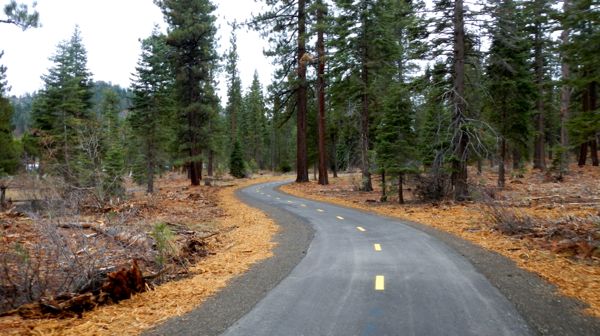
Now there is an alternative to that harrowing ride. A 1.7-mile Class 1 bike path was laid down this fall. It essentially follows what had been a dirt path mountain bikers would use.

It starts at Viking Way at the base of South Tahoe High School, meanders through the woods – with singed trees from the 2007 Angora Fire still visible, and ends at Sawmill Road.

The nearly $800,000 trail is on U.S. Forest Service land, operated by El Dorado County under a special use permit.

“There is no plan to extend a Class 1 bike path,” Donaldo Palaroan, senior civil engineer with El Dorado County, told Lake Tahoe News. “However, we do plan to construct bike lanes toward Clear View Drive where the bike lane currently ends. So, a Class 2 bike lane will be extended from Clear View Drive/Mule Deer Circle to Sawmill Road to connect with the Lake Tahoe Boulevard bike path and the Sawmill 2 bike path.”

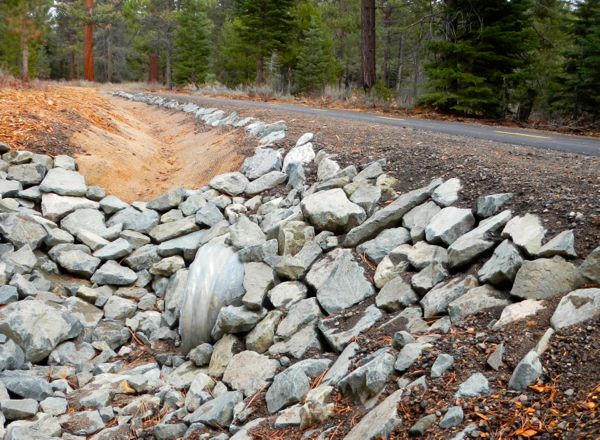
Erosion control measures line the trail.

Erosion control measures line the trail.

While road bike riders traditionally prefer the road to a path because they can go faster and not be encumbered by other users, they have been seen on this trail.

“Bikers are hypersensitive to 3,000-pound-plus metallic objects lumbering down the road at or above of 50 mph while rocking out to Axle Rose and Slash, particularly when those objects are within an arm’s reach,” Garrett Villanueva, USFS trails specialist, told Lake Tahoe News. “So, I think some roadies will use the bike path and I think recreational or less experienced bicyclists will tend to use the path exclusively.”

Mountain bikers are also using the trail. This gets them to dirt trails in the Tahoe Mountain area. A sign at the Sawmill end includes a permanent map that lists the various trails in the area.

Walkers, dogs and inline skaters have also been populating the trail.

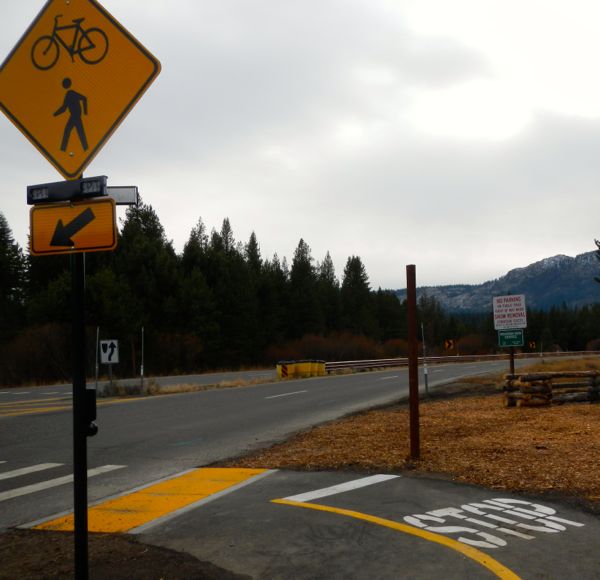
At the Sawmill juncture people have the choice to get onto Lake Tahoe Boulevard without any lane markings or to cross the boulevard to get onto Sawmill Road. Eventually the county is going to reduce Lake Tahoe Boulevard to one lane in each direction from Sawmill to Tahoe Mountain Road.

At the crosswalk there is a button that will trigger a flashing yellow light to warn motorists people are in the road.

The new path connects to the Sawmill Road trail.

The new path connects to the Sawmill Road trail.

Once across people have the opportunity to be on a trail for seven-tenths of a mile along Sawmill Road that was built in 2012. In 2015, the rest of the trail will be constructed. In total it will be 1.3 miles. The second half will remain on the same side as the current trail (which wasn’t always the plan) and has already been outlined. The erosion control work for the trail was done this year.

Once that section is done it’s possible to be on a bike trail from Meyers to STHS.

Future connections include going from STHS to the Y.

There is limited parking at Sawmill Road and Lake Tahoe Boulevard.