Weather apps not all created the same

By Molly Wood, New York Times

Weather can be a great equalizer. It can also be a way to make conversation with just about everyone.

No wonder, then, that the weather forecast is one of the pieces of information many of us crave when starting each day — and that weather apps are among the most frequently used programs on smartphones.

Weather apps aren’t all created equal, though. The built-in apps on iPhones and Android phones are perfectly serviceable, offering glanceable forecasts for as many cities as you want, and they’re tied into the phones’ virtual assistants. But weather technology — both the creation and presentation of forecasts — is evolving quickly. It’s worth checking out the options.

For prettier backdrops, Yahoo Weather is hands down the most gorgeous app out there. Weather Underground’s app is for budding meteorologists who want to dig deep into weather conditions, and Dark Sky’s mesmerizing globe of animated weather patterns is a great party trick.

In the end, though, finding the right weather app is really a matter of personal taste in the design, how much information you want and, crucially, how much you trust the forecast. And there is a bit of a philosophical difference brewing in terms of how those forecasts are created.

Now, weather apps are often powered by one of a few sources of information, including the Weather Channel and Weather Underground (both of which are owned by the Weather Company), and Weatherbug and AccuWeather.

Read the whole story


Tahoe Tails — Adoptable Pets in South Lake Tahoe

Bomber

Bomber

Bomber is a 4-year-old poodle-Yorkie mix. He has very nice manners, walks well on his leash and loves to snuggle with people.

He does well with other dogs and likes to play with them, but he can be a little bossy. Bomber weighs 7 pounds, and will need to be groomed regularly.

Bomber is neutered, microchipped, tested for heart worm, and vaccinated.

He is at the El Dorado County Animal Services shelter in Meyers, along with many other dogs and cats who are waiting for their new homes. Go to the Tahoe animal shelter’s Facebook page to see photos and descriptions of all pets at the shelter.

Call 530.573.7925 for directions, hours, and other information on adopting a pet.

For spay-neuter assistance for South Tahoe residents, go online.

— Karen Kuentz


Collaborative effort to monitor groundwater

By Kathryn Reed

Despite a multi-year drought, the amount of groundwater in the basin is still more than what is extracted every year — at least for now.

But overdrafting – the name for when more groundwater is used compared to what is replenished – is a problem in the Central Valley. When overdrafting occurs the groundwater level as measured by a monitoring well would get lower and farther from the ground surface.

California, until this year, did not regulate groundwater. Now a regional approach is being taken to better manage use, understand how much is being used as well as know the quality of that water. And if the regions don’t create a plan, the state will come in and do so.

“California was the Wild West of groundwater rules, where most other Western states manage groundwater on a state or regional basis,” explained Richard Solbrig, general manager of South Tahoe Public Utility District.

The entity with the longest straw was able to tap the groundwater, is how Solbrig described groundwater rules until this year.
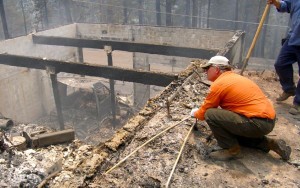
District crews crimping water supply lines in burn area. Photo/STPUD

South Tahoe PUD crews crip water supply lines in the Angora burn area. Photo/STPUD

The district was ahead of the state’s mandate and for the last year had been convening a stakeholders advisory group to come up with a plan. South Tahoe PUD’s board on Dec. 4 approved the Groundwater Basin Management Strategy Plan.

The district at the start of this century created a Groundwater Management Plan in the wake of the gasoline additive MTBE contaminating its wells. In many ways, the new plan is an extension, revision and update of the 14-year-old document.

Participants in the regional plan included Lukins Brothers Water Company, Tahoe Keys Water Company, Lahontan Regional Water Quality Control Board, South Lake Tahoe, El Dorado County, Tahoe Regional Planning Agency, Barton Health, Lake Tahoe Unified School District, a local gas station owner, and Harold Singer (former head of Lahontan) as the public member.

“(The goal was to) formulate a plan and a path forward in appropriately managing groundwater, including land use elements, monitoring, legacy contaminants such as PCE and MTBE, and pursuit of grant funding from Proposition 1 just passed, among other items,” Solbrig told Lake Tahoe News.

As Lake Tahoe's level drop, so goes the wells used by water companies. Photo/LTN file

As Lake Tahoe’s level drop, so goes the wells used by water companies. Photo/LTN file

The state is requiring a groundwater sustainability agency be created within two years. Having a plan is the first step to forming the agency.

The state is ranking regions on a low, medium and high priority for dealing with groundwater issues. The South Shore is rated medium because of ongoing contamination issues related to gas stations and dry cleaners.

The local group is hoping to receive Proposition 1 – the state water bond passed in November – money to deal with some of the issues as well as to help form the agency.

STPUD, Lukins and Tahoe Keys all use well water. The U.S. Forest Service has a well to service the Valhalla-Tallac area. Lakeside Water Company, near the state line, uses water directly from the lake. It has one well for emergency purposes.

Most water company wells are 300 to 500 feet deep. With the drought, the wells closer to the lake are seeing a change of water depth of about 5 feet and the wells farther way, say in Christmas Valley, have about a 10-foot difference. That, according to Solbrig, does not affect production.

“We still have 500 to 600 private wells in the basin,” Solbrig said. “They might be 50-years-old and 50- to 75-feet deep. A change of 5 to 10 feet could make the difference of producing no water.”

The plan is considering private and public wells.

There is a direct correlation in well level fluctuation with the level of Lake Tahoe.
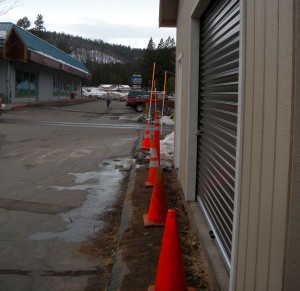
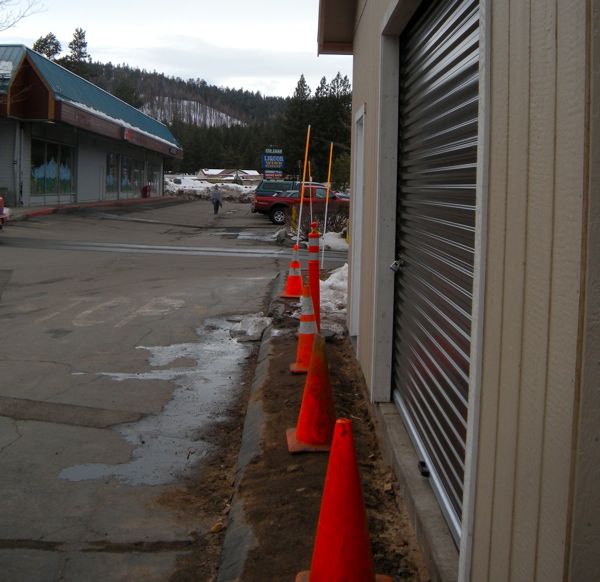
This structure will house remediation equipment to cleanup soil and groundwater contamination at the other end of the parking lot. Photo/Kathryn Reed.

This structure houses remediation equipment to cleanup soil and groundwater contamination in South Lake Tahoe. Photo/LTN file

STPUD will be the lead on the groundwater plan for the South Shore, in large part because it is the largest groundwater user in the basin. The group will meet once a year or more often if needed.

Various components are included in the plan, like paying attention to where any new wells would be drilled. The goal is to not influence the water table so it would have a negative environment impact by altering stream environmental zones or vegetation.

“One thing we will do is collect production data, and file regional based reports and estimates of the recharge,” Solbrig said.

Precipitation will be monitored and it will be compared to usage.

That type of data has long been required of surface water users. It’s a first for those tapping the groundwater.

It is better if moisture comes in the form of snow – even locally. Rain just means it all rushes to the lake faster. Snowpack means it gradually seeps back into the water table. Plus, then the water is distributed more uniformly underground and there won’t be dry pockets in outlying areas.

South Tahoe PUD supplies Heavenly Mountain Resort with water for snowmaking. Solbrig said about 85 percent of what is used returns to groundwater. The other 15 percent is lost in the process and to evaporation.

This compares to irrigation that is mostly consumed by the vegetation the water is being applied to.

“Why we do the turf buyback is because a majority of water property owners put on is gone. It goes into the grass or evaporates off into the environment,” Solbrig said.




Opinion: Time to undo Daly’s damage

By Larry Weitzman

Although President Dwight D. Eisenhower used the term D-Day meaning Departed Day. For the purpose of this column it means Deficit Day and it is fast approaching.

Actually, El Dorado County is already running at a deficit and has been doing so for about a year and a half. At the end of the county fiscal year on June 30, 2013, EDC had a General Fund balance of about $54 million. At the end of the FY 2014, the General Fund balance was down to $45 million. In other words, spending exceeded revenue by $9 million and therefore operated for FY 2014 at a $9 million “loss.” That is operating at a deficit.

Larry Weitzman

Larry Weitzman

According to its own projections, the county General Fund for the FY 2015 (July 1, 2014, to June 30, 2015) will operate at a $32 million deficit. That’s based on a sales and property tax growth of 5 percent. Those revenue projections appear to be overstated in that just four months prior a similar EDC projection showed that property tax revenues would be flat over the next five years. That might be a more reasonable assumption since the real estate market is relatively flat.

Secondly, three years of history shows that property tax revenues for the fiscal years 2012, 2013 and 2014 were $52.5 million, $52.7 million and $54.6 million, respectively. There are some rising property tax assessments from Proposition 8, but the last three years don’t demonstrate the kind of growth projected in the latest forecasts. But let’s get to the real issues, the overspending created by former CAO Terri Daly.

In my Oct. 2 column, I discussed that the 170 new employees hired by Terri Daly over the last two years cost the county about $13,600,000 annually based on an average salary and benefits of $80,000. When you examine the fiscal history of the county, that number will become more important.

The county has little control over its revenues as it comes from taxes and fees, and right now there is little new activity which points to rising revenues except for minor property tax assessment adjustments because of Proposition 8. Otherwise revenues will probably grow no more than the rate of inflation. Even if property values rise significantly, other than Proposition 8 adjustments, Proposition 13 limits the rise in property tax revenues to just 2 percent a year. The only real way for significantly increased property taxes is new development and that doesn’t look too realistic considering the current slow/no-growth climate in El Dorado County.

But what the county can control is General Fund expenditures. And this is where history becomes important. According to our chief budget officer, salaries and benefits make up about 65 percent of the county General Fund expenditures. For the last four fiscal years, actual salary and benefit expenditures were as follows, FY 2011 $118.2 million, FY 2012 $116.0 million, FY 2013 $118.5 million and for FY 2014 $132.1 million. As you can see when the excessive employee hiring started during FY 2013 there was a small increase in salaries but from FY 2013 to FY 2014 the increased cost of employees grew by, that’s right, $13.6 million. Understand some of that increase was due to the first 5 percent of a 15 percent across the board pay raise (about a 1.75 percent impact), which is also Daly’s doing, that took effect in the middle of the FY 2014.

When EDC budgets and forecasts included are all employee positions whether filled or not. For the FY 2015 the forecasted budget shows $153 million in salary and benefits. But currently there is an 8 percent vacancy factor (that is average vacancy rate for unfilled positions for the last several years), so if none of those positions is filled, the real expenditure for salary and benefits should be about $141milliion. That would still mean a deficit for the year of about $20 million.

When you compare FY 2015’s $141 million in salary and benefit expenditures to the level of FY 2013, the increase in salary and benefits over the two year period is $23 million. It is the main cause of the EDC deficit. The secondary cause is the Daly 15 percent raise. When it becomes fully implemented during the FY 2015, salary and benefit expenditures will continue to grow for the following years and the deficit for future years will make the current situation look like small potatoes as revenue growth will not keep up.

Even EDC’s own salary and benefit expenditures are projected to grow about $8 million annually for the next four years with a corrected number (unfilled positions accounted for) of $172 million by FY 2019. An actual projected growth of $31 million over four years and $54 million since FY 2013 all because of 170 mostly unnecessary new employees hired by Daly.

As written in previous columns, the position of the county is untenable.

What is the solution? It’s a rather obvious one in that there has been little change, if any in county services over the last three years, so it appears there is no identifiable benefit from the 170 new hires. As to public safety, the sheriff has essentially no new hires from these recently hired 170 employees. The plurality of the 170 employees was hired into the CAO’s office. Yes, by Daly. She packed her office with 18 do nothing analysts, fiscal techs and other administrative positions that alone cost the county nearly $2 million a year. Daly said in recent open session of the Board of Supervisors that “even with these new 170 hires, the county is not back to pre-recession levels,” implying that we are no longer in a recession. That’s funny, perhaps Daly could explain why the nation’s work force has shrunk to its lowest level in decades, income is still below pre-recession levels, housing prices are still in the tank in spite of historically low interest rates and most new jobs are low level, low pay retail and service jobs.

The solution is obvious, the county is going to have to lay-off most of those 170 new employees and most of the deficit will magically disappear. There should also be a freeze of the last portion of the Daly 15 percent raise. Done, problem solved. Now who on the BOS has the guts to do it?

Larry Weitzman is a resident of Rescue.


Guldemond takes Dew Tour title

By USSA

BRECKENRIDGE, Colo. — On the final day of competition at the 10th annual Dew Tour, veteran slopestyle rider Chas Guldemond (Reno) walked away with the second Dew Tour win of his career. Landing a solid first run with his brand new switch double wildcat and three double cork 1080s, Guldemond would prove to be unbeatable posting a 92 score after his first run.

Canadian Sebastien Toutant, put together a solid second run with back-to-back double cork 1080s that moved him into second just in front of fellow Canadian Tyler Nicholson.

Winning run: 270 onto the Nixon 20+ handrail, 450 off the Mountain Dew handrail, switch double wildcat, switch backside double 1080, cab 270 onto Toyota rainbow rail, cab double 1260, backside double 1080.

U.S. Snowboarding athletes have earned six of the twelve podium spots at the 2014 Dew Tour with Taylor Gold, Kelly Clark, Jamie Anderson and Guldemond winning their events.


Internet has made shoppers smarter

By Shelly Banjo and Sara Germano, Wall Street Journal

OCONOMOWOC, Wis.— Elisabeth Hoffman and fiancé Josh Loeser paused by a display of artfully decorated cakes and pastries while shopping recently at a Pick ‘n Save grocery store here. But after a split second of interest, their expressions faded.

“They’re not on the list,” said Hoffman, a 35-year-old interior designer and remodeler, as they pushed on to pick up chicken breast and diced tomatoes for a chicken chili recipe.

She and Loeser, a 30-year-old heating and ventilation repairman, have adopted a series of habits to make sure they buy only what they came for. They shop together, for instance, and when possible they avoid grocery carts, which come with the temptation to fill them up.

Retailers wondering what’s gone wrong with their business could learn a lot from the couple—and from other Milwaukee-area families The Wall Street Journal spent time with this fall. Observations of their carefully executed shopping plans identified what may be an endangered species in the retail landscape: the impulse buy.

A new intentionality has taken hold of shopping. Many Americans have the money and the will to spend. But they are time-pressed and deal savvy, visiting stores only when they run out of items like cereal or toilet paper and after doing extensive research on purchases online and with friends. They buy what they came for—and then leave.

Those habits threaten more than just gum sales at checkout. Impulse is why stores offer deep discounts on loss leaders, why they put the milk in the back corner and why marketers spend heavily to pile up products in displays at the ends of the aisles. If shoppers just target the deals and don’t let their eyes wander, long cherished models for boosting sales fall apart.

Read the whole story


Digital security a growing concern

By Nicole Perlroth, New York Times

Paul Kocher, one of the country’s leading cryptographers, says he thinks the explanation for the world’s dismal state of digital security may lie in two charts.

One shows the number of airplane deaths per miles flown, which decreased to one-thousandth of what it was in 1945 with the advent of the Federal Aviation Administration in 1958 and stricter security and maintenance protocols. The other, which details the number of new computer security threats, shows the opposite. There has been more than a 10,000-fold increase in the number of new digital threats over the last 12 years.

The problem, Kocher and security experts reason, is a lack of liability and urgency. The Internet is still largely held together with Band-Aid fixes. Computer security is not well regulated, even as enormous amounts of private, medical and financial data and the nation’s computerized critical infrastructure — oil pipelines, railroad tracks, water treatment facilities and the power grid — move online.

In a speech two years ago, Leon Panetta, the former defense secretary, predicted it would take a “cyber-Pearl Harbor” — a crippling attack that would cause physical destruction and loss of life — to wake up the nation to the vulnerabilities in its computer systems.

Read the whole story


EDC planners deny South Shore cell tower

El Dorado County planning commissioners denied the request by Cingular Wireless/AT&T to erect a cell tower on the south side of Skyline Drive about one mile northeast of the intersection of Highway 50 and Pioneer Trail on the South Shore.

Residents in the area had voiced concerns about the tower. Because of all the houses the commissioners said no.

The applicant could appeal the Dec. 11 decision.

The proposal was for a 113-foot monopine tower with nine panel antennas, equipment shelter, related ground equipment, HVAC units, sound barrier walls, and solid wood fence.

In April 2007, the Tahoe Regional Planning Agency denied a similar application.

“TRPA would have to approve the tower. That could be done at the hearings officer level – but back in 2007 it got elevated to the Governing Board and voted down,” TRPA spokesman Tom Lotshaw told Lake Tahoe News.

At that time it was a Verizon proposal. Minutes from the TRPA meeting show residents were concerned about health and safety issues, similar to what was voiced before the Dec. 11 county meeting in Placerville.

Prior to the county meeting Cingular Wireless/AT&T was working on an application with TRPA, but nothing had been submitted.

— Lake Tahoe News staff report


U.S. birthrate hits new low

By Karen Kaplan, Los Angeles Times

American women gave birth to 3,932,181 babies in 2013 as the nation’s birthrate fell to another record low, federal researchers reported.

The total number of births declined for the sixth straight year, with only 62.5 babies born for every 1,000 women between the ages of 15 and 44. The birthrate has dropped 10 percent since peaking in 2007.

The continuing baby bust comes courtesy of women under the age of 30, who are increasingly delaying motherhood until they are older. The birthrate for women ages 20 to 24 fell 3 percent between 2012 and 2013, and dipped 1 percent for women ages 25 to 29. Last year, there were 80.7 babies born for every 1,000 women in their early 20s, along with 105.5 babies born per 1,000 women in their later 20s.

Read the whole story


Snippets about Lake Tahoe

zephyr cove library• The Douglas County Public Library in Minden and Zephyr Cove will close Dec. 24 at 5pm and reopen Dec. 26.

• Tahoe Regional Planning Agency offices will be closed starting Dec. 24 and will reopen Jan. 5.

• Tahoe Youth & Family Services night of giving is Dec. 17-18.

• Soroptimist International South Lake Tahoe community grant applications are due Dec. 15.

• Stefanie Toutolmin, a preschool teacher at the now shuttered St. Theresa School in South Lake Tahoe, is reopening the preschool.