Congress ends federal ban on medical marijuana

By Evan Halper, Los Angeles Times

Tucked deep inside the 1,603-page federal spending measure is a provision that effectively ends the federal government’s prohibition on medical marijuana and signals a major shift in drug policy.

The bill’s passage over the weekend marks the first time Congress has approved nationally significant legislation backed by legalization advocates. It brings almost to a close two decades of tension between the states and Washington over medical use of marijuana.

Under the provision, states where medical pot is legal would no longer need to worry about federal drug agents raiding retail operations. Agents would be prohibited from doing so.

The Obama administration has largely followed that rule since last year as a matter of policy. But the measure approved as part of the spending bill, which President Obama plans to sign this week, will codify it as a matter of law.

Pot advocates had lobbied Congress to embrace the administration’s policy, which they warned was vulnerable to revision under a less tolerant future administration.

Read the whole story


Snippets about Lake Tahoe

opinion-stop-congress-from-taking-bike-money• Chuck Nelson, South Lake Tahoe resident and president of the Lake Tahoe Bicycle Coalition, was appointed to the California Bicycle Advisory Committee.

• A bobcat has been seen multiple times recently in Washoe Meadows State Park.

• Lira’s market in Meyers is contemplating putting in an electric car charging station.

• Surf Air, a private membership airline, is serving Oakland International Airport with daily nonstop flights to Truckee.

• Diamond Peak is opening Dec. 20.


SLTPD looking for drunken drivers

Update Dec. 16 9pm:

The Dec. 19 DUI checkpoint has been canceled because of the forecasted storm.

—-

South Lake Tahoe Police Department has plans for one  DUI/driver’s license checkpoint and 12 roving DUI saturation patrols this month.

The DUI saturation patrol will be operating from 7pm-3am now until Jan. 1. The DUI checkpoint will be Dec. 19 from 7pm-2am.

Additionally, police, sheriff and the CHP throughout the region are deploying multiple DUI operations to increase DUI arrests.

In December 2012 there were 830 people killed in crashes involving at least one driver or motorcycle operator with a blood alcohol concentration of 0.08 or higher; 26 of those deaths occurred on Christmas Day. On average, a third (31 percent) of all crash fatalities in America involves drunken driving. But on Christmas Day 2012, the percentage jumped to 36 percent. Every year, more than 10,322 people are killed by drunken drivers in America, with 802 of those in California. In California, an additional 24,000 are seriously injured.


How to balance home, office lives

By Paige Parker, Vegas Inc.

If it seems like your day job is taking over your night hours, you’re right. The Pew Research Center reports nearly half of all Americans do at least some work from home.

“In particular for those who run their own businesses, there is an epidemic of people working 24/7 and taking work home with them,” said Tina Forsyth, a business consultant and author of “The Entrepreneur’s Trap.”

The pressure to be constantly on the clock can have serious health consequences, according to the American Psychological Association, which found in 2012 that 65 percent of Americans cited work as a top source of stress. Untreated, chronic stress can lead to anxiety, insomnia, obesity and heart disease.

Read the whole story


Caesars misses $225 million interest payment

By Associated Press

Caesars Entertainment Corp. on Monday missed a $225 million interest payment it owes some of its creditors, giving the company 30 days to pay it or default.

A company official said in a financial filing that the company wouldn’t pay the $225 million its debt-heavy operations division owes because it was still negotiating with senior creditors for a deal that would restructure the division’s debt.

The missed deadline didn’t come as a surprise. Analysts and those watching the company’s financial situation had predicted the likelihood Caesars wouldn’t pay.

Caesars is the parent company of Harrah’s Lake Tahoe and Harveys in Stateline.

Alex Bumazhny with Fitch Ratings said days before that it was likely the company would miss it since it’s a payment to the operating division’s junior creditors. The company’s decision was predicated on how much time it wanted to buy to keep negotiating a deal with its first-in-line creditors to restructure finances ahead of a potentially messy bankruptcy filing, he said.

This gives the company 30 days.

Caesars had been talking with senior creditors for months in hopes of resolving its dire financial situation outside of potentially messy bankruptcy court proceedings. Some of those creditors had stopped negotiating and revealed the company’s proposal to split its operations division into a real estate investment trust with one entity owning the casinos and hotels and another paying to lease and manage them.

Among the ideas, Caesars officials proposed turning its flagship casino-hotel Caesars Palace into its own real estate investment trust and essentially mortgaging the property for $2.6 billion to raise cash to pay off lenders and bondholders.

Caesars had $1.5 billion in cash and $22.8 billion in debt as of Sept. 30.


NHP ramping up DUI patrols

Nationwide, approximately 10,000 motorists are killed in alcohol-related crashes annually. The Nevada Highway Patrol is increasing impaired driving enforcement now through Jan. 5 in an effort to reduce that number.

The enforcement is part of the state’s Joining Forces program, consisting of officers from law enforcement agencies statewide, and is designed to keep travelers safe during the holiday season with high-intensity enforcement that zeros in on drivers impaired by alcohol or drugs.

So far this year, Nevada has experienced 59 alcohol-related deaths on its roadways, a decrease of 16 from the same time in 2013.

The Nevada Office of Traffic Safety urges motorists to designate a sober driver, take taxis, stay overnight or call a friend when celebrating the holidays. Make plans to get home prior to leaving for the evening.

Impaired driving statistics:

· Somebody dies every 51 minutes in the U.S. from impaired driving.

· Male drivers ages 26 to 35 are involved in the most impaired driving fatalities.


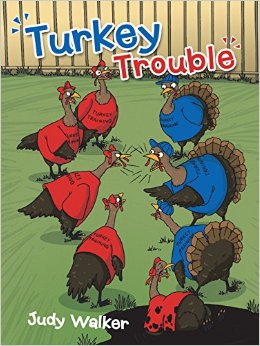
‘Turkey Trouble’ — serious message with fun

By Kathryn Reed

It would be hard to imagine anyone condoning bullying. Even bullies probably would like to overcome whatever insecurity they have to be a nicer person.

What’s sad, though, is that children’s books are now being deliberately written to call attention to bullying. Maybe there has always been this intent by authors and just the marketing is different now.

turkey trouble bookNonetheless, a book that came out this year is all about how being nice and respectful of others will bring out the tender side of people. Actually, in this case, it’s all about creating tender turkeys.

“Turkey Trouble” was written by Judy Walker. She is an educator who has seen the taunts at school as well as how love and kindness can soften bullies.

According to NoBullying.com, 160,000 students miss school each day for fear of attack or intimidation by other students.

Walker is trying to defuse the bullying by showing how being kind has more rewards than being mean.

Using royal turkeys to illustrate her point brings the message to light without being overbearing. In fact, the word bully is not found in the book.

Like many books, there is a message in here that children will likely not consciously realize they are being taught. But on some level it is bound to resonate that acting a certain way – good or bad – has consequences.


BPA seeping into beverages a health concern

By Anahad O’Connor, New York Times

People who regularly drink from cans and plastic bottles may want to reconsider: A study shows that a common chemical in the containers can seep into beverages and raise blood pressure within a few hours.

The research raises new concerns about the chemical bisphenol A, or BPA, which is widely found in plastic bottles, plastic packaging and the linings of food and beverage cans. Chronic exposure to BPA, as it is commonly known, has been associated with heart disease, cancer and other health problems. But the new study is among the first to show that a single exposure to the chemical can have a direct and fairly immediate impact on cardiovascular health.

The study found that when people drank soy milk from a can, the levels of BPA in their urine rose dramatically within two hours – and so did their blood pressure. But on days when they drank the same beverage from glass bottles, which don’t use BPA linings, there was no significant change in their BPA levels or blood pressure.

A single instance of increased blood pressure may not be particularly harmful. But the findings suggest that for people who drink from multiple cans or plastic bottles every day, the repeated exposure over time could contribute to hypertension, said physician Karin B. Michels, an expert on BPA who was not involved in the new research.

Michels said the design of the new study was impressive and its findings “concerning.” About 30 percent of adults nationwide have hypertension, and BPA exposure is ubiquitous.

BPA has been used since the 1960s to make countless everyday products like plastic bottles, food containers, contact lenses, and even sippy cups and baby bottles. The chemical can leach into food, and studies show that the vast majority of Americans who are tested have BPA in their urine.

Read the whole story


Birders flock to South Shore for annual count

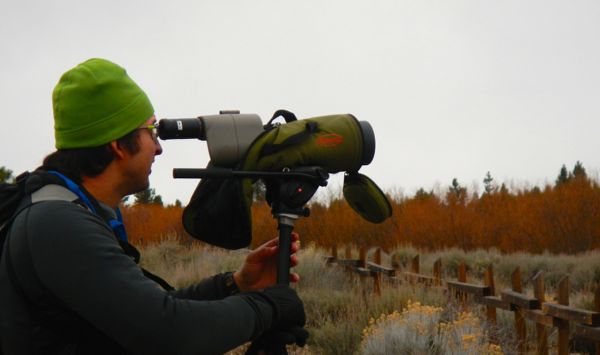
Scott Dietrich uses his scope Dec. 15 to better identify a bald eagle. Photos/Kathryn Reed

Scott Dietrich uses his scope Dec. 15 to better see a bald eagle. Photos/Kathryn Reed

By Kathryn Reed

With more than 300 bird species in the Lake Tahoe Basin, Scott Dietrich is on a quest to see as many as he can this year. Prior to the Dec. 15 Christmas bird count he was at 185.

Armed with binoculars to scan Cove East, Dietrich was quick to find the bald eagle perched atop a tree across the river and on the far side of the Upper Truckee Marsh. With a scope, there was no mistaking that white headed raptor.

The Incline Village resident has been birding for about seven years. While he does this mostly for fun, he has given birding tours and plans to again starting next May.

Dietrich’s most rare find was a short-eared owl that he saw in the Upper Truckee Marsh earlier in the fall. It’s unusual for this species to be at an elevation like Lake Tahoe’s.

His adventures take him to all parts of the lake, but it’s the South Shore he likes the most.

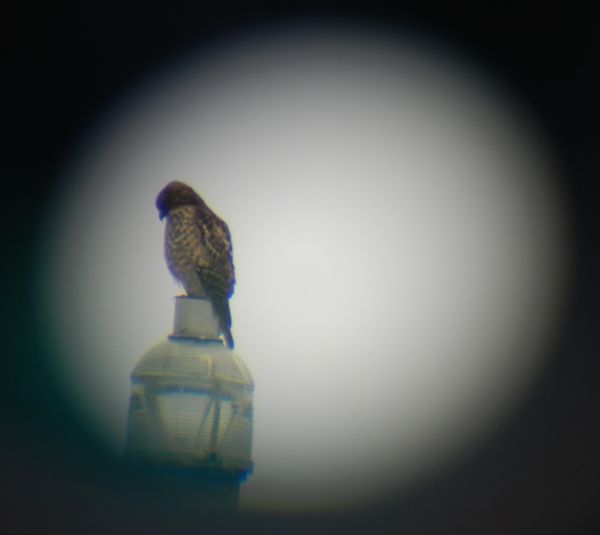
A red-shouldered hawk as  seen through a scope.

A red-shouldered hawk as seen through a scope.

“The Upper Truckee Marsh is probably the best area in Tahoe to look for rare birds,” Dietrich told Lake Tahoe News. “Lake Forest in Tahoe City is the other area for shorebirds.”

Dietrich was part of Monday’s annual bird count that takes place across the United States. This is the Audubon Society’s 115th annual bird count. Tahoe has been doing it since the early 1980s.

Data from the 2,300 counts will be tabulated by the national organization, which will document migration, breeding and other patterns.

Local numbers are still being calculated.

A 7½-mile radius, with the Upper Truckee Marsh being the center, is scoured for birds. Between 60 and 70 species have been documented the last few years. It’s the only bird count in the basin.

It didn’t matter that the temperature was in the 30s and snow was swirling in the air – this was the largest group to assemble for the annual count. They started at Cove East in South Lake Tahoe and then broke into groups stretching from Meyers to D.L. Bliss State Park to Cave Rock.

Before the group of 20 birders could get out of the roadway at Cove East the scopes were lined up looking at a red-shouldered hawk that was sitting on top of a pole at the Tahoe Keys Marina.

This bird used to be rare in Tahoe, but in the last few years it is common to find them at this higher elevation. Will Richardson, director of the Tahoe Institute for Natural Science, told Lake Tahoe News, “Bird populations are a dynamic thing. There are some natural contractions and expansions. Some is a result of climate change.”

But there is no disputing the avian population is changing.

“The Eurasian collared dove showed up a couple years ago. They came across the whole continent,” Richardson said.

A herring gull through a scope.

A herring gull through a scope.

Grace Mannell was probably the only one interested in seeing magpies. She recently moved here from the Bay Area, where this long-tailed bird is a rarity.

Some of the birders were on their first official count, others were veterans.

For Lynn and Don Harriman they have been counting birds every Wednesday for the last six years – either at Cove East or in the Upper Truckee Marsh.

“We wanted to see how the birds change through the years,” Don Harriman said of their avocation.

Almost everyone had binoculars, many had notepads to record what they saw, there were field books to help with identification and high-powered scopes — all tools of the trade.

Some of the birds were sitting still in trees, some flew overhead – like the two dozen robins, while others were on the water, and some were on the docks of the Keys – like the herring gull.

Three types of gulls call the Lake Tahoe Basin home – the herring, California, and ring billed. The herring is the most rare of the three. It’s here only in the winter. Those pink legs distinguish it from the others.

—–

Notes:

There will be a bald eagle count on Jan. 9. For more info, go online.


Opinion: U.S. must learn from torture report

By Dianne Feinstein

A week ago today, a five-year review of the CIA’s detention and interrogation program was finally made public, drawing back the curtains on a very dark period of American history. The purpose of making this report public is simple: to ensure something like this can never happen again.

The 500-page executive summary that was made public is part of a larger 6,700-page review of a CIA program that included clear examples of torture, far outside the bounds of American values.

Dianne Feinstein

Dianne Feinstein

It’s important to remember the study is based on CIA’s own records: 6.3 million pages of the CIA cables, memos, reports, e-mails and other documents. These records from the very time the actions took place — appear extensively in the report’s 38,000 footnotes.

Many of these records were disturbing, at times deplorable.

But there was also some wisdom in those records, like a 2005 email from then-CIA Inspector General John Helgerson. It read, in part: “We have found that the Agency over the decades has continued to get itself in messes related to interrogation programs for one overriding reason: we do not document and learn from our experience — each generation of officers is left to improvise anew, with problematic results for our officers as individuals and for our Agency.”

This report provides that documentation, and now we need to learn from it and apply the lessons.

We must never again allow our country to veer so far off course. To do that, we have to study where we went wrong.

Sen. John McCain, R-Ariz., said last week on the Senate floor, “The truth is sometimes a hard pill to swallow.” Indeed, the executive summary includes some particularly vile treatment, and it’s difficult to comprehend what happened. We included these details to drive home how wrong and un-American this program was.

One detainee was kept awake for 180 hours — that’s more than seven days without sleep. One otherwise healthy detainee died while in custody, likely from hypothermia.

Beatings were common, painful stress positions were often used and threats were made against detainees’ lives and against their families. There were even mock executions.

All of this happened outside the normal system of checks and balances. Congress was blocked from oversigt, and policymakers reviewing the program were often misinformed. What guidelines existed to prevent abuse were repeatedly ignored.

The result of these actions? A program of interrogation and torture that yielded no information necessary to stop terrorist plots or capture terrorists.

This was an ugly program, but let me be clear: Our country is strong enough to own up to what we did and make the necessary changes to make sure it never happens again.

It’s what the most powerful country in the world should and must do.

Lindsey Graham, a Republican colleague from South Carolina who also spoke on the Senate floor on Dec. 9, made this point: The evils our enemies visit upon us are far worse than how we treated these prisoners, but we must hold ourselves to a much higher standard than ISIL or al Qaeda.

This isn’t about our enemies. This is about us.

So now we need to move forward. It’s time to finally enact federal laws that ban interrogation techniques like these from ever being used again.

In the coming days, I plan on joining several other senators in offering a series of recommendations that stem from this report. We shouldn’t have to rely on a presidential executive order, which could be reversed and is the only thing prohibiting the CIA from resuming this program.

Critics of this report have said that releasing it will make us less safe, that the world is too unstable to handle what this report found. In considering these concerns, I determined that there is never a good time to admit we tortured people, but it must be done.

But it’s not the report that’s at fault, it’s the fact that we allowed torture to happen in the first place.

When we released the report, I talked on the Senate floor about how the study was conducted, what was in it and what it meant.

But the speaker who followed me really put it in the proper context, and that was Sen. McCain.

No one knows better that torture doesn’t work than John. He spent five years as a prisoner of war. He lived this debate, and I’m proud to have him on my side.

John spoke eloquently, offering argument after argument against the use of torture.

One passage in particular stuck me: “It is essential to our success in this war that we ask those who fight it for us to remember at all times that they are defending a sacred ideal of how nations should be governed and conduct their relations with others — even our enemies.”

Let’s not forget that lesson. Let’s not repeat the same mistakes. I encourage everyone to read the report, come to your own conclusion and if you agree, join in the fight to end torture.

Dianne Feinstein represents California in the U.S. Senate.