FedEx, UPS confront record holiday season

By Heather Somerville, San Jose Mercury News

The next week will be a 24/7, backbreaking, sleep-deprived haul for couriers such as FedEx, the United Parcel Service and the U.S. Postal Service, the last connections to deliver many much-anticipated Christmas gifts. And there is no room for mistakes.

Last year’s fiasco — when retailers over-promised on deliveries and bad weather snarled courier services, causing millions of gifts to arrive long after Santa’s visit — is still a painful memory, and everyone is working hard to avoid repeating the same mistakes.

With e-commerce sales up 8 to 11 percent this holiday season, delivery services face record-high volumes of packages that must get from warehouses to beneath Christmas trees before next Thursday. And with more retailers promising Christmas delivery to last-minute shoppers — and some ill-prepared to make good on those promises — holiday shipping has become a massive and challenging undertaking. For everything to go smoothly, analysts say, retailers must accurately forecast how much inventory they will sell and when, and courier services must run their planes and trucks like clockwork.

Read the whole story


Douglas County water rate drama heating up

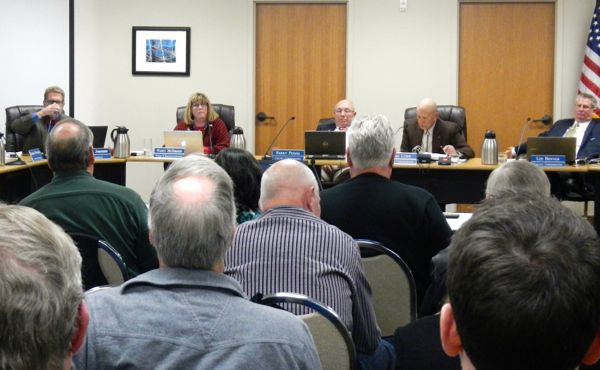
Douglas County commissioners on Dec. 18 discuss water issues. Photo/LTN

Douglas County commissioners on Dec. 18 discuss water issues. Photo/LTN

By Kathryn Reed

STATELINE – Mark Twain was on to something when he said, “Whiskey is for drinking, water is for fighting over.”

And when it comes to Douglas County, the fighting has been going on for years.

“I’m sure that I speak not only for myself when I say that if we are expected to pay for the most expensive little water system on the lake, then we expect something in return. We want to have a say in how our money is spent,” Jim Wire told the county commissioners at the Dec. 18 meeting. “What we expect is more accountability and more control. I propose that you establish a water advisory board with more power.”

Ratepayers are furious about having to continually pay exorbitant prices for water, not get adequate service and being left with an uneasy feeling about where all of their money has gone. The county has been operating the water systems for 25 years, but takes no responsibility for why things are the way they are and ratepayers feel they are being blamed for problems they did not create.

Resident Dana Tibbetts pointed out that Skyland is paying $100 less a month for water.

“Why?” she asked. “They are using the same water, the same pumps and getting the same service.”

No one answered her question.

No matter how many customers of the Cave Rock/Uppaway Water System spoke, the commissioners were resolved to vote for the staff’s recommendation on that and the Skyland Water System rate structures.

The vote was 4-1 on the Cave Rock plan, with Commissioner Barry Penzel dissenting. He wanted an advisory board. It was a 5-0 vote for Skyland.

Cave Rock/Uppaway customers will see rates drop from $202.46 per month to $172.68 in fiscal year 2015 and rise to $195.37 the following year.

In Skyland the monthly water bill for fiscal years 2015 and 2016 will drop by nearly 26 percent to $84.56.

While a couple people spoke against the Skyland proposal, most of the testimony was against the Cave Rock/Uppaway plan.

Most ratepayers anywhere would welcome a drop in rates. But when the reality is rates are projected to be $300/month for Cave Rock in the coming years, the ratepayers want a solution so their water bill is not equivalent to their property tax.

They were practically begging the commissioners to come up with a more permanent solution and not just a Band-Aid, as well as to let them have a seat at the table for a resolution. They got neither.

John McCall, after the meeting, told Lake Tahoe News that residents hired an engineer years ago to come up with a plan. It reportedly would have cost one-third of what the county implemented and would have been half paid for at this point.

Residents want commissioners to listen to them – not just to county staff because they believe staff isn’t relaying the whole story.

Water rates have been on commission agendas for years. The problem at the lake is that there are multiple agencies with their own budgets, so the cost of maintenance and other items is greater than it would be if expenses were shared with a larger pool of customers.

In the spring commissioners agreed to consolidate the lake water districts. But that unraveled when others protested in having to pay for debt that wasn’t theirs.

Commissioners agree a long-term solution needs to be created. Commissioner Nancy McDermid believes meters would be one solution – at least to get people to pay for what they use.

But there will always be fixed costs no matter how much one uses so the base rate could still be high.


STHS student died from blunt force trauma

By Kathryn Reed

An autopsy of 14-year-old Dejon Smith ruled the cause of death blunt force trauma.

The South Tahoe High School freshman died immediately, according to the Dec. 18 forensic autopsy conducted in Sacramento.

Dejon Smith

Dejon Smith

The results came hours before family and friends gathered Thursday night near the site where he died. A tree struck Smith during last week’s powerful windstorm.

While there is no question about how Smith died, there are plenty of unknowns about what led up to the tragedy and who might have more information.

“As in any kind of death investigation, we want to piece together the last hours of what happened,” Police Chief Brian Uhler told Lake Tahoe News.

Even if someone had seen the tree fall on Smith, no crime would have been committed by not reporting what happened. Civil charges could be a different situation.

Police said in the last week a friend of Smith’s admitted the two were “checking out houses” prior to the tragedy. No burglaries were reported.

“We are not sure what exactly was about to happen. There is no indication of other crimes in the area,” Uhler said.

Smith went out Dec. 11, knowing the next day had been deemed a snow day so there would be no school. But he didn’t come back and his parents reported him missing.

As is protocol, his information was entered into the Missing Unidentified Persons System because nearly one-quarter of the juveniles who run away from South Lake Tahoe are located in other jurisdictions. Police searched his neighborhood to no avail.

On Dec. 12 the boy’s parents received a call telling them about someone who may have information. Police say this is the youth who was with Smith looking at the houses for what are still unknown reasons.

“The juvenile described hearing a very loud crash, but denied seeing a tree fall. He was frightened and ran away. He believed Dejon likely did the same, but he had not seen him since,” a police press release states.

Searchers eventually found the body Dec. 13 under a large pine tree, almost completely concealed by branches. The pine tree was approximately 4 feet in diameter at its base. Firefighters had to use chain saws to section the tree into pieces to remove the body.

The investigation is not over. Officers have a list of people they intend to question. Tips may be called into the SLTPD at 530.542.6100 or to Secret Witness at 530.541.6800.


Opinion: TRPA Compact keeps protecting Tahoe

By Shelly Aldean

Forty-five years ago, in December 1969, President Richard Nixon signed a unique bi-state compact approving California and Nevada’s plan to create the Tahoe Regional Planning Agency. It was the first such undertaking of its kind, uniting two states, six local jurisdictions, and the federal government in a shared mission to protect Lake Tahoe’s sensitive environment from overdevelopment.

Shelly Aldean

Shelly Aldean

That effort has shaped the Tahoe we know and love today, and will help shape the Tahoe that we bequeath to future generations.

As we mark this important milestone, it’s important to note that some of our progress is measured by what’s not seen at Tahoe. The creation of the TRPA halted the runaway growth of the 1960s, ending plans for the development of a 750,000-resident city and a four-lane highway around the lake with a bridge across Emerald Bay.

Collaboration and progress have been a constant part of our efforts. So, too, unfortunately, has conflict.

Humans have cherished our beautiful mountain lake for thousands of years. Tahoe’s splendor inspires our imaginations and powers our appreciation of nature. It also supports a $5 billion per year economy and attracts millions of visitors annually. Residents, business owners, environmental groups, and tourists all have interests in Lake Tahoe’s well-being, and often hold differing views about how it should be protected and enjoyed. Our greatest progress over the past 45 years has been achieved through collaboration – and from working through our conflicts in search of compromise.

Disagreements about regulation and control between the states and local jurisdictions in the 1970s and differing views on the amount of development to permit at Tahoe in the 1980s led to the adoption of our prohibition on new housing subdivisions and our growth control caps for new lodging, commercial floor area, and homes. In the 1980s, consensus emerged from a plethora of opinions, resulting in the creation of an ambitious set of environmental thresholds that TRPA has a mandate to attain for key indicators such as air and water quality, lake clarity, fish and wildlife habitat, vegetation, scenery, and recreation.

None of our progress over the last 45 years has come without controversy or conflict, and yet, our progress has been real and noteworthy.

TRPA’s ban on highly polluting two-stroke watercraft engines at Tahoe was the nation’s first. It was highly controversial at the time, but has significantly improved our lake’s water quality. Our mandatory boat inspection program for aquatic invasive species prevention is considered a model for the nation.

Launched in the mid-1990s, the environmental improvement program has invested about $1.7 billion in federal, state, local, and private sector funding in projects that have stabilized our lake’s once-declining clarity, installed erosion control measures on 674 miles of roads, treated almost 56,000 acres of forest land with hazardous fuel reduction projects, restored 20,000 acres of wildlife habitat, improved public shoreline access, and built 137 miles of new bicycle and pedestrian routes.

Conflict has often tested the commitment to our unified effort, but it has been unable to break our common bond and purpose. Instead, it has strengthened our resolve and led to some of our greatest accomplishments.

In the years leading up to the adoption of the Regional Plan update in December 2012, differences emerged between California and Nevada that threatened to break apart our bi-state Compact. Once again, we found common ground with a science-based plan designed to improve lake clarity, make communities more walkable and bikeable, and streamline the permitting process for homeowners and businesses.

California and Nevada are as committed as ever to our shared mission, and to the continued implementation of that Regional Plan Update for the benefit of our environment and our communities. California Gov. Jerry Brown put it best at this year’s Lake Tahoe Summit in August when he said, “A breakdown can pave the way for a breakthrough.”

We have much to be proud of after 45 years, but much more to do. Conflict and differences of opinion over policy at Tahoe will remain a constant part of our effort. The most important issue is how we manage that conflict, look at the needs of the basin holistically in our search for common ground, and chart the best path forward for our beautiful lake and surrounding communities. History has shown us time and time again that this is how real progress is made and true success is achieved.

In the words of Henry Ford, “Coming together is a beginning; keeping together is progress; working together is success.”

Shelly Aldean is chair of the Tahoe Regional Planning Agency Governing Board.


Land transfer good for N. Shore bike trails

With the transfer of the Firestone property to Placer County, the county can move forward with construction of the 2.4 miles of the Dollar Creek Shared Use Trail.

The North Tahoe Public Utility District board this month agreed to the deal.

The county agreed to assume the district’s full responsibility for the planning permit, construction, operations and maintenance for the trail that was assigned to the district in the 1988 agreement with the California Tahoe Conservancy for the purchase of the Firestone property.

The county plans to break ground next year with funding coming from a grant from the Federal Lands Access Program.

The trail on one end will link up to where the Tahoe City Public Utility District trail ends in Dollar Hill and end at Fulton Crescent.

— Lake Tahoe News staff report


Debunking the myths about flu

By Lance Orr

Flu season is under way. Misconceptions about the flu prevent people from taking the proper precautions. For example, being out in the cold does not cause the flu.

Lance Orr

Lance Orr

Here are a few more flu myths I hear and facts to help you stay healthy this winter.

Flu myths

Myth: If you think you have the flu, go to the doctor to get antibiotics.

Influenza is a virus and antibiotics, designed to kill bacteria, are not effective to treat flu. Some antiviral medicines, such as Tamiflu, could help and you should ask your doctor if it is right for you. The earlier the flu is detected, the more effective antiviral medicines can treat flu symptoms.

Myth: Mercury in the influenza vaccine will make you sick or give your child autism.

Thimerosal is a mercury-based preservative used to prevent contamination of influenza vaccine vials. Extensive research shows an extremely low dose of thimerosal in vaccines and has been found to be safe. If you are still concerned, thimerosal-free vaccines may be available. The nasal vaccine does not have thimerosal.

Myth: You can get the flu from the flu vaccine.

The flu vaccine is made from non-infectious, inactivated virus and cannot transmit the flu. Many mistake the vaccine’s side effects, which can sometimes give mild flu-like symptoms, with the flu.

Myth: Protection from the flu happens immediately after you get the vaccine.

It takes up to two weeks to get the vaccine’s immunity. If you are exposed before or during this wait period, you can still get sick.

Seeking medical care

Doctors are keeping a watchful eye on this year’s common flu strain, H3N2. The Centers for Disease Control and Prevention recommends if you have asthma, lung or heart problems, or diabetes, to see your doctor or go to urgent care at the first sign of the flu, as these conditions may worsen symptoms.

Most flu cases won’t need medical treatment, but in severe cases with the following symptoms, an emergency department visit is recommended.

Any child or adult who is short of breath, has return of fever and bad cough after starting to get well, has confusion or trouble waking up, or has the inability to take and keep down fluids should be seen by a physician.

Children with flu symptoms and a fever with rash, bluish or grayish lips or skin, or extreme irritability should visit the emergency department.

Babies who can’t eat or drink, have no tears when they cry or have a decrease in the number of wet diapers are showing signs of significant dehydration require medical attention.

Shoo the flu

Ask your primary care physician for a flu shot. If you don’t feel well and need to see a doctor, protect others and wear a flu mask, available at the emergency department or at a mask station located throughout the hospital. The flu vaccine, accompanied with frequent and thorough hand washing, are your best protections against the flu.

Lance Orr is the director of staff operations for the Barton Memorial Hospital Emergency Department.


Fire plus rain plus drought equal mud

By Amy Quinton, NPR

Less than an hour west of South Lake Tahoe, trucks carrying burned timber from the Eldorado National Forest roar down the canyon as chain saws buzz in the distance.

But U.S. Forest Service ecologist Becky Estes says besides humans, not much else in this forest seems alive.

“We’re standing in an area that … is going to be probably 100 percent mortality of the trees,” Estes says.

Rainstorms continue to pound drought-stricken California, where dangerous mudslides have caused serious damage in areas burned by wildfires. This year, the state had one of its worst wildfire seasons on record.

Starting in September, the King Fire burned nearly 100,000 acres in the Eldorado. In this steep river canyon, 50,000 acres burned in one day. Now the pine trees are black and lifeless, and not one pine needle remains on the branches.

Read the whole story


Tax fraud lands Placerville man in prison

A Placerville man is going to prison for tax fraud.

Thomas W. Stringfellow, 55, was sentenced Dec. 18 to 18 months in prison and ordered to pay $687,182 in restitution for willfully making false tax returns.

According to court documents, from 2006-10, Stringfellow underreported his business income on tax returns by more than $1.1 million, and underreported his personal income on tax returns by more than $1 million.

Stringfellow owned New Horizon Painting, and rather than depositing all of the business checks into the appropriate accounts, he cashed some of the checks and did not report those amounts as income.

In total, Stringfellow’s underreporting of his business income and his personal income led to a tax loss of more than $687,000.

— Lake Tahoe News staff report


The save-the-world diet for athletes

By Ben Radding, Outside

The Mediterranean diet burst into American consciousness in the mid 1970s when renowned physiologist Ancel Keys began championing it as a heart-healthy way to eat. Since then, the primarily plant-based program has oscillated in popularity.

Now, researchers are bringing it back because they believe it could play a key role in curbing global warming — and keep you fit, with some important caveats.

“We analyzed how diets are changing in 100 countries around the world, the impacts of different food types on greenhouse gas emissions and land use, and the health impacts of different diets,” says physician David Tilman, author of a study of the Mediterranean and similar pescatarian and vegetarian diets published in the journal Nature. “What we found is that alternative diets that have less empty calories and less meat are much healthier for you and have significant environmental advantages.”

Between 1961 and 2009, people began consuming more meat and empty calories —  calories from solid fats and added sugars, Tilman and his colleagues found. The researchers speculated that diets in 2050 would contain fewer servings of fruits and vegetables but 60 percent more empty calories and 25 to 50 percent more animal protein than the current American diet.

Read the whole story


Ski towns worry pot is bad for tourism

By Kristen Wyatt, AP

BRECKENRIDGE, Colo. — Business is booming in Colorado’s mountain resorts, and the addition of recreational marijuana stores this year has attracted customers curious about legalized pot. But there’s mounting anxiety that ski towns have embraced stoner culture a little too much, potentially damaging the state’s tourism brand.

That worry flared up in two resort towns last week. In Breckenridge, residents voted overwhelmingly to force downtown’s lone dispensary off Main Street to a less-visible location. And just up the road in Granby, town officials used a property annex to prevent a dispensary from opening.

The fear is that some families — a mainstay of the ski tourism industry — will stop vacationing here.

“It’s not a morality issue, or that we think marijuana is bad,” said Breckenridge Councilman Gary Gallagher, who supported legal marijuana but also voted to force the Breckenridge Cannabis Club out of downtown. “Marijuana, it is not in this country’s DNA yet. It’s a little bit too early.”

So far, there’s no indication that legal pot has damaged tourism, Colorado’s No. 2 industry. The state notched a record $17.3 billion in tourism spending the year after legalization, with a record 64.6 million visitors, and state tourism officials say 2014 is poised to top last year’s record.

But it’s an open question whether pot has anything to do with it. Officials cite the improving economy and the weather, with healthy snow totals historically being the most significant driver for mountain visits.

The state and its marijuana industry are barred by law from advertising weed out of state, and the head of the Colorado Tourism Office says the state isn’t tracking the role of marijuana in tourist behavior.

“It’s all anecdotal,” Al White said. “I have heard from some angry parents who said they’ll never come back to Colorado because of marijuana. And I’ve also heard from people who say they came to Colorado just to see the marijuana.

“At the end of the day, it may be having a modest effect, but it’s not huge either way.”

The recent friction isn’t the first time officials have moved to lower marijuana’s profile.

The nation’s largest ski operator, Vail Resorts, made headlines over the last year tearing down makeshift shelters built illicitly in hard-to-reach areas and used by stoners to “get safe,” mountain slang for toking up out of the cold and away from ski patrollers. Resorts across the state are dotted with the so-called smoke shacks, and some of them are decades old.

“We will continue to communicate that consumption of marijuana is illegal in public and on federal land,” Vail Resorts’ Russ Pecoraro said in a statement about destroying the shacks in its four areas, Beaver Creek, Breckenridge, Keystone and Vail.

Still, at rates greater than their urban neighbors, mountain communities backed marijuana legalization in 2012, including Breckenridge, an early and enthusiastic support base, and there’s no doubt that recreational pot has had an effect on ski towns.

A state-produced July report on the new marijuana industry concluded that 90 percent of recreational sales in mountain resort communities go to out-of-state visitors.

The influx of shoppers — and camera crews that have become frequent sights as they work on pot-themed news stories and documentaries — has prompted a lively debate among residents about how pot is changing their resorts.

“Whether you’re pro-marijuana or against marijuana, you have to be concerned about how tourists react to seeing it,” said Bob Gordman, a Breckenridge retiree who voted to move the dispensary.

Others say the marijuana novelty will die down naturally and that resort towns shouldn’t worry about dispensaries or the souvenir shops that put “Rocky Mountain High” puns on T-shirts.

“In five or 10 years, it’ll be no big issue,” said Bill Kiser, a Breckenridge retiree who voted to keep the dispensary on Main Street.

“Why don’t families get turned off when they go on vacation and see a bar and people drinking alcohol? Because they’re used to it,” Kiser said. “People will eventually get used to this, too.”