Study: Yoga may guard against heart disease

By BBC

Doing yoga may be a good way to protect against heart disease, particularly if you cannot do more vigorous exercise, research suggests.

A review in the Netherlands of 37 studies involving nearly 3,000 people found yoga was independently linked to a lowering of heart risk factors such as high blood pressure and cholesterol.

Yoga does not count toward the recommended physical activity that we should all do each week.

Experts say it may still be beneficial.

Yoga is an ancient form of exercise that focuses on strength, flexibility and breathing to boost physical and mental wellbeing.

Read the whole story


Vail has no desire to change Kirkwood’s vibe

Vail Resorts' wants to maintain Kirkwood Mountain Resort's character. Photos/Kathryn Reed

Vail Resorts’ wants to maintain Kirkwood Mountain Resort’s character. Photos/Kathryn Reed

By Susan Wood

KIRKWOOD – The power of Vail Resorts has shown its light on the remote ski area straddling El Dorado and Amador counties since the Colorado ski industry giant took it over for $18 million in 2012.

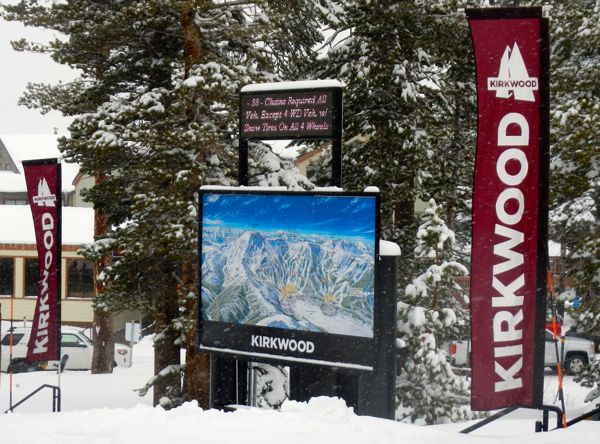
Upgrades and efficiencies at Kirkwood Mountain Resort range from the K Bar, an outdoor umbrella bar in the main area with views of the mountain, to permits for backcountry tours at Thunder, Avi and Reuter bowls, to a new kiosk to pick up tickets bought online, to a sign with real-time conditions, to all the safety bars that were installed on the chairlifts in year one.

“Over the past two seasons, we have focused our investment in the areas of maintenance and infrastructure. Some of our larger projects such as the K-Bar in the village mountain plaza and the ski patrol facility atop of the Wall are both guest centric and based on operational efficiency that greatly enhances our guests’ experience when they visit Kirkwood,” Casey Blann, Kirkwood general manager, told Lake Tahoe News.

Even though Vail Resorts releases the dollar figure for improvements at other resorts, Kirkwood officials were not forthcoming with the amount invested at their resort; only saying it’s been in the millions.
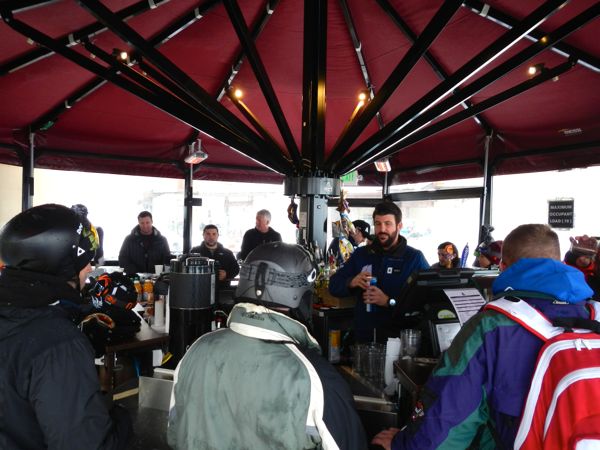
The K Bar in the plaza has views of the upper mountain.

The K Bar in the plaza has views of the upper mountain.

There are also Americans with Disabilities Act improvements, cellular phone upgrades, a new roof and windows for the Red Cliffs building, and new digs for ski patrollers – big enough to house a snowcat – at the top of the Wall chairlift.

Some upgrades are more subtle than others. New flooring was added to the Kirkwood Inn located down the road next to the Nordic Center.

One of the biggest improvements became effective Nov. 1 — the Wood is now on the grid. Following a huge fire on New Year’s Day 2010 that burned its powerhouse to the ground, the separate Kirkwood Meadows Public Utility District now gets its power for its 700 residents and the resort through Pacific Gas & Electric. The upgrade resulted from $263 million of loans secured by the U.S. Department of Agriculture. Kirkwood’s power has had periods of on and off electricity issues. But that incident left the community in the dark for a few days.

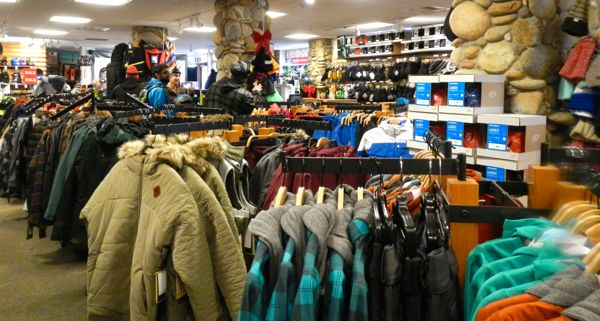
Retail offerings have been expanded.

Retail offerings have been expanded.

What’s different is how efficient things run since Pacific Gas & Electric lined up the ski area enclave.

Even with the windstorm earlier this month that knocked out power to much of South Lake Tahoe, Kirkwood had power. It went down, but within a few minutes came back up – unlike its lakeside counterpart. But it had nothing to do with being on the grid. The old diesel generators are now the resort’s backup supply.

“Being on the grid helps (for reliability),” Kirkwood spokesman Coop Cooper told Lake Tahoe News.

With all this said, upgrading Kirkwood is a different experience than Heavenly, Northstar and Park City, Utah – all resorts which Vail has bought in the last decade and poured cash into in order to appeal to a more upscale crowd. Kirkwood is not Northstar, nor is it Park City – Vail’s latest conquest that just got a $50 million pledge of money for improvements. A chairlift that links the northern Utah resort to nearby Canyons, another Vail property, was announced right away.

With Kirkwood, Vail has been assessing what’s needed and what the guests want. Whether that involves what’s outlined in the current master plan on file with the U.S. Forest Service remains to be seen.

Groomers/patrollers have better quarters, which expedites getting the mountain open.

Groomers/patrollers have better quarters, which expedites getting the mountain open.

“It’s Kirkwood. They know what they got. We’re going to keep the soul. But the neat thing about being in the Vail family is they’re taking a look at things and assessing (what to do next),” said Cooper, who dropped a few of the mantras the staff is working by: “operational efficiencies” and “reimagination.”

There’s even a separate mantra thrown out for single-day lift ticket buyers – “buy online, skip the line.” The kiosk sits flush with the most commonly used lift, Cornice as in Chair 6. And “real time” is used to describe the new sign next to it so guests can plan their day accordingly.

Efficiencies were also enhanced. One of them involved the new 2,048-square-foot “hut” on top of Chair 10, aka the Wall. The new one replaced the old structure that nearly tipped over in one of Kirkwood’s notorious windstorms. Now groomers starting their day at 6am can have the mountain from Palisades to Eagle Bowl ready by 9:40am.

Still, Cooper emphasized how Vail is dedicated to maintaining the undaunted character of the resort. Kirkwood is known for deep snow and expansive terrain with a hint of mountain funk that many old-timers want to see kept intact.

With his father-in-law Dick Reuter being one of the founders more than four decades ago, Cooper knows what that personality looks like. He even mentioned the bar and restaurant located across the street from the resort going back to the original name when Reuter frequented the place. It’s the Cornice Grill again.

It's often frosty at the Wood.

It’s often frosty at the Wood.

Kirkwood may mean deep snow and challenging terrain to many. It’s also a place for families to get away.

“Kirkwood is everything. We do have diverse terrain. It’s not just America’s deepest snow. We would alienate a lot of people that way,” Cooper said, referring to the Timber Creek beginning area set aside from the rest of the mountain.

A family of 21 people assembled at Kirkwood one recent Saturday seeking that special Kirkwood experience.

“We came here for one thing – to get our butts whipped,” said Alex Simon, who learned to ski 15 years ago at Kirkwood at age 6 and never forgot the feeling. As a self-identified intermediate skier, the Jupiter, Fla., resident insists Vail keep Kirkwood’s character. “We like just that rustic mountain vibe and that everyone’s friendly,” she said, while taking a break in the new K Bar.

The bar, which can collapse its umbrella with a push of a button and keep its windows erect, sits in the village on top of where the chiller that froze the skating rink once was located. Her father, Ron Simon, agreed about the need to keep Kirkwood, Kirkwood.

“No (big) changes (to the character) are why we keep coming back. We’ve been coming here as a family since the ’70s. It’s all about the skiing,” Simon said, while walking up to the bar table. The bar was picking up about 11am during a snowstorm with skiers and boarders seeking refuge and libations.

Signs alert riders to what is open.

Signs alert riders to what is open.

“If Kirkwood becomes another Northstar, I’m not coming,” Charles Christolini of San Francisco said, making his preferences known at the bottom of the Cornice Express. Christolini comes up about every week in the winter and has no desire to get Champagne served at 3pm like Northstar’s offering.

“We expected Kirkwood would be modernized. But Kirkwood needs to be about the mountain. People come here to ski first. It’s not about the après,” he said.

Christolini has noticed his favorite resort is more crowded with the coordinated Epic Vail pass that connects the Colorado, Utah and California resorts on one, as well as the pass for the three California resorts. Still, the buzz heard most often from the diehards is of accepting Vail’s piecemeal improvements that maintain the integrity of this resort known for its terrain, snow base and counterculture.


Editorial: Repeal of life sentences for minors should be retroactive

Publisher’s note: This editorial is from the Dec. 19, 2014, Los Angeles Times.

The Supreme Court made the right call two years ago when it found unconstitutional state laws mandating a life sentence without parole for minors convicted of grievous crimes. But in that decision, Miller vs. Alabama, the court left unresolved a crucial detail: Did the decision apply only to future cases, or did it extend to minors already serving life sentences? The court now has a chance to answer that question and to complete this important act of justice and decency by making the ruling retroactive.

The current case involves George Toca of Louisiana, who had just turned 17 in 1984 when, police said, he accidentally shot and killed an accomplice during a robbery. Toca maintains that someone else killed his friend (the Innocence Project has taken on the case), but that’s not the key issue in the appeal. After 30 years behind bars, Toca argues that he’s a different person than the child who was imprisoned in 1985 and that the Miller ruling means he should be able to offer mitigating evidence at a new sentencing hearing. Unsurprisingly, the state of Louisiana disagrees.

The Miller case involved a young man convicted of an even more heinous crime. In 2003, Miller, then 14, and a friend beat a neighbor with a baseball bat, then torched a house trailer with the victim still inside. The Supreme Court previously had recognized that, biologically and psychologically, young minds are not fully formed and, among other things, teens have an underdeveloped sense of responsibility. Given that, the court ruled in Miller that a mandatory sentence of life without parole for minors violated the 8th Amendment’s prohibition against cruel and unusual punishment. Sentences in such cases, the court held, must be tailored to the individual circumstances of the crime.

Read the whole story


Calif. law encourages EpiPens at all schools

By Joyce Tsaijtsai, San Jose Mercury News

A growing national consciousness on the dangers of food allergies is reflected in a state law that goes into effect Jan. 1, recommending schools keep vital medication on hand to prevent student deaths.

The Emergency Epinephrine Auto-injector Act, which was passed in September, recommends that at least one EpiPen injector is stocked at each public school, and at least one staff member is trained to use it. Similar laws have been passed in about 45 states nationwide, according to the nonprofit advocacy group Food Allergy Research & Education. In addition, a federal law was passed last year that rewards states that make it mandatory that schools stock epinephrine by giving them preferential treatment in awarding certain grants.

Prior to the law, if students had severe allergies, they had to carry their own EpiPen, or the devices were kept in stock at the school in their name. But EpiPens could not be administered if the devices were in another child’s name — all that could be done was to call 911.

Read the whole story


‘The Interview’ tickets sell fast at Minden theater

By KRNV-TV

MINDEN — Christmas Day is typically a big day at the movie theater. This year, there is one controversial movie that is helping draw the crowds.

It is the comedy “The Interview”. The Ironwood Cinema 8 in Minden is the only local theater showing this movie. It is selling out in theaters that are showing it across the nation, and Minden is no exception.

“According to marketing theory, this kind of event makes people even more hungry to watch it,” said South lake Tahoe resident Ryan Wong. “For example, something people who haven’t known it before and see it on the news and, ‘Oh, that’s a good one’ and probably want to watch it, but not only for the content itself. It’s probably for the, ‘I must support the freedom.'”

Read the whole story


Goats to feed on discarded Christmas trees

By Marcella Corona, Reno Gazette-Journal

It’s that time when decked-out Christmas trees covered in lights, glass ornaments and tinsel are at many homes. But what happens when it’s all over?

Most trees are tossed away outside or in landfills, creating potential fire hazards, said Vince Thomas, a volunteer firefighter with Truckee Meadows Fire Protection District.

“I’ve seen them everywhere, all you have to do is get off the beaten path a ways and you’ll see trees all over,” said Thomas, who’s worked as a firefighter for 26 years. “It was amazing to me to see how many Christmas trees people would just toss out there.”

But Thomas found an easy solution.

About 40 goats are leading the way for a new Christmas tree recycling program, launching Dec. 26.

Read the whole story


‘Traditional’ families no longer the norm

By Rebecca Adams, Huffington Post

When picturing the typical American family, you can forget about a “Leave It To Beaver”-type image. Currently, 54 percent of kids in this country don’t live in a home with two heterosexual parents in their first marriage, according to a recent Pew Research Center report.

“It’s important to keep in mind that what many define as ‘traditional’ is based on a 1950s-style family,” Gretchen Livingston, Senior Researcher at Pew and author of the study, told HuffPost in an email. “But in many ways, the 1950s and early 1960s were an anomaly, especially in terms of the fact that people were marrying quite young and also having relatively large families.”

Nowadays, only 46 percent of kids live in that aforementioned “traditional” family. Instead, 15 percent of today’s kids are living with two parents in a remarriage, 34 percent live with an unmarried parent, 4 percent live with cohabiting parents and 5 percent don’t live with either parent.

Read the whole story


Grappling with the culture of free

By Clyde Haberman, New York Times

Once upon a time, a new technology happened along. It was called radio. Soon enough, some people began plucking wireless transmissions out of the air for their own purposes.

One clever young man in Washington figured out how to intercept messages that Navy units sent to one another.

“He has represented himself to be at distant naval stations or at sea on warships equipped with wireless apparatus,” a magazine called Electrical World reported in 1907. Back then, this fellow’s actions were not unlawful. They amounted nonetheless to a form of piracy.

As radio grew more sophisticated, so did those intent on beating the system. In 1960s Britain, radio pirates flourished on unlicensed stations that broadcast from ships anchored beyond territorial limits. They found eager audiences in young people who tuned in for the latest from the Rolling Stones, the Kinks and the Who. (Talkin’ ′bout my generation.)

Then the world went digital. Naturally, pirates tagged along. One of them, the online sharing service Napster, forms the core of this Retro Report offering, the final installment in the current series of video documentaries examining the consequences of major news stories from the past.

Napster did not last long, two years. But for a while at the dawn of this century it claimed to have 70 million registered users. It spawned a host of Internet music-swapping providers, more than a few of them falling on the dubious side of the law. Most important, it irrevocably altered not only the way in which Americans absorbed music but also their belief system in what they should pay.

The conviction theologically held by many boiled down to a single word: nothing.

“You have a generation of people now who expect their music for free,” Greg Hammer, managing director of Red Bull Records, a branch of the energy-drink company, told Retro Report. “It’s very difficult to change.”

Read the whole story


E-books may be disruptive to sleep

By Nicholas Bakalar, New York Times

Planning to read in bed tonight? It may be better to read an actual book instead of an e-book reader. A small study has found that reading light-emitting electronic devices before bedtime is a recipe for poor sleep.

Researchers randomly assigned 12 healthy young adults to one of two activities: reading a light-emitting e-book in a dimly lit room for about four hours before bedtime on five consecutive evenings, or reading a printed book for the same amount of time.

All participants did both tasks.

Read the whole story


New Year’s Day guided hike at Spooner

Celebrate the new year with a free guided hike at Spooner Lake State Park.

This will be a snowshoe hike if there is adequate snow. The outing will follow the Spooner Lake loop trail, which is a little more than two miles. There is little change in elevation.

Park entrance fees are waived for hike participants.

Children are welcome, but dogs are not permitted. Dress warm and bring a snack and water. In the event of severe weather, the hike may be canceled.

The event is Jan. 1 from 10am-noon.