Squaw Valley patroller tests her endurance in outdoor reality TV show based in Alaska
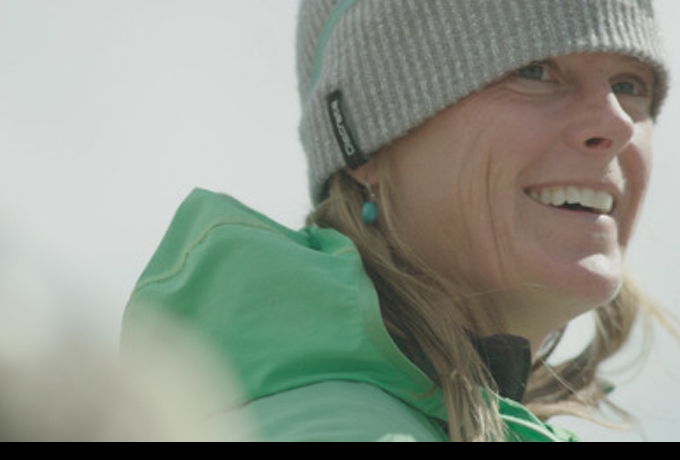
Lel Tone of Tahoe City is one of two women on this season's "Ultimate Survival Alaska" television show. Photos/National Geographic channel

Lel Tone of Tahoe City is one of two women on “Ultimate Survival Alaska” TV show. Photos/National Geographic channel

By Kathryn Reed

Lel Tone bounced like a ragdoll on the frozen tundra of Alaska as the dog sled team forged ahead; oblivious she was no longer in control. But she wasn’t about to let go. You never let go of the sled.

That is the lesson she learned as a ski patroller at Squaw Valley – and the mantra she maintains today when she is carrying someone downhill in a toboggan.

She is a force to be reckoned with, but that’s not obvious just by looking at her.

Don’t be fooled by the 44-year-old Tahoe City resident being barely 100 pounds. Her strength, tenacity and mental fortitude were put to the test this past summer when she spent three months participating in “Ultimate Survival Alaska”. The next season of the reality show airs Jan. 4 on the National Geographic channel.

“It was such an adventure … to have an opportunity to run around the wilderness in Alaska, to sleep under the stars (for 90 nights) in one of my favorite places on the planet,” Tone said. “It did feel really weird in mid-August to be under a roof again. I ended up sleeping on my porch to acclimate.”

Tone was picked for the show’s third season because of her heli ski guiding experience, mountaineering skills and avalanche forecasting abilities.
Talent_21_UltimateSurvivalAlaskaIII

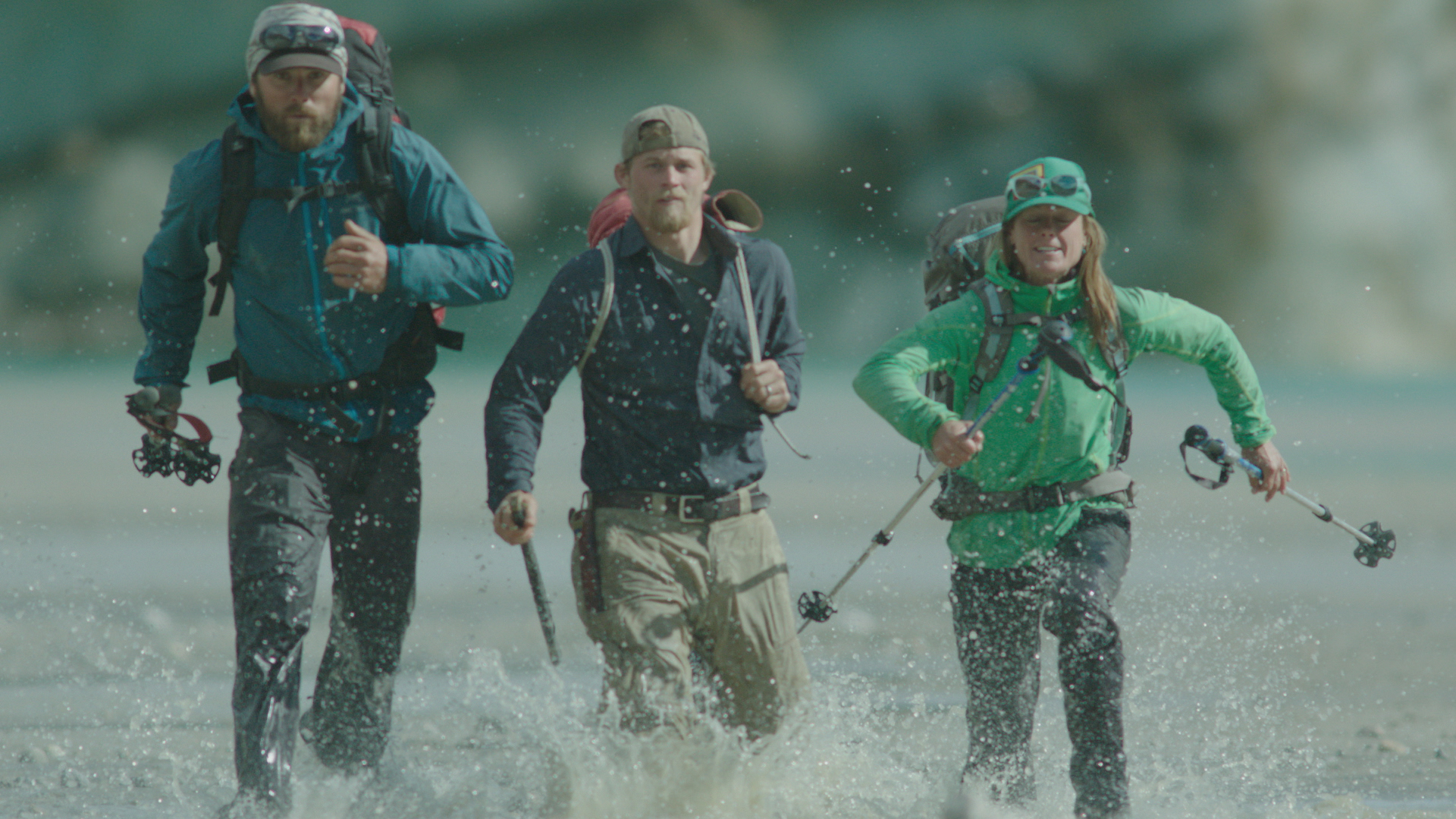
Lel Tone, right, holds her own with her male teammates.

She grew up in Switzerland, started skiing when she was a toddler, moved to the East Coast where she started ski racing while in college in Vermont and has been in Lake Tahoe for nearly two decades.

Tone was part of Team Endurance which consisted of two-time Iditarod champion Dallas Seavey, 27, of Alaska and mountain guide-rope access supervisor Ben Johns, 32, of Banff, Canada. But they didn’t know each other until they were thrown together in this adventure.

She is used to being on expeditions, like climbing Denali, where it’s a team, where you understand each other’s strengths and weaknesses.

A week before they met, Tone sent an email to the guys saying what gear she had and asking them what they had. Knowing they were about to entrust their lives to each other, the lack of coordination seemed a bit daunting.

Four teams of three participated in 13 challenges that required them to cross glaciers, raft whitewater, face predators, use means of travel – like dog sleds – they aren’t familiar with, scale mountains, bush whack and live off the land. They have the packs on the their back – Tone’s being about one-third her weight and equally as heavy as the guys’. No GPS, no phones.

At one point Tone whips out a .454 Casull, which makes one of her teammate’s weapons look like a child’s toy in comparison.

“My biggest concern was bear abatement and protection so I chose I gun that would do that job,” Tone told Lake Tahoe News as she took a break in the patrol shack at Siberia lift at Squaw. “I knew we could forage for food and fish for fish. The only thing in season for game was porcupine and ground squirrel.”

Large swaths of Alaska are bear country – and not the garbage variety black bears Tahoe is known for. She kept that .454 close by for quick, easy access.

“I have so much respect for big breasted women because I carried a chest harness. It weighed 7 pounds,” Tone said.

Her shoulders and neck were sore from carrying the gun and at times running with it strapped on.

Lel Tone in a snow cave for night with her teammates.

Lel Tone in a snow cave for the night with her teammates.

It was the water, though, that truly tested her grit.

“We ran a class 5 river at the end of the summer. That was probably one of my most frightening moments,” Tone said. “I have respect for fast running water, a respectful fear. I had to confront my fear of crossing rivers.”

Trusting her instinct got her through those sketchy situations.

Her ski patroller and guide jobs have taught her how to make cuts, when to throw bombs and when to hold back. Listening to her intuition when things didn’t feel right served her well during the filming.

Each team had a cameraman and producer. But they were extracted at the end of the day, able to eat real food and sleep off the ground. The teams were left to their own. If it wasn’t raining, they staked out a spot a little farther from one another; otherwise they were all under a tarp for protection.

On one of the more solo sleeping nights Tone was tempted to pull our her monster gun to eliminate a squirrel that wouldn’t stop squawking, but she knew it would freak her teammates out.

With it staying light out for hours, the production crew made sure each team took a mandatory four-hour break.

One of the hardest parts for Tone was making sure she had enough to eat. As an athlete competing in mountain bike and paddleboard races, Tone knows the importance of nutrition. But she didn’t have the luxury of well-balanced meals with unlimited ingredients at her disposal.

Rice, beans and foraging – those were her staples.

She came back 10 to 15 pounds lighter, but said it wasn’t a problem to put it back on since returning home.

Tone is happy to be back in Tahoe, but said she would jump at the chance to do something like “Ultimate Survival Alaska” again. For now she is part of Squaw’s patrol team. She will also be teaching avalanche courses this winter.

“I’m really passionate about teaching people how to be safe in their environment,” Tone said.

In mid-February she is off to Alaska where she is a heli ski guide for Chugach Powder Guides and Trudillo Mountain Lodge.

Summers find Tone racing paddleboards, being a mountain bike guide, piecing together guide work that often takes her to the Southern Hemisphere.

This year Outside magazine nominated Tone as one of the world’s top 10 guides. She was featured in the 2011 Warren Miller film “Like There is No Tomorrow”.

—-

Notes:

• “Ultimate Survival Alaska” two-hour season premiere is Jan. 4 at 9pm on National Geographic channel.



Editorial: Immigrant driver’s license policy makes sense

Publisher’s note: This editorial is from the Dec. 26, 2014, Los Angeles Times.

Beginning Jan. 1, immigrants who are here illegally will be able to take another small step out of the shadows by applying for California driver’s licenses.

It took years to enact this controversial policy, but ultimately granting licenses to qualified drivers, regardless of their legal status, is the right thing to do. Why? Because, as nine other states and the District of Columbia have figured out, ensuring public safety on the roadways is more important than punishing people for being in the country illegally.

As spelled out in AB 60, which was passed by the state Legislature and signed into law last year, applicants will have to clear reasonable hurdles. They must provide proof of identity (the accepted credentials, such as passports and birth certificates, vary by native country) and proof of California residency. They must then meet the same criteria as everyone else: Pass a written exam on the rules of the road, a vision test and a road test.

At the insistence of the Department of Homeland Security, each license will note that it is “not acceptable for federal purposes” and “does not establish eligibility for employment, voter registration, or public benefits.” Nor can the licenses be used to clear security checks at airports.

Read the whole story


Study: Teen e-cigarette use rising

By Sabrina Tavernise, New York Times

WASHINGTON — A new federal survey has found that e-cigarette use among teenagers has surpassed the use of traditional cigarettes as smoking has continued to decline. Health advocates say the trend for e-cigarette use is dangerous because it is making smoking seem normal again. They also worry it could lead to an increase in tobacco smoking, though the new data do not show that.

The survey, released Tuesday by the National Institute on Drug Abuse, measured drug and alcohol use this year among middle and high school students across the country. More than 41,000 students from 377 public and private schools participated. It is one of several such national surveys, and the most up-to-date.

It was the first time this survey measured e-cigarette use, so there were no comparative data on the change over time. Other surveys have shown e-cigarette use among middle and high school students to be much lower, but increasing fast.

Read the whole story


Study: Colorado sees increase in pot smokers

By John Ingold, Denver Post

As marijuana legalization took hold in Colorado, the estimated percentage of regular cannabis users in the state jumped to the second-highest level in the country, according to new federal data.

When asked, roughly one out of every eight Colorado residents over the age of 12 reported using marijuana in the previous month. Only Rhode Island topped Colorado in the percentage of residents who reported using marijuana as frequently.

The results come from the National Survey on Drug Use and Health and represent the average of estimates gathered in 2012 and 2013.

The numbers are among the first measurements of marijuana use in Colorado to be released after it became legal in late 2012 for people over 21 to use and possess marijuana in the state.

Read the whole story


Helped wanted signs signal economic growth

By Joyce M. Rosenberg, AP

NEW YORK — If you’re looking for signs that the U.S. economy is growing and that the job market is improving, just talk to small business owners.

After cutting back on spending for years, people are splurging again. That’s evident at Lady M Cake Boutiques.

Revenue is up 40 percent this year at the New York-based company with more customers paying $60 to $85 — three or four times what a supermarket cake costs — for confections made of paper-thin pastry dough and flavored with ingredients like green tea and chestnuts. Business is so good that owner Ken Romaniszyn, who has two locations in Manhattan and one in Los Angeles, plans three or four next year in New York, Boston and Charlotte, N.C. He’ll hire 60 new employees to staff the stores, adding to Lady M’s current staff of 145.

His cakes, which once appealed mostly to the wealthy, are now attracting a wider range of customers, Romaniszyn says.

“The middle class, they can afford to make a special occasion a little more special,” he says.

The U.S. economy is growing at a solid pace. This week, government figures showed that consumers and businesses drove growth to a sizzling 5 percent annual rate last quarter. Fewer Americans are applying for jobless benefits. In the first 11 months of this year, employers have added 2.65 million jobs. That already makes 2014 the best year for hiring since 1999.

A large chunk of the good news can be attributed to improvements at small companies. Reports from payroll company ADP and software maker Intuit show small business hiring has gained momentum since the summer. The trend looks to continue — surveys by Wells Fargo & Co. and the National Federation of Independent Business show more owners plan to bring in new employees in the coming months.

With revenue up 11 percent this year at her four Squeeze In restaurants in Reno and Truckee, owner Misty Young plans to add nine people to her staff of about 90 next year. She’ll also open a fifth restaurant next month in Redwood City, and hire 25 employees there.

Diners are spending an average 35 cents more per meal. When multiplied by the 270,000 people Young serves a year, it gives her an extra $94,500 in annual revenue, she says. Customers are ordering some of the most expensive items on the menu, like a $22 crab omelet. They’re willing to pay a few dollars more for a premium vodka like Grey Goose in their bloody Marys.

“People are in this ‘I deserve it’ mentality. They’ve worked hard and they want to play hard,” Young says.

The healthier economy is luring customers back to Spa Lamar for massages, facials and pedicures. Owner Heidi Lamar, who has 35 employees, is hiring to bring her staff back up to 50, the level before the recession.

Customers visit the Scottsdale spa more often, and they’re asking for more services. The average bill has soared this quarter to $122 from $98, Lamar says. She needs more staffers to handle the increased workload.

“The group we have is getting to the point where they’re maxed out,” she says.

The increase in business has encouraged Lamar to add new services such as massages for couples. She’s also renovating and painting the spa.

Some of the pickup in revenue comes from snowbirds, people who come to Arizona to escape the cold. But area residents are splurging on themselves again, she says.

“They say, ‘we’ve really missed you. It’s good to be coming back again,'” she says.


Vonn: Hard work, single-leg squats keyed comeback

By James S. Fell, Los Angeles Times

Dec. 6, 2014, was a good day to sit down with Lindsey Vonn. Her return to competition after a knee injury that crushed her Sochi Olympic dreams in February saw the star skier lead an American sweep in the World Cup downhill in Lake Louise, Canada, on Dec. 6. Vonn, a gold and bronze medalist in the Vancouver 2010 Olympics, started her career in Minnesota, a state not known for its long ski runs. But a move to Colorado and later making friends with her physical therapist has kept this 30-year-old downhill racer in the snowy spotlight.

The big story right now is your return to competition after injury. Tell me what happened.

The first injury in February 2013 was an MCL-ACL tibial plateau fracture [torn knee ligaments coupled with a knee fracture] and the second the following November was ACL meniscus…. One was during the World Championships and the other was right before the Olympics. To miss out on a race that happens once every four years is extremely disappointing.

Read the whole story


Marriott wants to block Wi-Fi hotspots

By David Goldman, CNN

Google and Microsoft have joined a growing chorus of businesses that oppose Marriott’s attempt to block guests’ Wi-Fi hotspots in their hotel rooms.

Marriott and the hotel lobby American Hospitality & Lodging Association asked the FCC this summer to allow hotels to deploy equipment that prevents people from turning their phones into Wi-Fi hotspots.

In order to avoid pricey hotel Wi-Fi charges, many guests opt to use their data allotment from their cell phone provider, connecting their laptops to the Internet via their smartphones.

At Marriott connection rates start at $14.95 per day. For $19.95, guests get “enhanced high speed Internet” which includes video chatting, downloading large files and streaming video.

Read the whole story


Gun violence: Suicide more likely than homicide

By Abbie VanSickle, Center for Investigative Reporting

Americans are nearly twice as likely to die from suicide by firearm as they are to be killed by someone else with a firearm, contributing to a rising suicide rate in this country, according to a new study published in the Annual Review of Public Health.

Suicides accounted for nearly two-thirds of deaths from firearms in 2012, according to the study, “The Epidemiology of Firearm Violence in the Twenty-First Century United States.” That year, 20,666 people died from suicide by firearm, compared with 11,622 who died from homicide by firearm.

That’s one firearm suicide every 25 minutes.

Mass shootings, such as the deadly school cafeteria shooting near Seattle in October, make headlines but account for a small percentage of firearms deaths each year, according to the study by Garen Wintemute, professor of emergency medicine and director of the Violence Prevention Research Program at the UC Davis. The four deadliest mass shootings in this century killed 84 people, the study says.

What makes guns such a common method of suicide? They are lethal and easy to obtain.

Easy access plays a role because suicide often is impulsive, according to research by Matthew Miller, a professor at Northeastern University and co-director of the Harvard Injury Control Research Center.

At a conference earlier this month near Boston on medical issues related to guns, Miller cited a Houston study of people who had survived a nearly fatal suicide attempt. For 70 percent of them, the time between deciding to kill themselves and attempting suicide was less than an hour. For 24 percent, it was less than five minutes.

One high-risk group: veterans. Wintemute reported that researchers have found suicide rates rising among both former and current members of the military. Veterans tend to have access to firearms and training in how to use them.

How does race fit into this picture?

For homicide by firearm, black men face a higher risk throughout most of their lives, researchers say, using data from the Centers for Disease Control and Prevention’s Web-based Injury Statistics Query and Reporting System. In 2012, for instance, the firearm homicide rate for black men between the ages of 20 and 29 was at least 20 times that for white men.

But suicide is another story. There, white men dominate, and the gap between them and black men widens with age. Among white men ages 35 to 64, there were 9,063 deaths from firearm violence in 2012. Nearly 90 percent were suicides.

Wintemute’s study also found that the U.S. is an outlier among industrialized countries in firearm deaths, with a substantially higher rate of both homicides and suicides.

Those deaths come at enormous cost. In 2010, researchers estimate, firearm suicides and homicides together cost society $164.6 billion, with suicides representing about 56 percent of that total. The costs include insurance claims, lost wages and lost tax revenue.


Snippets about Lake Tahoe

tahoe douglas fire• Mark Novak, assistant fire chief for Tahoe Douglas Fire Protection District, is going to be the No. 1 guy for the Vail Fire Department starting in February.

• Fifty-Fifty Brewing in Truckee is considered one of the best ski town brewpubs by Outside magazine.

• Fishermen, skaters and others are being told to be wary of venturing on ice because most of the lakes in and around the basin don’t have a thick enough layer to hold people.

• Truckee Donner Recreation & Park District is planning higher caliber of performances now that the Community Arts Center is renovated.

• Sharkey’s casino in Gardnerville is closed.


Realtors in South Tahoe recognize their own

By Sharon Kerrigan Gomez

Natalie Yanish, South Tahoe Association of Realtors 2014 president, passed the gavel to Brooke Hernandez, incoming president for 2015 at an Installation and Awards Dinner earlier this month at Edgewood Tahoe.

Sue Lowe, broker for Chase International Realty, was the installing officer and Ken Daley(of Re/Max Realty Today expertly emceed the event.

Ginger Nicolay-Davis of Help U Sell Lake Tahoe Properties and Theresa Souers of Pinnacle Real Estate Group of Lake Tahoe honored outstanding members for their contributions to the association this year:

  • Ellen Camacho (Deb Howard & Co) was honored with one of STAR’s community service awards for her tireless efforts with multiple organizations in the South Lake Tahoe community, including Soroptimist International of South Lake Tahoe and St. Theresa Church, as well as with STAR’s Community Service Committee.
  • Colleen Manzer (Re/Max Realty Today) received a community service award for her efforts throughout the community, especially her incredible commitment as chair of Soroptimist International of South Lake Tahoe’s annual wine tasting and silent auction fundraiser, which directly benefits women and youth in South Lake Tahoe.
  • Joe Filipko (Chase International South Tahoe Realty) was presented with the distinguished service award, and thanked for dedicating multiple years as STAR’s Multiple Listing Service Committee chair. He guided this committee through a lockbox exchange using new blue tooth technology, and has embarked on MLS data share discussions with neighboring organizations. Joe dedicates valuable time attending conferences at the state and national level exploring cutting edge technologies that members might benefit from, as well as stays abreast of current issues and trends effecting MLS’ throughout the nation.
  • New Realtor member Rhonda Keen (Help U Sell Lake Tahoe Properties) was recognized as the rookie of the year for jumping in as Scholarship chair in 2014 after having been a member for less than a year. She launched STAR’s first silent auction fundraiser at this event, which raised $875 for future scholarships.
  • Realtor of the year award was given to Craig Woodward (Deb Howard & Co), with gracious thanks for dedicating multiple years as Local Government Relations chair. He was praised for his tireless efforts attending local government agency meetings on STAR’s behalf, working with the Lake Tahoe South Shore Chamber of Commerce’s Government Affairs Committee, and especially on their new Independent Expenditure Committee which identified business friendly candidates in the local election and encouraged local constituents’ votes.

The members installed on the new board of directors for 2015:

  • Brooke Hernandez, president (Chase International South Tahoe Realty)
  • Ellen Camacho, president-elect (Deb Howard & Co)
  • Jim Wire, vice president (Chase International South Tahoe Realty)
  • Michelle Benedict, secretary-treasurer (Pinnacle Real Estate Group of Lake Tahoe)
  • Natalie Yanish, immediate past president (Deb Howard & Co)
  • Amanda Adams, director (Re/Max Realty Today)
  • Sheila Edner, director (Chase International South Tahoe Realty)
  • Jill Moffett, director (Sierra Sotheby’s International Realty)
  • Jessica Seifert, director (Century 21 at Tahoe Paradise)
  • Dan Spano, director (Paradise Real Estate)
  • Flip Walker, director (Pinnacle Real Estate Group of Lake Tahoe)
  • Craig Woodward, director (Deb Howard & Co)
  • Jesse Yohnka, director (Re/Max Realty Today)

Sharon Kerrigan is executive vice president of South Tahoe Association of Realtors.