CHP struggles to recruit minority officers

By Jon Ortiz, Sacramento Bee

Glancing at the 458 candidates who recently showed up for the California Highway Patrol’s applicant screening on a recent blustery morning, one wouldn’t think the department has a diversity problem.

The group that had gathered in the gym at the CHP’s West Sacramento academy came from the Sacramento region and mirrored its multi-hued ethnic palette. Brown and black. Yellow and white. No color stood out.

Yet if the history holds true, the tiny fraction of hopefuls who pass that physical fitness testing, survive a background check and manage to graduate from the CHP’s academy a year or so from now will swear an oath to take a job that pays $6,225 to $7,720 per month to start. Most of the graduates will be white.

While the CHP is trying to make inroads, it remains far less diverse than the state it patrols. Nearly 7 in 10 officers are white, compared to 4 in 10 Californians.

Read the whole story


Road beat: A minivan worth consideration

The Toyota Sienna is a mini van that has style, room and power. Photos/Larry Weitzman

The Toyota Sienna is a mini van that has style, room and power. Photos/Larry Weitzman

By Larry Weitzman

Let’s get something straight right from the start, minivans may be the most practical vehicles ever designed and with the new Toyota Sienna it gives away very little to other kinds of vehicles in performance and handling. But it has more utility than any other kind of vehicle. Sure, you’re not going to take it racing at a local track, but not so fast. As a support vehicle or even a tow vehicle it would be second to none with its 3,500 pound tow capacity.

Minivans are a simple upright two box design. But clean lines and a slick upslope nose give them a bit of style. The Sienna is at the top in that category with an excellent window line and no unnecessary add-ons. In fact, its cleanliness is reflected in an extremely slick coefficient of drag of 0.308.
Specifications Price $30,000 to about $47,000 Engine  3.5L DOHC 24 valve with VVT-i V-6 266 hp @ 6,600 rpm      245lbs.-ft. of torque @ 4,700 rpm Transmission Six speed electronically controlled automatic Configuration transverse mounted front engine/front wheel drive/all wheel drive Dimensions Wheelbase 119.3 inches Length 200.2 inches Width 78.1 inches Height 68.9 inches Weight 4,375 to 4,705 XLE AWD Track (f/r) 67.7/67.7 inches Ground clearance 6.6 inches Turning circle 37.4 feet Steering lock to lock 3.44 turns Fuel capacity 20 gallons Wheels 17X6.5 inch standard/18X7/19X7 inch optional Tow capacity 3,500 pounds Co efficient of drag 0.308 Cargo capacity 150.0 cubic feet (behind first row)   Performance 0-60 7.44 seconds 50-70 3.94 seconds 50-70 uphill 6.03 seconds Top Speed Faster than a speeding freight train Fuel economy 18/25/21 mpg city/highway/combined (6 cyl, FWD), 16/23/19 mpg city/highway/combined (V-6, AWD. Expect 20-22 mpg in rural country driving and 28 mpg at constant legal speeds on the highway.

Specifications
Price $30,000 to about $47,000
Engine
3.5L DOHC 24 valve with VVT-i V-6 266 hp @ 6,600 rpm
245lbs.-ft. of torque @ 4,700 rpm
Transmission
Six speed electronically controlled automatic
Configuration
transverse mounted front engine/front wheel drive/all wheel drive
Dimensions
Wheelbase 119.3 inches
Length 200.2 inches
Width 78.1 inches
Height 68.9 inches
Weight 4,375 to 4,705 XLE AWD
Track (f/r) 67.7/67.7 inches
Ground clearance 6.6 inches
Turning circle 37.4 feet
Steering lock to lock 3.44 turns
Fuel capacity 20 gallons
Wheels 17X6.5 inch standard/18X7/19X7 inch optional
Tow capacity 3,500 pounds
Co efficient of drag 0.308
Cargo capacity 150.0 cubic feet (behind first row)
Performance
0-60 7.44 seconds
50-70 3.94 seconds
50-70 uphill 6.03 seconds
Top Speed Faster than a speeding freight train
Fuel economy 18/25/21 mpg city/highway/combined (6 cyl, FWD), 16/23/19 mpg city/highway/combined (V-6, AWD. Expect 20-22 mpg in rural country driving and 28 mpg at constant legal speeds on the highway.

As a full-size minivan its dimensions are standard with a long wheelbase of 119 inches, a length of 200 inches, width of 78 inches and a height of 71 inches. Those are almost identical numbers of your standard full size SUV. While it may be dwarfed by a full size trucked based van, minivans are anything but small. That’s why they hold eight people in comfort with almost 40 cubic feet behind the third row. And this mini is no lightweight, tipping the scales at a portly 4,700 pounds for this AWD model. An FWD version saves you about 200 pounds.

So Toyota wisely makes its 3.5L DOHC 24 valve workhorse standard in all models, knocking down 266 hp at 6,200 rpm and 245 pounds of twist. The engine is also producing 220 hp at 4,700 rpm where peak torque is developed. Power is sent to the front wheels via a six speed auto cog swapper, except in this AWD version all wells are driven.

Sienna moves out quite smartly conquering the 0-60 mph acceleration benchmark is a short 7.44 seconds. That’s rockin’ for a 4,700 pound minivan and probably quicker than most V-8 full sized vans. And that performance run is backed up with surprisingly good 50-70 mph passing times of 3.94 and 6.03 seconds on a level highway and up a 6 percent grade. My advice is not to get into a traffic light drag race with Sienna or you might get embarrassed.

But here is the Sienna minivan bonus great full economy. The EPA says you should expect in the AWD model 16/23/19 mpg city/highway/combined, but my test vehicle did much better, even better than the 18/25/21 mpg that the FWD model should achieve. I averaged 21 mpg in mixed rural driving with some moderate traffic and with the cruise control set at 70 mph, the trip computer average 28 mpg on a two way run with only me on board.

Sienna is suspended with a set of MacPherson struts up front and a twisting torsion beam in the rear with antiroll bars at both ends. Coils are at all four corners. Enhancing its cornering ability is a track of 68 inches front and rear. It doesn’t get much wider and makes for a stable platform. The electric steering rack is a bit slow at 3.44 turns lock to lock and in high speed twisties it needs a bit more driver attention (than a sporty sedan) to point the vehicle correctly as it otherwise has surprisingly good cornering power. In the tight twisties, the Sienna could handle the change in direction at much higher speeds than expected, however because of the softer suspension and a bit of float you had to guide the Sienna with a bit more attention and steering input. Body roll was nicely controlled. Sienna turning circle is a tight 37 feet and it does ride on large 18 x 7 inch wheels. One very minor complaint never before found in a Toyota, the steering wheel was off center by about 3 to 4 degrees to the left.

Ride quality was compliant and smooth helped by its long wheelbase. Road noise was a bit higher than expected on coarse roads, perhaps hurt by the stiffer sidewalls of its run-flat tires. But on most other roads the Sienna is quiet with no noise coming from the engine room as it spins a low 2,000 rpm at 70 mph.
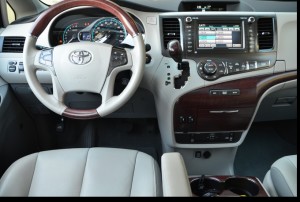
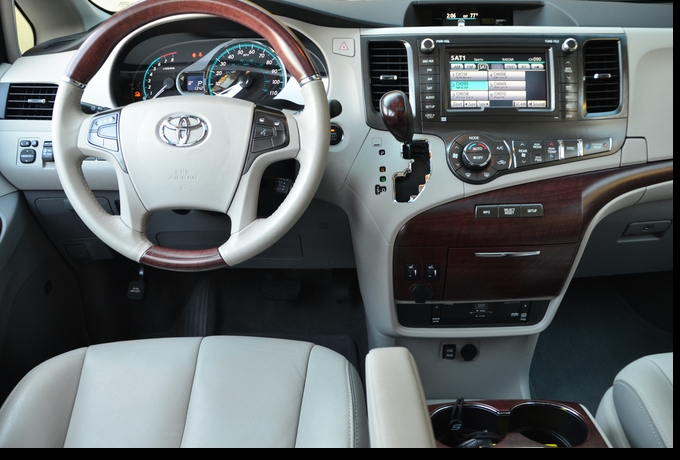
A mini van with comfort in mind.

A mini van with comfort in mind.

Braking is by four-wheel discs (vented up front) with a strong pedal stopping the Sienna in a good 45 feet under perfect control from 40 mph. Sienna has all the safety acronyms, plus more than half a dozen airbags, Safety Connect emergency assistance and collision notification, rear view camera, blind spot monitoring, rear cross traffic alert and rear parking sonar in case you forget there is a rear backup camera. Sienna has so many anti-collision devices you would think you would have to work at having an accident.

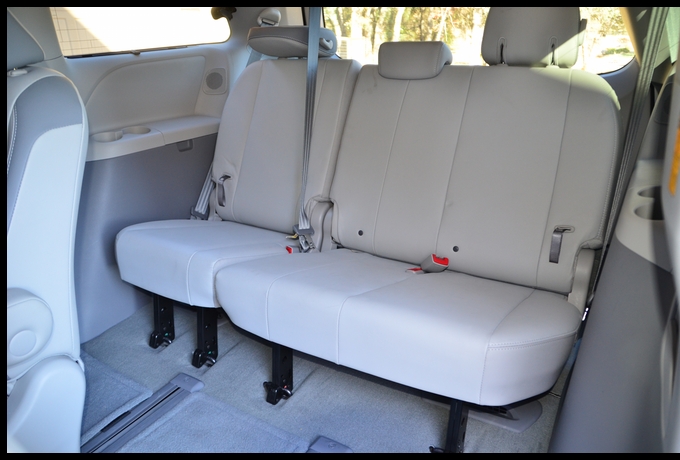
Now for the real reason why everyone should own a minivan, the interior. There is no other vehicle that packs so much volume and utility in such a relatively small package. Passenger volume is 165 cubic feet or about 60 percent more than your average midsize or full size sedan. And on top of that there are almost 40 cubic feet of cargo capacity behind the third row of seats. Shoulder room in each of its three rows is over 5 feet and about 5½ feet in the first two rows. Legroom is in limousine proportions and President Abraham Lincoln could sit in any seat with his top hat on. And this is all packed into a 200-inch vehicle and this one has all wheel drive. Where do you get more utility than that?

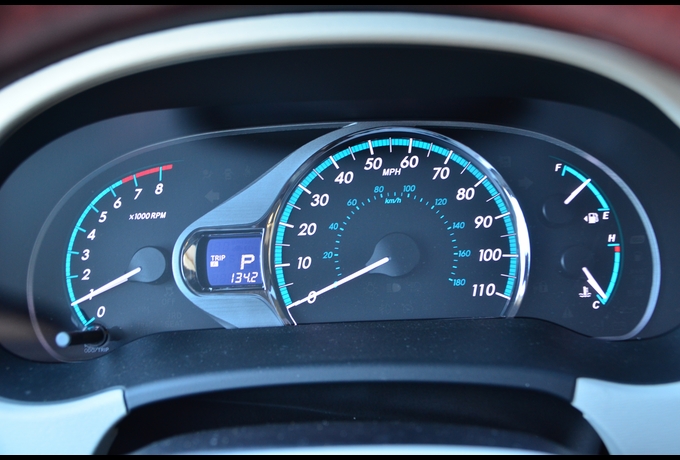
Oh, and that interior was done in quality leather and all the appropriate appointments were of Toyota’s top quality materials. Of course it had a full instrumentation package (tach and speedo), trip computer and a sound/entertainment system second to none.
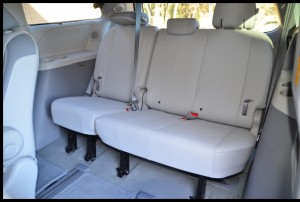
Plenty of room for large families, lots of friends or an entire team.

Plenty of room for families, lots of friends or an entire team.

Pricing for my fully loaded tester was $41,710, plus $860 for the truck from its Princeton, Ind., manufacturing plant. In addition it had the Limited Premium Package ($4,105), a Limited Convenience Package ($890) which included excellent HID lighting. Unfortunately they want $330 for floor mats, but there is a lot of flooring to cover. But in the final analysis, Sienna offers the most practical vehicle one can buy. What vehicle can do more, offer decent fuel economy combined with sporty performance and with AWD not be hampered by poor driving conditions? Only the minivan, the Sienna minivan.

Larry Weitzman has been into cars since he was 5 years old. At 8 he could recite from memory the hp of every car made in the U.S. He has put in thousands of laps on racetracks all over the Western United States.


Trail angels help keep hikers going on PCT

By Chris Erskine, Los Angeles Times

By any measure, the Pacific Crest Trail is a beastly thing, an angry anaconda that slithers up the entire length of California and all the way to Canada, some 2,650 rugged miles. That’s approximately 6 million steps — some of them glorious, many of them merciless.

But along the way, mercy is at hand.

Near the southern trail head, Sandy and Barney Mann open up their five-bedroom San Diego home to up to 60 hikers a night. They even pick them up from the airport and ferry them and their gear to the starting point an hour east.

Up the trail, in Agua Dulce, Donna and Jeff Saufley not only provide a night’s rest to more than 1,000 hikers a season, they offer food and shelter to their dogs, horses and the occasional llama.

East of the Bay Area, Hank Magnuski functions as a sort of outdoors concierge, erecting a pop-up cafe to provide hot coffee and fresh fruit topped by whipped cream to hikers coming off a particularly grueling 300-mile stretch.

They are all part of a small network of outdoor Samaritans called “trail angels.”

Read the whole story


Opinion: California must deal with pension issues

By Ted Gaines

Jan. 1 marks the New Year and also the day that hundreds of new California laws go into effect. In addition to the changes those laws are supposed to bring, there are other major problems facing the state in 2015.

The budget picture is improved, but the state consistently ignores the longterm, massive, and unfunded pension costs when it makes its rosy announcements about balanced budgets.

Ted Gaines

Ted Gaines

The unfunded pension bill may be in the hundreds of billions of dollars. As municipalities in California and around the country file for bankruptcy, driven in part by lavish pension promises and the costs that follow, it’s critical — for the state, for the taxpayers and for the workers — that California uses conservative, honest and transparent accounting for pensions and for all state taxing and spending.

The pension bill is going to come due and politicians are already looking at the state’s improved finances and calling for increased spending. To pay for it all, I’m worried about the threat of a Proposition 30 tax extension and that legislators are going to turn to the worst and most predictable page of their playbook and raise taxes by undermining Proposition 13. This watershed Proposition has saved citizens countless billions of dollars since 1978, but it can be altered to make it easier for cities and counties to raise taxes. I think that would be a terrible mistake. Without spending control, no amount of tax dollars will ever be enough. It’s not more revenues Sacramento needs, it’s more self–control.

This legislative session, I will be fighting to keep taxes down and to keep a tight lid on state spending, and looking for ways to make California the best place for businesses to prosper. A growing economy and a little common–sense fiscal discipline could inject some truth into the “balanced budget” statements we are likely to hear again in 2015.

Stay tuned for more information on Proposition 13 and other developments this year. Until then, I want to wish each and every one of you a Happy New Year.

Sen. Ted Gaines represents the 1st Senate District, which includes all or parts of Alpine, El Dorado, Lassen, Modoc, Nevada, Placer, Plumas, Sacramento, Shasta, Sierra and Siskiyou counties.


Snippets about Lake Tahoe

bona fide• Join fellow book artists for an afternoon of free book making on Jan. 4 from 3-5pm at Bona Fide Books, 1609 Magua St., No. 4, Meyers. No experience necessary, but a love of books helps.

• Tahoe City Cross Country is open.

• The U.S. Coast Guard still hasn’t finished its investigation of when the Tahoe Queen ran aground in August.

• Here is the Caltrans roadwork schedule for the week for El Dorado-Tahoe.

• The Winter Holiday Anti-DUI crackdown resulted in three driving under the influence arrests from local routine traffic enforcement and special Avoid the 6 DUI overnight deployments in El Dorado County Dec. 12-28. Over the course of the next week of the campaign extra DUI saturation patrols will be deployed in Placerville, South Lake Tahoe, and the unincorporated parts of El Dorado County. The CHP is deploying all available officers between Dec. 31 at 6pm and midnight Jan. 1.


Caltrans driver rescues missing man in Truckee

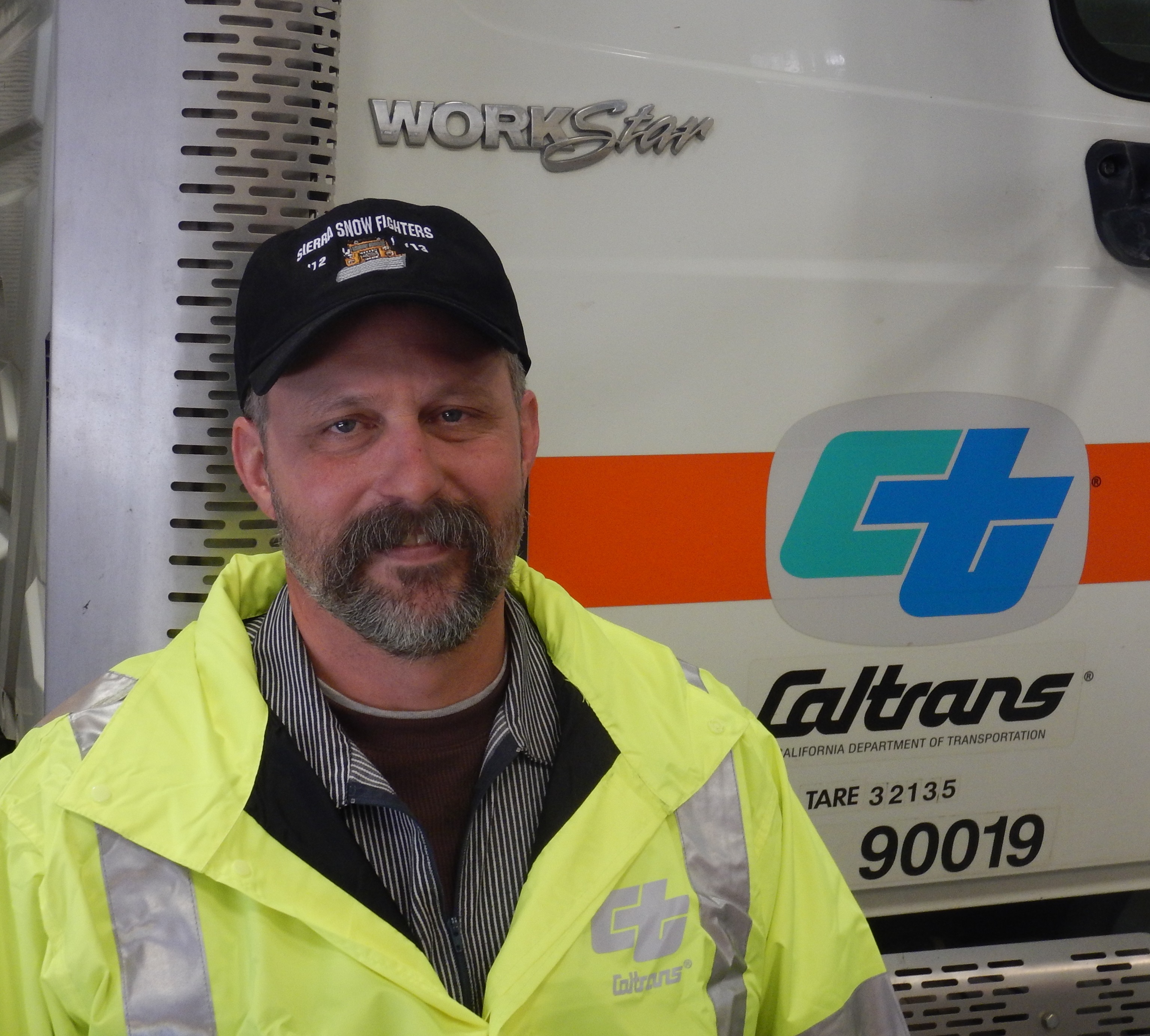
Robert Fish, a seasonal Caltrans equipment operator working out of Truckee, was plowing Interstate 80 on Christmas about 9pm when he noticed a man trying to wave down traffic near the eastbound Hirschdale Road off-ramp.

robert fish

Robert Fish

James Mengel, 77, of Citrus Heights said he had been involved in a hit-and-run accident and his truck would not run. Fish noticed Mengel’s speech was very quiet and that he seemed disoriented. Fish recognized this as possible signs of Alzheimer’s, which he was familiar with after caring for his step-father who had the disease.

Fish had Mengel get in his snowplow to warm up because he wasn’t wearing a jacket.

After a CHP officer arrived, it was determined that Mengel had been reported missing out of the Sacramento area and that a Silver Alert, used by the CHP for an unexplained or suspicious disappearance of an older person, had been issued for him more than a day earlier.

— Lake Tahoe News staff report


Prescribed burning on South Shore to begin

The Tahoe Douglas Fire Protection District and the U.S. Forest Service will continue prescribed fire operations this week on Kingsbury Grade near Buchanan Road, Ski Run Boulevard near Heavenly, Luther Pass and Spooner Summit.

Operations will last through the next several weeks as conditions allow.

Each operation follows a prescribed fire burn plan, which considers temperature, humidity, wind, moisture of the vegetation, and conditions for the dispersal of smoke. This information is used to decide when and where to burn.

The Tahoe Fire and Fuels Team gives as much advance notice as possible before burning, but some operations may be conducted on short notice.

Smoke from prescribed fire operations is normal and may continue for several days after an ignition depending on the project size. Agencies coordinate with state and local county air pollution control districts and monitors weather conditions closely prior to prescribed fire ignition. They wait for favorable conditions that will carry smoke up and out of the basin.

Before prescribed fire operations are conducted, agencies may post road signs around affected areas and make email or phone notifications. The Forest Service updates the local fire information line at 530.543.2600, ext. 6. To receive prescribed fire notifications, send an email to pa_ltbmu@fs.fed.us.


Gas prices to rise in Calif. in 2015

By Josh Richman, San Jose Mercury News

After months of seeing gas prices sink ever lower, Californians will ring in 2015 by paying more at the pump as a result of the state’s landmark greenhouse-gas emissions law.

But how much more we’ll pay, and whether it’s worth it, remains bitterly debated among oil companies, some state lawmakers and environmentalists.

Starting Thursday, gasoline and diesel producers will be subject to the state’s cap-and-trade system, forcing them either to supply lower-carbon fuels — which are more expensive to produce — or to buy pollution permits for the greenhouse gases created when the fuel is burned. In the short term, at least, that will mean higher prices at the pump.

Opposition groups backed by the oil industry have claimed prices will rise 16 to 76 cents per gallon, although that’s admittedly based on an underlying price of about $4 per gallon — far higher than recent prices. A UC Berkeley energy and economics expert says the increase will be more like 9 or 10 cents per gallon, which supporters say isn’t so high a price to pay for the environmental good it will do.

Read the whole story


South Shore gaming numbers down in Nov.

It depends on what end of the lake you are on if the gaming revenue numbers are good or bad news.

On the South Shore the win was down 30.36 percent for November compared to 2013, while on the North Shore there was a gain of 22.14 percent.

The Nevada Gaming Control Board released the figures Dec. 30.

Statewide the numbers were flat, with a slight increase of 0.04 percent for a take of $876.3 million.

— Lake Tahoe News staff report


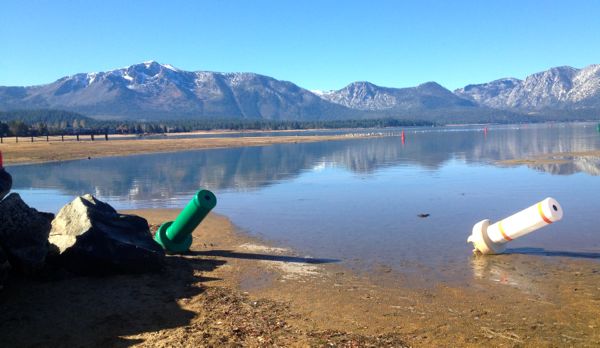
Boat channel at Keys narrowing as lake drops

Navigational buoys at the mouth of the Tahoe Keys main channel on Nov. 25. Photo/LTN

Navigational buoys at the mouth of the Tahoe Keys main channel on Nov. 25. Photo/LTN

Getting boats in and out of the Tahoe Keys is not getting any better as winter progresses.

Buoys for navigation and speed limits at the main channel are sitting to the side, in muck because the water level is so low.

If the lake level rises — especially in any significant way, it won’t be until the spring from runoff.

It remains to be seen if boaters who use the South Lake Tahoe waterway will get any help in regards to dredging. The marina owners are responsible for the main channel and the homeowners for the other inlet.

“(Tahoe Keys Property Owners Association) has a permit from Lahontan to dredge the homeowner’s channel in the lake. We have recently heard from their consultant that they will be submitting a request to amend the permit. We do not have anything in writing regarding this request to amend the permit,” Lauri Kemper, assistant executive officer with Lahontan Regional Water Quality Control Board, told Lake Tahoe News. “We do not have a complete application from the Tahoe Keys Marina for dredging.”

The U.S. Coast Guard station in Tahoe City said it would not issue a hazardous navigation warning because the marina is privately owned.

— Lake Tahoe News staff report