Comments sought on OHV grants

The Humboldt-Toiyabe National Forest is seeking public review and feedback on its applications for California off-highway vehicle cooperative funds for the 2017-18 grant cycle.

The forest has submitted three preliminary applications to the Off-Highway Motor Vehicle Recreation Division in Sacramento that would support the Carson and Bridgeport ranger districts. The first grant includes a strong emphasis on law enforcement and will fund law enforcement officers and forest protection officers. A ground operations grant will focus on operating and maintaining OHV and snowmobile areas across the two districts. The final grant application will focus on avalanche safety and education on the Bridgeport Winter Recreation Area.

The grant applications will be posted on the OHMVR website after March 6. Instructions for submitting comments are posted on the website.

The 30-day public review and comment period ends April 2. 


Nutrition trends subject of talk at LTCC

The next Barton wellness lecture is titled Making Sense of Current Nutrition Trends.

Greg Bergner, Barton Health medical director of lifestyle and wellness, will talk about how eating patterns effect longevity and how healthy eating can reverse disease. He will share what foods are best for a healthy life.

The free talk is March 8, 6-7pm in the board room at Lake Tahoe Community College.


Ski industry gurus share decades of experience

By Kathryn Reed

For those who are schussing down the slopes, it’s all about having fun. And while it can be fun for those responsible for the operation of the ski resort, the bottom line is it’s a business – and with that reality comes some not so fun aspects of the job.

In a wide-ranging conversation last week, two ski industry titans shared what their experience during past 40 or so years has been like.

Locally, Tim Cohee is known for having run Kirkwood Mountain Resort for years. He is director of the ski business and management program at Sierra Nevada College in Incline Village. He also owns China Peak Ski Resort near Fresno.

John Rice is at the helm of Sierra-at-Tahoe.

Both are well regarded in the industry and are fixtures in the Tahoe community.

Their professional lives have been intertwined for decades, starting when they both worked for a Southern California ski resort. While they were competitors in Tahoe, the respect they have for one another was evident during the Feb. 28 talk.

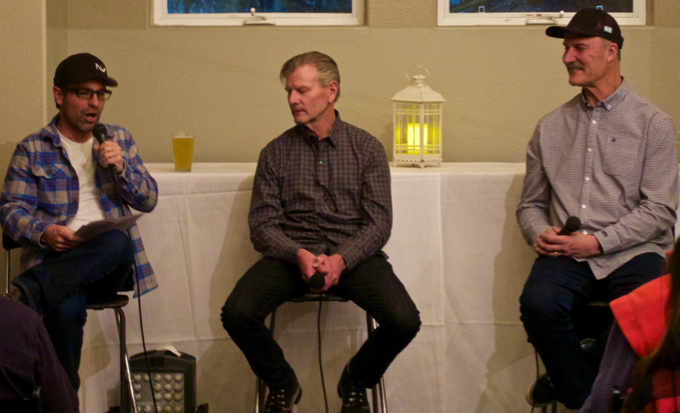
Outdoor photographer Corey Rich, whose business is in the Ski Run area, was the moderator for the evening. The event at Blue Angel Café was part of the Ski Run Presents series, which is designed to bring the community together over relevant topics.

Cohee and Rice acknowledged the industry isn’t the same as when they started out. It’s more serious. Employees aren’t as apt to want to work long hours.

Corey Rich, left, moderates a talk Feb. 28 between ski industry mavericks Tim Cohee and John Rice. Photo/LTN

The terrain park as we know it might not have ever been born under today’s workplace constraints.

Rice is credited with taking snowcats for “joy rides” when he worked at Sierra Summit, which is now known as China Peak. He was bending frames and breaking tillers to build jumps on the side of the mountain.

He moved to Bear Mountain and continued to build features through trial and error. It was in 1993 that he moved to Tahoe.

“Today it’s way more complicated. There are so many regulatory things,” Rice said. “The competition is more fierce and cutthroat.”

Now 70 percent of the ski resorts in the United States are owned by two companies – Vail Resorts and Alterra. Both have a presence in the Tahoe area – Heavenly, Kirkwood, Northstar (Vail), Squaw and Alpine (Alterra).

Rice is one of those industry leaders who believes in giving athletes what they need.

“They need a playground to do their thing. It takes a lot of resources. The mountain has to commit to that,” Rice said. Sierra-at-Tahoe has a long history of Olympians, with two (Jamie Anderson and Maddie Bowman) competing in South Korea last month and two others (Hannah Teter and Kyle Smaine) each missing the team by one spot.

Cohee and Rice know it’s an expensive sport, admitting it can cost a family of four $1,000 a day.

“At the end of the day, they will only do it if the value is there,” Cohee said.

Demographics are changing. Rice said five years ago 78 percent of Sierra’s guests were Caucasian, today that percentage is 53 percent.

“There is an opportunity with the ethnic market to bring in new skiers,” Rice said.

It’s millennials who have been a disappointment. They aren’t skiing. That’s why resorts are now focused on the younger generation.

Cohee believes skiing is affordable for those who do it regularly – they buy passes and seldom eat at the resort.

Rice admits Tahoe needs to raise its game when it comes to service as well as food and beverage.

Resorts make about 40 percent of their revenue from day tickets, 20 percent from season passes, 13 percent food and beverage, 13 percent ski school, 13 percent retail, and 1 percent miscellaneous.

And while millions of dollars may be collected each season, it’s not a highly profitable business because of the expense and need to reinvest in the product. China Peak recently installed a new lift. It has sat idle most of this winter because of the lack of snow. The resort reopened this weekend.

Climate change is something very real to these men. They see the swing in snow years, which isn’t what it was say, 20 years ago.

They recognize it’s expensive for young people to get started in the industry, especially with housing an issue in most every ski town. Sierra is working on ways to improve that situation.

As Rice said, “It’s more than a job, it’s a lifestyle.”


Opinion: Calif.’s public pension crisis in a nutshell

By Dan Walters, CalMatters

The essence of California’s pension crisis was on display last month when the California Public Employees Retirement System made a relatively small change in its amortization policy.

The CalPERS board voted to change the period for recouping future investment losses from 30 years to 20 years.

The bottom line is that it will require the state government and thousands of local government agencies and school districts to ramp up their mandatory contributions to the huge trust fund.

Client agencies – cities, particularly – were already complaining that double-digit annual increases in CalPERS payments are driving some of them toward insolvency and the new policy, which will kick in next year, will raise those payments even more.

“What we are trying to avoid is a situation where we have a city that is already on the brink, and applying a 20-year amortization schedule would put them over the edge,” a representative of the League of California Cities, Dane Hutchings, told the CalPERS board before its vote.

But CalPERS itself may be on the brink, and the policy change is one of several steps it has taken to avoid a complete meltdown.

The system, once more than 100 percent funded, now has scarcely two-thirds of what it would need to fully cover all of the pension promises to current and future retirees – and that assumes it will hit an investment earnings target (7 percent per year) that many authorities criticize as being too optimistic.

The trust fund lost about $100 billion in the Great Recession and never has fully recovered. By lowering its earnings projection – it had been 7.5 percent – while moving to a more conservative investment strategy and cutting the amortization period, CalPERS hopes to avoid another disaster were the economy to turn sour.

Officials fear that were it to experience another big investment loss, it would pass a point of no return and never be able to pay for pension promises.

Protecting CalPERS, however, means getting more money from its client agencies, which could drive some of them into insolvency, as Hutchings said. Three California cities have gone bankrupt in recent years, in part because of their ever-increasing pension burdens, and payments have escalated sharply since then.

So on one hand, CalPERS is doing what it has to do to remain financially solvent, but on the other hand its self-protective steps threaten local government solvency. That’s the crisis in a nutshell.

One way out would be to modify benefits in some way. City officials, for instance, have suggested reducing automatic cost-of-living escalators in pensions over a certain mark, such as $100,000 a year.

However, the CalPERS board, dominated by public employee organizations and sympathetic politicians, has spurned such pleas.

“Our members have expressed frustration that you keep coming to them asking for more while at the same time not providing a lot of other options and assistance for them,” Dillon Gibbons of the California Special Districts Association told the board.

Everyone involved is waiting for the state Supreme Court to rule on pending pension rights cases, and were it to overturn the so-called “California rule” that bars changes in benefits, it would open the door to pension modification.

CalPERS officials are also concerned that should it become insolvent, or pension payments force some cities into bankruptcy court, it would revive long-dormant plans for a statewide pension reform ballot measure.

This crisis will haunt California for many years to come and will be a big headache for the next governor.


Lost skier found safe at Mt. Rose resort

Washoe County sheriff’s deputies were called out to Mount Rose Ski Resort on Feb. 3 because of a lost skier.

Mount Rose ski patrol rescued the lost skier on the east side of the mountain.

“The skier is OK and our volunteers are bringing him down to Davis Creek Park,” officials said.

Further details were not available.

— Lake Tahoe news staff report


Snippets about Lake Tahoe

·       Ridge Tahoe’s 35th anniversary spring carnival will be March 25. It will include dance, hula hoop, ’80s ski theme costume and snowman making contests; dodge ball and corn hole tournaments, snowshoe relay races and pool party from noon-4pm. Attendees may fuel up with barbecue and s’mores, and partake or spectate in Frisbee, volleyball, badminton and bocce ball. Admission is free even for non-resort guests; corn hole tournament is $10/team and dodge ball is $35/team.

·       The International Freeskiers and Snowboarders Association’s Tahoe Freeride World Tour Qualifier is March 28-31 at Kirkwood Mountain Resort.

·       The 14th annual Gunbarrel 25 will be March 31 at Heavenly Mountain Resort.

·       Google expert trainer Corissa Saint Laurent will explain how customers find businesses online, how to promote your online presence with search engine optimization, and online advertising. The class is March 15, 8-10:30am at the Truckee airport. Tickets are available online.

·       The Bridgeport Winter Recreation Area on the Humboldt-Toiyabe National Forest’s Bridgeport Ranger District will re-open for snowmobiling on March 5.


Drones, wireless sensors take water research to new level

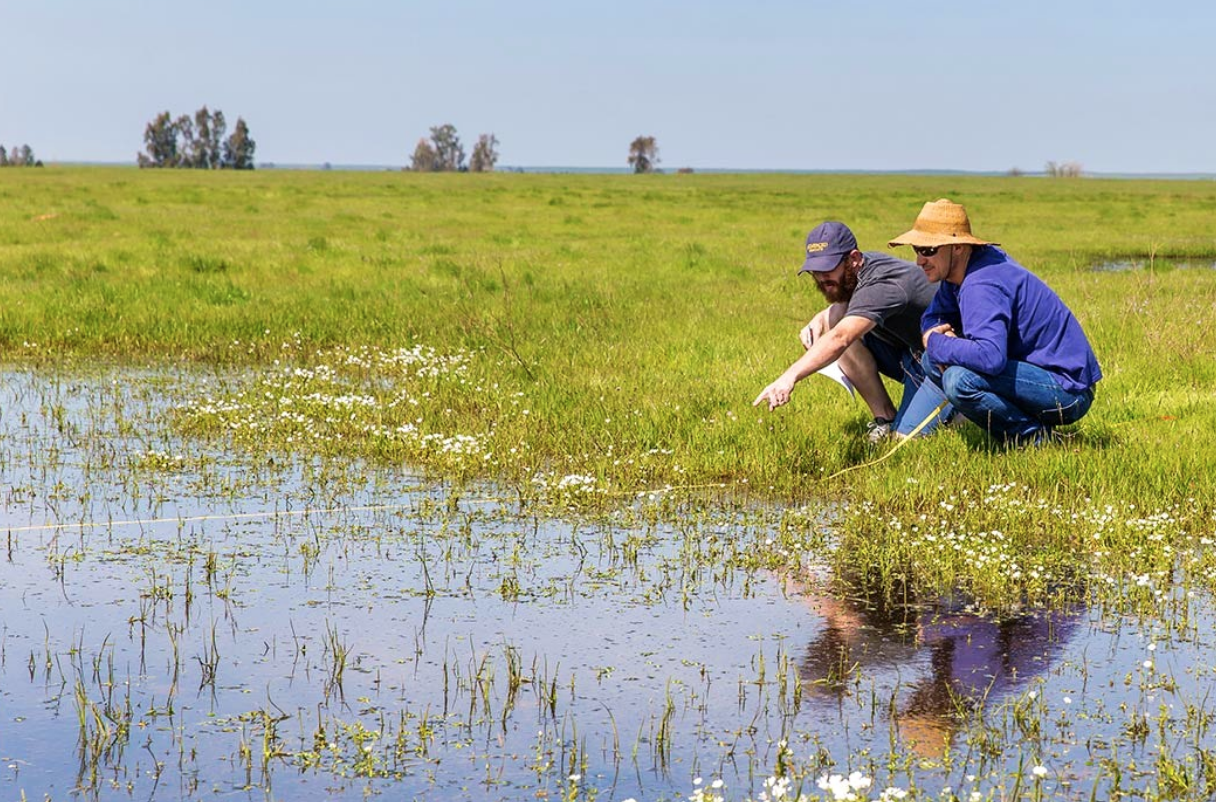
Researchers in Merced a site owned by the University of California. Photo/University of California

By Matt Weiser, Water Deeply

California is about to learn a whole lot more about how water moves through its many diverse landscapes.

The Gordon and Betty Moore Foundation has awarded a $2.2 million grant to the University of California to use remote sensors and drones to monitor hydrology across various landscapes. The subject areas will be the U.C.’s Natural Reserve System, a network of protected lands covering more than 750,000 acres and representing many habitat types in the state.

Called the California Heartbeat Initiative-Freshwater, the project will equip reserves with wireless sensor nodes to track weather, soil moisture, transpiration and a host of other criteria. Each node, about the size of a thermos, is outfitted with a battery and solar panel. They communicate wirelessly with each other and a central computer. Drones will fly programmed routes with special cameras attached to monitor how vegetation changes with the climate.


Placer County working on Sustainability Plan

Placer County is in the process of developing a Sustainability Plan, outlining ways to reduce greenhouse gas emissions and manage climate risks that threaten property value, natural resources and quality of life.

Two community workshops this month will offer a chance for people to learn about the plan’s purpose and goals, and how to become involved in the planning process.

The plan inventories current sources of greenhouse gas emissions in unincorporated Placer County and will outline the county’s strategy to reduce them in a way that maximizes economic benefits from energy savings and operational costs, improves infrastructure, and further benefits the county and community.

Additionally, the plan is intended to provide a streamlined environmental review process related to GHG emissions analysis for land development projects.

It will also describe strategies to prepare the county and residents to reduce and adapt to the effects of climate risks like wildfire, drought and flood.

California law calls for reducing greenhouse gas emissions statewide to 40 percent below 1990 levels by 2030.

Placer expects to complete its Sustainability Plan in spring 2019.

The workshops will be March 7 in Kings Beach (North Lake Tahoe Event Center) and March 8 in North Auburn (Community Development Resource Agency). Both will are from 6-8pm and will begin with a presentation by county staff, with staff available afterward to answer questions and take feedback in an open-house style workshop. The presentation will include an explanation of the plan’s greenhouse gas inventory , completed in January.


Road Beat: ’18 Camry Hybrid, the rebirth of Toyota

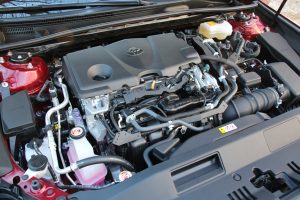
The latest Camry hybrid restores Toyota’s image. Photo/Larry Weitzman

By Larry Weitzman

Thirty or more years ago, Toyota was showing the world how to make cars, especially the United States. While they have continued to always produce well designed, great cars, other manufacturers had caught up in terms of design and quality. Its bread and butter car, the Camry, while an excellent automobile, was being overshadowed by other brands who produced cars that were perhaps more daring and edgy.

Today that has all changed with the new 2018 Camry. It is an unbelievable vehicle, offering top in the class performance, incredible style, brilliant design inside and out, outstanding fuel economy, superb handling, ride and quiet and of course, it’s a Toyota.

Where to begin? Outside, despite the front end (which is muted by the blacked-out grille), the new Camry is beautiful, with soft flowing lines and body contours, giving it a luxury look. The rear end is exceptional with the softly rounded and sculptured rear fenders and shoulders, giving it a look of one of my favorite cars ever, the sixth-generation (1991-1995) Mazda 929. Proportions of the new Camry are perfect as is the window line. Kudos to Toyota. Now just clean up the front end, although some of the new front end adds to the car’s aggressiveness.

Camry has grown as well, about 2 inches in wheelbase and length, an inch or so in width adding to new found roominess. Wheelbase, length and width now measure 111 x 192 x 72 inches, which follows the trend of mid-size car spaciousness.
Specifications
Price $30,395 to about $33,695
Engine
2.5L DOHC, 16 valve inline four cylinder !76 hp @ 5,700 rpm
163 lb.-ft. of torque @ 3,600-5,200 rpm
Electric motor 118 hp (maximum hp available at full throttle 32 hp)
149 lb.-ft. of torque
Battery: Nickel-Metal Hydride
Maximum combined power output: 208 hp
Transmission
CVT
Configuration
Transverse mounted front engine/front wheel drive
Dimensions
Wheelbase 111.2 inches
Length 192.7 inches SE (XLE 192.1 inches):
Width 72.4 inches
Height 56.9 inches
Ground clearance 5.7 inches
Track (f/r) 62.2/62.6 inches
Fuel capacity 13.0 gallons
Trunk capacity 15.1 cubic feet
Weight (SE) 3,549 pounds
Interior passenger volume 99.9 cubic feet
Steering lock to lock 2.7 turns
Turning circle 38.0 feet
Wheels 18X8 inch alloys
Tires 235/45X18
Performance
0-60 mph 6.78 seconds
50-70 mph 3.38 seconds
50-70 up 6-7 percent grade 5.04 seconds
Top speed anyone care?
Fuel economy EPA rated 44/47/46 city/highway/combined. Expect 44-46 mpg in rural country/suburban driving. 50 mpg on a level highway at legal speeds.

Also growing is engine power and performance. The standard 2.5L four-banger now puts out 203 to 206 hp (at 6,600 rpm) depending on the model and at 13:1 compression can run as a more efficient, Atkinson Cycle engine. The 3.5L V-6 also with a super high compression ratio of 11.8:1 now extricates 301 horses, up about 15 percent and fuel economy is also up by about 5-10 percent. But my hybrid version gets the 2.5L DOHC, 16 valve inline four with an even higher compression ratio of 14:1. It’s the highest I know of in automotive gas engines.

In hybrid form it produces “just” 176 hp but at a much lower 5,700 rpm and a strong 163 pounds of twist at a low 3,600-5,200 rpm. But it gets a strong kicker in the form of a 118 hp electric motor, but battery output limits output to about 32 hp as the combined number it 208 hp. But those are some of the biggest horses ever found under the hood of an automobile as you will see. They transmit power to the front wheels via an electronic CVT. The results are close to spectacular.

Zero-60 mph comes up in a very quick 6.78 seconds and if that isn’t enough for you, passing performance in 50-70 mph tests averaged just 3.38 seconds on a level highway and 5.04 seconds up a 6-7 percent grade. Twenty years ago, a level pass of 5 seconds was considered high performance. This hybrid rocks and throttle response feels even stronger. It is a high-performance car.

OK, so it goes like “stink,” what about fuel economy? Glad you asked. Camry Hybrid is rated at 44/47/46 mpg city/highway/combined. But this hybrid will exceed those numbers. First, on a level highway with cruise control set at 70 mph (speedo is very accurate) it averaged exactly 50 mpg in a two-way run.

In my round trip to Carson City from Placerville, the average was 44.1 mpg and it included about 18 full throttle passing applications and mostly aggressive driving. Breaking the trip up in segments, the trip over the Sierra to Carson City averaged 38.2 mpg while the return trip averaged 52.4 mpg. From South Lake Tahoe which includes climbing the grade to Echo Summit (from 6,200 to 7,400 feet) the Camry Hybrid averaged an astounding 64.4 mpg and yes, I was full throttle at least nine times. Overall my tester averaged 44 mpg including all performance testing. Think about this, 0-60 mph well into the sixes and 44 mpg and 50 mpg on the highway and we are not talking about a two-passenger motorcycle (heck, they don’t get that kind of fuel economy) or a mini-car that can’t get out of its own way and has a carrying capacity of two to four sardines and a small tackle box, but a high performance, big family sedan with more comfort than a Tempurpedic or Sleep Number mattress.

About the only negative as to fuel economy is the small fuel tank of 13 gallons, but at 50 mpg that still would give you a range of over 600 miles. Maybe Toyota is worried about the fuel going stale as the time between fill ups might be a couple of weeks.

Besides the extreme comfort and quiet, the new Camry hybrid handles well helped in part by some impressive credentials, such as state of the art fully independent suspension (double wishbone in the rear), stab bars at both ends, a quick electric steering rack (2.7 turns lock to lock) and big 18X8 inch alloys shod with some respectable (235/45 x 18) rubber. Track is also wide and 62 and 63 inches front and rear. While the steering is a bit numb, it is very accurate with superb on center feel. Body roll is well controlled and the tires hang on until tomorrow all adding up to very sporty handling. A little more steering feel and you have a real sports sedan. But, notwithstanding, this Camry inspires cornering confidence beyond any Camry driven before. Even the weight of this hybrid is held in check at 3,549 pounds. Good stuff.

As to the aforementioned comfort, if it wasn’t for the excellent sound system your passengers may fall asleep. Forget noise and road imperfections, the Camry simply dispels them.

Safety is also complete, with all the safety acronyms including lane departure warning and steering assist. Toyota Safety Sense and Star Safety Sense are standard. LED headlights are fabulous and the auto high beams improve night safety. You will need all your fingers and thumbs to count the air bags. One item which Toyota could add is the multi-view 360-degree camera, besides the rear camera and rear cross traffic alert system.

Inside are sublime seats done in Toyota SofTex and cloth. With the added wheelbase, rear seating approaches limousine proportions. Everything you can touch is all soft touch with top quality materials. Instrumentation is hybrid style, meaning no tach, but the trip computer allows for great flexibility is calculating mpg.

The center stack, sound system and two-zone HVAC are easy to use except for Bluetooth phone installation, but once understood, no problem or issue. Even all the windows are one touch up and down. Truck capacity is huge for a hybrid at 15 cubic feet.

Pricing is incredible for this mileage machine stickering at $29,500 plus $895 for shipping. My tester had a couple thousand in options, a convenience package ($325), Blind spot monitoring and cross traffic ($600), moonroof ($900), upgraded audio ($1,080) and the special Ruby Flare Pearl paint ($395) bringing the total Monroney to $33,695. That’s a bargain considering there are Priuses that sticker for more. Zero to 60 mph in 6.78 seconds and 50 mpg on the highway. Simply amazing.

Larry Weitzman has been into cars since he was 5 years old. At 8 he could recite from memory the hp of every car made in the U.S. He has put in thousands of laps on racetracks all over the Western United States.


Avalanche closes Mammoth Mountain

By Carlos Lozano, Los Angeles Times

An avalanche at Mammoth Mountain early Saturday forced the closure of the mountain and area ski resorts, officials said.

There were no immediate reports of injuries or missing people, but rescue operations have been activated, officials said.

Read the whole story