Tahoe Tails — Adoptable Pets in South Lake Tahoe

Blue

Blue

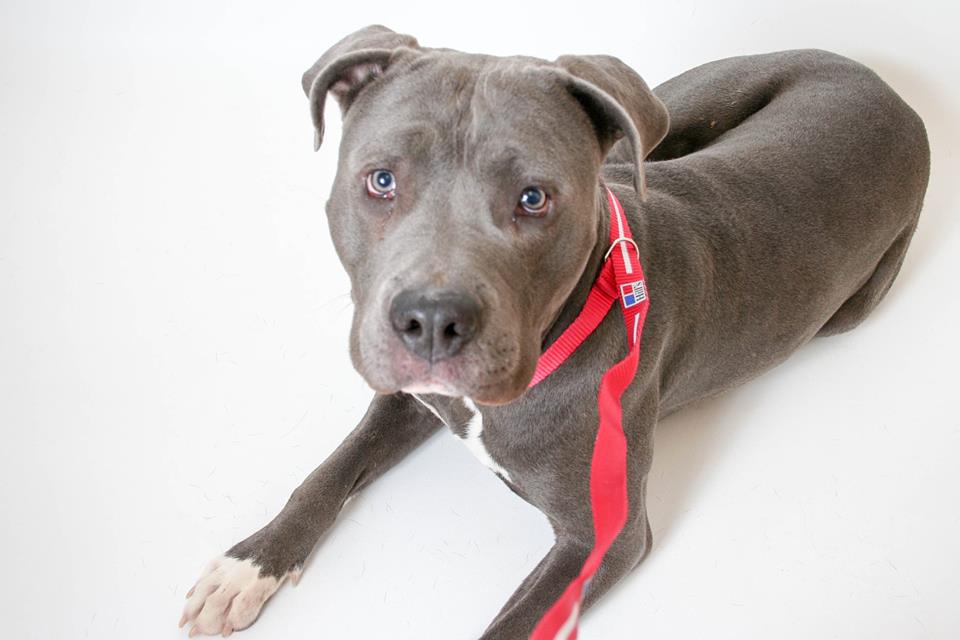
Blue is a big pit bull puppy with beautiful silver fur and blue eyes. He is 9 months old, and may get just a bit bigger than his current 75 pounds.

He knows several commands, and after he works out his initial excitement at going for a walk he walks pretty nicely on the leash. He likes to play with other dogs, but he might be best suited to a companion about his size. Blue is a very happy energetic boy who will make a great pet for an active family.

Blue is neutered, microchipped, tested for heart worm, and vaccinated. He is at the El Dorado County Animal Services shelter in Meyers, along with many other dogs and cats who are waiting for their new homes. Go to the Tahoe animal shelter’s Facebook page to see photos and descriptions of all pets at the shelter.

Call 530.573.7925 for directions, hours, and other information on adopting a pet.

For spay-neuter assistance for South Tahoe residents, go online.

— Karen Kuentz


Family turns snowboarding death into opportunity to save lives at Sierra-at-Tahoe

By Susan Wood

TWIN BRIDGES – Kristin Jacobson remembers almost dying like it was yesterday.

The Benicia attorney, an advanced skier, had waited a while for a powder day in 2012. She finally got her wish on St. Patrick’s Day at Sierra-at-Tahoe where she volunteers. She and husband Eric were negotiating the black diamond Upper Dynamite run off Grandview chairlift when he suddenly stopped on a boulder. Just as he turned to warn her of a depression in front of them, she had skied by him. Next thing she knew, the snow gave way underneath her.

“I thought I was just swept up in an avalanche,” she said.
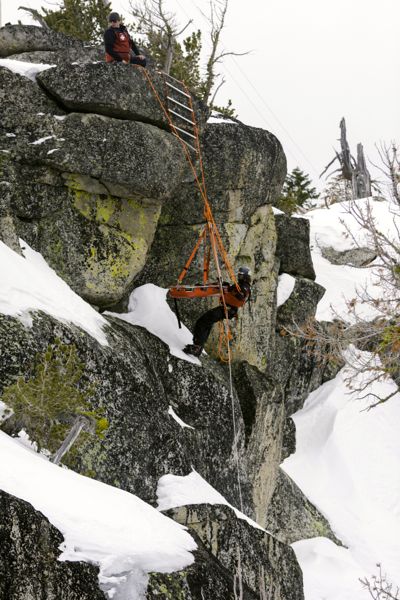
Sierra-at Tahoe patrollers practice high angle rescues. Photo/Merick Rickman

Sierra-at Tahoe patrollers practice high angle rescues. Photo/Merick Rickman

At a mere 5-foot, 4-inches, the snow enveloped her. She was conscious and knew not to struggle in order to conserve energy – especially since the snow was particularly wet and encased her like concrete.

Since the temperatures had been high, the water had been flowing in the creek below. She tried to make an air pocket, but attempts were futile in the eventual 10-foot tomb.

“I believed I was upside down,” she said.

Jacobson could feel snow embedded in her nose and ears. She was uncomfortable, frustrated and knew she was running out of oxygen.

“I blacked out. I thought that was it. I was going to die,” she told Lake Tahoe News.

Meanwhile, her husband had been working feverishly to get help. He tried to dig her out without being encased himself. She was buried so solidly, he pulled her glove off when trying to dig her out.

Luckily, a ski patroller and paramedic were on the lift and caught word of the incident.

After the longest 45 minutes of her life, the patrol team had dug her out using ropes and harnesses anchored to trees in order to keep the snow relatively stable. Jacobson was purple from being hypothermic and very close to being gone.

“Even the ER doctors were baffled,” she said.

Jacobson attributes her survival to the equipment the team used that day.
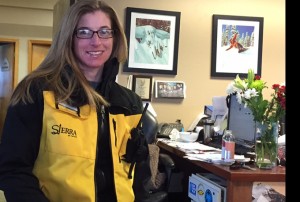
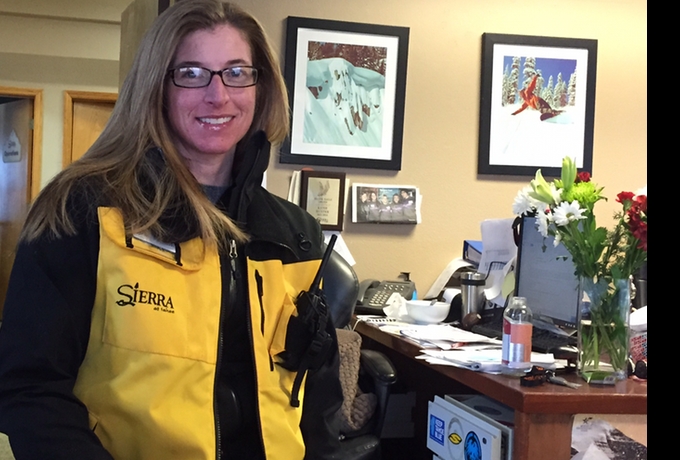
Kristin Jacobson knows she is lucky to be alive. Photo/Susan Wood

Kristin Jacobson won’t let the near-death experience keep her off the slopes. Photo/Susan Wood

“I don’t know how they would have done it. I’m just incredibly grateful,” she said of the 10-minute rescue dig once patrollers arrived.

Sierra-at-Tahoe gained one victory and later others as a result of losing a tragic one. The equipment used to save Jacobson was bought with a fund established by the family of 22-year-old Philip Walker, a snowboarder who died in a tree well the year before Jacobson’s near miss.

“This was a really sad event that happened, but we’re happy we got good equipment to train for future rescues,” said Hugh Ham, Sierra’s assistant ski patrol director.

With about $1,100 left in reserve, the Philip Walker Rescue Fund has secured about $6,000 in clear goggles to help find lost riders in the evenings, ropes for both low- and high-angle rescues, headlamps, radio batteries and deep immersion snow signs. The hope is signs that read, “Stay clear of tree wells” and “Always ride with a buddy” would permeate the minds of those who want to venture into the trees.

That’s the message the father of the young snowboarder, who one day wanted to work at Sierra-at-Tahoe, wants to get across.

“There’s nothing we can do to bring (Philip) back. If anything, continuing on for him and saving someone else and possibly preventing this from happening again – that’s why we do this,” Steve Walker told Lake Tahoe News from his San Jose home.

“Tree wells are dangerous, even for an intermediate skier or snowboarder like Philip,” Walker said.

The family started the fund with $5,000 in seed money, notifying relatives from across the nation to donate in lieu of flowers at the boarder’s funeral service a week after his death on March 26, 2011.

The young Walker was skiing with his brother, Ben, and a friend when he went into the trees alone. Ben called his father at 5pm to tell him he couldn’t find Philip.

“That was gut-wrenching,” Walker said.

The ski resort was forced to call off the search that night because of a fierce storm and resumed it the next day. Walker, his wife and other family members waited out the news in General Manager John Rice’s office.

“I knew something was up when two sheriff’s deputies walked in the room. Unfortunately, I can’t get that image out of my mind,” Walker said while choking back tears.

He described the event as a sense of despair, helplessness and sobering.

“A friend asked me how long it took me to get over,” Walker said.

You don’t.

“I told him it’s like jumping into an icy lake. It takes your breath away, then slowly you get used to it. But you don’t want to,” he said.

The whole family went into grief therapy. Starting this fund is all a part of the bereavement process for them. The family’s goal of the fund isn’t necessarily monetary. It’s to ensure the equipment “makes a difference and to help others,” Walker insisted.

Beyond Jacobson’s story, there have been others who have benefited by a highly skilled and geared Sierra-at-Tahoe.

Rice shared in a letter to Walker the story of a skier who had fallen through a snow bridge between two large rocks and was stuck in a hole of 25 feet off the Huckleberry Canyon area. The patroller who responded requested the harness and pulley system purchased through the rescue fund.

“He was fortunate to have been skiing with a friend who knew where to locate him, but more so that our crew had the right gear to get him out,” Rice wrote. “Thank you to all of your friends and family who honored your son through the cause.”

—–

Notes:

To donate, send checks to the Sierra-at-Tahoe Education Foundation, c/o The Walker Rescue Fund; 1111 Sierra-at-Tahoe Road, Twin Bridges, CA 95735.

Opinion: Not all baseball artifacts are in Cooperstown

By Larry Weitzman

Our national pastime, baseball has been with us since the middle of the 19century. To honor its greatest players, a shrine in Cooperstown, N.Y., was created almost 80 years ago to honor the greatest that have played the game.

But as we are learning, to become a member of the Baseball Hall of Fame you need to be elected by 75 percent of the approximately 500 baseball/sports journalists who are members of the Baseball Writers Association of America. The election is in January of each year.

Founded by Stephen Clark, grandson of Edward Clark who was a founder of the Singer Sewing Machine Company, the site of the Hall of Fame was part of a gymnasium built by Clark’s father Alfred Corning Clark. It was the first gymnasium built in Cooperstown and Cooperstown was the birthplace of Stephen Clark. Part of Clark’s thinking with respect to the hall was tourism for Cooperstown.

Larry Weitzman

Larry Weitzman

With nearly 500 baseball writers making the selection, the procedure is very political. Just look at the controversy created by the likes of Mark McGwire or Sammy Sosa, players with incredible credentials but politically barred by the alleged use performance enhancing drugs. Look what happened to Barry Bonds. McGwire and Sosa perhaps single-handedly saved the game after the baseball player strike of the mid-1990s with their home run duel in 1998. It brought fans back to the game in droves.

However, there is another place that these baseball players may find themselves someday, the Baseball Reliquary. Founded in 1996 in Monrovia, Calif., by Terry Cannon, the Reliquary contains artifacts of the game like some of the original turf and soil from Elysian Fields (located in Hoboken, N.J.), thought to be the place of the first organized (played under the first written rules) baseball game played on June 19, 1846.

Cannon says the Reliquary celebrates the merging of baseball, culture and art and the effect on all three as well as people who had an affect on the game that may not be well known, like Emmett Ashford who became the first black umpire in the Major Leagues. But the reason Ashford is significant isn’t necessarily his skin color, but because Ashford turned umpiring into an “artform.”

Those of us who were here during the era of the Pacific Coast League and teams like the Sacramento Solons, Hollywood Stars, San Francisco Seals and the Los Angeles Angels knew Ashford well. He added style to the game with his “colorful” moves and he was a sharp dresser off the field. When Ashford made it to the show in 1960, Cannon actually got his autograph at Angels stadium (the Big “A”) in the early 1960s.

Cannon has been a baseball fanatic since he first read as a 9 year old child in 1962 the book “Veeck is a wreak.” Bill Veeck Jr. was the general manager of the Chicago White Sox who in 1951 put 3-foot-7-inch Eddie Gaedel in the line up to get the team a walk. Shortly thereafter American League President Will Harridge banned midgets from the game. While Gaedel’s jersey wore the number “1/8” and hangs in the Hall of Fame, his athletic supporter is part of the Reliquary collection along with a miniature trophy given to him by the St. Louis Browns sponsor, Falstaff Brewery. Cannon since has read hundreds of books about baseball. One of the Reliquary supporters is Jim Bouton, former big league pitcher and author of the best seller “Ball Four.”

In 1999, the Reliquary started its own hall of fame called the Shrine of Eternals, honoring three people every year voted in by its 300-plus members. And the beauty is anyone can become a member so the public essentially votes members in. There are currently 42 Shrine members and they are an eclectic group. Members include Jim Abbott (one-armed pitcher), Yogi Berra, Ila Borders (daughter of former Major Leaguer Pat Borders. Ila pitched for the Colorado Silver Bullets and reportedly had an 86 mph fastball), Bill Buckner, Steve Dalkowski, Mark “the Bird” Fidrych, Shoeless Joe Jackson, Curt Flood (broke baseball’s reserve clause), Bill “Spaceman” Lee, Roger Maris, Minnie Minoso (played in six decades), Pete Rose, Casey Stengel, Louis Tiant, Fernando Valenzuela and many others, some of whom are already in the Hall of Fame.

On a recent ballot were people like Sy Berger, who joined Topps bubble gum Company as a sales promotion executive after World War II and re-invented the modern baseball card as we know it today. Also on the ballot is a star from the Pacific Coast League’s Los Angeles Angels, Steve Bilko who hit 56 home runs and won the PCL’s Triple Crown in 1956. I saw him play many times and being a Hollywood Stars fan, didn’t like him much. It is said that Phil Silvers, who starred as Sargent Bilko in the TV comedy “You’ll Never Get Rich” took his characters name from Steve Bilko because of his popularity. (I thought Silvers took the name as a play on words because he was always trying to bilk people out of money.)

Ballots are replete with others who made significant contributions to the game like Bert Campaneris (he played all nine positions in one game in 1965 and became part of the A’s World Championship dynasty from 1972-74), Rocky Colavito, Carlos Delgado, Ernie Harwell, Bo Jackson, Manny Mota, Tug McGraw (his son is singer Tim McGraw whose other talent is baseball as well. Tim played in the minor leagues), Annie Savoy (yes, a character from Ron Shelton’s film classic Bull Durham), Rusty Staub (whose charitable foundation created the year after his retirement from the game after 23 years in the Bigs has raised more than $112 million), Fay Vincent, Rube Waddell and even Don Zimmer.  There are more, too many to name, but you get the idea.

The Reliquary which goes on periodic display at various libraries and similar venues in Southern California are loaded with significant and unusual artifacts of the game like Joe Bauman’s 70th home run ball from 1954, 44 years before Mark McGwire accomplish the feat, Bauman did it while playing for the class C league Roswell Rockies (he went on to hit 72 that year). Or does the Dave Bresnahan potato pique your interest? What is a potato doing in the Reliquary you ask?

Bresnahan was catching for the Double A Williamsport team in the Eastern League and before the game he made a potato look like a baseball and concealed it on his body. When there was an opposing runner on third base he threw the potato wildly over his third baseman’s head in a pickoff attempt. The runner on third came home and was tagged out with the real ball which Bresnahan still held in his glove. The umpire called the play deceptive and awarded the runner home and threw Bresnahan out of the game. The next day he was released by the club and his career was over, but he became an instant celebrity. Three years later the club had a Dave Bresnahan day and retired his number. Not bad for a backup catcher hitting .140. A young fan retrieved the potato and preserved it.

A recent documentary DVD by Jon Leonoudakis aptly sums up the Reliquary with the title “Not exactly Cooperstown, an unorthodox look at America’s most orthodox game.” If you love baseball, you at least have to visit their website. Just give yourself enough time, because it is like a book you cannot put down.

Larry Weitzman is a resident of Rescue.


18 bears killed by Nevada hunters

By Associated Press

Nevada hunters killed 18 black bears in 2014, the most in the hunt’s four-year history.

The Nevada Department of Wildlife says 12 of the bruins were killed in the Pinenut Mountains near Carson City. Others were killed in the Carson Range, Pine Grove Mountains and Washoe Valley, all in Northern Nevada.

The Reno Gazette-Journal reports dogs were used in all but four successful hunts in 2014.

A total of 57 bears have been killed by hunters since the hunt began in 2011. A maximum of 20 bears can be killed each season.

The hunt has drawn strong opposition from the start, with critics saying there are not enough bears in arid Nevada to support it.


Snippets about Lake Tahoe

tryp logo• Tahoe Regional Young Professionals is having a mixer Jan. 14 from 6:30-9:30pm at the Tavern at Tahoe Beach Retreat in South Lake Tahoe.

• Golden 1 Credit Union gave $2,500 to the Food Bank of El Dorado County.

• Ian Magary will talk about diabetes and the military on Feb. 3 during the monthly support group meeting at 5:30pm in the board room at Barton Memorial Hospital. For more info, call 530.543.5581.

• Lake Tahoe Preschool is having an open house Jan. 9 from 1-3pm. Lake Tahoe Preschool will be serving children age 2-6 who are potty trained. The school is at 1081 Lyons Ave., South Lake Tahoe. For more info, go online.

• Nick Carr, author of “The Shallows”, will be at the Resort at Squaw Creek on Jan. 15. Cocktail hour is at 5:30pm, the event at 6:30pm. For tickets and more info, go online.


Children’s book all about sugar pines

On Jan. 31 at 11am South Lake Tahoe Friends of the Library will be supporting the Sugar Pine Foundation with the reading of “The Happiest Tree in the Forest”, a new children’s book about the sugar pine trees of Lake Tahoe.

With colorful and playful illustrations, the book tells the story of Lambe, a lonely little sugar pine seedling who grows up to be a very happy tree. Follow Lambe as he grows from a little seed in a big pinecone into the biggest sugar pine in all the forest. Meet all of his animal friends along the way.

Author Michelle McLean and illustrator Ana Valdez will read the story and have books and prints available for purchase and signing.

This event is free and open to all.

The library is at 1000 Rufus Allen Blvd., South Lake Tahoe.


Despite menu changes, fast food still unhealthy

By Karen Kaplan, Los Angeles Times

Fast food has gotten a little better for you over the last 18 years — except in cases where it’s gotten worse.

Among 27 menu items subjected to scrutiny by Tufts University researchers, eight of the offerings contained fewer calories in 2013 than in 1996 and nine contained more. In addition, five of the 18 items tested for sodium content had less of it at the end of the 18-year period and seven had more.

The researchers looked up nutritional information for all of the cheeseburgers, French fries, grilled chicken sandwiches and nondiet sodas sold between 1996 and 2013 at three leading fast-food chains. The restaurants weren’t mentioned by name, but one of them was “the top restaurant on the basis of sales” — a designation that describes McDonald’s. The other two chains had “similar menu items,” a “national presence” and were “in the top 10 for total U.S. sales revenue” — attributes that describe Burger King and Wendy’s. (The researchers, from Tufts’ Jean Mayer USDA Human Nutrition Research Center on Aging and the Friedman School of Nutrition Science and Policy, declined to confirm or deny these identities.)

In general, the calorie content of similar items varied from chain to chain, the researchers found. For instance, an order of small fries at one of the chains packed 110 more calories than an order of small fries at one of the other chains. (The one exception to this trend was large-sized orders of fries.)

Read the whole story


El Dorado County saddled with caring for 91 horses

By Richard Chang, Sacramento Bee

A longtime animal rescue group has run out of cash, leaving El Dorado County officials scrambling to provide care to an unprecedented 91 horses.

The nonprofit Grace Foundation was formally evicted Nov. 20 from a private ranch off Latrobe Road after losing its insurance, said the foundation’s executive director, Beth DeCaprio. Since then, 91 horses, along with several goats, chickens and pigs, have been placed in the protective custody of El Dorado County Animal Services.

Local authorities are responsible for impounding animals that remain following an eviction in accordance with state law. But the case has tested the capabilities of the county’s animal services agency.

“It’s not cheap to feed that many animals,” said El Dorado County Animal Services Chief Henry Brzezinski. “We’re talking 91 horses and multiple miscellaneous livestock.”

Read the whole story


Suzi Elizabeth Berens — 1958-2014

Suzi Elizabeth Berens

Suzi Elizabeth Berens

Lifelong Homewood resident Suzi Elizabeth Berens brought love and joy to those around her from the day she was born Nov. 15, 1958, until she passed away on Dec. 15, 2014 surrounded by family and friends in Hermosa Beach.

Along the way, she made innumerable friends through her relentless optimism, loyalty and selflessness that inspired all of us.

While fully embracing her own life, Suzi was always first to care for those around her and thought of everyone else’s well being before herself. Suzi simply could not say “no” when a friend was in need.

An animal-lover, generous spirit and loving soul, Suzi was a long-time member of the Lake Tahoe community where she spent her summers in the family home on the Western shore of the lake.

An adventurous traveller, outdoorswoman, camper and sailor, Suzi spent three years sailing around the world, before settling in the San Francisco Bay Area, where she worked for 15 years in the film business, while continuing to work summers in Lake Tahoe.

Through the years Suzi enjoyed success personally and professionally: wife, mother, props master, real estate investor, volunteer, den mother and very active in her communities.

She and husband Norm Berens shared 20 years together and have two children: 16-year-old Sean and 10-year-old Ellie. She was a tireless and passionate advocate for her children and was very involved in their lives volunteering at school, at play and in sports, arts and scouting. S

he was a caring daughter to Howard Skaggs, Merriam Lewis and George Lewis, and loyal sister to Vicki Skaggs, James Lewis and Betsy Clemings.

Suzi will remain in the thoughts of many people in Lake Tahoe, Northern and Southern California, and around the world.

A remembrance service and celebration of her life will be on Jan. 17 at 2pm at the Redondo Beach Center for Spiritual Living at 907 Knob Hill Ave., Redondo Beach.

For those of you who would like to make a donation, the family requests that you send in the memory of Suzi Berens to: Mesothelioma Alliance, 3206 Heritage Trade Drive, Suite 116, Wake Forrest, NC 27587.


Calif. drought: Early months of 2015 critical

By Miguel Llanos, NBC News

Drought? What drought?

Californians could be forgiven for asking that question after two big storms in December brought record rain to the north and mountain snow to Southern California that dusted palm trees in some lower-elevation towns. The start of a new year, however, has the state back in a dry stretch, and experts wonder what’s in store for the critical few weeks ahead.

“We must necessarily plan for the worst but hope for the best,” said Jeanine Jones, deputy drought manager with the California Department of Water Resources. “We are only now entering the normally wettest part of our winter season, and what happens — or doesn’t — in the next six weeks or so will tell us a lot about the likely outcome of the water year.”

But the start to 2015 does not look promising for the Golden State. On New Year’s Eve, the Los Angeles branch of the National Weather Service summarized the outlook on its Facebook page. “Rain for California to bring in the New Year?” it asked. Showing a map modeling precipitation over the next week, its answer was blunt: “Not very likely.”

And with California’s rainy season being defined by a short winter window, what happens in January and February will be critical.

Read the whole story