Fire cameras could prevent devastation in basin

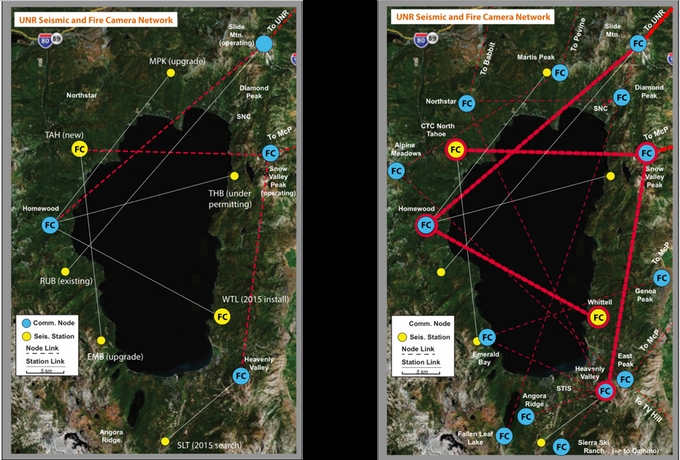
Left: Pilot program cameras; right: build out. Images/UNR

Left: Pilot program cameras; right: camera network when the system is built out. Images/UNR

By Kathryn Reed

INCLINE VILLAGE – If the fire alert system that is in its infancy in the Lake Tahoe Basin had been in place in 2007, the Angora Fire might not have wiped out 254 homes on the South Shore.

That is the prediction of Graham Kent, a South Tahoe High School graduate who is now the state seismologist for Nevada. He gave a talk Jan. 8 at the Tahoe Center for Environmental Sciences about AlertTahoe, the fire camera system that is being developed in Tahoe.

That same day the newest camera – at Homewood Mountain Resort – came online. Other cameras are at Snow Valley Peak, Angel’s Roost at Heavenly Mountain Resort, and on California Tahoe Conservancy property in North Lake Tahoe. A permit is secured to place a camera above Whittell High School, but there is no money to do so.

“Angora would be easy to control under a system like this,” Kent told the group.

The problem with Angora was dispatchers in Truckee believed it was a controlled burn and didn’t direct resources to the wildland fire in a timely manner. These cameras would have shown that smoke was no control burn. Plus, officials are working to put information on the website that identifies prescribed burns.

There was a time when people said a massive fire could not burn in the Sierra. The Rim and King fires prove that theory wrong. Had the winds changed, last September’s King Fire would have easily entered the basin at Tahoma.

Kent showed time lapsed images of the King Fire smoke that was captured on one of the cameras.

“You’re looking at stands of trees blowing up,” he said, as there would be a burst of smoke.

At one point flames are visible. (Video is in HD and 4K, with infrared capability.) The cameras can be moved to get a wider or zoomed in view.

On July 29 a camera picked up smoke on Mount Pluto at Northstar that neither CalFire nor the U.S. Forest Service was aware of. A storm came through to douse those flames. On Aug. 9 a tree was on fire north of Spooner. Officials knew about it because of a camera. The fire was kept to a half acre.

“That’s the point of the system. We find them, knock them down and make them small,” Kent said.

The Sept. 24 Cascade Fire allowed officials to see what a small fire looks like at night.

The U.S. Forest Service used to use fire lookouts to spot fires. These cameras are the modern day version of those lookouts – only much better. Fire agencies and the public may view them online.

The cameras are also used by UNR scientists to study earthquakes and floods. But as Kent pointed out, the cameras cannot change the size of those disasters. The cameras can help contain a fire.

An effort is under way to raise $2 million – in public and private dollars – in the next decade to be able to install more cameras, as well as to keep up with the maintenance and operation.

It cost $160 million to fight the Angora Fire, and at just more than 3,000 acres, that was a small fire. Angora was 1 to 3 percent of the size of the Rim and King fires.

With the snowpack diminishing in the Sierra and climate change taking hold, Kent said, “It is a very poor time to sit back and let fire happen.”

He said one fire could wipe out all of the $3 billion in environmental improvements that have been made in the basin since the 1990s.

The program continues to evolve. AlertTahoe is working with BLM to show two weeks worth of lightning strikes. If people think they see smoke from a fire, that location could be matched with where the lightning occurred. A Twitter feed, that will be activated this spring, will be geared toward spreading AlertTahoe info to the masses. The ability to show longitude and latitude identifiers for fires is in the works. And the website interface is being expanded.

—–

Notes:

• For more info or to help fund the project, go online.


Opinion: Report IDs true bully in EDC

By Larry Weitzman

El Dorado County’s recently ousted Chief Administrative Officer Terri Daly may still be menacing the county.

It wasn’t just enough that she, 1) hired the Assistant CAO Kim Kerr, who demonstrated her incompetence by violating the California Public Contract Law at least 36 times, and 2) created a deficit of more than $100 million during the the next four and a half years because of her hiring of 170 mostly unnecessary employees and awarding a 15 percent raise while squandering a $54 million General Fund surplus by the end of 2015. Rumor has it that she is still complaining to the current Grand Jury about something and if it’s about a climate of fear within the county, she has no credibility. Daly was the ringleader of the “climate of fear.”

Larry Weitzman

Larry Weitzman

About a year ago Daly created a campaign against certain elected officials, especially the auditor, and that because of him the working environment for EDC employees had become a “climate of fear.” Daly’s campaigned with the prior Grand Jury to damage the auditor’s re-election by claiming he was a bully and trying to get the El Dorado County Charter changed (during the Charter Review Committee’s existence and now disbanded for another five years) to eliminate elected officials, such as the auditor and tax collector/treasurer and make them all appointed (by Daly as CAO).

I obtained from the county counsel the almost complete 931-page Van Dermyden Maddux Climate Assessment survey in which Daly attempted to use as evidence of the auditor’s bullying.

But something was wrong with Daly’s claims and conclusion. The summary of the Van Dermyden survey said the auditor had a 92 percent employee satisfaction rating, while the county average was 60 percent. The auditor had the highest satisfaction score of all departments with more than eight employees.

While the Van Dermyden summary said there was retaliation and bullying within EDC, the survey summary wasn’t specific as to who was to blame. But that didn’t stop Daly from claiming it was the auditor. Daly lied. In fact, if you read the 931-page report, you will learn the problem was anything but the auditor. It was Daly.

While not reported in the summary, there were four departments that received satisfaction scores of 100 percent, Air Quality (8 respondents), Risk Management (3 respondents), Clerk of the Board (1 respondent) and Elections (3 respondents). On the flip side, even the Board of Supervisors staff had low marks with only 33 percent of the reporting employees saying they were very satisfied or satisfied with their employment with EDC.

So, you have a complete understanding of the survey results, 55 percent of BOS employees said they were neutral and 11 percent say they were very dissatisfied.

Is there a “climate of fear” in El Dorado County and if so where was it prevalent? No matter what the Van Dermyden says about El Dorado County, we will never be able to judge the results completely because we have no baseline. And Van Dermyden refused to release any data from other jurisdictions with which to compare.

However, in examining the Van Dermyden study, it points to three departments, the CAO’s office, Kerr’s Community Development Agency and the Information Technology Department which was run by a Daly minion which had a dissatisfaction rating two and a half times the county average (41 percent). That’s right, the “climate of fear” had nothing to do with the auditor, it had everything to do with the CAO and her handpicked ACAO Kim Kerr.

Starting with the CAO’s office, question seven of the study asked: “If an incident occurs in your department, do you feel comfortable reporting?” Title and names were redacted, but you can take a guess. There were 11 responses with one saying “our TITLE, NAME” the another comment was “relationship between the TITLE, TITLE and TITLE.” I’ll bet I can name two of the redacted parties. Two more of the 11 comments said “get thrown under the bus” and another was ”no one acts on it.”

These are just a few of the remarks for question seven from the CAO’s section of the study. However, question 12 tells us another story about the county’s problems, the hiring of 170 county employees, most of whom were unnecessary.

Q12 asked: “What concerns do you have about the workplace?” One employee in the CAO’s office put it this way, “We do all the difficult work for the county and make the least amount of money in our department. Also there are redundant positions that duplicate what we do … and they get more money….”

It was Daly who went on a hiring spree for her department, adding 18 new analysts, administrators and fiscal techs in the last two years at a cost of almost $2 million annually. Daly left EDC facing a five-year deficit of ore than $100 million.

Overall, within that two-year period she hired or allowed to be hired an additional 150 employees. That is what happens when at least three blind mice are on the Board of Supervisors.

If Daly were such a wonderful person, you would think her overall satisfaction rating for the CAO’s office would have been off the chart. It wasn’t. It was about average for the county with a satisfied rating of 62 percent, 19 percent neutral and 19 percent dissatisfied. The overall county averages were 60 percent average, 23 percent neutral and 17 percent dissatisfied.

But when we get to the Community Development Agency which the ACAO, Kim Kerr, ran it makes the CAO’s employees remarks to question seven look like child’s play. Overall the CDA had a 56/22 percent satisfied/dissatisfied rating from 156 respondents. But it is the responses to Q7 that are so telling. Half of the 42 responses used the word retaliation, bullying, belittling, reprisal, repercussion, and in some cases words to that effect. Many used a combination of the words. It just supports the fact that if there is a bully in El Dorado County, it lived in the CDA.

Fifty-six percent of the respondents in the CDA said the reason for leaving EDC employment would be the “challenges with culture or climate of department.”

Next and hardly last in the EDC misery index is Information Technologies. Another handpicked Daly loyalist, Kelly Webb, who was recently dismissed from the job as department head, ran this department. Webb never met the minimum job qualification requirements, but small things like that never bothered Daly. IT had 29 respondents and not only did it have the highest score for dissatisfaction at 41 percent, it had the lowest score for satisfaction at 27 percent.

As to Q7 there were 13 responses with retaliation used or described at least eight times. But that is only the half of it. Q12: “What concerns do you have about the workplace?” had some telling remarks. The first one said, “Mgmt is not qualified. TITLE (redacted) not following county policy….” A second more telling remark was: “The department is being managed by people who are not technically qualified, but have been placed in management positions thru favoritism by the TITLE (redacted) and are now running the department into the ground.” It is obvious that the redacted title belonged to the CAO.

Here is another IT respondent’s statement: “The management in my department actively engages in discrimination, harassment and retaliation against employees and is condoned by the TITLES (redacted name).”

And the auditor is the bully? As you can see, the three departments directly involving Daly and her minions, Kerr and Webb are the worst in the county. And Daly as you can see is not only a liar, but knew her largest impediment in her attempted coup of the county was the auditor. Daly already had the BOS eating out of her hand. That is why she wanted him gone. The auditor was the only remaining watchdog and check on Daly. One of the main functions of the auditor is the county fiscal watchdog.

Writer’s note: The report as received from the County counsel redacted in its entirety question 11 from the entire report from each department: “What would you consider your greatest workplace challenge or difficulties?” The comments were so voluminous that they took up five pages in the CAO section, 12 pages from the CDA section and three pages from IT section. Most of the other 34 questions took one page. I am sure they were devastating regarding Daly and Kerr and because of that they were impossible to redact. Also questions 34: “Is there anything that was not included in your responses that you would like to add with respect to workplace culture?” and Q35: “Please provide any general topic area you would like to discuss such as retaliation, harassment, equal employment opportunity issues, culture, workplace civility, etc.” were fully redacted from all 931 pages as for the same reason, too many names made it impossible to redact. The county says it does not have those pages. You can bet Daly and Kerr were liberally named. The entire 931 pages should be posted on the Internet. I hate to break bubbles, but the BOS has the ultimate responsibility.

Larry Weitzman is a resident of Rescue.


Study: Youngsters reading fewer books

By Motoko, Rich, New York Times

Cue the hand-wringing about digital distraction: Fewer children are reading books frequently for fun, according to a report released Thursday by Scholastic, the children’s book publisher.

In a 2014 survey of just over 1,000 children ages 6 to 17, only 31 percent said they read a book for fun almost daily, down from 37 percent four years ago.

There were some consistent patterns among the heavier readers: For the younger children — ages 6 to 11 — being read aloud to regularly and having restricted online time were correlated with frequent reading; for the older children — ages 12 to 17 — one of the largest predictors was whether they had time to read on their own during the school day.

The finding about reading aloud to children long after toddlerhood may come as a surprise to some parents who read books to children at bedtime when they were very young but then tapered off. Last summer, the American Academy of Pediatrics announced a new policy recommending that all parents read to their children from birth.

Read the whole story


Traffic stop ends with arrest of murder suspect

suspectsA routine traffic stop in Truckee led to the arrest of a man wanted on murder charges in Fresno and Florida.

California Highway Patrol officers stopped a vehicle going west on Interstate 80 about 10:30pm Jan. 10. Officers were suspicious and asked for Truckee officers to bring in K-9 Trax.

Officers said a search of the vehicle revealed a small amount of marijuana as well as more than 100 credit cards in an unidentified female’s name, multiple pre-paid gift cards, altered debit cards, pre-paid cash cards and numerous receipts of recent transactions for high-end apparel from different states across the country.

During the booking process, it was confirmed that the driver, 33-year-old McKinley Williams, had falsely identified himself during the traffic stop. Williams had two outstanding warrants for murders.

The passenger, 23-year-old Karion Bickham, had correctly identified herself to officers during the traffic stop. However, during the initial search, officers located a second Florida driver’s license with her picture and a fictitious name that matched the name on the numerous credit cards found in the vehicle.

Williams and Bickham were booked into the Truckee jail on several fraud related charges.

— Lake Tahoe News staff report


King Fire restoration plans to be discussed

The Eldorado National Forest is seeking comments as it prepare an environmental impact statement for the King Fire restoration project.

In order to be considered, comments must be submitted by Jan. 23.

An open house to discuss the project is on Jan. 13 at the Best Western Plus Placerville Inn, 6850 Green Leaf Drive, Placerville from 6-8pm. A presentation on the proposed action will be followed by questions and answers with the planning team, and an opportunity to talk to specialists about specific aspects of the project including fuel reduction, tree salvage, reforestation, wildlife, watershed protection, and research.

The purpose of the King Fire restoration project is to maintain the ecological integrity of post fire habitat; reduce future fuel loadings in strategic areas important to fire control; increase resiliency of the vegetation in the project area to future fire; reduce risk from dead, falling tree hazards to people, structures and cultural resources; recover some of the economic value of dead trees to help pay for restoration activities and contribute to societal needs for wood products; take advantage of opportunities for research to increase knowledge regarding effects on the environment from large fires and post-fire tree removal; and protect watersheds by reducing sediment input to streams and large woody fuel accumulation in sensitive areas.

A complete description of the proposed action, including project maps can be found by going online.


Nev. to consider allowing betting on Olympics

By J.D. Morris, Las Vegas Sun

In recent years, gamblers expecting to place wagers on the Olympic Games at Nevada sports books were in for a letdown: Per state law, they were prohibited from doing so.

The South Point is trying to change that.

Next Thursday, the state Gaming Control Board will hold a workshop in Las Vegas to consider a regulation change proposed by the South Point that would allow for wagering on sporting events sanctioned by the International Olympic Committee.

South Point executives also are asking the board to loosen some regulatory language that would make it easier for sports books to accept wagers on other types of events, too.

Nevada gaming regulations ban wagering on any noncollegiate amateur sport or athletic event. The South Point wants to alter that language to expressly permit Olympics betting.

Read the whole story


Bus service caters to Truckee area seniors

TAHOE CITY — A one-year transportation pilot program in the Truckee region is benefitting seniors.

“It’s not just for folks without a vehicle or the disabled,” explained Tara Styer, mobility manager with Tahoe Transportation District.

While the curb-to-curb service is designed for those 60 and older, anyone is allowed to use the system. But preference will be given to the older crowd because that is whom the grant is designed to serve.

Scheduled trips go to Reno, Grass Valley-Nevada City, Auburn-Roseville-Sacramento, and Kings Beach-Tahoe City-Homewood. Many of these are doctor and shopping related. But trips can also be social in nature.

An additional trip has been added Jan. 15 to take people to Reno. Cost is $8 round trip.

“We provided a couple holiday trip so seniors could get out,” Styer said Jan. 6 when she made a presentation before the North Lake Tahoe Resort Association’s Tuesday Morning Breakfast Club. “We’ve added trips to South Lake Tahoe so seniors could see specialists there.”

She said if the demand is there, the goal is to continue the program beyond June.

—-

Notes:

• For more info, go online.

• To book a ride, call 530.550.7451.

• Reservations may be made 72 hours in advance.

• Personal care assistants ride for free.

— Lake Tahoe News staff report


K’s Kitchen: Creamy vegetable pasta

By Kathryn Reed

An open container of cream, half a carton of vegetable broth, fresh rosemary and spinach stared back at me when I opened the refrigerator door to figure out what I was going to eat.

It wasn’t enough. Off to the grocery store I went.

But for what I wasn’t sure. Mexican? Italian? Something else?

I bought overpriced asparagus, a three-pack of exotic mushrooms that seemed pricy and green onions. The end result was pretty darn good and worth every penny.

Sometimes winging it can have its rewards.

pastaCreamy Mushroom, Asparagus, Spinach Pasta

1 bunch green onions, chopped

8 cloves garlic, minced

White wine

½ bunch asparagus, chopped

2 C vegetable broth

8 ounces mixed wild mushrooms, chopped

1 T fresh rosemary

4 ounces fresh spinach

¾ C heavy cream

Salt and pepper, to taste

1 pound spaghetti

Parmesan cheese, optional

Cook pasta according to package directions.

Coat pan with white wine so it is about 1/8-inch deep.

Add onion and garlic, cooking over medium heat. Cook until liquid is absorbed.

Add veggie broth and asparagus. Simmer about 3 minutes.

Add mushrooms and rosemary.

Gradually add spinach until it is wilted. Keep stirring. Bring to a boil for 5 minutes. Add salt and pepper to taste.

Add cream, turning down heat so concoction simmers.

If you want the sauce to be thicker, add flour or corn starch. If using cornstarch, first dissolve it in cold water so there are no chunks before adding to mixture. Constantly stir.

Drain pasta and then return to pot it was cooked in.

Add creamy vegetable mix to pasta. Mix. Serve in individual bowls. Top with cheese.


Snippets about Lake Tahoe

jamie anderson• Meyers resident and Sierra-at-Tahoe Olympic snowboarder Jaime Anderson is on Forbes magazine’s 30 Under 30 in sports list for her accomplishments.

• Tahoe Regional Young Professionals is having a mixer Jan. 28 at the Mellow Fellow in Kings Beach from 5:30-8:30pm. It is free for members, $10 for non-members, which includes appetizers and a drink.

• Lake Tahoe Community College and Lake Tahoe Unified School District boards are having a joint meeting March 24 at 5:30pm at the college.

• Debbie Endsley, 56, of Placerville has been appointed acting secretary of the California Department of Veterans Affairs.

• The film “Fed Up” is being shown for free Jan. 22 at 6pm in the Truckee High School auditorium. A nutritious meal will be available for $5. Following the film, a panel of community experts will answer questions.


Increase in police deaths isn’t what it seems

By Abbie VanSickle, Center for Investigative Reporting

In his remarks at the funeral of slain New York police Officer Wenjian Liu, FBI Director James Comey told those gathered that 2014 had been an unusually deadly year for law enforcement officers.

“We had 115 officers killed in the line of duty last year, a shocking increase from 2013,” he said.

Comey’s remarks suggest that officers are dying at the hands of criminals at a higher rate than in the past. But do the statistics support this “shocking increase?” Not really.

While newly available data show that law enforcement deaths did rise from 2013 to 2014, a closer analysis shows that 2013 may have been the aberration, with an unusually low number of police deaths, while 2014 marked a return to the recent norm.

“It was not far out of line from the other years,” said Steve Groeninger, spokesman for the National Law Enforcement Officers Memorial Fund. “I think it was troubling in that I think that we as a community had hoped that we were turning a corner on law enforcement safety, and, boy, they just jumped back up again.”

The memorial fund, a Washington-based nonprofit that tracks nationwide law enforcement deaths, compiles a database widely used by researchers. Its preliminary data for 2014 show that 126 law enforcement officers in the U.S. died in the line of duty, up 24 percent from 2013, when 102 officers were killed. In 2012, 122 officers died. But in 2011, 171 officers lost their lives, and in 2010, the figure was 161.

The biggest news in the 2014 statistics may be that firearms deaths surpassed traffic-related fatalities as the leading cause of death among law enforcement officers.

police_deaths


Firearms-related fatalities among law enforcement officers have decreased each decade since the 1970s, according to the memorial fund’s data. In the 1970s, an average of 127 officers were killed with guns annually. That dropped to an average of 87 officers a year in the 1980s. Last year, firearms deaths rose from 32 officers in 2013 to 50 in 2014 – a 56 percent increase, but still below this decade’s average of 53 officers a year.

This data is largely in line with related sources. The FBI tracks deaths of law enforcement officers each year and publishes an annual report, “Law Enforcement Officers Killed or Assaulted,” also known as LEOKA. This data differs slightly from the National Law Enforcement Officers Memorial Fund’s data because it does not include some types of law enforcement officers, such as prison guards, and relies on voluntary reporting by agencies.

While the 2014 FBI report is not yet available, prior data show that 2013 was an exceptionally safe year for police. According to the FBI, 26 officers were killed with firearms in 2013, a sharp decline from 2012, which saw 44 officers killed with firearms, and 2011, when 63 officers killed.

Interested in how many people were killed in 2014 by law enforcement? That’s much a harder question to answer. No national government database tracks deaths at the hands of law enforcement. Instead, local police departments can self-report information to the FBI on what it calls justifiable homicides, but that data is widely considered to be unreliable, according to recent media reports including Nate Silver’s ESPN website FiveThirtyEight and the Washington Post.