Carson City man dies in Hwy. 50 accident

One person died Jan. 14 in a single-vehicle accident on the South Shore. Photo/NHP

One person died Jan. 14 in a single-vehicle accident on the South Shore. Photo/NHP

A Carson City man died early Wednesday morning when the 2001 Jeep Wrangler he was driving overturned on Highway 50 near Glenbrook.

Joseph David Winters, 27, died at the scene. The accident occurred about 2:10am Jan. 14.

Nevada Highway Patrol officers said Winters was going east when he drove off the roadway and onto the right shoulder and struck the guardrail twice.

“Mr. Winters’ vehicle rotated and crossed both the east and westbound travel lanes of U.S. 50 and struck a raised curb. The vehicle overturned, ejecting Mr. Winters,” NHP said in a press release.

Troopers also said Winters was not wearing a seat belt and they suspect alcohol to be a factor.

— Lake Tahoe News staff report


Businessman at center of CalPERS scandal commits suicide

Updated 2:12pm

By Dale Kasler, Sacramento Bee

SAN FRANCISCO — In failing health and facing up to 30 years in prison, one-time Stateline businessman Alfred Villalobos apparently committed suicide before going on trial in connection with the bribery scandal at CalPERS.

Villalobos’ attorneys, appearing at a pre-trial hearing in U.S. District Court on Wednesday, disclosed that Villalobos died the day before. His death ends the government’s criminal case against the Nevada businessman –and largely closes the books on a corruption scandal that roiled the nation’s largest public pension fund.

Lt. Albert Snover of the Reno police department said Villalobos’ death is being investigated as a suicide. No further details were available.

Villalobos’ death leaves one matter outstanding in the criminal case stemming from the CalPERS corruption probe. The pension fund’s former chief executive, Fred Buenrostro, who has admitted taking more than $250,000 in bribes from Villalobos, is still scheduled to be sentenced in May for his crime.

Read the whole story


S. Tahoe photographer capturing historic climb

By Jeff Jardine, Modesto Bee

To suggest Corey Rich of South Lake Tahoe has a bird’s-eye view of the historic climb going on in Yosemite National Park might be an understatement.

Our fine feathered friends haven’t ventured nearly as close to the climbers as Rich, who began his career at the Modesto Bee as an intern in 1996.

Two days after Christmas, 36-year-old Tommy Caldwell of Colorado and 30-year-old Kevin Jorgeson of Santa Rosa began their ascent of El Capitan’s Dawn Wall in a 3,000-foot free climb, using only their hands, feet and safety ropes.

Experts will tell you these gents are making perhaps the world’s most difficult free climb because of the smoothness of the mountain’s face on the route they’ve chosen.

And there is Rich, 39, right with them capturing their efforts – their daily successes, struggles, failures and victory – but most of all, their will to conquer the Dawn Wall. This is his love as well, a life’s dream being fulfilled. He joined the climb Jan. 3, just 48 hours removed from a trip to South America, using the ropes that dangled to the valley floor to catch up with them already well into their climb.

Just about everyone involved, from the climbers themselves to Rich to others shooting from the ground, has been posting on their Facebook pages (search for his at Corey Rich or Corey Rich Productions).

Read the whole story


Caesars bankruptcy filing expected this week

By Matt Jarzemsky, Peg Brickley and Kate O’Keeffe, Wall Street Journal

Caesars Entertainment Corp. ’s largest unit is preparing to file for bankruptcy protection as soon as Thursday, the final gambit of a yearslong attempt to salvage a soured buyout.

Caesars Entertainment Operating Co.’s Chapter 11 filing would launch the final stage of Apollo Global Management LLC’s effort to save some of its $1.7 billion investment in the company, which it took private in 2008 with fellow buyout firm TPG.

Caesars is the parent company of Harrah’s Lake Tahoe and Harveys in Stateline.

Read the whole story


Fire, water and climate change talk in SLT

How Global Warming is Changing California’s Weather and a Bipartisan Solution is the subject of a talk on Jan. 27 from 5:30-8pm at the South Lake Tahoe Library.

The speakers will be Dana Nuccitelli, environmental scientist, risk assessor, and climate blogger for the Guardian and SkepticalScience.com; and Jennifer Wood, soil scientist and leader of the Sacramento chapter of Citizens’ Climate Lobby.

California has been hit hard by drought and wildfires in recent years. These events have left many Californians wondering is this extreme weather linked to global warming, and what can we expect for the future?

Nuccitelli will discuss and answer questions about the latest scientific research into the possible links between climate change and California’s wildfires and drought, and projections of their future changes in a warming world. The event will also include discussion of a proposed free market, bipartisan solution.

For more information, contact Jeff Miner at jeffminer@etahoe.com or 530.577.7293.

The library is at 1000 Rufus Allen Blvd.


Road beat: 2015 Tundra ride quality excels

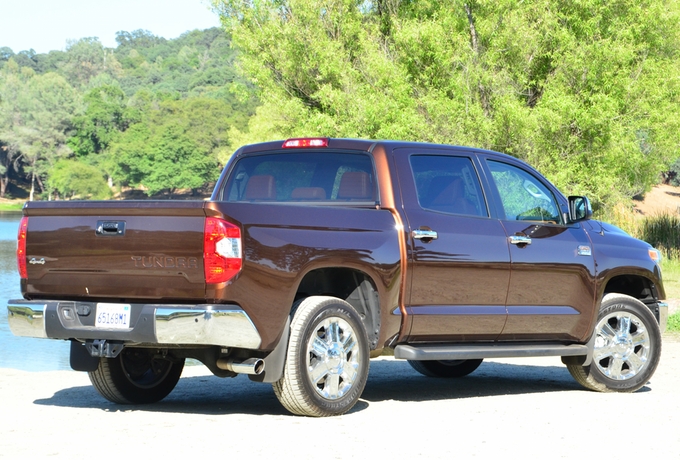
The 2015 Toyota Tundra is a complete package. Photos/Larry Weitzman

The 2015 Toyota Tundra is a complete package. Photos/Larry Weitzman

By Larry Weitzman

Toyota’s new third generation 2015 Tundra (refreshed in 2014) has finally got it right (keep reading and you will understand). Toyota has been making trucks for decades with the Tacoma owning the mid-size class for years and one of its biggest competitors, the Ford Ranger no longer in production.

In the full size realm, Toyota started with the T100 in 1992, which morphed into the first generation Tundra in 1999. Although it had an 8-foot bed and was considered by some automotive types as a full size pickup, it was smaller, especially in the cab. It was more like a 7/8 truck. But it was a great truck. Go try and find a used first generation Tundra; good ones are expensive.

In 2007 Toyota brought out a real full size “half-ton” Tundra pickup, matching the size and dimensions of the Big Three in every way, including power with a 5.7L 381 hp V-8. In several tests of this second generation Tundra, there was no question it was effectively the equal of the competition in almost category, except one, ride quality. Toyota tried too hard to make its truck feel tougher than the competition and it did that by making it ride more like a heavy-duty truck. It could be bouncy over expansion joints. In my first test of the 5.7L about six years ago, I remarked that the oscillation was intolerable. In a 4.6 version tested a few years later it was much improved, but still not perfect.
Specifications Price (1794 Crew Max 4X4, as tested) $48,880  Engines 4.0L DOHC, 24 valve V-6 270 hp @ 5,600 rpm  278 lbs.-ft. of torque @ 4,400 rpm 4.6L DOHC 32 valve V-8 310 hp @ 5,600 rpm 327 lbs.-ft. of torque @ 3,400 rpm 5.7L DOHC 32 valve V-8 381 hp @ 5,600 rpm 401 lbs.-ft. of torque @ 3,600 rpm Transmission  Five speed automatic (4.0L V-6 only) Six speed automatic (4.6L, 5.7L V-8) Configuration Longitudinal front engine/rear wheel drive/four wheel drive Dimensions (as tested)   Wheelbase 145.7 inches Length 228.9 inches Width 79.9 inches Height 76.2 inches Track (f/r) 67.9/67.9 inches Ground clearance 10.4 inches Bed size (l/h/w) 78.7/22.2/66.4 inches Weight 5,880 pounds GVWR 7,200 pounds Tow capacity 9,000 pounds  GCWR (gross combined weight rating) 15,300 pounds Fuel capacity 26.4 gallons Steering lock to lock 3.71 turns Turning circle 44.0 feet Brake rotor diameter (f/r) 13.9/13.6 inches Co-efficient of drag 0.38 Performance 0-60 mph 6.61 seconds 50-70 mph 3.63 seconds 50-70 uphill 4.98 seconds Top speed Without a governor it would probably hit 130 plus mph. It=s got a lot of air to push. Fuel economy EPA rated at 13/17/15 mpg city/highway/combined. Expect 14-15 mpg in rural country driving and 19-20 mpg on the highway at legal speeds.

Specifications
Price (1794 Crew Max 4X4, as tested) $48,880
Engines
4.0L DOHC, 24 valve V-6 270 hp @ 5,600 rpm
278 lbs.-ft. of torque @ 4,400 rpm
4.6L DOHC 32 valve V-8 310 hp @ 5,600 rpm
327 lbs.-ft. of torque @ 3,400 rpm
5.7L DOHC 32 valve V-8 381 hp @ 5,600 rpm
401 lbs.-ft. of torque @ 3,600 rpm
Transmission
Five speed automatic (4.0L V-6 only)
Six speed automatic (4.6L, 5.7L V-8)
Configuration
Longitudinal front engine/rear wheel drive/four wheel drive
Dimensions (as tested)
Wheelbase 145.7 inches
Length 228.9 inches
Width 79.9 inches
Height 76.2 inches
Track (f/r) 67.9/67.9 inches
Ground clearance 10.4 inches
Bed size (l/h/w) 78.7/22.2/66.4 inches
Weight 5,880 pounds
GVWR 7,200 pounds
Tow capacity 9,000 pounds
GCWR (gross combined weight rating) 15,300 pounds
Fuel capacity 26.4 gallons
Steering lock to lock 3.71 turns
Turning circle 44.0 feet
Brake rotor diameter (f/r) 13.9/13.6 inches
Co-efficient of drag 0.38
Performance
0-60 mph 6.61 seconds
50-70 mph 3.63 seconds
50-70 uphill 4.98 seconds
Top speed Without a governor it would probably hit 130 plus mph. It=s got a lot of air to push.
Fuel economy EPA rated at 13/17/15 mpg city/highway/combined. Expect 14-15 mpg in rural country driving and 19-20 mpg on the highway at legal speeds.

While this new third generation is more of a refreshed second generation with new sheet metal and interiors, it is mechanically quite similar to the second generation except for one thing, this new third generation rides smoother than a baby’s butt. Fabulous.

Toyota also brought out a new top of the line model, the 1794 Edition, which turns out to be an obscure reference to the location of the San Antonio plant where Americans assemble the Tundra. Still don’t get the 1794? You see that was the date of the founding of the JLC Ranch upon which the Tundra plant is located. Texas wasn’t even Texas back then and Sam Houston was only 1 year old in 1794. It wasn’t an American ranch. It appears to be a feeble attempt to mimic Ford’s King Ranch pickups.

Outside the new Tundra is a bit busy, but styling a pickup to be different is a tough job considering it is a true three-box design. Let’s put it this way, it is good looking and everyone who looked at it remarked on its beautiful color, Sunset Bronze Mica, which is exclusive to the 1794 edition. It is captivating; Toyota may sell this truck because of the paint finish. Surprisingly, the coefficient of drag is a low (for a pickup) 0.38.

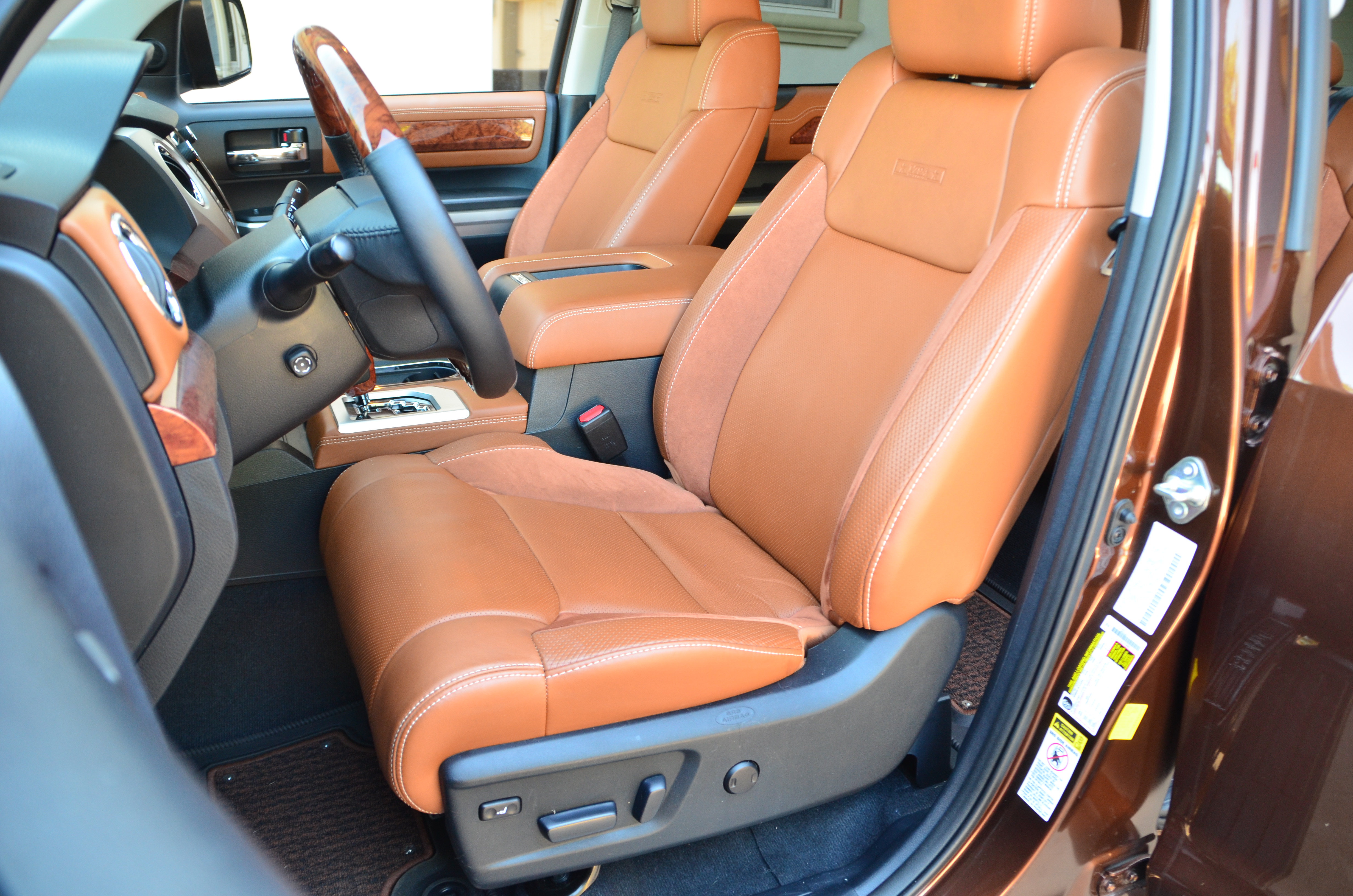
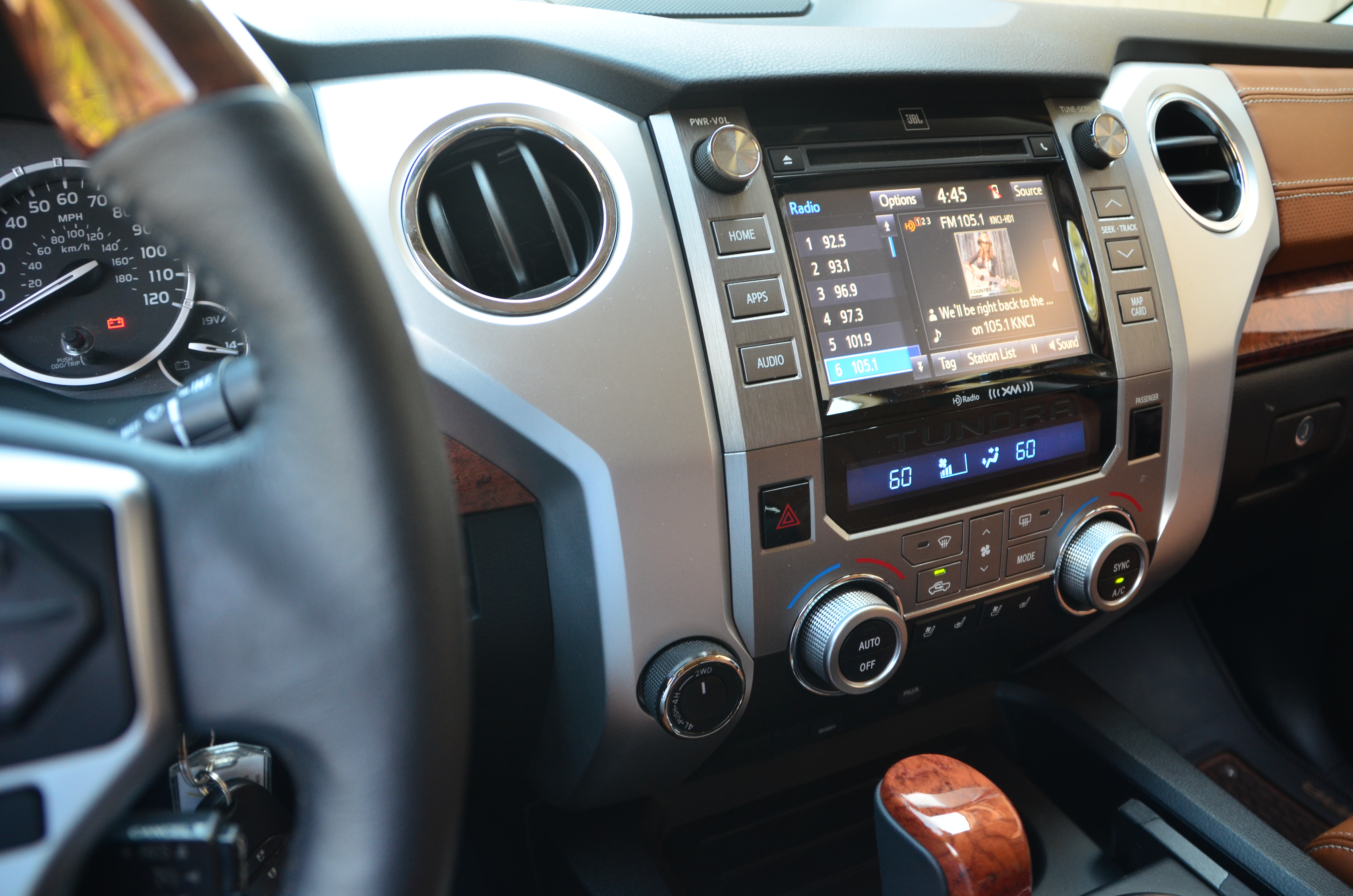
But it doesn’t end there. Wait until you open one of the doors and take a look inside. King Ranch watch out. First are the soft oil tanned leather seats. Fabulous number two. The rear seating has more luxury, comfort and space than a limousine. Even the floor mats are trick. About the only comment is I would have left out the basket weave on a couple of the trim pieces. The instrument panel is also new and well done. The front chairs are as comfortable as they look. Kudos, Toyota.

The nuts and bolts of the new Tundra are a carryover, including most powertrain, suspension and chassis components with some obvious beneficial tweaks as is evident in the much improved ride quality. Three engines are available, a 270 hp V-6 found also in the Tacoma/4Runner, a 4.6L DOHC V-8 of 310 hp and a stroked version of that block displacing 5.7L and producing 381 peak hp (at 5,600 rpm) and peak torque of 401 lbs.-ft of twist at a low 3,600 rpm. The 5.7 came with the 1794 Edition. Performance is excellent with a 0-60 mph elapsed time of 6.61 seconds. Passing runs are also quick with 50-70 mph on a level highway requiring just 3.63 seconds and the same simulated pass up a six percent grade slowing that time to 4.98 seconds. Compared to the 4.6L V-8 this times are a half to a full second quicker. The six speed auto tranny needs special mention for its incredible shifting smoothness. While a pat-time 4 x 4 system, all testing was done in rear wheel drive.

Considering its weight (5,860 pounds) and large engine, fuel economy is not the forte of the 1794 4 x 4. EPA rates it at 13/17/15 mpg city/highway/ combined. On the highway at 70 mph with the engine spinning just 1,800 rpm, the Tundra averaged 19.4 mpg on a two-way run. Overall in rural hilly driving expect 14-15 mpg. It did average 17.4 mpg on a trip from Placerville to South Lake Tahoe and back at mostly legal speeds, plus a 10-minute stop for the Wagon Train and several full throttle passes. Fuel tank is a bit small at 26 gallons.

Suspension is a carryover from the prior generation, meaning fully independent double wishbones up front and a live, solid axle with trapezoid multi-leaf springs in the rear. Low-pressure nitrogen gas shocks reside in all four corners. Steering is a hydraulic rack with a winding 3.71 turns lock to lock. Another big surprise is the short 44 foot turning circle. Wheels are 20 x8 inches shod with 275/55×20 tires and the track is 68 inches front and rear. Lots more surprises to come such as excellent handling with good cornering power, a flat, stable cornering attitude and good steering feedback. It will “surprise” you at seven to eight-tenths driving. After eight-tenths you can feel the rear end start to rotate, but if you are paying attention, it telegraphs its intentions well. It may seem big and ponderous, but it is actually relatively light on its feet.

As said before, ride quality is baby butt smooth. No expansion joints, no bobbing and weaving, no float, just an extremely smooth controlled ride. It is a pleasure on the highway. Sure there is some jiggle on choppy surfaces, but there is no jarring.

Braking is done by four wheel ventilated discs of nearly 14 inches in diameters. You could serve a Thanksgiving turkey on discs that big. Of course every conceivable acronym is standard and in panic stops from 40 mph are achieved in 46 feet. Vehicle stability control, traction control and in this 4x 4 model, A-TRAC or active traction control is standard.
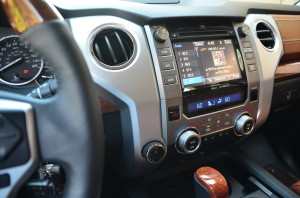
Luxury has not been sacrificed.

Luxury has not been sacrificed.

I have already described one of the best truck interiors ever, roomy, comfortable, connected, convenient, full power and then some. Lots of cubbies and storage as well. Just open the door and you will understand.

One of the newer styling designs are the deep cargo boxes now in the Tundra, over 22 inches deep. Even the width between the interior wheel wells is 50 inches. While the box is a short 5½ five, the box looks and is voluminous. With the tailgate down there is about 7.5 feet of length. It will haul a big motorcycle.

Pricing starts and ends at $47,320, plus $995 for the trucker from San Antonio. Chrome clad wheels and running boards add another $565; $48,880 and you are all done; for a 4 x 4 Cowboy Lexus.

Larry Weitzman has been into cars since he was 5 years old. At 8 he could recite from memory the hp of every car made in the U.S. He has put in thousands of laps on racetracks all over the Western United States.

WHS striving to provide students more options

By Kathryn Reed

ZEPHYR COVE – Dreaming big, with an eye toward reality. That has been the focus of a committee tasked with coming up with ideas to make Whittell High School more than it is today.

There was a time when it looked like the two remaining Douglas County School District schools at Lake Tahoe would be merged into one K-12. This committee has determined that is not fiscally doable or responsible, nor would it be good for the students.

On top of that, the district is going through an enrollment upswing after years of decline. That is something committee members at their final meeting on Monday acknowledged and want to stress to the board – staffing concerns are going to need to be addressed to handle the student population boom that is going to start next school year. The current sixth-grade class at Zephyr Cove Elementary is 38 students.

The group wrapped up its work – for now – on Jan. 12. Facilitator Nancy McMillan will be putting the ideas into a working document in the next week. There will be a special workshop Feb. 19 at 4pm for the committee to present its ideas to the board. The location has yet to be determined, but it will be at the lake.

The committee came about because last spring the school board started taking programs away from the Zephyr Cove school. Parents filled meetings, expressed their concerns, sought equity compared to valley schools and desired a voice in the process.

The committee became that voice.

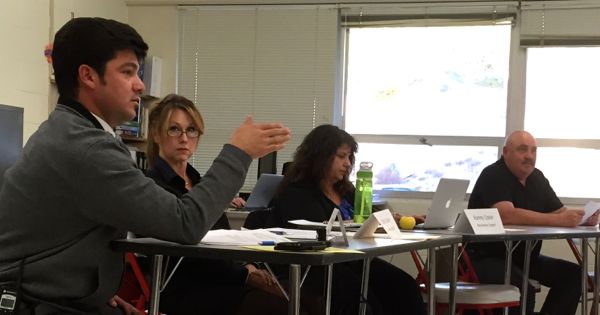
Whittell High School Principal Crespin Esquivel, from left, makes a points Jan. 12 while ZCES Principal Nancy Cauley, DCSD employee Rommy Cronin, and school board member Ross Chichester listen

Whittell High School Principal Crespin Esquivel, from left, makes a point Jan. 12 while ZCES Principal Nancy Cauley, DCSD employee Rommy Cronin, and school board member Ross Chichester listen.

Working on a memorandum of understanding with Lake Tahoe Unified School District so students can cross the state line to go to school in each state is a suggestion. The desire is to make it feasible to pick and choose classes or to be a full time student in the other state. As it is now, Nevada students can go to the California school, but not the reverse.

Working on dual credits with area community colleges is a goal, but some of that will be up to state lawmakers in Nevada and California.

Committee members know not everything can happen at once, so some recommendations include more study of an idea or putting it on the back burner until money is not an obstacle. But having things on the public record will give the concerns validation and put it in the archives for future reference.

The committee wants Douglas County School District board members to offer online classes – aka e-learning. But the district needs to file an application with the state to allow this to happen. And depending on what is offered and when, it could affect the district financially based on not being reimbursed by the state.

Then there was the discussion of using the word “empowerment” versus “autonomous”. The former is now more closely associated with underperforming schools, which WHS is not. (The middle school is considered a five star school – the top honor, while the high school last year was recognized by U.S. News and World Report as 80th best high school in the nation.)

Seeking a little more autonomy is desirous.

While Whittell is a 7-12 school, it is operated more like two schools within one building. This continues to present challenges the committee wants addressed.

A mentoring/intern program could provide youngsters with an opportunity to get hands-on experience that a traditional classroom cannot offer. Intensive intersessions would allow more in depth study of a topic.

Today the dean is also the athletic director. A dean and vice principal have different duties and limitations. Changing titles may get Whittell more of what it wants/needs.

Principal Crespin Esquivel and ZCES Principal Nancy Cauley agreed they could easily share an instructional coach.

The complete list of recommendations and priorities will be presented next month to the board. At that time it’s expected the board will direct staff to work on what it sees as doable for the 2015-16 school year. The public will also have an opportunity to weigh in at the February meeting.


Opinion: Can local lawmakers speak freely to voters?

By Peter Scheer

Local government, Republicans and Democrats agree, is the most democratic (with a small d) form of government. The closer government is to the people, the theory goes, the more accountable it is to voters and the more responsive to the public will. Congress is the most remote, hence least accountable; your local city council is the closest, therefore most attuned to your needs and interests.

Except in California and several other states where elected, local officials can find themselves in trouble for doing exactly what elected local officials are supposed to do. Things like communicating regularly with citizens; staking out clear positions on issues that constituents care about; listening to voters’ complaints about the status quo and promising, if elected (or re-elected), to make specific changes.

These communications are the lifeblood of democracy. They enable voters to make meaningful choices among candidates, while providing elected officials the information they need to represent the people’s interests. The resulting feedback loop between politicians and voters is political expression of the highest order, entitled to the fullest, most robust First Amendment protection.

And yet this paradigm of government accountability is under a cloud of uncertainty.

The cause: legal rulings that force legislative bodies to function like courts when they make decisions that are — to use the applicable legalese — “quasi-judicial” in nature. In such cases, the members of a city council, school board or county board of supervisors must be impartial and unbiased, more like judges than legislators.

What does this mean for a newly elected (or re-elected) city council member? Suppose the council will decide whether to approve expansion of a controversial housing development. If the member told voters during the election that she opposed expansion (because that is what she believed), then she may be forced — on grounds of bias — to abstain from the vote and all deliberations.

The upshot is that her constituents will be disenfranchised, which is no small penalty.

This collateral damage to free speech rights might be tolerable if local officials at least had a clear understanding of when it’s OK to act politically — that is, doing what voters want — and when, instead, they must act as disinterested judges, watching what they say and disregarding what voters say. But the fact is that the distinction between legislative acts and quasi-judicial acts is anything but clear.

Take, again, the real estate example. … If the proposed housing expansion comes before the city council as a zoning code amendment — ostensibly a legal change of general applicability but also necessary for the project to go forward — the council is probably free to proceed in legislative mode, taking politics into account and honoring members’ election promises. On the other hand, if the issue comes up as a vote on an application for a permit or license, the council members probably have to put on their judicial robes (figuratively speaking), ignore what voters say, and exclude from the process those council members who have spoken out on the issue.

The line separating legislative from quasi-judicial decisions is barely discernible to lawyers who practice in the government arena — much less to the amateur politicians who predominate on legislative bodies of cities, counties, school districts and the like.

Moreover, even in cases where the line is ultimately visible, elected officials may have no way of knowing, well in advance of the decision, whether the issue will be presented to the council as a legislative matter or a quasi-judicial matter.

Faced with this uncertainty, many council members do the only safe thing: They censor themselves.

Unsure whether they will have to act like judges on a particular issue, they will act more like judges than politicians on all issues. They will curb their interaction with voters. They will refrain from making political promises. When asked by reporters and voters to comment on a local controversy, they will resort to vague generalities, avoiding specifics at all costs.

The court rulings creating this uncertainty are not new. Some have been on the books for years. What is new is that lawyers representing local governments are relying on these rulings in their advice to local officials. Because their job is to keep their clients out of trouble, the lawyers are warning public officials to curb their comments, and their candor, about local issues.

The result is a cumulative weakening of democracy, and a diminishing of political discourse and debate on the local issues that citizens care most about.

Peter Scheer is the executive director of the First Amendment Coalition. The views expressed here do not necessarily reflect the views of FAC’s board of directors.


Calif. school builders seek 2016 bond

By Jim Miller, Sacramento Bee

School-construction and home-building groups Monday launched an effort to qualify a $9 billion school bond for the November 2016 ballot, only days after Gov. Jerry Brown released a budget plan that minimized the state’s role in paying for building new classrooms and modernizing existing ones.

The last state school bond was in 2006, and the pot of new construction and modernization money is virtually empty, with a $2 billion backlog in applications for assistance. Besides putting students in aging or overcrowded classrooms, officials warn that the situation could trigger a 1998 state law that would double developer fees on new homes.

“Every child deserves access to safe, secure, modern learning environments,” Joe Dixon, the chairman of the Coalition for Adequate School Housing and an assistant superintendent at the Santa Ana Unified School District, said in a statement Monday from the pro-bond Californians for Quality Schools. “This is an investment in the development of our state’s future workforce, and will help ensure our children are prepared to compete in a 21st Century global economy.”

Read the whole story


TAU battle looming between Placer County, SLT

By Mark Anderson, Sacramento Business Journal

There may be a duel this winter over hotel rooms around Lake Tahoe.

Placer County is interested in paying about $3.7 million to buy hotels from private owners and demolish them in South Lake Tahoe, which is in El Dorado County.

South Lake Tahoe doesn’t wantto lose the hotels, along with the important associated sales and room taxes.

Placer County wants the hotels so it can open development of new lodging along Placer County’s north shore of Lake Tahoe, which hasn’t had a new hotel built since 1959.

Read the whole story