Climate change to bring rain, floods to Tahoe

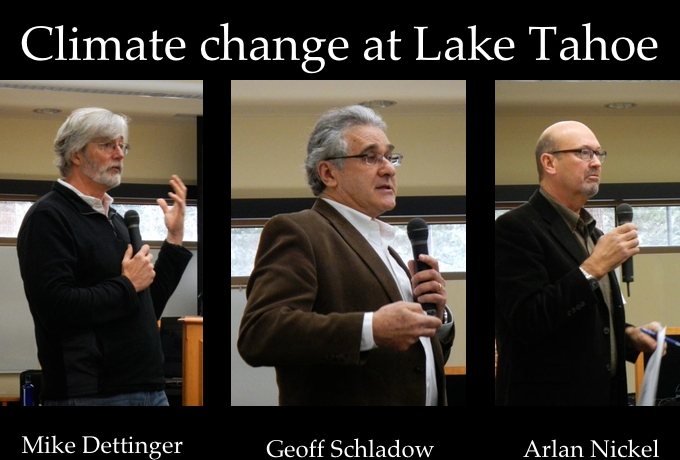
Local agencies are trying to address the affects of climate change to Lake Tahoe. Photos/LTN

Scientists are adamant climate change is already affecting Lake Tahoe. Photos/LTN

By Kathryn Reed

Tahoe’s isn’t likely to be barren anytime soon, but the type of moisture it receives in the future will be in the form of rain instead of snow, according to scientists.

That’s one outcome of climate change.

This in turn has consequences such as storage issues, flooding, more dry days than wet, and the increased threat of fire.

All of this was outlined during a climate change workshop hosted by the Lahontan Regional Water Quality Control Board at Lake Tahoe Community College on Jan. 15.

By 2050 the average snowpack for the Sierra is expected to be half of what it is now, according to Mike Dettinger, with the U.S. Geological Society and Scripps Institution of Oceanography at UC San Diego.

“With more rain, less snow, and larger storms it all comes together that the flood risk goes up in the Sierra,” Dettinger told the crowd of more than 60 people.

The meeting was one day before NOAA said 2014 was the 38th straight year with global annual temperatures above average.

Dettinger pointed out the last time California had colder than average years was from 1975-79.

Most models point to a trend of temperatures rising. This means the snow level will rise as well. That is why those living at lake level, and even many ski slopes in the Tahoe area, will see rain instead of white stuff.

Arlan Nickel with the U.S. Bureau of Reclamation said it may be time for agencies to look at when they release water so it better coincides with runoff and need. Peak runoff today is in May, but that date keeps moving up and is eventually expected to be in April.

With Lake Tahoe accounting for half of the Truckee basin’s water storage, he would like evaporation to be studied more.

While he didn’t mention it at this week’s talk, his agency along with scientists from the Desert Research Institute in Reno, and officials from the California Department of Water Resources this month placed a floating weather station at Folsom Lake with the intention of gathering data about evaporation.

DWR officials admit evaporation is a missing piece of information in the bigger water picture.

Geoff Schladow, director of the UC Davis Tahoe Environmental Research Center, is worried that dead zones are being created in Tahoe because the lake is not mixing like is used to. At 100 meters in 2014, that was the shallowest Lake Tahoe had mixed since records have been kept.

The mixing of water from the bottom of the lake to the top brings oxygen to all levels.

Without the mixing, ecosystems can be affected, heavy metals in the sediment become soluble, which can affect human health, fish die and other issues arise.

Lake Tahoe is not unique to these dead zones. Schladow said it is occurring throughout the world.

Schladow believes the models scientists have been using need to be updated because conditions are changing, and the data and assumptions from 10 years ago are outdated.

After the scientists spoke those attending were broken into groups to further discuss climate change and Lake Tahoe.

Lahontan is going to take the information from the workshop, compile a report and make recommendations to the regional board about potential policy changes or new policy.


Letter: Searching for grandfather

To the community,

My name is Morgan and I’ve been in search of my grandfather for the past 10 years. I was hoping if I provided some information maybe someone would remember him.

The story takes place in Zephyer Cove between 1961-1963 at what was once The Shoals restaurant owned by Jean and Herman Strucker. There were two chefs during this time; John Ross and Max Jones. The gentleman I’m in search of was the restaurant’s manager who went by the name of Chuck. From what I understand he also owned a used car lot in Carson city off Highway 395.

If anyone has information on this person, please email me at Morganamell06@yahoo.com

Thank you,

Morgan Amell


Holland just misses podium in snowboardcross

By USSA

Lindsey Jacobellis (Stratton Mountain, Vt.) added a fourth World Championship title to her long list of snowboarding accolades and Nick Baumgartner (Iron River, Mich) collected his second World Championships bronze medal in Kreischberg on Friday.

Experience was the key to success for Jacobellis and Baumgartner, who both fought hard battles to land on the podium. Jacobellis’ fourth win in as many World Championship starts didn’t come easy.

“This year was definitely my hardest World Champs to win because I didn’t make any starts and I was fighting through all the heats, trying to finding opportunities to pass,” said Jacobellis.

In each of the four rounds, Jacobellis failed to win the hole shot, but what she lacked at the get-go, she made up for with her 12 years of World Cup experience.

Baumgartner also rode hard, seizing the opportunities in each race to earn his spot in the final. For the first half of the medal round, it looked like Baumgartner and teammate Nate Holland (Squaw Valley) would take one and two. But in the ways of snowboardcross, Baumgartner was bumped into the fence on an attempted pass and got tangled up with Holland, so the duo settled for third and fourth behind Italian Luca Matteotti and Canadian Kevin Hill.


Arrest made in 24-year-old Placer County murder

By Bill Lindelof, Sacramento Bee

Placer County Sheriff’s detectives have made an arrest in a 24-year-old cold case involving the execution-style killings of a Placer County couple.

Joseph Victor Foster, 54, was arrested at Correctional Training Facility on Wednesday where he was serving a 50-years-to-life sentence for the 2006 kidnapping and raping of a family member in Modesto.

Foster is suspected of killing Jacqueline Sue Barton, 33, and Hugh Cleveland Gresham, 37, at the Placer County home where the couple was shot to death on Jan. 7, 1991.

Recently discovered forensic evidence linked Foster to the murders, according to a sheriff’s press release.

Read the whole story


Washoe County starting CERT Academy

Washoe County Sheriff’s Office Citizen Corps is offering a free emergency preparedness and response training academy beginning Jan. 22.

The Community Emergency Response Team (CERT) Academy provides residents with the information to help save lives and reduce trauma in the event of an emergency. CERT Academy training includes disaster preparedness, emergency medical techniques, fire safety, light search and rescue, disaster psychology, and terrorism awareness education.

The CERT Academy offers 25 hours of training during six sessions over two consecutive weekends. The training is free and trainees are not required to become a Citizen Corps volunteer to participate.

No special skills are required. Children 12-15 may participate with parent’s supervision, teens 16-17 with parent’s permission. To sign up for training, call CERT Program Manager Shirlee Rhodes at 775.325.6928 or email: srhodes@washoecounty.us.ement and support all of the Sheriff’s Office volunteer Citizen Corps Programs.


NOAA: Calif. drought likely to last into summer

By Ed Joyce, Capital Public Radio

The National Oceanic and Atmospheric Administration said the drought that started in 2011 in California will linger into summer.

NOAA reports that after nearly four years of drought, the California water deficit can only be made up by “epic amounts of rain and snow” and that isn’t likely to happen.

NOAA said if warmer temperatures bring more rain than snow in the Sierra Nevada, areas that depend on melting snowpack in late spring and summer will be left wanting. NOAA report said the snowpack is currently 50 percent of normal.

Read the whole story


Victor Keith Gottschalk — 1935-2014

Keith Gottschalk

Keith Gottschalk

One of South Lake Tahoe’s first directors of Parks and Recreation, Victor Keith Gottschalk, has died. He was 79.

Mr. Gottschalk died at his home in Reno on Dec. 2. He was born Jan. 12, 1935.

His career spanned more than three decades as director of parks and recreation in Merced and South Lake Tahoe. He also had many professional Parks and Recreation Society memberships at state and national levels.

For more than 50 years, he was an active member in a variety of service organizations including the BPOE, the Lions Club and Rotary Clubs of Merced and South Lake Tahoe.

Mr. Gottschalk was a member of the United States Marine Corps.

Mr. Gottschalk is survived by Patricia, his loving wife of 55 years; daughter Megan Kangail (Paul) of Danville; son Darren Gottschalk (Terri) of Franklin, Tenn.; grandchildren Ryker and Austen Kangail, and Jordan, Makena and Sheldan Gottschalk; brother Christian Gottschalk of Minden; sister Carol Williams of Reno; as well as several nieces and nephews.

A memorial service and celebration of life will be Jan. 17 at 1pm at the Thunder Canyon Golf Clubhouse, 19 Lightning W. Ranch Road, Washoe Valley, Nev.

In lieu of flowers, the family requests donations be sent in Mr. Gottschalk’s memory to the Freedom Alliance Scholarship Fund, 22570 Markey Court, Suite 240, Dulles, VA 20166. The fund grants college scholarships to the children of disabled and deceased military members.


Meyers resident Albert Morch dies

Albert Morch

Albert Morch

Longtime Meyers resident Albert Morch died in his sleep Christmas morning.

After retiring from a career in the newspaper business in San Francisco, he moved to Meyers where he lived for the past 28 years.

Morch joined the San Francisco Examiner, then a Hearst publication, in 1976 as a society writer. He wrote his influential and entertaining column for 20 years. It grew in popularity and eventually ranked second to that of the San Francisco Chronicle’s venerable Herb Caen. The two developed a friendly rivalry and often chided one another in their respective columns.

Morch, originally from Brooklyn, N.Y., started his career as a writer/photographer for the Hollywood Citizen-News, later joining Fairchild Publications’ Los Angeles bureau as a general assignment reporter for Women’s Wear Daily. He eventually moved to San Francisco as assistant bureau chief of Fairchild’s San Francisco office, a post he had before joining the Examiner.

In addition to writing his society column, Morch also served as the paper’s art critic until 1978. He edited the paper’s East Bay edition during the final four years of his career with the Examiner until his retirement in 1996.

When he retired, Morch purchased a cabin in Meyers.

At one point in his long career as society columnist, Morch wrote several columns on the growing use of cocaine among the city’s upper crust. Although he named no names, he received credible death threats and was under police protection for several months. In his years in Southern California, Morch also worked as a freelance photographer and his pictures of Hollywood celebs appeared in many magazines and newspapers in the U.S. and foreign countries.

He is survived by daughters Melissa and Stephanie, grandson Talon, granddaughters Kaylee and Mara, as well as his former wife and mother of his children, Lucille, and Jackie, his Jack Russell Terrier.

Morch, a Navy non-com whose final tour was on an aircraft carrier, requested cremation and his ashes scattered at sea from a ship leaving from Pier 39 in San Francisco. Friends are invited to contact his daughter, Melissa, by calling 818.640.4790, if interested in attending his sea burial.


Calif. state workers hoarding vacation days

By Will Evans, Center for Investigative Reporting

Not many workers can rack up almost two years of paid vacation time.

Yet two California state officials have done just that and stand to cash out their vacation for hundreds of thousands of dollars when they quit or retire.

They are the top vacation hoarders in a state bureaucracy with a lot of them. Tens of thousands of state employees have exceeded the official limit of 80 banked vacation days, leaving the state on the hook for hundreds of millions of dollars.

What are the names of the workers at the top of the list? The state Controller’s Office, which collects the information and generally prides itself on transparency, wouldn’t say.

Rick Chivaro, the controller’s top lawyer, said he considered the information confidential, even though his office routinely discloses salaries of state workers by name.

It turns out that one of the two top vacation troves belongs to Chivaro himself. By June of last year, he had saved up 498 days of vacation, more than six times the limit. If he retired with that much time off, Chivaro could cash out $317,000 ­­– nearly two years of pay.

The Center for Investigative Reporting was able to identify a few of the state’s biggest vacation misers by their pay rates and job titles, information provided by Chivaro in response to a public records request.

Chivaro actually is second on the list – the first is Bruce Wolfe, executive officer of the San Francisco Bay Regional Water Quality Control Board. As of June, Wolfe had 507 days of vacation stashed away.

“Wow. That’s just wrong,” said Joe Nation, professor of the practice of public policy at Stanford University. “Anyone on the inside or the outside (of government) knows that that’s wrong.”

Nation, a former state lawmaker and municipal water board president, said it’s especially inappropriate for senior managers in salaried positions to “be able to take advantage of and abuse rules like this.”

Wolfe and Chivaro lead a pack of more than 300 state employees who have amassed at least a full year of paid time off.

California’s cap of 80 days –16 weeks – is among the more generous nationwide. And it’s a cap that pops off easily.

Overall, more than 35,000 California state employees have gone over the limit – nearly 1 in 5 of those workers tracked by the controller’s office.

The state’s permissiveness is pricey. California owes those employees $447 million more than it would if they had been held to the cap, according to CIR’s analysis of vacation time and annual leave, an alternative benefit that combines vacation and sick time.

Workers across the country make do with a finite amount of vacation. Many companies, and some states, have use-it-or-lose-it policies that keep employees from carrying over endless amounts of vacation.

In New York, for example, state workers can’t roll over more than 40 days and get paid out for up to 30 days if they quit or retire. At the stingy end of the spectrum, many employers don’t let workers save any unused time off at all, according to a survey by the Society for Human Resource Management.

As for unlimited stockpiling of vacation, “I’ve never seen it in the private sector,” said Bruce Elliott, manager of compensation and benefits for the Virginia-based organization. “It’s crazy to do that if you don’t expect a big expense.”

But in California government, the problem has simmered for years, despite audits and media reports raising alarm about excess vacation time.

Chivaro didn’t respond to calls and emails asking about his paid leave. He’s worked for the state since 1972, and his “extreme commitment and service is widely respected,” according to an agency spokesman.

Last month, then-Controller John Chiang’s office provided a statement saying, “There is no more important value to the Controller than to make government more transparent and accountable.” Chiang was sworn in last Monday as state treasurer.

Chivaro’s decision to withhold names had nothing to do with his own vacation balance, the statement said.

“This is not a case of ‘won’t’ but of ‘can’t,’ ” it said. The state attorney general’s office, it said, determined that leave balances are personnel records that legally cannot be disclosed.

Betty Yee, sworn in last Monday as state controller, said that her hands were tied but that “if there is any ability to disclose this information, I would disclose it in a heartbeat.”

The opportunity is there for the taking, said open government lawyer Terry Francke. State officials made a subjective interpretation of the law, he said, giving more weight to employee privacy than to public interest in vacation balances.

“I think that’s of more public significance than just what (an employee’s) standard salary is,” he said.

Two and a half years ago, the controller’s office criticized the California Lottery Commission for failing to enforce the state vacation cap among its employees. Yet the controller’s office employs 48 individuals with at least twice the maximum vacation days, the data shows. Seven of them, including its chief of human resources, had more vacation on the books than anyone at the Lottery Commission.

Yee, unlike her predecessor, granted an interview on the subject, saying she’d be aggressive in encouraging her staff to reduce their paid time off and “guard taxpayer dollars.”

She defended those with high balances as “dedicated public servants” but said she’d like to see legislative action to make the state cap enforceable.

“There’s no teeth to it,” Yee said. “It really puts us in a bad place in order to have any impact in keeping these balances down.”

Agency leaders not enforcing cap

Back in 2000, the state auditor’s office chastised the Department of Corrections for shortsighted management of time off.

“By allowing its custody staff to accumulate large balances of holiday, vacation, and annual leave, the department is faced with a huge and rapidly growing liability that will become increasingly expensive to liquidate,” the audit said.

The manager responsible for that audit, Doug Cordiner, is now second in command at the auditor’s office. He’s personally accumulated 264 days of paid time off.

Asked about his own record, Cordiner referred questions to the agency’s spokeswoman, Margarita Fernández. She noted that Cordiner has served in state government for more than 35 years.

“While he makes every effort to use his accrued leave, he would need to be away for extended periods of time to reduce his balance,” Fernández wrote by email. “Given his responsibilities and the mission of our office, this isn’t feasible.”

Most state workers earn two to six weeks of vacation a year, depending on seniority, job type and which benefit they chose. State regulations allow exceptions to the 16-week limit for emergencies and long stretches of critical work in “extenuating circumstances.”

The heads of state agencies are responsible for enforcing the cap, said Pat McConahay, spokeswoman for the state human resources department.

But that doesn’t mean they actually do.

“Mostly, the departments we talked with just said it’s impossible,” said Marianne O’Malley, managing principal analyst with the Legislative Analyst’s Office, which released a report on the issue in 2013.

Many state workers can’t leave their posts because they’re under pressure to get their jobs done, she said. Some departments, she added, operate 24-hour-a-day facilities like prisons and don’t have enough extra staff to fill in for employees on leave.

Unpaid furloughs, imposed during tight budgets from 2009 to mid-2013, made the problem worse. Workers banked more vacation because they used furloughs for time off, the analyst’s report found.

A strict use-it-or-lose-it policy would require legislation and probably would have to be negotiated with public employee unions, O’Malley said.

Correctional officers pushed in the opposite direction, obtaining a contract in 2011 that allows them to carry over as much vacation as they want. The corrections department has more employees over 80 days than any other state agency, though none of those employees are in the top 10 vacation balances.

Failing to enforce the limit presents another problem: California hasn’t set aside money to pay for all the unused vacation when employees cash out, O’Malley said. And those costs rise over time – an employee who starts earning vacation at an entry-level wage, for example, can cash out later at a much higher salary, increased through years of promotions.

Last year, the state offered to buy back two and a half days of vacation from certain state workers. It was a start, but it barely made a dent in the large stashes of leave.

Tension over high time-off balances

Wolfe, 60, the water board official with the largest vacation cache, has worked for the state for more than 37 years and thinks he’ll retire within the next few years. He wrote by email that his board is aware of his high balance but “is not pushing me to use more leave than I currently do.”

Wolfe seemed concerned about the cash value of his stockpile – $262,000 as of June – but not because he thought it was inappropriate.

“If it’s getting that high,” he wrote, “I’ll definitely need to figure out how I can reduce my balance given the tax bite I’ll take on the payout.”

At the California Energy Commission, two staff members rank among the top 10 for leave balances statewide, each with more than 400 days. Executive Director Robert Oglesby wouldn’t divulge his employees’ vacation tallies by name, citing his staff’s privacy. He also declined to be interviewed.

Oglesby’s own balance, however, is easily identified by his title. He had amassed 309 days of vacation as of June, nearly four times the state limit. He noted in a written statement that his balance, currently worth $159,000, accumulated during 24 consecutive years in state service.

The bloated balances in his department resulted not just from furloughs and hiring freezes, but also because dedicated employees work hard to meet deadlines, Oglesby said in a statement.

Mary Khoshmashrab remembers flagging the high balances soon after Oglesby hired her in 2013 to be the commission’s top auditor, leading a new audit and investigation unit, she said. She brought the problem to commission leadership but she said they weren’t interested.

Commission officials didn’t closely monitor leave time, opening the possibility that staff could cheat by taking vacation off the books, Khoshmashrab said. She warned her bosses and planned a deeper audit but became incensed when they told her to drop the issue, she said.

The energy commission disputes her account. A statement provided by spokeswoman Lori Sinsley said that supervisors do review time sheets and that Khoshmashrab was not prevented from looking into it further.

“We recognize the importance of managing leave balances, but strive to balance staff leave with the need to accomplish our public service mission,” the statement said.

It still bothers Khoshmashrab that officials are able to cash out vacation time at a much higher rate of pay than when they earned it.

“Isn’t that misuse and abuse of public funds?” she said in an interview. “If we continue to do this, we’re just pushing debt further and further out, and we’re continuing to abuse the program.”

Tensions built over this and many other concerns Khoshmashrab brought forward, she said, leading the agency to remove her from the post last year. She briefly returned to a previous position, but then decided to resign from state service after 18 years, she said. Commission officials said they would not discuss personnel issues.

Oglesby said his agency has encouraged employees to take time off. His personnel manager sent a memo last January reminding supervisors of the 80-day cap. It said employees over the limit had to submit a plan to reduce their hours. The commission is in the process of checking to see whether those plans are in place.

Oglesby’s boss is the energy commission’s chairman, Robert Weisenmiller. Oglesby’s vacation surplus “has been the subject of numerous conversations” between them, the commission’s statement said. “At issue,” it added, “is how he can manage his leave balance without compromising his ability to carry out his responsibilities.”


Feinstein resolute in opposition to legalizing pot

By Evan Halper, Los Angeles Times

As the majority of California voters grow comfortable with the idea of pot legalization, their senior senator in Washington is making it clear that she most certainly is not.

Dianne Feinstein is emerging as one of Washington’s toughest critics of the Obama administration’s tolerance for marijuana use. Long a strident supporter of the government’s War on Drugs, the 81-year-old Democrat is showing no sign of bowing to the shifting views of constituents in California and colleagues on Capitol Hill.

Feinstein’s resolve was on full display in two letters she and Sen. Chuck Grassley, R-Iowa, her co-chair on a Senate panel that oversees international narcotics control, fired off this month to the administration.

Read the whole story