Writing your way to happiness

By Tara Parker-Pope, New York Times

The scientific research on the benefits of so-called expressive writing is surprisingly vast. Studies have shown that writing about oneself and personal experiences can improve mood disorders, help reduce symptoms among cancer patients, improve a person’s health after a heart attack, reduce doctor visits and even boost memory.

Now researchers are studying whether the power of writing — and then rewriting — your personal story can lead to behavioral changes and improve happiness.

The concept is based on the idea that we all have a personal narrative that shapes our view of the world and ourselves. But sometimes our inner voice doesn’t get it completely right. Some researchers believe that by writing and then editing our own stories, we can change our perceptions of ourselves and identify obstacles that stand in the way of better health.

It may sound like self-help nonsense, but research suggests the effects are real.

Read the whole story


Blood drive in South Lake Tahoe

BloodSource is having a blood drive in South Lake Tahoe on  Feb. 2 from noon-6pm.

It is sponsored by the Barton Memorial Hospital Auxiliary.

Walk-ins are welcome. Blood drive participants will receive a parking validation for the Lake Tahoe Resort Hotel parking lot at the blood drive check in.

Donors must weigh at least 110 pounds, be 17 years old (16 year olds need a signed BloodSource Parental consent form) and be generally healthy. There is no upper age limit. Donors must bring a photo ID and should drink plenty of fluids before donating. Potential marrow donors can register for Be the Match through BloodSource.

For more information, call 800.995.4420, ext. 60039.


Super Bowl party benefits High Fives Foundation

Soul House Project in Truckee will host an all-ages event called the Super Soul Party on Feb. 1.

From 3-8pm participants may watch the Super Bowl from comfortable couches on the Soul House Project’s 150-inch screen. Unlimited beer is available for $10, and for $20 attendees may eat food from Kellen’s Kitchen. There will be mini contests throughout the game.

Proceeds from the Super Soul Party will benefit the High Fives Foundation – supporting the dreams of mountain action sports athletes by raising injury prevention awareness, while providing resources and inspiration to those who suffer life-altering injuries.

The Soul House is at 10116 E St., Truckee.


Brine on Tahoe roads the new norm for storms

Brine leaves streaks on the road Jan. 1 at 3pm at the end of North Upper Truckee Road toward Highway 50. Photo/John Adamski

Brine leaves streaks on the road Jan. 1 at the end of North Upper Truckee Road on the South Shore. Photo/John Adamski

By Kathryn Reed

While there hasn’t been much snow to clear from roads this winter, crews in the Lake Tahoe Basin have been busy putting brine on streets when the threat of weather has been in the forecast.

This salt-water solution that is designed to prevent icing on the roads leaves a white film behind. It’s been more noticeable this season than in the past because more entities are using it.

Nevada Department of Transportation was one of the first agencies to go in this direction. They have more issues with snow storage so the less snow that sticks to the road, the less that has to be cleared.

“In the Tahoe basin we’ve done a lot of changes to winter maintenance,” NDOT spokeswoman Meg Ragonese told Lake Tahoe News. “We reduced the use of sand for winter road traction quite a bit since the 1990s. In the Tahoe basin specifically, NDOT has reduced winter road maintenance-related sand use from 4,300 cubic yards per year in 1990 to approximately 850 cubic yards, and reduced salt usage by 70 percent.”

Brine is a preventative treatment. If cars pack the snow down before a plow gets to it, the snow is released easier and doesn’t form a thick layer of ice.

Brine allows agencies to use less sand and salt, two substances that are deemed harmful for the environment.
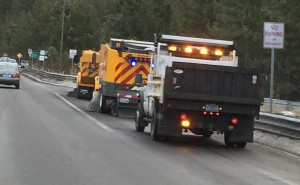
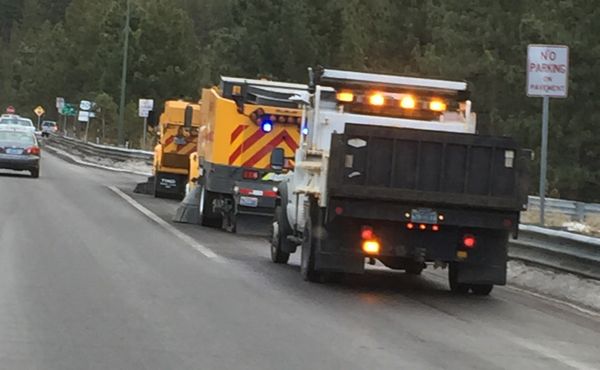
NDOT street sweepers remove salt and sand from roadways within four days of storm end in urban areas, dependent on weather. Photo/Kathryn Reed

NDOT street sweepers strive to remove salt and sand from roads within four days after a storm. Photo/Kathryn Reed

Through the years road crews have experimented with different products to keep the roads safe.

“When the snow begins, the brine is also mixed with a 75 percent sand and 25 percent salt combination to produce a wetter, heavier sand that will not as readily be thrown off roadway surfaces,” Ragonese said.

Agencies say improved equipment, mixture of products and weather forecasting allows for better application of all materials, and less need for the more harmful products.

“Brine would go on before a storm, sand during storm for traction, then salt or brine after to help melting process,” Steve Nelson with Caltrans told Lake Tahoe News. “Salt brine treated highways and bridges will resist frost for several days per application, reducing the time chain controls are in effect and the amount of traction sand used, significantly reducing chain control and sweeper employees’ exposure to moving traffic. Salt brine anti-icing techniques save time, are cost-effective and safer for workers and motorists, and they are more environmentally friendly than other methods.”

This report shows the increased use in brine for Caltrans’ Tahoe City and South Lake Tahoe maintenance yards. Brine is typically applied by tanker trucks at a rate of 50 gallons per lane mile.

When salt is applied, its rate is 200 to 500 pounds per lane mile, according to Caltrans. Caltrans went from averaging about 16,000 tons of sand in the basin each winter in the 1990s to 2,953 tons in 2012-13. Here is a chart of the amount of sand used from 1993-94 through 2012-13.

Tahoe Regional Planning Agency officials said they have no policy for what is applied to roads. Lahontan Regional Water Control Board takes a big interest on the California side. This is because they care about ends up in the lake.

Lauri Kemper with Lahontan said her agency supports the use of brine. Salt does not adversely affect lake clarity. But scientists don’t know what the affect on aquatic life is.

While road crews don’t want to hurt the lake or trees, the whole purpose of putting anything on the roadway is to help drivers.

“Public health and safety trumps everything,” Brendan Ferry, principal planner with El Dorado County, told Lake Tahoe News.

His people must balance safety with environmental concerns when it comes to deciding what goes on the roads.

Two years ago the county switched from using volcanic rock to decomposed granite. That switch has meant a 90 percent reduction – or 50,000 pounds – in fine particles reaching the lake, Ferry said.

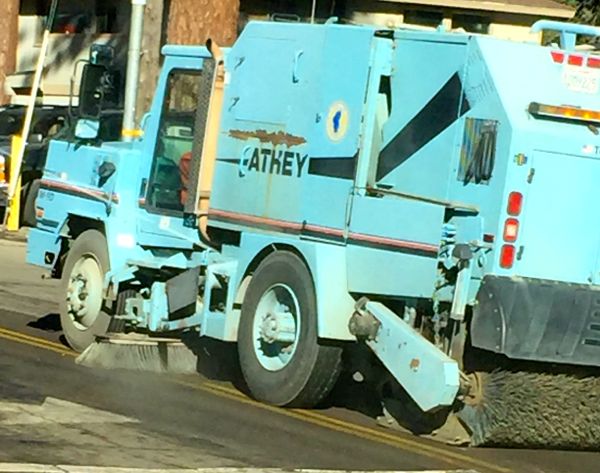
South Lake Tahoe aims to have sweepers out two days after a storm. Photo/Kathryn Reed

South Lake Tahoe aims to have sweepers out two days after a storm. Photo/Kathryn Reed

With granite being a native material, if it does reach the lake, it isn’t as detrimental as the coarser, foreign volcanic material.

“We focus a lot on roadway maintenance strategies. It’s one of the bigger things that is linked to Lake Tahoe’s clarity loss – ultra fine particles,” Ferry said. “Roadway abrasives are a primary source of those types of materials.”

The abrasives are used to help with traction. The county uses brine – which is usually a 27 percent salt, 73 percent water solution – on primary roads like Pioneer Trail and North Upper Truckee.

“We use that so we don’t need to use as many abrasives,” Ferry explained.

For years salt was applied to roads in and around the basin. But as the trees along the highways became tinged with a rust color it was determined the salt was the cause. It was distributed in hoppers, with much of the product ending up on the edge of the road and not having any affect on making the driving surface safer.

Then volcanic rock started to be used. Nearly everyone has followed El Dorado County’s lead and is using decomposed granite.

South Lake Tahoe doesn’t use brine because it has not seen the need nor does it have the equipment to do so. The city’s two sander trucks come out to drop Washoe sand at key intersections, routes to Barton Hospital and schools during storms.

The city is shopping for a sander truck that will likely cost about $350,000. It is a multiuse vehicle.

“The new one will have computerized distribution system. It will calculate how much sand to put down and where,” Jim Marino, assistant public works director, told Lake Tahoe News. “From the seat of the vehicle you will know how much you’ve put down. Two days later we’ll determine how much is picked up from an intersection.”

That’s the other environmental component. As part of Lahontan’s regulations, jurisdictions must report how much abrasive material is put down and then how much is collected either from sweeping or by cleaning storm drains. This way everyone knows how much was left in the environment or tracked into garages via tires.


Opinion: When climate, population and food collide

By Jeff Baldwin ad Asher Sheppard, Santa Rosa Press Democrat

Human population is often overlooked when we think about climate change. Yes, industrialization brings the greenhouse gases now warming the Earth, but it also affects world population, the proportions of young and old, where people live, what they consume and how their food is grown. Today, technology- intensive industrial agriculture is producing the food for many of Earth’s billions.

The link between industrialization and climate change is well known. The shift from muscle power to energy from combustion of fossil fuels releases vast amounts of carbon that living organisms took from the atmosphere hundreds of millions of years ago. Energy stored in the coal, oil and gas of Earth’s crust powers large-scale industrialization, while the accompanying greenhouse gas emissions warm Earth’s climate.

The relationship between industrialization and demographic changes in the developed world is less widely known. As Western Europe, North America and Japan industrialized, farmers were pushed off their lands and moved to cities. Large families became problematic, particularly with the passage of child labor laws and as women went to work outside the home. Education and the ability to control fertility have combined with these societal changes to cut fertility rates markedly in the developed world.

Yet in many developing countries today, women commonly have more than five children. Many of these will be among the 2 billion additional people at the global dinner table by mid-century — most too poor to buy enough food should prices rise.

Read the whole story


Police continue investigation into Villalobos death

By Dale Kasler, Sacramento Bee

The Nevada businessman facing charges in the CalPERS bribery case apparently shot himself to death with a 9mm semiautomatic handgun.

Reno police released new details  in the death of Alfred Villalobos, 71, who died about a month before he was due to go on trial in California on charges of bribing the former chief executive of the California Public Employees’ Retirement System.

Villalobos is believed to have died from a single, self-inflicted gunshot wound to the head, police said. His body was found about 3:30pm Tuesday at an indoor shooting range south of Reno-Tahoe International Airport. Medical personnel were unable to revive Villalobos at the scene.

Read the whole story


Water heads list of top 10 global risks

By Randall Hackley, Bloomberg

International conflict and water crises lead the list of top 10 global risks, according to a survey by the World Economic Forum ahead of this week’s meeting in Davos.

The 2015 report published last week highlighted the most significant threats expected over the next decade, according to almost 900 WEF members surveyed from July to September. Deemed the likeliest risk was interstate conflict followed by extreme weather events; the top global risk as ranked by impact was water crises, then infectious diseases.

With almost 2 billion of Earth’s 7 billion people lacking access to clean drinking water, about 14 percent of the population still defecating outdoors and a child dying every 20 seconds due to poor sanitation, water was also eighth on the likelihood list. Conflict was fourth on the impact ranking followed by failure to adapt to climate change. Joblessness or underemployment was fifth for likelihood, ninth on impact.

Read the whole story


6 invisible benefits of exercise

By Cassie Shortsleeve, Outdoor

Muscle tone and weight control. For the past decade, these benefits have topped the list of reasons why we exercise, according to the Sporting Goods Manufacturers Association’s annual report on the fitness industry. They consistently edge out others—like “feeling good after” and “increased energy”—we can’t see in a mirror.

That doesn’t mean we don’t care about the stuff we can’t see. We assume, for instance, that the effort to break a sweat leads to better cardiovascular health and a lower cancer risk. And extra energy and happiness are still key benefits.

But the breadth of invisible boons goes even further, affecting everything from our dating lives to our bowel movements. So the next time you’re stressing about a few stubborn pounds or a less-than-cut quad, focus on these six invisibly awesome effects of your efforts. We’ll start with your pain tolerance.

Read the whole story


9-day outdoor festival on North Shore

Alpenglow Mountain Festival, the nine-day festival in North Lake Tahoe, returns Feb. 21-March 1.

This is a celebration of human-powered mountain sports, events, clinics, equipment demonstrations, presentations, film and more. Geared toward beginner and intermediate winter recreation enthusiasts, the Alpenglow Mountain Festival will showcase some of the best activities Lake Tahoe has to offer – Nordic skiing, backcountry skiing and split boarding, snowshoeing and natural history events.

The festival has been designed to inspire participants as they enjoy and explore North Lake Tahoe’s playground with friends and family.

The festival offers a range of activities that span daily ski and snowboard tours, winter adventure presentations, and natural history excursions for outdoor enthusiasts of all interests and ability levels. The majority of events are free, so space is limited and participants are encouraged to register online.


Carson City film fest grows to 3 days

Carson City’s film fest is expanding this year be a multi-venue, free three-day event. The festival was started last year by five local women. This year’s event is Feb. 5-7.

The Carson City Community Center and Western Nevada College will be venues for viewing three foreign feature-length films, three independently produced films, and several Brewery Arts Center contest-winning short films. International screenings include “Boy” on Feb. 5, followed by “Himalaya” on Feb. 6, and “Obaba” Feb. 7. All three films will be shown at 7pm in the Bob Boldrick Theater at the Carson City Community Center, 851 E. William St.

With an eye toward encouraging local youth and independent filmmakers in Nevada, the Carson City partners will also offer work by three local filmmakers. The award-winning documentary, “Baking Alaska,” produced by Kari Barber, an assistant professor at the UNR’s Reynolds School of Journalism, follows the adventures of a woman who leaves the security of her office job in Oklahoma to open a bakery in Homer, Alaska, with the help of her mother and sister. This 30-minute film will show at 3pm Feb. 5 at WNC’s Cedar Building in Marlette Hall.

A short film on Native American culture by Gabriel Lopez Shaw, a Pyramid Lake Paiute Tribe member and a past Sundance Film Festival contributor, is also scheduled for viewing on the opening day of the film weekend. “Nevada Stories: Great Basin Pipemakers” captures master artist Hillman Tobey, a Northern Paiute living at the Reno-Sparks Indian Colony, teaching pipe-making skills to apprentice Norman Zuniga. Tobey, who recently celebrated his 100th birthday, talks about the materials and tools used to make pipes as well as the origins and uses of ceremonial pipes in prayer.

To cap two days of independent film presentations, “Rockin’ at the Red Dog — The Dawn of Psychedelic Rock,” directed by Mary Works, will be shown in Marlette Hall at 3pm Feb. 6. The film is 99 minutes. Works, who grew up in Silver City, Nev., examines the role that the Virginia City saloon played in the counterculture of the 1960s, and the psychedelic dancehalls that contributed to the popularity of rock n’ roll heavyweights such as the Grateful Dead, Jefferson Airplane and Quicksilver Messenger Service. Works’ father, Don, co-founded the unconventional saloon and through Works’ memories, interviews, music, art, and a 25-year reunion in 1991, shows the Red Dog’s impact on history. Works and Barber will be on hand to discuss their films.

Several winning mini-films from the Brewery Arts Center’s Citywide Short Film Competition will also be shown Feb. 5. Each film will be preceded by a brief introduction and followed by an optional, open forum discussion after viewing. Refreshments will be available in the lobby of the Carson City Community Center. All film events are free to the public.

For more information, phone 775.445.3222 or email internationalfilmweekend@gmail.com.