Avalanches a reminder of danger lurking in the snow

By Andrea Castillo, Benjamin Oreskes and Tony Barboza, Los Angeles Times

MAMMOTH LAKES — One day after an avalanche roared down Mammoth Mountain, danger was hardly on the mind of snowboarder Caleb Hill as he carved through fresh powder under clear skies Sunday.

Like hordes of other visitors to the Sierra Nevada resort, Hill, 24, was undeterred by avalanches at two of California’s largest ski resorts that closed runs and triggered rescue operations in recent days. The Colorado native was more frustrated by the long lines and lift closures keeping him from the slopes as Mammoth reopened Sunday, saying the risk of an avalanche was a fact of life.

“It’s a reminder that just because you’re at a resort doesn’t mean you’re safe,” Hill said. “Powder is forgiving but it’s also dangerous.”

Read the whole story


‘Jarhead’ coyote released into wild in EDC

By Benjy Egel, Sacramento Bee
Gold Country Wildlife Rescue released a healthy, antsy female coyote into El Dorado County on Sunday evening, one month after rescuing it from the brink of fatal dehydration.

The coyote had originally been spotted with a thick plastic jar firmly secured atop of its head, which inhibited its ability to eat and drink over nearly two weeks. When a search party finally corralled it Feb. 5 near Cool, the coyote had dwindled down to 15 pounds, sprayed by a skunk and suffered tick and flea infestations as well as a related blood disease.

Read the whole story


Colorful caladiums brighten shade gardens all season

By Melinda Myers

Tuck them into the garden, pop some in a container or dress up a window box. Then water as needed, add a bit of fertilizer and wait for the color explosion.

The showy heart-shaped leaves of caladiums come in combinations of pink, red, white and green. These heat-loving plants provide beautiful color all season long. Best of all, no deadheading is needed.

Caladiums can be used to create a stunning garden almost anywhere around your home. These tropical beauties grow well in full to partial shade, and some varieties grow equally well in full sun. Choose varieties that will provide the color, size and look you want to achieve, and that match the light conditions in your yard.

Caladiums planted in container gardens to dress up patios and decks. Photo/Longfield-Gardens.com

Compact caladiums, such as lime and dark pink Miss Muffet, grow about 12-inches tall and are perfect for lining a pathway, edging a flowerbed or dressing up a container. Florida Sweetheart’s bright, rose-pink leaves have ruffled green edges, and Gingerland has creamy white leaves that are decorated with splashes of green and red. All of these miniature varieties combine nicely with larger caladiums and elephant ears.

Step up the color impact with caladium Red Flash. This full-size caladium grows about 20-inches tall and has brilliant red centers, decorated with pink dots that pop against the large, deep green leaves. Use these anywhere you want a big splash of color in a garden bed or container.   

Combine caladiums with shade-loving annuals like begonias, coleus, and mildew-resistant impatiens or other summer bulbs like cannas and elephant ears. 

When planting caladiums directly into the garden, wait until at least two weeks after all danger of frost has passed. Nights should be warm, and the soil temperature should be at least 65 degrees. Prepare the soil before planting. Add compost or other organic matter to improve drainage in clay soil and the moisture-holding ability in fast draining soils. Plant tubers about 6 inches apart and 2 inches below the soil surface. Water thoroughly and often enough to keep the soil moist, but not soggy.

Those gardening in cooler climates may want to start the tubers indoors for an earlier show outdoors. Plant indoors four to six weeks before moving them into the garden. Set the tubers near the surface of a shallow container filled with a well-drained potting mix. Grow them in a warm sunny spot indoors, keeping the soil barely moist. Move outdoors once the danger of frost has passed and the soil has warmed.

As the summer temperature rises, watch your caladiums shine while many other flowers fade in the summer heat and humidity. Continue to water as needed and fertilize throughout the summer to encourage new growth.

Those gardening in zones nine through 11 can leave their caladiums in place year-round. Others can either treat these colorful beauties as annuals or dig up the tubers and overwinter them indoors. Dig tubers in early fall when soil temperatures drop to 55 degrees. Spread them out in a warm, dry location for at least a week. Label each variety, remove the foliage and place tubers in a mesh bag or pack loosely in dry peat moss. Store in a cool, dark location at around 60 degrees.

Make this the year you add caladiums for beautiful splashes of color throughout your landscape all season long.

Melinda Myers has written more than 20 gardening books, including “Small Space Gardening.” She hosts the Great Courses “How to Grow Anything: Food Gardening For Everyone” DVD set and the nationally syndicated “Melinda’s Garden Moment” TV and radio segments.


Sports betting’s big wager — younger bettors

By Davide Porter, AP

NEWARK, N.J. — As the push to legalize sports gambling in the U.S. nears a crucial Supreme Court decision, states hoping to reap a financial windfall could face another hurdle: Attracting younger players used to online fantasy sports.

The explosion in popularity of daily fantasy sports over the last decade has created a generation of sports fans more attuned to gauging individual player statistics than how two teams may fare against each other, the challenge at the heart of traditional sports wagering.

Even more important, experts say, is whether states will be able to offer online sports wagering to a demographic raised on smartphones and laptops. That will depend heavily on how the Supreme Court decides New Jersey’s case, expected this spring.

Read the whole story


Letter: Barton crews serves at Bread & Broth

To the community,

Sponsoring their first Bread & Broth Adopt A Day of Nourishment on Feb. 26, Barton’s pharmacy department sent a wonderful group of young health care professionals to help with the sponsorship dinner. Acting on behalf of their fellow pharmacy department members were Cathy Deering, Jeff Koeck, Chrissy Robertson and Celeste Taormina.

According to Dana Tucker, B&B’s sponsor crew coordinator, “This wonderful group did an amazing job. They wanted to help with everything and anything. They loved working with the dinner guests and had a smile on their faces the entire evening.” 

The opportunity to participate and bring food and fellowship to the Monday diners is always a rewarding experience and for the pharmacy department members the evening was just an extension of their caring and concern for those who are experiencing difficult life situations.

“We enjoyed coming and meeting the community” said Robertson. “The people we served were so grateful of us being here. Thank you for inviting us to come and help support at our sponsorship dinner.” 

 B&B is also grateful to have the support of the Barton pharmacy department for our mission of easing hunger and their important service in our community.

Carol Gerard, Bread & Broth


Road Beat: Toyota C-HR a small eco CUV

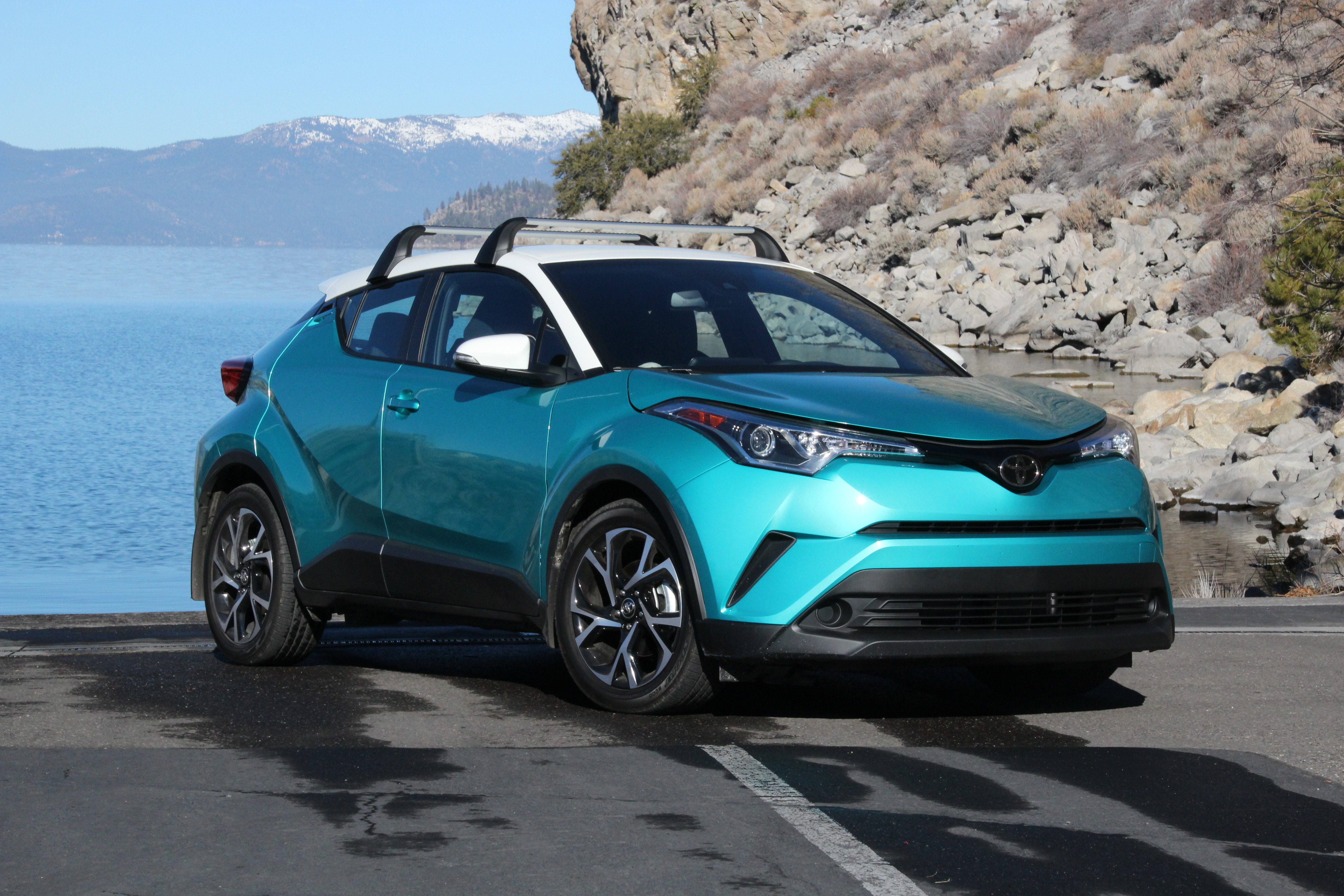
The biggest flaw of 2018 Toyota C-HR is that it doesn’t come with AWD. Photos/Larry Weitzman

By Larry Weitzman

Loosely based on the Corolla (iM) platform, the new C-HR presents a daring iteration of a subcompact CUV which segment is rapidly growing in the market place. Outrageously styled, it looks to be after the market started by two other outrageously styled CUVs, the first not being a CUV, but used as such the Kia Soul and the other being the Nissan Juke. The Soul is too small to be considered in the small class, but the Juke is more the target, although the Juke is also smaller than the C-HR.

C-HR, while having avant-garde styling, has a much better, more cohesive look. Its top line is beautifully done and flows smoothly from the top of the windshield to the rear end. The roof spoiler is beautifully integrated, the single character line, body sculpt is unique and works well and the massive tail lights which bulge from the rear like rocket launchers add muscle, style and shape. While other small CUVs have a quirky look, the C-HR stands out as a creative, good looking, styling exercise. Nice job Toyota.

Size wise, the C-HR is 10 inches shorter than your average compact car with a length of 171 inches. But it’s relatively wide at 71 inches, which Toyota uses wisely by widening the track to 61 inches front and rear. It stands a tall 62 inches.

You are given a choice of one engine, a low stressed, 2.0L DOHC, 16 valve inline four knocking out 144 hp at 6,100 rpm and 139 pounds of twist at a low 3,900 rpm. If there is an issue with the C-HR, it is perhaps an underwhelming powerplant relative to its styling performance promise. But it is an extremely smooth engine and running platform. Power is sent to the front wheels only via a smooth CVT.

Specifications
Engine
2.0L DOHC, 16 Valve inline four cylinder 144 hp @ 6,100 rpm
139 lb.-ft. of torque @ 3,900 rpm
Transmission
CVT
Configuration
Transverse mounted front engine/front wheel drive
Dimensions
Wheelbase 103.9 inches
Length 171.2 inches
Width 70.7 inches
Height 61.6 inches
Track (f/r) 60.6/60.6 inches
Ground clearance 5.9 inches
Fuel capacity 13.2 gallons
Cargo volume (rear seats up/down 36.4/19.0 cubic feet
Interior volume 102.8 cubic feet
Turning circle 34.2 feet
Steering lock to lock 2.76 turns
Wheels 18X7 inch alloys
Tires 225/50X18
Weight 3,300 pounds
GVWR 4,330 pounds
Performance
0-60 mph 8.66 seconds
50-70 mph 4.40 seconds
50-70 mph (up hill 6-7 % grade) 8.15 seconds
Top speed well into triple digits
Fuel economy EPA rated at 27/31/29 mpg city/highway/combined. Expect 28-29 mpg in rural/country driving and 35 mpg on a level highway at legal speeds.

As to performance, the C-HR is about mid-pack among compact cars with a 0-60 mph of 8.66 seconds. Passing performance is perhaps a little better with a 50-70 mph level accel run of 4.40 seconds while up a steep grade that number expands to 8.15 seconds. The numbers reflect better performance than the feel. Tip-in is a bit weak and nailing the go-pedal on a steep grade is a leisurely experience. Yes, I have tested vehicles with much worse numbers, but the feel is not one of a strong response.  Most drivers will find the performance more than adequate.

At times the performance feels better depending on the driving situation. That is possibly a result of the CVT tranny which operates with complete smoothness and maximum efficiency. During some performance runs there were times it felt like a decided “shift” taking place, like it had a planetary gear box, which it doesn’t. This is not an issue, only a comment as to the operation of the CVT. Maybe Toyota is trying to give the C-HR the characteristics of having a “gearbox.”

Fuel economy is quite good with an EPA rating of 27/31/29 mpg city/highway/combined and the C-HR does a bit better with a 35.1 mpg number being recorded in a two-way highway run at 70 mph. My tester had the optional (and stylish) removable crossbars attached and that might have affected highway mileage by an mpg or more to the negative. In other words, without the crossbars the C-HR might have reached 36-37 mpg in my highway test, although they looked fairly streamlined. Overall 28.8 mpg was the average in 504 miles of aggressive rural and suburban driving. In my Placerville-Carson City round trip the average was 32.1 mpg and from South Lake Tahoe to Placerville. Good solid numbers for a small SUV.

In another strong suit for the C-HR, handling is exemplary with four-wheel independent suspension with double wishbones hold up the rear, stab bars are at both ends, quick steering (2.76 lock to lock), a wide 61-inch track and big 18X7 inch alloys shod with some serious 225/50 series rubber. When you add up all the creds, C-HR could stand for competent handling ride. And it is just that with oodles of cornering power, accurate steering, excellent roll control and crisp turn in. Its handling mimics a good sport sedan, with confident cornering power and decent feedback. Turning circle is a tight 34 feet. Nice job, Toyota.

Ride quality is especially quiet and eerily smooth, so smooth and quiet it was actually noticeable. And it handled bumps with aplomb. Engine speed was a remarkable 1,800 rpm at 70 mph which contributes to the excellent highway mileage. But the fuel tank is just 13.2 gallons, but that is still a 400-mile range, which is beyond most human capacity.

Safety is also standard with the C-HR with a full complement of safety features usually extra cost on other cars, like Toyota Safety Sense which includes pre-collision braking, lane departure warning with steering assist, auto high beams and radar cruise. Those are nice features to have as standard equipment. Ten airbags are also standard along with about every safety acronym.  Blind spot monitor and rear cross traffic alert are standard, but the rear view camera, located in the rear view mirror would be nicer in the big center screen.

Brakes are large four wheel discs (front ventilated) and headlights, while not LED, are projector bean halogen and they are very good.

Inside in my non-premium XLE model was done in a hearty cloth with very comfortable seating in front. I didn’t try the rear seats although when tested by a 175 pound, 5-foot 10-inch teenager created no complaints. Maybe it beat walking.  The IP was legible and was well done with a big tach and speedo left and right flanking the center info center/trip computer. All materials were top quality. While not huge, rear storage offered copious space, a flat floor and access was easy.

Now here’s the good part, pricing. Stickering for a scant $22,500 plus $960 for the boat from Arifiye, Turkey (yes, this Toyota was made in Turkey in Asia Minor. Cars are now world class simply by location of the assembly plant) this C-HR completely equipped. The only options were the special Radiant Green/white top two tone paint ($500), which received an amazing amount of positive compliments along with the C-HR itself, the crossbars ($299, floor mats ($194), mud guards ($125) and some other small items brought the total to $24,969 all in. About the only negative is AWD is not an option.

Larry Weitzman has been into cars since he was 5 years old. At 8 he could recite from memory the hp of every car made in the U.S. He has put in thousands of laps on racetracks all over the Western United States.



Calif. spent nearly $1.8B fighting major 2017 wildfires

By Jonathan J. Cooper, AP
 
California state agencies spent nearly $1.8 billion fighting fierce wildfires that killed dozens of people and destroyed thousands of homes and businesses last year, legislative budget experts reported.

The federal government will reimburse most of the costs, but the state will still need to come up with about $371 million on top of the state’s existing wildfire budget, the Legislative Analyst’s Office told the Senate Budget committee. That shouldn’t be a problem because state revenue has far exceeded expectations so far this fiscal year and the general fund is flush with cash.

Read the whole story


Opinion: TRTA, USFS partners more important than ever

By Chris Binder

Nonprofit partners of government agencies play a critical role in managing trails, recreation, planning and other essential activities taking place on public lands. Locally, the Tahoe Rim Trail Association is the region’s largest nonprofit trail organization and has the primary responsibility for managing and maintaining about 200 miles of hiking, biking and equestrian trails in and around the Tahoe basin in partnership with the U.S. Forest Service and Nevada State Parks.

The Tahoe Area Mountain Bike Association, another regional nonprofit, maintains close to 100 additional miles.

With only about 300 total miles of non-motorized trail in the Tahoe basin, these numbers confirm the significance of agency/nonprofit partnerships in managing the recreation resources that are vital to the quality of life and economy of the Tahoe region. While USFS firefighting costs consume a rapidly growing portion of already tight budgets and staff hours, the role of the TRTA and other nonprofit partners in managing resources on National Forest lands has become more important than ever.

As Randy Moore, USFS Pacific Southwest Regional Forester, noted in his op-ed late last month, “More fires mean less funds for local Forest Service projects.” The Forest Service is the only federal agency required to fund its entire emergency management program through its regular appropriations budget. This means that the more the agency spends on the essential work of fighting large, devastating fires, the less it has to spend on other programs, like maintaining and constructing trails and upgrading recreation facilities. While the importance of the USFS firefighting program is undeniable, it comes at a great cost to other crucial work the USFS has traditionally accomplished. Moore and countless others both in and out of government have been working to fix this broken budgeting system for years, but so far no solution has been able to pass both houses of Congress. In the meantime, the USFS has its hands tied as more and more of its staff and budget are dedicated to fighting increasingly intense and widespread fires. This leaves fewer people and less money available to maintain and construct trails and other recreation infrastructure or plan for future recreation projects. Such functions are vital on our public lands, particularly in the Tahoe basin where 56,000 permanent residents and 5.7 million annual visitors rely on them.

A 2015 USFS publication titled “The Rising Cost of Fire Operations: Effects on the Forest Service’s Non-Fire Work” notes that the loss of staffing and funding for non-fire work on National Forests has a “debilitating impact [on] … programs and infrastructure that support thousands of recreation jobs and billions of dollars of economic growth.” This is particularly true in communities, such as ours, that are dependent on outdoor recreation and pristine public lands. USFS staff dedicated to managing National Forest lands decreased by 39 percent between 1998 and 2015, while fire staffing increased 114 percent over the same time period (the overall number of staff remained largely unchanged at around 23,000). Similarly, the report projected that 67 percent of the national USFS budget would go toward wildland fire programs by 2025, up from just 16 percent in 1995. It’s troubling to note that only three fire seasons after the publication of the report that projection has been revised. The USFS now expects to reach the 67 percent benchmark by 2021, with no data to suggest that the cost of firefighting will be curbed any time soon. Between 1998 and 2015 USFS funding (adjusted for inflation) fell 35 percent for inventory and monitoring programs, 64 percent for land management planning, and 68 percent for capital improvement and maintenance of facilities. USFS money for planning, building and maintaining recreation infrastructure is literally disappearing in a haze of smoke.

A shift of staff and money within a federal agency on a national scale does not necessarily equate to a shift in priorities for local agency staff. Our local USFS personnel recognize the importance of recreation in the Tahoe region. We have dedicated and talented individuals in our local and regional USFS offices who work hard to find creative solutions to managing trails and other recreation facilities that do not rely on dwindling funding from the agency’s budget. However, each passing year brings longer absences by agency staff pulled from other duties to fight fires, more key non-fire positions left vacant and unfilled, and a reduction in the agency’s ability to produce funding for non-fire projects. In the USFS’s “National Strategy for a Sustainable Trail System” published late last year, the agency cites a need to shift to “a model of shared stewardship” that embraces “a community driven and locally sustainable trail system model” led by volunteers and nonprofits. Members of the trails community are recognizing that the USFS is increasingly more reliant on local non-profit partners to maintain and expand recreation opportunities than at any time in the past.

The TRTA and the Tahoe region’s other nonprofit trail organizations are up the task, and have been expanding to plug the holes left by diminished agency resources. However, now more than ever, local nonprofit groups working on public land need public support to lead the charge. These groups are building, maintaining and improving the valued recreation infrastructure that helps to make the Tahoe region one of the best places to recreate in the country. If you value outdoor recreation on public lands and its effect on our community’s quality of life and economy please consider becoming a member of a local trail organization or joining one of the scores of volunteer events hosted around the lake each year. Our forests and trails need us, now more than ever.

Chris Binder is the director of trail operations for the Tahoe Rim Trail Association.


Ask the Secret Service how to stop school shootings

By Jeff Daniels, The Conversation

While President Trump has not shied away from offering suggestions on how to prevent school shootings – including one controversial idea to arm teachers – what often gets overlooked in the conversation is research on the subject that has already been done.

This research includes one major study of school shootings conducted in part by the very agency charged with protecting the president of the United States himself – the U.S. Secret Service.

Has this research been ignored or just forgotten? I raise the question as one who has studied averted school shootings and the news coverage that followed.

Two months after the Columbine tragedy in 1999, experts from the U.S. Department of Education and the U.S. Secret Service collaborated to study the “school shooter” phenomenon. They published the study on their findings in 2002. The study focused on examining the thinking, planning and other behaviors of students who carried out school attacks. Particular attention was given to identifying pre-attack behaviors and communications that might be detectable – or “knowable” – and could help prevent future attacks.

The team studied 37 school shootings involving 41 attackers that took place from December 1974 through May 2000. Data included investigative, school, court and mental health records. In addition, 10 school shooters were interviewed to gain their perspectives from “conceptualization to execution” of the attacks. A series of findings emerged. In light of the Florida school shooting massacre and the fact that the alleged shooter drew a lot of attention prior to carrying out the shooting, those findings bear repeating here.

  • “Incidents of targeted violence at school rarely were sudden, impulsive acts.” Most attackers progressed through a process that started with an idea, to a plan, to accessing weapons and ending with the attack. If noticed, this process may be interrupted at any time before the attack.
  • “Prior to most incidents, other people knew about the attacker’s idea and/or plan to attack.” The implication is that schools must develop a culture that promotes student sharing of concerns about others. In studying schools that averted a shooting, I and other researchers found that a key factor was establishing trusting relationships with students. We also found that the notion of “snitching” needed to be reframed to being helpful. Unfortunately, it seems that in the case of the Parkland shooting, multiple people did come forward with concerns. The alleged shooter was on several different radars, but unless he was posing an imminent danger to himself or others, he couldn’t be jailed or forced to receive psychological services. It therefore becomes an issue of individual versus collective rights. Unless we are ready as a society to lock people up for disturbing communications, there will be some individuals who will fall through the proverbial cracks.
  • Along similar lines, most attackers “engaged in some behavior prior to the incident that caused others concern or indicated a need for help.” Some of these behaviors included talking about bringing a gun to school, or warning friends to avoid a certain area of the school on a given day. The Parkland shooter had a history of violent and aggressive behavior, including Instagram posts about becoming a “professional school shooter.”
  • While most attackers – 96 percent – were male, the report found that there “is no accurate or useful ‘profile’ of students who engaged in targeted school violence.” Three-quarters of the attackers were white; one-quarter of the attackers came from other racial and ethnic backgrounds, including African-American (12 percent), Hispanic (5 percent), Native Alaskan (2 percent), Native American (2 percent) and Asian (2 percent). Most came from intact families, were doing well in school and were not loners, according to the report.
  • “Most attackers had difficulty coping with significant losses or personal failures. Moreover, many had considered or attempted suicide.” Knowing the students and what they are dealing with in their lives, such as parental divorce, ending of a relationship or other failures is important for getting help in a timely manner. The Parkland shooter’s adoptive mother died of pneumonia just three months prior to his deadly attack. And at age 5, he also witnessed his father die of a heart attack.
  • “Many attackers felt bullied, persecuted or injured by others prior to the attack.” Almost two-thirds reported being targeted by others prior to the attack, with some claiming to have withstood severe bullying for a long time. There is evidence that Nikolas Cruz was often mocked for his odd behavior.

Following the publication of the Secret Service study on school shootings, my research on averted school shootings found that schools that prevented a shooting had done some of the things recommended by the Secret Service.

The case in Florida shows that many of these recommendations were followed and people spoke up when they saw something wrong. The issue is whether authorities need more power to intervene once they have been made aware of a potential threat, or whether they just need to do a better job with the power they already have.

Jeff Daniels is a professor of counseling at West Virginia University.


2 Heavenly skiers rescued after skiing out of bounds

Two skiers had to be rescued March 4 after they skied out of bounds at Heavenly Mountain Resort.

“They soon found themselves in waist deep snow due to the recent storm. Both subjects were fatigued and it was quickly growing dark when they called for help,” EDSO said.

El Dorado County sheriff’s deputies along with Tahoe Search and Rescue began the search after getting the call about 5:30pm Sunday. The two were located a couple hours later, and were able to ski out with the assistance of the rescue crew.

Heavenly had received more than 4 feet of snow in the last week.

The names, hometown and ages of the men have not been released.

— Lake Tahoe News staff report