Nev. may save millions with switch to state-based program

By Jessie Bekker, Las Vegas Review-Journal

Nevada’s health insurance marketplace, the Silver State Health Insurance Exchange, is one step closer to transitioning onto a state-based operation.

A $24.4 million, five-year contract with vendor GetInsured is set to save the state around $6 million annually starting in 2020 compared to using the federal enrollment platform, Healthcare.gov.

The exchange board voted unanimously at a Thursday meeting to approve the step.

Read the whole story


No fences around major burns at Burning Man

By Associated Press

Officials with counterculture festival Burning Man say they won’t install fences around major burns at this year’s event in the northern Nevada desert, nearly a year after the death of a man who ran into flames of a towering wooden effigy.

However, the Reno Gazette-Journal reports that Burning Man officials said they will plan other security measures but not fencing for large-scale burns. They include more safety personnel and longer protective barriers of volunteers, said Burning Man spokesman Jim Graham. “There will be no fences at the large burns.”

Read the whole story


Road Beat: 2018 Kia Stinger GT2 AWD stands out

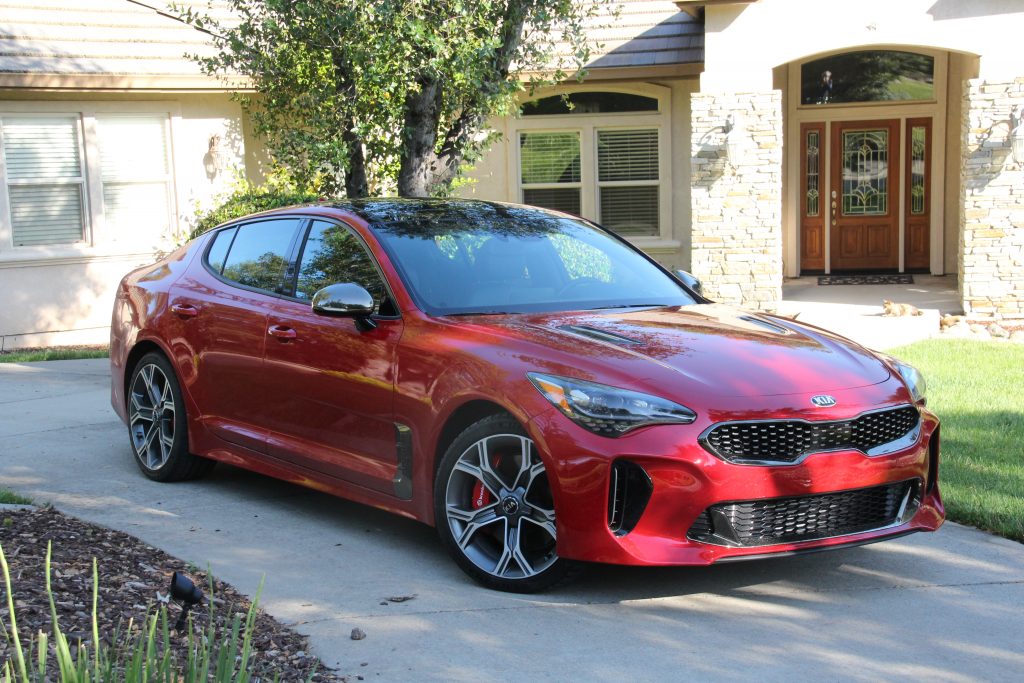
Dollar-for-dollar the 2018 Kia Stinger GT2 AWD has top in its class. Photos/Larry Weitzman

By Larry Weitzman

It has been a long time coming, but the day that Korea could claim to be the manufacturer of the best performance sedan value in the world has arrived in the form of the Kia Stinger.

While it is built in Sohari, South Korea, its origins and design are all German. Stinger was penned in Frankfurt, Germany, by Peter Schreyer (now president of Kia North America and the designer of the Audi TT) and Greg Guillaume, Kia’s chief designer. Kia’s new executive VP of performance, Albert Biermann, whose prior work includes being the former vice president and head of engineering for BMW M series super high-performance cars, headed the engineering team for the Stinger. The results were obvious, Stinger is a leadoff grand salami right out of the box. It is the best performance sedan value in the world.

First, Stinger is beautiful with some of the best lines ever to grace a midsize sedan. A massive, yet sleek aggressive front-end flows rearward creating a slick window line that terminates in a rear end that reminds an automobile gourmet of either an Audi A7 or an Alfa Guilia. Everyone who sees it remarks of its fabulous design and looks. While a perfect midsize 190 inches long, Stinger rides on a huge 114-inch wheelbase meaning lots of rear leg room and a smoother ride. At 74 inches wide it sports broad shoulders, strong hips with bulging muscles.  The smooth roof line flows into a hatchback design that still looks like a slick sedan.

Specifications
Price $32,800 to $52,300
Engine
2.0L DOHC 16 valve direct injected turbo four cylinder 255 hp @ 6,200 rpm
260 lb.-ft. of torque @ 1,400-4,000 rpm
3.3L DOHC 24 valve directed injected turbo V-6 365 hp @ 6,000 rpm
376 lb.-ft. of torque @ 1,300-4,500 rpm
Transmission
Eight-speed torque converter automatic
Configuration
Longitudinal front engine/RWD/AWD
Dimensions
Wheelbase 114.4 inches
Length 190.2 inches
Width 73.6 inches
Height 55.1 inches
Track (f/r) (19-inch wheels) 62.6/63.7
Weight (V-6/AWD 4,023 pounds
Fuel tank 15.9 gallons
Turning circle 38.4 feet
Steering lock to lock (AWD) 2.1 turns
Wheels (19-inch f/r) 19X8/19X8.5 inches
Tires (f//r) 225/40X19//255/35X19
Passenger volume 93.8 cubic feet
Cargo volume (seats up/down 23.3/40.9 cubic feet
Brake diameter (f/r) 13.8/13.4 inches
Performance
0-60 mph 4.66 seconds
50-70 mph 2.00 seconds
50-70 mph uphill 2.47 seconds
Top speed Governed @ 167 mph
Fuel economy (V-6 AWD) EPA rated 19/25/21 city/highway/combined mpg. Expect 22-23 mpg in rural suburban driving and 27 mpg on the highway at legal speeds.

OK, so the Stinger is beautiful, but does it fulfill its promises. The one-word answer is yes, and then some. No other sports sedan comes close for the money. There are two engine choices, a 2.0L DOHC twin scroll turbo charged four belting out 255 hp at 6,200 rpm and 260 pounds of twist between 1,400 to 4,000 rpm and a 3.3L DOHC twin turbo V-6 monster motor that cranks out 365 hp at 6,000 rpm and 376 pounds of twist from 1,300 to 4,500 rpm. My tester was the GT model, which means the V-6. Both engines are longitudinally mounted to drive the rear wheels but also have an AWD option. Whatever the configuration, both engines drive through the same super slick eight speed torque converter auto cog-swapper. And, yes, there are paddle shifters. My tester was an AWD version which adds about 200 pounds and $2,200 as my fully optioned GT2 AWD tester weighed in at 4,023 pounds, certainly no lightweight.

Developing on that theme, performance is heavyweight as in champion of the world. It’s not the fastest or quickest car in the world as there are $70,000 to $150,000 sedans that accomplish the 0-60 mph feat in 4 seconds flat. The least expensive being the $70K base BMW M4 RWD. But by the same token a base Kia Stinger GT with RWD stickers for $38K making it the absolute best performance sedan buy in the world by tens of thousands of dollars.

My AWD Stinger did the 0-60 mph deed in an amazing 4.66 seconds. In studying the literature, the RWD version, which can be had for about $38K with a huge standard equipment list including leather will do the deed in about 4.4 seconds. There are no other sporting sedans or otherwise that offer this kind of World Class performance for such low bucks. Maybe a Mustang GT or a Nissan 370Z, but certainly not if you are thinking Subaru WRX sti.

Passing numbers are also astounding with a 50-70 mph simulated pass taking 2 seconds and the same run up a steep (6-7 percent) grade only slows that time to 2.47 seconds. But there is more. Throttle response is almost instant off the line and once underway this engine and tranny respond like a sledgehammer as it might drop a couple of gears or four and be at full boost in about an eye blink. Part throttle response is wonderful acting like a direct connection to your brain. It’s almost unbelievable. But driving in slow traffic, no problem as the throttle is easy to modulate and feather foot.

OK, so it has super car performance, but what about fuel economy. EPA says to expect 10/25/21 mpg city/highway/combined. It does a little better averaging 27.3 mpg on a level highway two-way run at 70 mph with the engine turning a low 1,750 rpm. In my 200-mile round trip to Carson City the Stinger returned a surprising 25.9 mpg with the run from Carson City to Placerville averaging 28.9 mpg. But overall for 500 miles the average was 21.7 mpg, but this was 500 miles of hammering and almost no time on the interstate. In this day an age not exactly stellar fuel economy, but with some restraint you might achieve an extra mpg or two. About the only negative is the Stinger’s relatively small 15.9-gallon fuel tank. It should be at least 18 gallons, a minimum for a GT car like the Stinger. The four cylinder should average 3-4 mpg better.

Handling is also spectacular. Of course, suspension is state of the art independent. Steering on the AWD is super quick 2.1 turns lock to lock and my tester had fitment of beautiful staggered 19-inch alloys, 8.0 inches wide in the front and 8.5 inches in the rear shod with super high-performance Michelins Pilot Sport rubber 225/40s in front and 255/35s in the rear. Track is 63 and 64 inches respectively front and rear. Grip seems limitless and roll control is perfect and the variable ratio electric rack steering is super accurate. It handles absolutely perfect, straightening out the twisties easily and effortlessly as a true GT car should. It is easy to place in a corner, exactly where you want, holding its line perfectly. It’s magic. Some saying the RWD handles better than the AWD partly due to less weight.

Some early reports talked of a stiff and unsettled ride. However, my tester with all the suspension bells and whistles actually had a sublime ride and while firm when necessary had some softness to it. Some drivers may actually find the ride on the cushy side. Control of body motions was perfect. Wind, engine and road noise are nonexistent at cruise with the engine spinning a low 1,750 rpm. However, engineers tuned the exhaust note from near a near zero murmur to an enhanced note befitting the Stinger’s world class performance. In fact, the whole car can be set up customized to the driver’s preference or he/she can select one of four driving modes preset at the factory (eco, comfort, normal and sport).

I was able to log a few miles in a new four-cylinder Stinger, courtesy of the folks at Folsom Lake Kia for comparison. It was almost equally as impressive. In fact, for most drivers it is as impressive. The 255 hp felt more like 300 hp and it sounded like a throaty V-6, making it the best sounding inline four on the market. Wow. I hope to do a full test in the next several months.

Safety is special. With all the acronyms including lane keep assist. Brakes are also special with huge Brembo ventilated discs with four piston calipers up front and two piston calipers in the rear. They are powerful and progressive. Headlights are fabulous LED with auto high beams and directional control.  

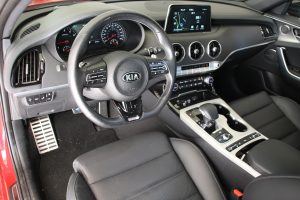
While leather is the standard bill of fare in all Stingers, the GT2 gets super soft Nappa leather and the heated/cooled power seats are sublime with terrific lateral support. Instrumentation is complete with a three away trip/info computer that is flanked left and right by a big tach and speedo. Within the info center are boost and torque meters, lap timers and a “g” meter. Trick stuff belying the fact that Stinger is a world class super sports sedan.

With its extra long wheelbase rear seating legroom is huge. Cargo volume is enhanced by its hatchback design with over 23 cubic feet which expands to over 40 cubes with the rear seats folded flat.

Stinger has no flaws; it is about as perfect as you can get except for the smaller fuel tank. How about at least 18 gallons, Kia? Pricing starts at just $31,900, plus $900 for the boat from Korea for a 2.0L turbo four RWD with 255 hp which should get to 60 mph in the low sixes. That is the performance bargain of the decade. A GT with the super 3.3L turbo V-6 RWD starts at the bargain price of $38,350 making it the best performance sedan bargain in the World. Zero to 60 mph in about 4.4 seconds. But wait, the $32,800 base four cylinder, which should get to 60 mph in about six seconds flat may even be a better near luxo, performance sedan buy. My top of the line, loaded GT2 AWD stickered for $51,400 and is also a World beater bargain. Any Stinger will make a believer out of you. It’s what will be in my garage.

Larry Weitzman has been into cars since he was 5 years old. At 8 he could recite from memory the hp of every car made in the U.S. He has put in thousands of laps on racetracks all over the Western United States.


Candidates Morse, McClintock square off

By Sage Sauerbrey, Moonshine Ink

As the California 4th Congressional District campaign stretches into July, incumbent Tom McClintock and challenger Jessica Morse have yet to square off in a public debate. Moonshine Ink recently reached out to both candidates and they both agreed to a virtual debate using written responses. Each responded to a different selection of three of the six separate questions, and their answers were forwarded to the opposing candidate for rebuttal.

Q: California has, of late, run against the grain of the national trends. Its sanctuary state policies run counter to federal law, Kevin De León is pushing a single party healthcare system, and Governor Jerry Brown has repeatedly stood up to President Trump on climate change. Do you think California is ahead of, or behind the curve, and why?

McClintock: How are those policies working? California now has the highest effective poverty rate in the nation, the 13th highest violent crime rate, is 10th from the bottom in education, has the seventh highest electricity prices, despite the highest income, sales, and gasoline taxes in the country. Compare that to our success in Washington in reducing the tax and regulatory burdens on Americans: unemployment is the lowest since 2000, consumer confidence the highest since 2004, with the economy expanding at more than twice the rate we averaged under Obama. Which direction we want to take as a nation is the fundamental choice before us in November.

Morse rebuttal: Tom McClintock is a career politician who has spent decades collecting a paycheck from California taxpayers, all the while choosing to lay blame and sow division rather than address any of the serious challenges facing our district. Rather than supporting measures to help our struggling families, Tom McClintock voted for a tax bill that raises taxes on the majority of families in our district, those making under $100,000 per year. Rather than supporting our seniors, he wants to raise the retirement age and just voted to cut more than $400 billion from Social Security and Medicare. Rather than making it easier for the next generation to have high paying local jobs, Tom McClintock cut funding for vocational training and proposes eliminating all financial aid for higher education. Tom McClintock has not passed a single piece of meaningful legislation during his decades in politics and is actually harming the people of our district by voting against our values and our pocketbooks. I’m sick of career politicians playing political games rather than coming up with solutions. That’s why I will work with both parties to implement real solutions to the real problems facing our district.

Read the whole story


Opinion: Calif. shouldn’t be bragging about 40 million

By Joe Mathews

This summer, California’s population finally surpasses 40 million.

We should celebrate by reflecting on just how small we are.

Joe Mathews

Of course, we won’t. California, like an insecure male lover, is always bragging about how big it is. And so crossing the 40-million threshold—by state figures, it’s likely to happen in late summer—will occasion another round of boasting about our size, not merely in population but in economic output and cultural impact. The moment will also produce new predictions about how soon we’ll get to 50 million or even 100 million people.

But such projections, while fun, are unlikely to be fulfilled. To the contrary, California should consider the real possibility that our era of population growth is over—and that shrinkage may be our future.

Trends that produced population decline in other places are now strong in California. Our birth rate has fallen to its lowest rate ever. We’re losing more people to other states each year than come back to us. And international immigration remains low—and could fall further given the federal government’s systematic harassment and mass deportation of immigrants.

Our state’s own policies—especially underinvestment in schools, infrastructure, and housing—all discourage family creation and add to the high cost of living that drives people away. The result is an aging California population that will consume less and innovate less (most new things are invented by the young), weakening the economy and reducing the number of jobs.

And I’m not even mentioning the population reduction that could result from once unthinkable disasters—from nuclear war to epic firestorms.

California’s population growth is already at record lows—less than 0.8 percent annually—and falling. During the heyday of immigration, in the 1980s, annual population growth was 2.5 percent a year. Indeed, with many other states growing faster than the Golden State, in 2022 California actually could lose a seat in the House of Representatives for the first time ever. The likelihood of such a loss increases if the Trump administration succeeds in politicizing the census and undercounting California’s population.

California would hardly be alone if its population started to decline. Illinois and Pennsylvania have seen their populations decline in some recent years. And the most recent population report from the United Nations says 51 countries are expected to see population decreases between now and 2050, including countries that inspire our state’s social policies, like Germany. In Asia, Japan’s population is already in decline; its prime minister has declared a goal of limiting losses so that the total doesn’t fall below 100 million. Even China is expected to see a 2.5 percent decline in its population by 2050.

Despite the warning signs, the prospect of population loss hasn’t penetrated the California mind. To the contrary, we remain devoted to the great California pastime of overestimating our own population growth. One big offender, Gov. Jerry Brown, has talked about reaching 50 million as a certainty and an environmental threat, urging Californians “to find a more elegant way of relating to material things.”

But, out of sight, number crunchers at the state’s think tanks and government bureaus have been quietly ratcheting down California’s population estimates. As recently as the mid-1990s, the state and federal governments’ official predictions showed California reaching 50 million people by 2020, a year when our real population likely will be fewer than 41 million.

And if we never get much beyond 40 million, will it be a mortal wound to our pride? After all, the United States had almost exactly that population way back in 1872, which was when the newspaperman Horace Greeley, famous for the advice “Go West, young man, and grow up with the country,” ran for president, lost, and promptly dropped dead.

Today’s 40-million-person California, for all its delusions of grandeur, has less than one-eighth the population of the United States, less than one-third the population of Mexico, one-fifth that of Pakistan, and not even one-thirty-fifth the population of China. If California were a country, we would rank just 35th. Ukraine, Uganda, Argentina, Colombia, Tanzania, and Myanmar all have millions more people than us. Our most populous city, Los Angeles, ranks just 71st on the planet.

This California, of 40 million, faces a choice. Either accept that, instead of the colossus of our boastful imaginings, we’re a small place that’s likely to become smaller—at least compared to a world that is growing faster than we are. Or think more seriously about how to attract more people here from other states and countries, and do a better job of nurturing and retaining our own young people.

If we’re as big as we think we are, this is no time to think small.

Joe Mathews writes the Connecting California column for Zócalo Public Square.


Ride-hailing could improve public transportation

By Daniel Sperling, Austin Brown and Mollie D’Agostino, The Conversation

Over the last half-decade, public transit ridership declined nationwide. The number of vehicle miles traveled in cars is rising, and traffic congestion is getting worse in many U.S. cities. At the same time, the century-old taxi industry is struggling, with many taxi companies going bankrupt.

Are ride-hailing companies such as Lyft and Uber to blame? What has been their impact and what should be done?

While ride-hailing threatens public transit, it is also key to its future success – but only with smart policies and the right price signals. As researchers working at the intersection of energy, the environment and public policy, we have been analyzing transportation trends for decades – and seeing remarkably little innovation. Now we are on the cusp of major transformations. We see ride-hailing through the framework laid out in Daniel Sperling’s new book, “Three Revolutions: Steering Automated, Shared, and Electric Vehicles to a Better Future.”

More travel, less mass transit

Let’s start with the data. Public transit ridership dropped in 31 of 35 U.S. major metropolitan areas in 2017. It has declined by 3 percent since 2014, and 2017 was the lowest year of overall transit ridership since 2005.

Meanwhile, total U.S. vehicle miles traveled, or VMT, has increased steadily since 2011. Most dramatically, Lyft, Uber and other ride-hailing companies have soared, from near zero trips in 2012 to about 2.6 billion in 2017. As of 2016, 250 million people globally used ride-hailing apps, including 15 percent of the U.S. public.

Parsing the impacts of ride-hailing

As ride-hailing has grown, so too has the number of researchers working to understand its impacts. Experts at UC Berkeley, UC Davis, the University of Colorado, the University of Michigan and Texas A&M University have all found that a significant fraction of ride-hailing customers would have traveled by transit, or opted against traveling at all, had ride-hailing been unavailable. This indicates that ride-hailing is displacing transit ridership and increasing vehicle miles traveled by cars.

Why is this happening? People are choosing ride-hailing because transit does not match the comfort and convenience offered by private vehicles, and taxis cannot offer the affordability and transparency of app-based ride-hailing. VMT is increasing as growing numbers of for-hire cars log “deadhead” miles driving to pick up passengers or returning from destinations. In New York City, unoccupied taxi and ride-hailing hours grew by 81 percent from 2013 to 2017.

But the net effects are highly region-dependent. Dense urban markets are responding differently than suburbs. In San Francisco, fully one-third of Lyft and Uber riders use ride-hailing in lieu of public transit. A survey in Denver found that 22 percent of respondents would have used transit had ride-hailing been unavailable. In contrast, researchers found that only 3 percent of Lyft and Uber riders in Austin switched to transit during a suspension of ride-hailing services.

Positive impacts too

While ride-hailing is pulling riders away from public transit in some places, it can also enhance transit ridership. The UC Berkeley survey found that 4 percent of Uber and Lyft customers ended their rides at transit stations, which suggests that they were using ride-hailing to connect to transit. Our colleague Caroline Rodier has observed that multiple surveys show about 5 percent of respondents relying on ride-hailing to access transit, although Rodier concluded that the increased transit trips are offset by diversion of trips away from transit.

Local governments and agencies can work with ride-hailing services to enhance public transit instead of undermining it. For instance, ride-hailing can help smooth transportation demand shocks caused by temporary transit disruptions, such as closures of subway stations for maintenance.

What’s more, while ride-hailing may increase car-based travel, this is not necessarily a bad thing. More mobility increases access to jobs, health care and education. And a significant percentage of ride-hailing trips occur late at night when congestion is not a big concern and transit options are not always available.

Indeed, its late-night popularity suggests that ride-hailing is removing some of the most dangerous type of vehicle miles. According to a UT Austin study of all 273 U.S. cities with a population of more than 100,000, ride-hailing services reduced fatal drunken driving crashes by 10 to 11 percent.

Ride-hailing also offers greater independence for elderly and disabled populations. The Center for American Progress observes that ride-hailing can help disadvantaged populations overcome geographic isolation and access jobs, education and health care services.

Complementing public transit

For transit agencies, ride-hailing services can be an attractive alternative to serving sparsely populated, low density areas with fixed routes and schedules. Private mobility companies and public transit agencies have launched nearly 50 pilot projects and partnerships to explore these opportunities. Many agencies are subsidizing travel in ride-hailing vehicles to meet the needs of certain rider groups.

In San Clemente and Dublin, officials canceled fixed-route buses with the lowest ridership and provided discounts for people to travel in Lyft and Uber. Phoenix is discounting the price of ride-hailing trips to and from 500 city bus stops. Denver is offering free rides to suburban light rail stations.

Reducing solo travel

The number of innovative transit partnerships is growing rapidly, but the jury is still out on what types of partnerships can yield win-wins for communities, companies and transit agencies. An overarching goal should be to increase mobility – that is, passenger miles traveled – while reducing vehicle miles traveled.

This will only happen if ride-hailing services continue to shift toward multi-passenger services, such as Lyft Line and UberPool. Such a change will require policy frameworks that encourage shared rides and discourage single-passenger rides – starting with ride-hailing services, and eventually including travelers using their own vehicles.

Road pricing practices, in which drivers pay fees to travel in high-use areas, have reduced traffic and increased pooled rides and transit trips in London, Stockholm and Singapore. Importantly, Uber and Lyft embrace these strategies to expand pooling services and gain relief from stifling traffic congestion, just like the rest of us.

Pooling and road pricing will be especially critical with the coming vehicle automation revolution. If automated vehicles are individually owned, they will likely generate massive new vehicle use, since travel will no longer be seen as onerous. Occupants can sleep, eat, text, read and watch videos while their cars do the navigating. But if those automated vehicles are pooled, then vehicle use would be pushed in the opposite direction, toward fewer vehicle miles traveled.

U.S. cities and transit operators have done little innovating in the past 50 years, and are ill-prepared for the changes ahead. They need to decipher what is happening, build partnerships and support price signals that encourage pooling. Acting to maximize the societal benefits of ride-hailing and other transportation revolutions will provide benefits now and into the future.

Daniel Sperling is a professor of civil and environmental engineering and founding director of Institute of Transportation Studies at UC Davis; Austin Brown  is executive director at the Policy Institute for Energy, Environment, and the Economy at UC Davis; and Mollie D’Agostino is policy director, 3 Revolutions Future Mobility Program, Institute of Transportation Studies, UC Davis.


Are seasonal employees in ski towns underpaid?

By Matt McDonald, Powder

If you’ve held a seasonal ski resort job you understand what it is to slide along the poverty line in a little corner of paradise that caters to the not-yous. Forget saving money. You need to score three more shifts this week to pay rent on Monday. Bills loom. If you stop long enough to remember you turn 26 in two weeks, knocking you off your parents’ health insurance, your head explodes.

Then, your employer announces another sparkling partnership with three new resorts, plus $50 million in capital improvements that include a hotel and mid-mountain sushi bar. Sure, you’ll get a raise if you stay for another season, but at a quarter an hour, it feels more like a gesture than a game-changer. But hey, at least you ski for free, right?

Read the whole story


Snippets about Lake Tahoe

·      California State Parks is leading a tour of Washoe Meadows State Park on July 17 from 5:30-7pm to talk about the Upper Truckee River project and future of Lake Tahoe Golf Course. Meet at the corner of Country Club and Bakersfield at 5:25pm. If attending, RSVP to utproject@parks.ca.gov.

·      El Dorado and Placer counties received silver awards in the counties exhibit at the California Fair. Amador won gold as well as best of show.

·      A culvert on Elks Club Drive in El Dorado County between Boca Raton and Waverly will be replaced on July 16 from 8am-2pm. There may be up to a 30-minute delays. Use Meadowvale Drive and Tam ‘O Shanter Drive as alternative routes.

·      El Dorado County has a website dedicated just to vacation home rentals.

·      The next meeting of the El Dorado County VHR ad hoc committee will be July 16 at 5:30pm at the magnet school in Meyers.


Algae bloom at Wright’s Lake a concern

By Dawn Hodson, Mountain Democrat
 
Concerns over an algae bloom at Wright’s Lake resulted in a call to the Central Valley Water Board to conduct water samples.

According to staff at the Eldorado National Forest, a member of the public visited the lake on June 28 and observed a subsurface algal bloom that appeared to extend throughout the lake.

Read the whole story


El Dorado County streamlining VHR process

Beginning this month, enforcement of El Dorado County’s vacation home rental ordinance will be handled by the Department of Planning and Building. Compliance activities will become the responsibility of code enforcement. The treasure-tax collector will continue to issue VHR permits and business licenses for the rest of 2018.

Early next year, the county anticipates transferring the permitting and licensing function to the Department of Planning and Building.

The goal is to streamline the process and provide greater transparency.

 “Between now and the end of the year, we will be making additional recommendations to the board regarding programming, staffing and funding related to VHR and code enforcement activities as we move forward with the transition process,” CAO Don Ashton said in a press release.

For general information about VHRs, go online. For the updated VHR ordinance that took effect July 5, click here.