Satellite to track drought from space

By Marcus Woo, Wired

The launch of a small satellite won’t fix the the drought in the American West—now entering its fourth year—and it won’t change the fact that January was the driest month in recorded California history. But the Soil Moisture Active Passive mission might at least tell scientists and farmers something new about that drought, and maybe how much worse it’ll get.

Winds and mechanical issues delayed the SMAP launch for two days, but on Saturday morning a Delta II rocketed it from Vandenberg Air Force Base to about 400 miles above the planet. After three months of “commissioning”—when ground control makes sure all the instruments are working—SMAP will spend three years taking the most accurate readings ever of soil moisture around the world. That’s right: It will measure how wet the dirt is. From space.

For understanding water on Earth getting a good handle on dampness is crucial. SMAP can see through atmospheric moisture, plants, and a couple of inches of dirt to measure wetness over an area of about 3.5 square miles.

Read the whole story


Renowned rock climber to talk at Squaw

Emily Harrington, one the top rock climbers in the world, continues the Alpenglow Sports Winter Film Series on Feb. 12 at 7pm at Squaw Valley’s Olympic Village Lodge.

Her show “The Long Way,” documents a National Geographic expedition of adventure, suffering, and ultimate reward in the remote jungles and high altitude peaks of Myanmar. Harrington is a professional rock climber and adventurer who has been a prominent and leading figure in the climbing community since she was a teenager.

She is perhaps best known for her five-time National Championships, two-time North American Championships, and numerous podiums on World Cup circuit.

The series is designed to inspire, motivate and educate. The event runs from November through March and showcases five famous athletes.

All shows are free and raffle prizes are used to raise funds for local nonprofits. Tahoe Institute for Natural Science is the beneficiary for Harrington’s show.


Rodent says 6 more weeks of winter

By Associated Press

PUNXSUTAWNEY, Pa. — The handlers of Pennsylvania’s most famous groundhog, Punxsutawney Phil, said Monday the furry rodent has forecast six more weeks of winter.

Members of the top hat-wearing Inner Circle announced the “prediction” Monday morning.

A German legend has it that if a furry rodent sees his shadow on Feb. 2, winter will last another six weeks. If not, spring comes early.

The forecast was also announced on Twitter, as was referenced in the official proclamation read by Bill Deeley, president of the Inner Circle.

“Forecasts abound on the Internet, but, I, Punxsutawney Phil am still your best bet. Yes, a shadow I see, you can start to Twitter, hash tag: Six more weeks of winter!”

The forecast was delivered after a steady pre-dawn rain turned to snow as temperatures dropped from the high 30s to around freezing. They were forecast to keep dropping over much of the state, prompting the state Department of Transportation to lower the speed limit to 45 mph for many interstate highways which were already wet and expected to freeze or be covered with snow as the day wore on.

The rain kept some revelers away, with state police estimating the crowd at around 11,000, slightly smaller than in recent years when upward of 15,000 attended.

No mention was made of Sunday night’s Super Bowl, unlike Groundhog Day 2009 — the last time the celebration occurred the morning after the big game — which was won by the nearby Pittsburgh Steelers that year.

Despite the German legend, Phil’s handlers don’t wait to see if he sees his shadow — as he likely would not have on such an overcast day. Instead, the Inner Circle decide on the forecast ahead of time and announce it on Gobbler’s Knob, a tiny hill in the town for which the groundhog is named, about 65 miles northeast of Pittsburgh.

Records going back to 1887 show Phil has now predicted more winter 102 times while forecasting an early spring just 17 times. There are no records for the remaining years.


EDC supes poised to hire new CAO

El Dorado County may have a new chief administrative officer this week.

The Board of Supervisors on Feb. 4 is being asked to hire interim CAO Pamela Knorr as the county’s future leader. It is the 26th item on a closed session agenda with 27 items.

Pam Knorr, now temporarty hea of El Dorado County and fomer CAO of Alpine County, is one of the defendants in a lawsuit

Pam Knorr

Knorr was hired to be the human resources director for El Dorado County, and still is, in addition to be acting chief administrative officer because of CAO Terri Daly’s departure in November and Assistant CAO Kim Kerr leaving in December. She was CAO of Alpine County before being hired by El Dorado County.

The recommendation is to hire her without having done a background check. The county has never done a background check on Knorr so it’s not like supervisors can rely on the information gathered when she was first hired.

El Dorado County has a history of not running background checks. Ones were not done when Daly or Kerr were hired.

Plus, there has never been a recruitment for a CAO, so the county hasn’t taken the time to see who else might be out there besides Knorr.

— Lake Tahoe News staff report


Tahoe Tails — Adoptable Pets in South Lake Tahoe

Reba

Reba

Reba is a beautiful Catahoula leopard dog-Lab mix who is 3-year- old and very sweet.

She is about 45 pounds, and has very soft, pretty fur. She gets along well with other dogs, but appears to be a little too interested in cats. Reba is an active girl who would like to get exercise each day.

Reba is spayed, microchipped, tested for heart worm, and vaccinated. She is at the El Dorado County Animal Services shelter in Meyers, along with many other dogs and cats who are waiting for their new homes. Go to the Tahoe animal shelter’s Facebook page to see photos and descriptions of all pets at the shelter.

Call 530.573.7925 for directions, hours, and other information on adopting a pet. For spay-neuter assistance for South Tahoe residents, go online.

— Karen Kuentz


SLT eager to get pot grows into compliance

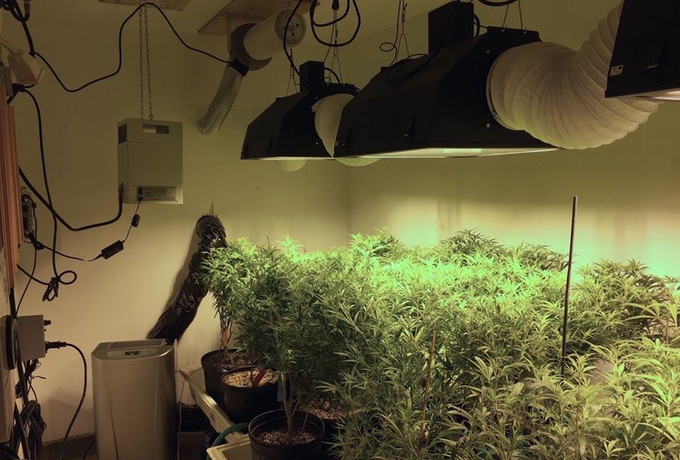
Special lights are required in the grow room. Photo/Steve Kubby

Special lights are required for marijuana plants to thrive in an indoor grow room. Photo/Steve Kubby

By Kathryn Reed

Plants are thriving even though it’s winter in Lake Tahoe.

That’s what happens when a garage is converted into a grow room.

Buds are sprouting from the 29 marijuana plants.

And this is all legal in South Lake Tahoe.

Ten permitted grows exist in the city. But what worries city officials is the hundreds of people who are illegally growing marijuana indoors. They pose a safety threat to themselves and their neighbors.

“With all the illegal grows I see there are a lot of hazards and it is a little spooky how close people are to burning the house down, or having damage with mold or water,” Dave Walker, South Lake Tahoe building official, told Lake Tahoe News. “I would love to see more people get permitted to make sure everybody is safe.”

Steve Kubby, who helped write Proposition 215 – the Compassionate Care Act, received his permit from the city last month.

“This was an amazingly effortless process for me,” Kubby told Lake Tahoe News. “The building department was so cooperative.”

Despite being legal, Kubby has reservations about having had to go through the process in the first place because the state law doesn’t say people need a municipality’s permission. Still, he said he complied to be a role model for others.

Kubby used Corey Barack, who is a plumber by trade, to ensure his place would meet all of the city’s rules and be as safe as possible. His business, Grow Safe, is a consulting firm for those seeking to grow marijuana legally in the city for medicinal reasons.

“The whole room is sealed,” Barack said as he gave a tour of Kubby’s room that is a walled-in section of the garage.

He hooked up a reservoir, which is really a sump pump, as a drip system. Kubby said the CO2 generator is like putting the plants on steroids.

“That generator increases the yield by about 30 percent,” Kubby said.

People may use 10 percent of their living area for a grow room, up to a maximum of 250-square-feet. Permits cost more than $300 and are good for one year. A 215 card is required to get the city permit. There is no limit on the number of plants allowed.

Outside Kubby’s house there is no stench of marijuana. That is another requirement of the city’s – to make sure everything is ventilated correctly. Many older homes cannot handle the amount of electricity required to keep a grow room going. That is why fire hazards are common. For Kubby, he changed his electric range and oven to gas to allow for more amps to be used for the grow room.

“We anticipated people might increase the grow area or add things that were not safe, but that has not been the case,” Walker said. “They have been very good about following the rules.”

—–

Notes:

• Building official Dave Walker and Police Chief Brian Uhler are giving a free informational talk Feb. 2 at 7pm at the Wellness Center in the Bijou Center in South Lake Tahoe. The purpose is to give information about the permit process for indoor grows and to answer questions.


Opinion: California’s budget saga

By Dan Walters, Sacramento Bee

Although the state budget is finally balanced after years of deficits, polls tell us that most Californians are still concerned about the state’s fiscal stability.

Their concern is well-placed.

Dan Walters

Dan Walters

A temporary tax increase, mostly on the wealthy, and a recovering economy have provided the wherewithal to cover the state’s current obligations.

Gov. Jerry Brown, who championed the tax hike, has also restrained the ambitions of his fellow Democrats to spend more money and persuaded voters to create a rainy-day fund as a partial hedge against future downturns.

Nevertheless, the budget is “precariously balanced,” Brown reminds us, and is dangerously dependent on how wealthy taxpayers’ investments are faring – a peril echoed in a new Standard & Poor’s report on California last week.

Read the whole story


Park board to consider agreement with EDC

Tahoe Paradise Resort Improvement District’s board of directors will meet Feb. 5 at 6pm in the Lake Valley Fire Department’s training room behind the station.

This is a continuation of the January meeting that ended because of time.

Here is Thursday’s agenda as well a copy of the draft MOU between TPRID and El Dorado County.


Nevada’s top gaming regulator not a fan of pot

By J.D. Morris, Las Vegas Sun

Nevada’s top gaming regulator hasn’t made his professional career in the casino industry or in the law, but he’s plenty experienced with both of those fields anyway.

A doctor by trade, Tony Alamo is the first non-attorney to serve as chairman of the Nevada Gaming Commission, the body that has the final say over regulatory matters that concern gambling in the state. Other parts of his background give him an understanding of gambling and regulatory affairs: His father was a longtime casino industry executive, and Alamo previously served on the state Athletic Commission.

Alamo joined the commission as a member in 2008, then he was appointed by Gov. Brian Sandoval to replace Chairman Peter Bernhard last summer. In the half-year since he took over the chairmanship, Alamo has led the commission’s meetings on several high-profile gaming developments, including the opening of the SLS Las Vegas and concerns about the background of Sam Nazarian, the businessman who led the creation of SLS.

Read the whole story


Consumers eager to spend, economy improves

By Josh Boak, AP

WASHINGTON — There’s a good reason the U.S. economy is impressing the world right now despite a slowdown in the final three months of 2014: In a word, steadiness.

Companies have been hiring at healthy rates for the past year. Layoffs hover near historic lows. Auto sales are strong. Gas prices have sunk. Congressional budget fights have faded. Americans are increasingly confident.

All that fed a surge of consumer spending last quarter, offsetting weaker business spending caused in part by a pullback by oil drillers and a frail global economy.

The U.S. economy as a whole expanded at a 2.6 percent annual rate, the government said Friday, down from a sizzling 5 percent gain the previous quarter. Yet consumers signaled their optimism by spending at the fastest rate in nearly nine years.

“This hasn’t changed my picture on the strength and resilience of the U.S. economy,” said Scott Anderson, chief economist at the Bank of the West. “Almost all the drivers of consumer spending are pointing in the right direction.”

Nearly six years into the recovery from the Great Recession, the economy has finally gone from straining just to grow to posting consistently solid gains. The gains have come even though many households continue to struggle without much of a financial cushion. Nearly half say they spend all their income, go into debt or use savings to meet their expenses, a new analysis by the Pew Charitable Trusts has found.

In addition, a surging dollar is denting the earnings of U.S. companies that operate overseas. And energy firms have been hurt by plummeting oil prices, and as a result companies in the Standard & Poor’s 500 index are expected to report weak profit growth.

But collectively, consumers and investors are showing renewed faith in the economy.

On Friday, the University of Michigan said its sentiment index found that U.S. consumers are more confident than they’ve been since 2004. Also Friday, the government said wages and benefits are ticking up, a sign that steady job gains may be compelling employers to pay a bit more.

Most indicators suggest that the economy has surpassed a psychological threshold that has made businesses more comfortable with hiring and infused consumers with more enthusiasm.

“Psychology has been a big contributor to the improved level of performance in the United States,” said Carl Tannenbaum, chief economist at the bank Northern Trust.

At a time when Europe, Asia and South America face deep anxieties, the U.S. economy’s greatest strength might be its remarkable sturdiness.

The consensus expectation is that the U.S. economy will expand a solid 3 percent this year, well above the recovery’s 2.2 percent annual average. This has made U.S. stocks and Treasurys comparably attractive — havens from the risks from Europe’s prolonged slump, collapsing oil prices, China’s slowdown and Japan’s struggles to stave off recession.

Yet the U.S. economy still has additional room to continue expanding. In current dollars, the median household income of $54,417 remains about $1,800 below its late 2007 levels, according to Sentier Research. More than 5 million households owe more on their mortgages than their homes are worth, according to the real estate data firm CoreLogic.

Because the U.S. economy is rebuilding its core without relying heavily on mortgages, credit cards and other debt, it has avoided the sharp swings and shocks that can tip an economy into recession.

“You’re getting solid consistent growth,” said John Canally, chief economic strategist at LPL Financial. “If you have a slow recovery, you don’t build up the excesses that ultimately cause a recession.”

The gourmet hamburger chain BurgerFi plans to nearly double in size from its more than 60 restaurants this year. More consumers are upgrading from fast food, and the chain can choose from towns and cities “where the economic train has been rolling along at a pretty rapid pace,” said Corey Winograd, CEO of the Florida-based chain.

If all goes as planned, BurgerFi will account for 2,000 new jobs this year.

Investors are still trying to adjust for this newfound steadiness. The rush of foreign money into U.S. Treasurys has cut the yield on 10-year note to about 1.67 percent from 2.9 percent a year ago. A result is that it’s now cheaper for companies and homebuyers to borrow in ways that nurture growth.

During 2014, employers added an average of 246,000 jobs a month. That figure has remained above 200,000 for the past 11 months and has helped whittle the unemployment rate to 5.6 percent from 6.7 percent 12 months earlier. Given that applications for unemployment benefits have stayed consistently below a weekly average of 300,000, most economists think hiring should grow at a pace similar to the 2014 levels.

Wages have yet to grow significantly. But all those new jobs mean that the U.S. economy entered 2015 with an extra $126 billion in combined annual paychecks. That money has trickled into restaurant dinners, new cars and other goods and services.

Sales of new vehicles climbed 6 percent to 16.5 million last year, according to Autodata Corp. Car buying is poised to eclipse 17 million for the first time in a decade. Spending at restaurants and bars improved 5.8 percent last year, the government says.

Cheaper energy has been a gift for consumers, who account for nearly 70 percent of all U.S. economic activity. The Energy Information Administration projects that an average U.S. household will save about $750 this year on gasoline.

At the same time, Tannenbaum of Northern Trust cautions against becoming too complacent if consumers begin to fear that the economic woes abroad threaten the U.S. job market or financial markets.

“Psychology could also be the avenue through which some of the world’s uncertainties drag us back to growth that’s a bit less desirable,” he said.