New fabric may rival Gore-Tex

By Jason Blevins, Denver Post

Upstart apparel company Voormi is making waves with Core Construction, perhaps the first major progress in waterproof, breathable fabrics since the advent of Gore-Tex 46 years ago.

Voormi announced the technology at the SnowSports Industries America Snow Show in Denver last week.

“We see this as a game-changer,” Voormi founder Dan English said.

Pagosa Springs-based Voormi stirred interest in 2013 when it unveiled its locally sourced, locally made wool layers. Blending Rocky Mountain wool with moisture-wicking synthetic fabrics, the company took on Goliaths such as Patagonia and The North Face.

But it wasn’t just Voormi’s designs that rocked the boat. Voormi trumpets itself as “the microbrew of apparel,” and its nimble network of local manufacturers are able to whip up clothing on short notice for retailers eager to tap the locavore trend. The apparel reflects the small-batch ethos that pervades the blossoming hand-crafted economy in the high country.

The company hinted in 2013 that something bigger was brewing — something that had been in the works since English founded Voormi in 2010.

Read the whole story


Incline Village couple suing Bear League

By Jeff DeLong, Reno Gazette-Journal

A Lake Tahoe couple who claims they were harassed and subjected to death threats after reporting a problem-causing bear that was later killed by authorities have sued a nonprofit bear advocacy group they contend was responsible for the harassment.

Richard and Adrienne Evans of Incline Village sued the Bear League and the organization’s founder, Ann Bryant, seeking unspecified damages in connection with the December 2013 incident at the upscale north Tahoe community.

Through the suit, filed Dec. 8 in the Washoe District Court, the Evans hope to alter a pattern of behavior that has people properly reporting black bear problems to Nevada wildlife officials subject to harmful harassment by critics, said the couple’s Reno attorney, Sean Rose.

An attorney representing Bryant and the Bear League did not return repeated phone calls by the Reno Gazette-Journal. In an answer to the complaint filed in District Court Dec. 30, central allegations made in the Evans’ complaint were denied, including that the Bear League urged and encouraged the alleged harassment.

Read the whole story


SLT firefighter quits; remains in custody

By Kathryn Reed

Disgraced South Lake Tahoe fire Capt. Mark WyGant has resigned, making him no longer on the city’s payroll after Feb. 4. WyGant received one day of paid administrative leave.

WyGant is accused of possessing more than 5,000 child pornography images and 50 videos of child porn.

Mark WyGant

Mark WyGant

He remains in federal custody after being arrested Jan. 29.

A flash drive with the sexual images was found by a city employee and turned into authorities. The internal investigation led local law enforcement to believe the drive belonged to a member of the fire department. Then the FBI was brought in. WyGant was later identified as the suspect.

Images are explicit, including showing young girls having anal, vaginal and oral sex with men – but none of WyGant engaging in any acts. Lake Tahoe News has been told that no local children are believed to be in any of the images. According to the criminal complaint, WyGant admitted to filming at least one young girl.

The complaint lists WyGant’s address as Chico. The memorandum of understanding the city and firefighters are working under does not have a residency requirement. This is new as of last fall when contracts were being reworked. Prior to the new MOU, WyGant had been leasing a place in Tahoma. After the MOU was written he changed his residency to Chico. (The city agreed to remove the residency requirement because of case law that said this violated employees’ rights.)

WyGant has a court hearing scheduled for Feb. 13 in Sacramento.


Report reveals how much wine is being produced each year — and who’s drinking it

By Will Lyons, Wall Street Journal

How many bottles of wine do you think were produced last year? A friend and I were trying to figure out an answer to this question over supper the other day. I won’t embarrass myself by revealing how far off I was, but let’s just say it was by a very long way.

The latest figures from International Wine & Spirit Research (IWSR), a London-based drinks research group, in a report commissioned by Vinexpo, estimate that in 2013, 3.2 billion cases of wine were produced. That’s 38.4 billion bottles—quite an astonishing number. The majority, 54 percent, is red wine, compared with 37 percent for white and 9 percent for rosé.

Who drinks it all? The quick answer is Europe and the U.S. But if I were to ask you to name the No. 1 wine-consuming country by volume, I suspect you might guess France. Wrong.

According to the IWSR, the U.S. is still the biggest market by volume, drinking a total of 339 million cases of wine in 2013. This was above France’s 296 million cases, Italy’s 288 million, Germany’s 274 million and China’s 144 million (which made it the world’s fifth largest consumer of wine). The U.K. came in sixth, drinking a total of 133 million cases.

Per capita wine consumption is perhaps the more interesting figure. Here, Italy leads the pack, ahead of France, Switzerland, Portugal and Austria. In terms of total market value (which nation spends the most on wine), the top three are the U.S., France and the U.K., with Britain forecast to increase its spending over the next three years, nudging France into third place. The IWSR predicts that by 2018, the top two still-wine markets by value, the U.S. and U.K., will be worth $33.2 billion and $17.1 billion respectively.

Read the whole story


Nevada not a great place for high-value jobs

By Andrea Domanick, Las Vegas Sun

Nevada’s workforce may be well on its way to recovering from the economic crash, but the state still has a long way to go when it comes to developing jobs critical for long-term growth, the Brookings Institute found.

Nevada ranks almost last nationally for high-value jobs.

A new report, “America’s Advanced Industries: What They Are, Where They Are, and Why They Matter,” outlines the strength and distribution of 50 advanced industry sectors across the United States, including manufacturing, energy, computer software and biotechnology.

Read the whole story


Atmospheric river en route to Sierra

By Darrell Smith, Sacramento Bee

Water vapor – Mississippi River-size amounts of it flowing at hurricane speeds miles above the Earth – is hurtling across the Pacific, an atmospheric river poised to drench a parched Northern California and the Sacramento region as early as Thursday night.

A crack team of science experts is going along for the ride, part of an experiment known as CalWater 2015, many of whom gathered at McClellan Park near Sacramento on Tuesday in preparation for the major weather event and the vital information they hope to pull from the phenomenon.

“It’s a real milestone for us. Nothing of this scope has happened,” said Marty Ralph, director of the Center for Western Weather and Water Extremes at Scripps Institution of Oceanography in San Diego, of the project he’s helping to lead. “One of the drivers of CalWater was the uncertainty of climate projections. We haven’t had the data to measure the strength and structure of ARs. … There’s so much potential for the monitoring of atmospheric rivers.”

Read the whole story


Colo. may have to give pot money to the public

By Kristen Wyatt, AP

DENVER — Colorado’s marijuana experiment was designed to raise revenue for the state and its schools, but a state law may put some of the tax money directly into residents’ pockets, causing quite a headache for lawmakers.

The state constitution limits how much tax money the state can take in before it has to give some back. That means Coloradans may each get their own cut of the $50 million in recreational pot taxes collected in the first year of legal weed. It’s a situation so bizarre that it’s gotten Republicans and Democrats, for once, to agree on a tax issue.

Even some pot shoppers are surprised Colorado may not keep the taxes that were promised to go toward school construction when voters legalized marijuana in 2012.

“I have no problem paying taxes if they’re going to schools,” said Maddy Beaumier, 25, who was visiting a dispensary near the Capitol.

But David Huff, a 50-year-old carpenter from Aurora, said taxes that add 30 percent or more to the price of pot, depending on the jurisdiction, are too steep.

“I don’t care if they write me a check, or refund it in my taxes, or just give me a free joint next time I come in. The taxes are too high, and they should give it back,” Huff said.

Legal weed has collided with the tax limitation movement because a 1992 voter-approved constitutional amendment called the Taxpayers’ Bill of Rights requires all new taxes to go before voters.

The amendment also requires Colorado to pay back taxpayers when the state collects more than what’s permitted by a formula based on inflation and population growth. Over the years, Colorado has issued refunds six times, totaling more than $3.3 billion.

Republicans and Democrats say there’s no good reason to put pot taxes back into people’s pockets, and state officials are scrambling to figure out how to avoid doling out the money. It may have to be settled by asking Colorado voters, for a third time, to cast a ballot on the issue and exempt pot taxes from the refund requirement.

Republicans concede that marijuana is throwing them off their usual position of wanting tax dollars returned to taxpayers. But they also tend to say that marijuana should pay for itself – that general taxes shouldn’t pay for things like increased drug education and better training for police officers to identify stoned drivers.

“I think it’s appropriate that we keep the money for marijuana that the voters said that we should,” said Republican Senate President Bill Cadman. His party opposes keeping other refunds based on the Taxpayers’ Bill of Rights but favors a special ballot question on pot taxes.

“This is a little bit of a different animal. There’s a struggle on this one,” said Sen. Kevin Grantham, one of the Republican budget writers.

After legalizing marijuana in 2012, Colorado voters returned to the polls the following year and approved a 15 percent excise tax on pot for the schools and an additional 10 percent sales tax for lawmakers to spend.

Voters were told those taxes would generate about $70 million in the first year. The state now believes it will rake in about $50 million.

But because the economy is improving and other tax collections are growing faster, Colorado is obligated to give back much of what it has collected. Final numbers aren’t ready, but the governor’s budget writers predict the pot refunds could amount to $30.5 million, or about $7.63 per adult in Colorado.

“It’s just absurd,” said Democratic state Sen. Pat Steadman, one of the Legislature’s budget writers.

The head-scratching extends to Colorado’s marijuana industry. Several industry groups actively campaigned for the pot taxes but aren’t taking a position on whether to refund them.

Mike Elliott of the Denver-based Marijuana Industry Group said it isn’t pushing for lower taxes, but that’s an option lawmakers don’t seem to be considering. State law doesn’t bar lawmakers from cutting taxes without a vote.

Lawmakers have a little time to figure out how to proceed. They’ll consider pot refunds and a separate refund to taxpayers of about $137 million after receiving final tax estimates that are due in March.

When they talk about pot refunds, they’ll have to figure out if the money would go to all taxpayers, or just those who bought pot. Previous refunds have generally been paid through income tax returns, but Colorado also has reduced motor vehicle fees or even reduced sales taxes on trucks.

Lawmakers seem confident that the refund mechanism won’t matter because voters would approve pot taxes a third time if asked.

“This is what the voters want, and if we’re going to have (pot), and the constitution says it’s legal, we damn well better tax it,” Steadman said.


College hockey coming to S. Lake Tahoe

The PAC 8 Hockey Championships are Feb. 6-8 at the South Lake Tahoe Ice Arena.

The first round of the college series will have two games on Friday. The first will be No. 3 seed Oregon against No. 6 seed Cal at 5pm. Game two will be No. 4 Washington taking on No. 5 UCLA at 8pm.

In the semifinal round, No. 2 USC will play the winner of Oregon and Cal at 1pm Saturday. The other semifinal will be No. 1 Utah against the winner of the Washington-UCLA game at 4pm.

The winners of the two semifinals will meet in the championship game on Sunday at noon.

Tickets are available online.


LTCC soccer players recruited by NCAA schools

Two members of Lake Tahoe Community College’s men’s soccer program are expected to sign today with NCAA schools.

Josh Jirbandye, Coyote defender and team captain, is headed to UNLV, while defender Ross Gray is going to Concordia University in Oregon.

Today is the national letter of intent day for soccer players. The two will make it official at a press conference at 2pm at LTCC’s gym.

“In my 18 years of coaching, I’ve never worked with a player like Josh,” LTCC men’s head coach Benjamin Wade said in a statement. “He’s the best, most gifted player I’ve ever coached. He’ll be a professional soccer player some day.”

The Coyote men’s soccer team finished the season ranked No. 10 in the state and No. 17 in the country. In their first year, they won the Golden Valley conference with a 13-4-6 record.

More signings are expected in the coming days.

— Lake Tahoe News staff report


Road beat: Toyota’s RAV4 is all grown up

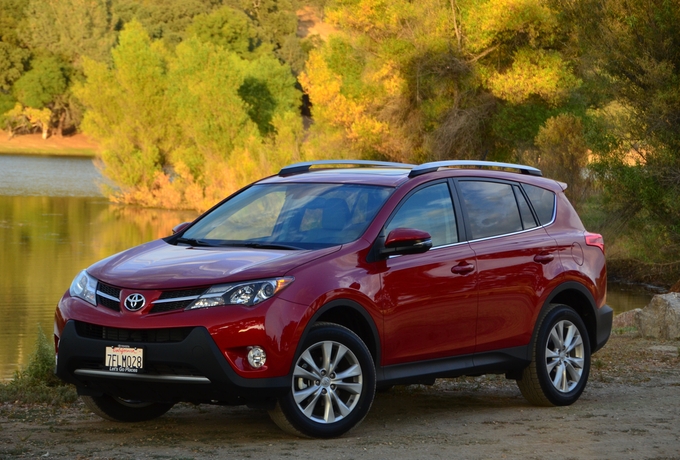
The  RAV4 is one of many reasons why Toyota is No. 1. Photos/Larry Weitzman

The RAV4 is one of many reasons why Toyota is No. 1. Photos/Larry Weitzman

By Larry Weitzman

Toyota as of late, at least ever since the Camry unintended acceleration problem five years ago, has been flying under the radar while still maintaining its No. 1 position in the world. (Although the government bludgeoned Toyota into a large fine, data still shows that the problem was caused by driver error, stepping on the gas instead of the brake. As to Toyota losing some of the lawsuits, it only demonstrates the need for a professional jury system.)

Under the radar or not this new RAV4 shows why Toyota is still the No. 1 car company in the world. They make great cars. After 19 years of production, the RAV4 entered its fourth generation as a 2013 model about a year ago and it has become a grown up SUV as the first two generations were more of a mini-SUV variety. 2006 was the first year of the third generation RAV4 and its first year into the larger, compact SUV class and sales more than doubled. When this fourth generation hit the show room floor, first-year sales jumped again by another 20 percent. Toyota is doing something right.
Specifications Price $23,550 to about $33,000 Engine  DOHC 16 valve Inline four cylinder gasoline 176 hp @ 6,000 rpm        172 lb-ft of torque @ 4,100 rpm	 						       134 hp @ 4,100 rpm 	Transmission Six speed automatic	 Configuration Transverse front mounted engine/FWD/AWD Dimensions Wheelbase104.7 inches Length 179.9 inches Width 72.6 inches Height 67.1 inches Ground clearance 6.3 inches Track (f/r) 61.4/61.4 inches Weight  3,610 pounds GVWR 4,600 pounds Fuel  capacity 15.9 gallons Tow capacity 1,500 pounds Cargo volume (rear seat down/up 73.4/38.4 cubic feet Wheels (LE/XLE/LTD) 6.5x17/7.0x17/7.5x18 steel/alloy/alloy Tires (LE&XLE/LTD) P225/65x17/P235/55x18 Turning circle 36.7 feet Steering lock to lock 2.68 turns Performance 0-60 mph 8.51 seconds 50-70 mph 4.57 seconds 50-70 mph uphill m7.73 seconds Top speed Who cares? Fuel Economy EPA rated at 22/29/25 mpg city/highway/combined. Expect 25-26 mpg overall in a combination of all driving and 32 mpg on the highway at legal speeds.

Specifications
Price $23,550 to about $33,000
Engine
DOHC 16 valve Inline four cylinder gasoline 176 hp @ 6,000 rpm
172 lb-ft of torque @ 4,100 rpm
134 hp @ 4,100 rpm
Transmission
Six speed automatic
Configuration
Transverse front mounted engine/FWD/AWD
Dimensions
Wheelbase104.7 inches
Length 179.9 inches
Width 72.6 inches
Height 67.1 inches
Ground clearance 6.3 inches
Track (f/r) 61.4/61.4 inches
Weight 3,610 pounds
GVWR 4,600 pounds
Fuel capacity 15.9 gallons
Tow capacity 1,500 pounds
Cargo volume (rear seat down/up 73.4/38.4 cubic feet
Wheels (LE/XLE/LTD) 6.5×17/7.0×17/7.5×18 steel/alloy/alloy
Tires (LE&XLE/LTD) P225/65×17/P235/55×18
Turning circle 36.7 feet
Steering lock to lock 2.68 turns
Performance
0-60 mph 8.51 seconds
50-70 mph 4.57 seconds
50-70 mph uphill m7.73 seconds
Top speed Who cares?
Fuel Economy EPA rated at 22/29/25 mpg city/highway/combined. Expect 25-26 mpg overall in a combination of all driving and 32 mpg on the highway at legal speeds.

Sleeker is the watchword of the new design. The window line shows more style and the front end is more rakish. Its high belt line terminates in the taillights almost creating a shelf on top of the taillights and encircling the tailgate. Once you notice this unique styling you will find it amazing, like, “I never noticed that before.” But the RAV4 styling doesn’t take any chances, it is like the Camry of compact CUVs.

While everything is all-new on the outside, the platform remains the same as generation three with an identical 105-inch wheelbase. Length also fits into the center of compact CUVs at 180 inches while its beam is a wide 73 inches. Those dimensions play a big roll in its outsized utility as you will see later.

Under the bonnet is a choice of one engine, Toyota’s 2.5L inline four cylinder DOHC, 16 valve unit of undersquare dimensions with VVT-I that pumps out 176 hp at 6,000 rpm while peak torque settles in at 172 pounds of twist at a moderate 4,100 rpm meaning that at 4,100 rpm the engine is producing 134 hp. While there is a definite front wheel bias, power is sent to all four wheels via a six speed auto cog swapper. If you want a manual transmission you will have to buy a different CUV.

Although built on the same platform as generation three, a 3.5L V-6 is no longer offered in the RAV4, but with the new generation of inline fours, it really isn’t necessary and the fuel economy benefits are pleasing. Zero to 60 mph tests reveal good performance at 8.51 seconds. Better yet it feels quite sprightly, part of that is due to its six-speed cog swapper. Passing times are also good with a 50-70 mph simulated pass requiring only 4.57 seconds and the same pass up a six percent grade only slows that time to 7.73 seconds. That bests many performance vehicles of 15-20 years ago.

On the flip side is fuel economy that you will appreciate. EPA rate the RAV4 at 22/29/25mpg city/highway/combined . Testing reveals it does a bit better with a two-way level highway run averaging 32.7 mpg. Overall mpg averaged between 25-26 mpg during all kinds of driving, including heavy stop and go, a few miles on the highway, performance testing and rural, hilly country roads. One of the reasons for the very good fuel economy is the tall sixth gear allowing the engine to spin a low 2,150 rpms at 70 mph that also makes the vehicle very quiet. It is also trim weighing in at a svelte 3,610 pounds. Fuel capacity is a medium 15.9 gallons.

Handling is surprisingly good and here’s why. While most people would look at a RAV4 and think it is a tall SUV because it stands 67-inches high there is not that much weight up high. The ground clearance is only 6.3 inches which is only about an inch more than many cars so the center of gravity is still quite low. In addition the track is wide, about 62 inches and it has 18 x 7.5 inch alloys shod with some meaty rubber that is 235/55 series. And then there is the state of the art suspension, MacPherson struts up front and double wishbones holding up the rear with coils at all four corners and stab bars at both ends. Add that to a very quick power rack steering that is 2.68 turns lock to lock, and you have some serious credentials.

How does it all work? Splendid would be a good one word answer. In a special course all Road Beat vehicles go through, grip was tenacious, turn in was crisp and the cornering power was quite surprising. This baby can motor through the twisties more like a sports sedan. It responds well, easily changing directions exactly as asked. Part of this is also due to its relatively low weight and well controlled body roll.

Ride quality is smooth, handling big and small bumps and dips alike with aplomb. There is no heading tossing and about the only thing you can say is that it is not as quiet in ride noise or interior noise as the Lexus GX460 tested last week. Of course that was twice the money, too. Road and wind noise was also very subdued. After being spoiled with the vault like, bullet proof Lexus GX460 and LX570, anything will not quite have that muted feel these vehicles provide, as if everything is covered or packed in a super dense foam material, but the RAV4 on its own was impressive.

Braking is performed by four wheel discs of nearly a foot in diameter with the front discs being ventilated with all the acronyms including ABS stopping the RAV4 in an excellent 42 feet from 40 mph. The reason only the front brakes are ventilated is that front brakes do 80 percent or more of the stopping and thereby get the hottest for which the ventilation provides cooling. It is the reason that in most vehicles, except those vehicles that are designed for super high performance have only front ventilated brakes. Rear ventilated brakes would be a waste of money. How many of you are going to drive your RAV4 hard on the race track as a weekly event?

Of course the RAV4 has a plethora of airbags, VSC and other stability and electronic traction devices and at least half a dozen more items that specifically enhance occupant safety all of which can be attributed to a significantly lowering highway death rate.
Performance and handling have not been compromised.

Performance and handling have not been compromised.

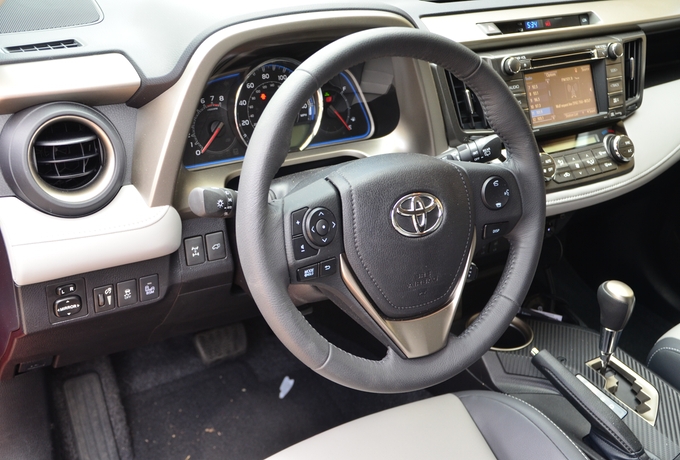
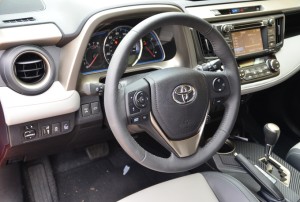
Inside is a quality interior. Sure it has its share of hard plastic, but it is high quality stuff that has a nice feel. Seats are done in a new Toyota material they call Softex. It is some of the best synthetic as it looks and feels like leather. Now if Toyota can get that leather smell in the Softex? Seats have excellent support and comfort and in the Limited the driver’s seat is eight way powered plus both front seats are heated.

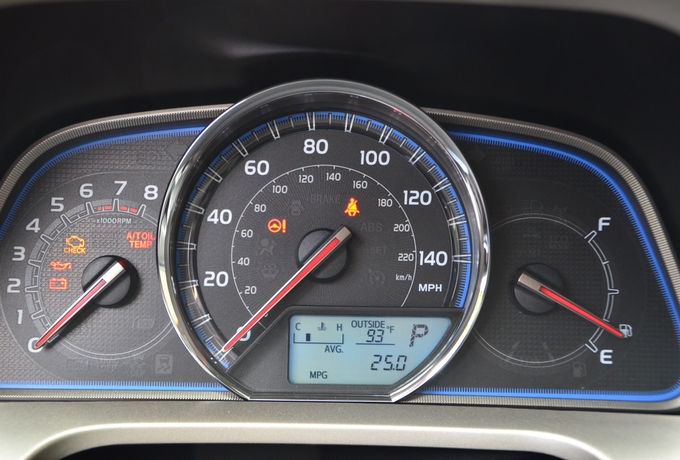
Instrumentation is complete with a large tach flanking left and a full trip computer to the right. The center stack which includes the inexpensive ($785) JBL audio, Nav and connectivity systems is easy to use and well displayed and the JBL system sounds like Carnegie Hall.

Rear seat is copious and comfortable. Another plus is the RAV4’s large Home Depot quotient. Behind the front chairs is over 73 cubes and even with three kids occupying the second row you almost have 40 cubic feet. Small on the outside, big on the inside.

Pricing starts $23,550 for a base LE FWD (AWD is a bargain at $1,400) and tops out at $29,720 for my AWD Limited tester. The bargain JBL Nav system is a $785 bargain and the $725 tech package includes blind spot monitor, lane departure warning and rear cross traffic alert plus auto high beam. Another bargain. Carpeted floor mates are $225. Then there is $860 for the choo-choo from Detroit. All toll the bottom line is $32,315. And its looks have grown on me. This is what Toyota is all about.

Larry Weitzman has been into cars since he was 5 years old. At 8 he could recite from memory the hp of every car made in the U.S. He has put in thousands of laps on racetracks all over the Western United States.