Today’s ski bum works for Silicon Valley, lives in Tahoe

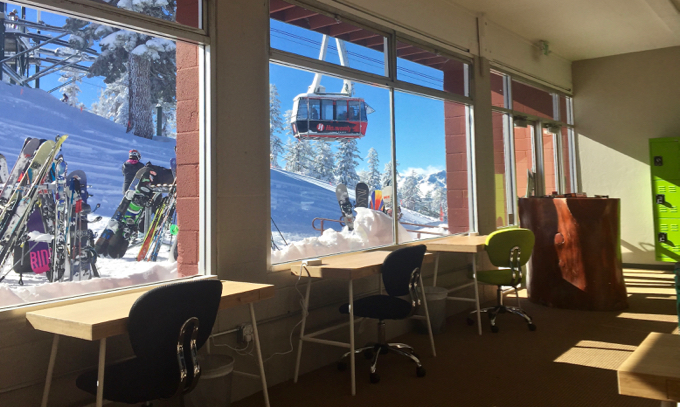
Tahoe Mountain Lab has a satellite facility at Heavenly Mountain Resort. Photo/Jamie Orr

By Michelle Robertson, San Francisco Chronicle
 
Aaron Rothschild starts most of his days about 6am. That way, he can finish up work in time to catch a few runs on the ski slopes. Some afternoons, he conducts meetings in the Squaw Valley Ski Resort parking lot with a “laptop between me and my steering wheel.”

The recent advent of telecommuting – a Gallup poll found at least 43 percent of Americans spent at least some time working remotely in 2016 – has enabled the rise of a new breed of ski bum. Unassuming in his beanie and laid-back demeanor, this individual blends into the ragtag fabric of a mountain town. He lives in his chosen domain year-round, but unlike other full-time residents, he does not depend on the unpredictable fall of snowflakes to stay afloat.

With its proximity to Silicon Valley, the greater Tahoe region has become an obvious weekend escape for the tech jetset. These “weekend warriors” are known to flood the ski resorts and snap up second homes along the lake, and their high incomes (and willingness to spend them) is most welcome to locals.

Read the whole story


Caesars: 4th-quarter revenue hurt by LV shooting

By Todd Prince, Las Vegas Review-Journal

Caesars Entertainment Corp. said Wednesday that its Las Vegas revenue fell in the fourth quarter after the Oct. 1 massacre, but the company gave an upbeat outlook for 2018.

Las Vegas same-store net revenue, including its off-Strip property Rio, declined 3.9 percent to $873 million for the quarter, the company reported Wednesday after the market closed.

Caesars is the parent company of Harrah’s Lake Tahoe and Harveys.

Read the whole story


Money Matters: Things to consider when changing jobs

By Rick Gross

The economic expansion in the United States since 2009 has presented opportunities for many Americans to explore new job possibilities. If you are among those looking to make a change in your career path, you should know that switching employers can have a substantial impact on your financial life.

Here are four tips to help keep your finances on track through the transition:

Rick Gross

1.     Review your entire compensation package

When considering a new position, it’s important to review the base salary offered in the context of the full compensation package. Many U.S. companies offer competitive benefits that could help you manage everyday expenses, such as health and disability insurance, onsite health clinics, fitness centers, or a company car. Financial benefits, including a pension plan, company matching retirement plan contributions or employee stock options can also be important pieces of your financial plan. Consider the benefits you and your family use and value most from your current compensation package as you make your career decision.

2.     Maintain health insurance

If you currently have health insurance through your employer, make it a priority to sustain coverage through the job transition. Depending on your new employer, you may begin to receive coverage on your first day or after a waiting period. Unexpected health issues or accidents can happen any time, so it’s not worth the risk to be uninsured – even for just a few days or weeks. To retain coverage, consider the following options:

·       Holding onto your current insurance until the new plan is in place. COBRA federal law (the Consolidated Omnibus Budget Reconciliation Act) allows you and your qualified beneficiaries to remain on your employer’s plan for up to 18 months if you were not terminated for cause. You are responsible for up to 102 percent of the plan’s costs – the full expense for coverage plus a possible administration fee. 

·       If you’re married, check to see if you can secure coverage with your spouse’s employer. The qualifying events for enrolling in your spouse’s plan may vary, but it’s worth exploring if this option is available to you.

·       Purchasing insurance through the open market. If you’re considering this option, research the costs and benefits of each plan thoroughly so you know what’s covered before signing on the dotted line.  

3.     Prioritize your long-term financial goals

If your new position comes with a salary increase, use the additional dollars from each paycheck to solidify your financial future. It can be easy to spend the extra money if you don’t have a plan in place to save it. Commit to applying your bump in income to your key long-term goals, such as retirement, college tuition or another important milestone.

If you choose a job with a lower salary – which may make sense for a variety of reasons – update your budget accordingly to ensure you’re able to live within your means each month. Saving even a modest amount on a regular basis will help you make meaningful progress toward key goals.

4.     Take care of your retirement plan dollars

The vested balance in your employer’s retirement plan is yours. As you change jobs, it’s important to make an informed decision about what to do with these retirement savings. You typically have several options – keep the money in your previous employer’s plan; roll it into the plan offered by your new employer; or roll it into an individual retirement account (IRA). There are pros and cons to each option, and no one choice is right for everyone. As you review your options, consider discussing your decision with a financial advisor who can evaluate your specific situation from an objective perspective.

It’s worth noting that another option is to take the retirement funds in cash. Although bear in mind that choosing cash will incur steep tax and early withdrawal penalties. In addition, taking a distribution results in a loss of tax-deferred savings and the potential growth that could come from keeping the money invested.

A career change presents many choices that could impact your financial situation. Being thoughtful about the decisions you make through the transition can help position you to meet your future financial goals.

Rick Gross is a financial advisor and private wealth advisor with Ameriprise Financial Services Inc. in South Lake Tahoe.


SnowGlobe promises to suppress noise

By Kathryn Reed

Chad Donnelly is committed to South Lake Tahoe even if some residents wish he would take SnowGlobe, his three-day music festival, elsewhere.

“I really believe in what we do,” Donnelly told Lake Tahoe News.

Since 2011 he has brought the electronic music festival to the ball fields on Al Tahoe Boulevard. It’s grown in that time – in terms of the number of attendees, the ability to attract Grammy-winning artists, the amount of money in his pocket, donations to nonprofits, and overall impact to the local economy.

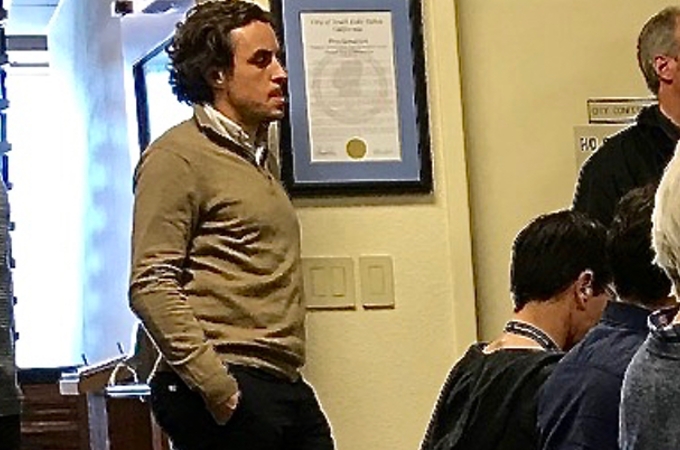
Chad Donnelly, SnowGlobe producer, listens to deliberations on March 6. Photo/LTN

It’s also grown in the number of complaints, or least the effort to have the venue changed or concerts banned is more cohesive. A petition with 175 signatures supporting modifying or canceling SnowGlobe has been given to city officials.

Asked why he stays when there is a backlash against him – at least by a small vocal group – Donnelly gets a bit melancholy. SnowGlobe is his baby. He loves the mountains. And for the most part, the South Shore has welcomed him no matter the noise. He’s built something he is proud of.

Noise and the condition of the fields are sticking points for many people, even electeds. Those issues were brought up again March 6 at the City Council meeting during a presentation about SnowGlobe.

Of the 34 people who spoke, the majority were in favor of the festival – saying it’s good for the economy – especially in lean snow years, that it is putting South Lake Tahoe on the map in a positive way, it is upping the number of lodging nights, and it is diffusing the chaos at Stateline.

The contract goes through 2018. What Donnelly wants is a long-term agreement. The council isn’t ready to say yes or no to that request just yet. And there is no set date when that will be back before the council.

At the end of the lengthy discussion on Tuesday it was decided that city staff would meet with Donnelly and those who have concerns. The goal is to have a resolution in the next couple of weeks.

Part of the urgency to get things resolved quickly is that the producers are already signing contracts and the NoGlobe people want the hours curtailed. If the times change, it means fewer acts to book.

Donnelly and his reps have promised to do more to control the sound – starting this year. This in part includes covering the entire field. Technology via computer modeling will be implemented on every speaker, the subwoofers will be lifted off the ground, and delay towers will be used.

Snow is a natural absorber of sound. But Mother Nature has not always come through. Lake Tahoe News asked Donnelly if blowing snow would be an option. Possibly, he said; he needs to know the costs, logistics and figure out the depth that would be required to make a difference.

Even so, Mother Nature would still be a variable. The overnight temperature has to be at a certain level for consecutive days for snowmaking to be viable.

The ball field after the 2017 event was in sad shape. Donnelly is paying up to $250,000 for the field to be replaced.

He paid $50,000 to rent the field.

The Community Playfield Consortium, made up of the city and Lake Tahoe Community College, manage the fields. The city this week received two bids to fix the damaged field. Work will begin as soon as possible, though the normal date to be able to move dirt in the basin is May 1.

The council is worried that the public who paid for that field is being denied access because it won’t be ready for use until mid-June most likely. On the one hand that isn’t a huge issue because the field has never been in the rotation for use because the sod was just laid last fall. Still, fields are in short supply – which was the reason to build it, and means a delay is getting people to use them for their intended purpose.


Opinion: When LA ruled the music scene

By Kent Hartman

It was 1962, and the rock ’n roll record business was on the rise after the multiyear slump that had followed the debuts of artists like Elvis, Chuck Berry, and Little Richard. The industry’s savior, in large part, was a manic, diminutive, wig-wearing, Hollywood-based record producer (and future convicted murderer) named Phil Spector.

The mastermind behind such throbbing, multi-instrumental hits as “He’s a Rebel,” “Da Doo Ron Ron,” and “Be My Baby,” Spector was a gesticulating wunderkind on the other side of the control room glass. And the effects of his so-called “Wall of Sound” were immediate and profound; 14 Top 40 singles from 1962 through 1963 dwarfed that of Spector’s competition. Soon, seemingly everyone wanted to work with the tiny titan, or copy him, or both. Rock ’n roll had found its bombastic rebirth—and L.A. had solidified its place at the center of the action.

The late ’50s and early ’60s represented a time and place like no other in American history, particularly in sun-drenched Southern California. Convertibles, palm trees, bikinis, surfboards, and ever-present transistor radios advertised a post-war optimism that reigned supreme among teens and twentysomethings. And the record business’s rebound into a new kind of hot-sounding (and selling) style of rock and roll, exemplified in the simultaneous rise of many of Los Angeles’ vaunted recording studios, was a critical part of the story.

Starting during Spector’s heyday, one iconic studio after another came to prominence in the city: Gold Star, at the corner of Santa Monica and Vine; Crystal Sound, just two blocks south; TTG, about a mile away from them both, near Hollywood High; and a few dozen more. The windowless, nondescript buildings, jammed with expensive recording gear, would become the epicenter of America’s musical universe, humming with activity 24/7, for the better part of almost four decades. They generated an unprecedented string of million-seller singles and albums, and attracted all the hottest musicians: Neil Young. Steppenwolf. Joni Mitchell. Three Dog Night. Paul Revere and the Raiders. Van Halen. Tina Turner. Fleetwood Mac. Sam Cooke. The Doors. Cheap Trick. REO Speedwagon. Madonna. Earth, Wind and Fire. Steely Dan. The Eagles. Guns N’ Roses. Sly and the Family Stone. Even Led Zeppelin and the Rolling Stones made frequent pilgrimages.

Producers like Spector fueled the studios’ rise. Picking the right studio for the right project was a crucial task, and—at least at first—was a producer’s domain. Many record labels, including A&M, Motown, Liberty, Paramount, MGM, Warner Bros., and CBS maintained their own L.A. recording studios, which their artists were expected to use. But stature had its privileges, and successful producers found ways to get back to their favorite haunts.

Spector, who mostly worked with artists on his own Philles Records label (until 1966 when he faded from the business after the stinging, much-publicized failure of “River Deep, Mountain High,” sung by a young Tina Turner), liked recording at Gold Star. Brian Wilson, the Beach Boys’ production mastermind, loved the cozy confines of Studio 3 at Western Recorders—even though the Beach Boys’ label, Capitol Records, had a world-class, in-house studio nearby that the band could have used for free.

Sometimes a producer’s preference came down to superstition, not wanting to mess with a good thing. If a producer had recorded a big hit or two at a certain studio, then the odds were good that he (in those days, producers were virtually all male) would be back for more. Paul Rothchild, the Doors’ producer, only wanted to record at Sunset Sound after the surprise chart-topping success of the band’s second single, “Light My Fire,” in 1967. Peter Asher stuck with the Sound Factory after he scored a No. 1 hit there with Linda Ronstadt’s “You’re No Good” in 1974. 

By the ’70s and into the ’80s, when album rock became the dominant force in popular music, the power balance in picking where to record began to tilt even further from label executives—this time, in favor of musicians, who also had pet studios. Jackson Browne initially favored the Sound Factory, then later Record One, on the other side of the Hollywood Hills in Sherman Oaks. Though the ’80s version of the light-rock hit-makers Chicago were signed to Full Moon Records, distributed (and eventually owned) by Warner Bros., the band recorded at West Hollywood’s Record Plant, in part because of its “artist-friendly” policies concerning in-studio partying.

Costs of making an album in Los Angeles could get hefty, but it really made little economic sense to set up shop anywhere else. It was still cheaper to record in a city where everybody knew everybody, nobody needed a plane ticket or a hotel room, and there were plenty of well-known local session musicians at the ready. Great recording gear also set the Los Angeles studios apart. The incessant push for better sound led, by the early ’60s, to the creation of some of the most revered equipment in the business.

David Gold, the co-owner and co-founder (with Stan Ross) of Gold Star, hand-built that popular studio’s coveted microphone preamps and world-famous echo chamber. Nearby, at Western Recorders, owner and technical wizard Bill Putnam built most of his own equipment, too—from mixing consoles to EQ units to limiters and compressors—and started a separate business to sell his gear to other studios around the world.

Also distinguishing L.A. studios was the “hang,” a shorthand word among musicians for the vibe, accommodations, and/or people in any given recording studio. Smart owners knew how to cater to the specific, if sometimes decadent, demands of their clientele. Niceties varied from studio to studio: sumptuous lounge areas, gourmet kitchens with chefs, private bedrooms, hot tubs, waterbeds, 24-hour personal assistants known as runners. Sunset Sound, the Village Recorder, and Cherokee were all known for the quality of their hang.

Coffee, tobacco, liquor, and depending on the artist, marijuana all were standard issue during recording sessions; sometimes harder drugs were, too (particularly cocaine, which some saw as a good tool to help stay awake). Liquor bottles might be everywhere. Ashtrays routinely overflowed with butts. About the only real no-no was spilling anything on the mixing console. That could actually get a person in trouble.

By the mid-’80s, the record industry was modernizing. Vinyl albums started falling out of favor, supplanted first by analog cassette tapes and then by digital CDs. At the same time, studios began moving away from analog recording equipment, which required engineers to use a razor blade to slice out a section of magnetic recording tape when they wanted to alter a portion of a song. Suddenly, a few clicks of a computer mouse could achieve the same result.   

Despite the obvious benefits of digital technology, some classic L.A. studios, such as Sound City in the San Fernando Valley, didn’t want to make a hefty investment in new equipment and decided instead to ride out what they hoped would be a passing fad. It was a losing gamble; the demand to record on digital equipment only increased. Sound City managed to remain open for a time, bolstered by the success of Nirvana’s “Nevermind” in 1991. But the studio never regained its previous level of popularity and ultimately closed for good in 2011. (Note: an effort to revive Sound City, by the daughter of its late owner, occurred in 2017.)

The introduction of ProTools recording software in the ’90s further sped the old studios’ decline by lowering barriers to entry. Today, spare bedrooms and garages are routinely used to cut “professionally” recorded songs.   

A full-throttle phase of record industry mergers and acquisitions during the 1980s, involving some very big companies, had an impact, too. The bottom line became far more important. Gone were the warm-and-fuzzy late ’60s and early ’70s, when labels—largely run by hustlers, dreamers, and music lovers—frequently covered the cost for fledgling acts to cut two or three albums before seeing a hit record out of the deal, if ever.

Inadvertently ushering in the new era of fiscal responsibility, in 1979 Fleetwood Mac—with the colossal success of 1977’s “Rumours” still reverberating—got their label, Warner Bros., to provide a custom, million-dollar rebuild of the Village Recorder’s Studio D in Westwood to record a follow-up album. When Tusk didn’t sell as well, Warner Bros. began taking a much harder look at album-related expenditures, no matter how big the musical act. As did most of the other labels in town.

Today, some landmark recording studio buildings in Los Angeles remain standing—a few with functioning studios still inside—but gentrification has rendered many nearly unrecognizable. At the corner of Sunset and Gower, in the heart of old Hollywood, sit the remains of the celebrated CBS Columbia Square facility, birthplace of hit singles such as Simon and Garfunkel’s “Bridge Over Troubled Water.” Now a mixed-use complex called Columbia Square, the site features an upscale sushi bar, a high-end jewelry store, and about 200 high-rise condos.

Gone too are Wally Heider, Record One, RCA, Cherokee, Larrabee, Motown, Goodnight L.A., Crystal, TTG, Kendun, American Recording, Rumbo, Davlen, Clover, Amigo, Grandmaster Recorders, and more—names that were once commonplace on the jacket backs of scores of gold and platinum albums.

Radio Recorders on Santa Monica Boulevard, where Elvis cut many of his hits, is now an art exhibition space. Gold Star mysteriously burned to the ground in 1984, and is now a strip mall. Even A&M Records’ venerated in-house studios on La Brea Avenue in West Hollywood—the birthplace of Carole King’s “Tapestry,” Bruce Springsteen’s “Tunnel of Love,” Aerosmith’s “Get a Grip,” and “We Are the World,” the 1985 anthem that helped raise money for African famine relief—has morphed, becoming the headquarters of the Jim Henson Company, home of the Muppets.

Most of L.A.’s irreplaceable temples of sound have gone silent, leaving only a handful of still-intact studios— Capitol Records’ in-house facilities, Sunset Sound, the Village Recorder (now the Village Studios), the Record Plant, the Sound Factory and a few more. The glory days in the ’70s or ’80s of seeing Linda Ronstadt, Mick Jagger, and Tom Petty and the Heartbreakers laying down tracks at the same time, in the same building, are long gone.  

Yet there may be hope. RCA’s historic Studio A in Nashville recently escaped the wrecking ball with the help of some well-heeled philanthropists. So did the revered Power Station in New York. A visionary local businessman saved Sun Studio in Memphis, where some very cool cats called Elvis, Johnny, Jerry Lee, and Carl all got their start. Perhaps the same kind of preservationist efforts could emerge in the City of Angels, to save the literal building blocks of its rich musical heritage.

Kent Hartman is the author of two books about the glory years of the Los Angeles music and recording scene during the ‘60s, ‘70s, and ‘80s: “The Wrecking Crew” and “Goodnight, L.A.” He lives in Portland, Ore.


Vacation rental fraud in Incline, Truckee

An Incline Village homeowner is reporting more than $75,000 in damage and stolen goods from a vacation renter.

Washoe County sheriff’s deputies said the home had been rented for a number of days by a couple using a fraudulent credit card issued by a foreign country.  When the rental company returned to the home on Friday afternoon, they discovered major damage to the residence as well as the theft of thousands of dollars worth of electronics and other valuables.  

The rental company also reported that another expensive home in Truckee had been rented by a couple using a credit card from the same country.

On March 7 at about 11am, Truckee police officers went to the residence located in the 12000 block of Rainbow Road.  The occupants in the residence refused to come out of the house for approximately one hour. 

When the man finally exited the house he refused to speak to officers and refused to identify himself. He has been identified as Alexander Silviera, 29.

Inside the house was Haylay Brown, 21, of Oregon. Officers said she was also under the influence of heroin. 

Both have been charged with possessing stolen property, theft, providing false identification to a peace officer, and being under the influence of heroin. More charges are pending in Washoe County.

Officers recovered approximately $3,500 in stolen property that was returned to the owner.

— Lake Tahoe News staff report


Feds sue Calif. over laws protecting immigrants

By Evan Halper, Los Angeles Times
 
The Trump administration, seeking to force a defiant California to cooperate with its agenda of stepped-up immigrant deportations, went to federal court Tuesday to invalidate three state laws — the administration’s most direct challenge yet to the state’s policies.

Administration officials say the three laws in question, all passed by the Legislature last year, blatantly obstruct federal immigration law and thus violate the Constitution’s supremacy clause, which gives federal law precedence over state enactments.

The laws make it a crime for business owners to voluntarily help federal agents find and detain undocumented workers, prohibit local law enforcement from alerting immigration agents when detainees are released from custody, and create a state inspection program for federal immigration detention centers.

Read the whole story


Study: Snowpack drops over decades

By Gillian Flaccus, AP

PORTLAND — Scientists have found dramatically declining snowpack across the American West over the past six decades that will likely cause water shortages in the region that cannot be managed by building new reservoirs, according to a study published last week.

The study led by scientists from Oregon State University and the UCLA found drops in snow measurements at more than 90 percent of regional snow monitoring sites that have consistently tracked snow levels since 1955, said Philip Mote, director of the Oregon Climate Change Research Institute at Oregon State University.

Study authors also used modeling to show the average snowpack in the region dropped between 15 and 30 percent in a little more than a century, he said, and that modeling paralleled the actual findings based on existing measurements.

Read the whole story


Father recalls vibrant, worldly lives of wife, son killed at Kirkwood

By Benjamin Spillman, Reno Gazette-Journal

As a young child from Belgrade in the former Yugoslavia, Olga Perkovic learned to ski on slopes in Europe.

As a young adult she helped her husband, David M. Goodstein, learn to ski when he lived in Logan, Utah, and taught physics at Utah State University.

As she approached middle age she taught her daughters Sophie and Daria and son Aaron to ski from a condo the couple bought in 2005 next to the slopes at Kirkwood Mountain Resort.

Read the whole story


EDC reschedules VHR meeting in Tahoe

The El Dorado County Board of Supervisors has rescheduled the special vacation home rental meeting for March 24.

It will be from 1-3pm in the multipurpose room at South Tahoe Middle School.

Last week’s planned meeting had to be canceled because of weather and the meeting last month was shutdown because of overcrowding.